“Please, Sir… Don’t Leave.” The Boy Clung to the Cowboy’s Leg — The Cowboy Refused to Walk Away

Part 1
The scream didn’t sound human.
That was the first thing Caleb McCord thought when it cut through the wind — not a cry, not a whimper, but something torn loose from a place no child’s body should hold.
He almost rode past it. God help him, he almost did.
Seven weeks of silence had turned Caleb into something less than a man and more than a ghost — a shape on a tired bay gelding, moving through Montana snow with $2.40 in his saddlebag, five bullets in his Colt, and a scar on his right palm that never stopped aching. He hadn’t spoken to another living soul since the last town, hadn’t cared about anything since the night six years ago when he’d dug his wife and daughter out of the ashes of his own homestead with his bare hands.
He’d made a rule after that. Don’t stay. Don’t care. Don’t feel.
Then the boy grabbed his leg.
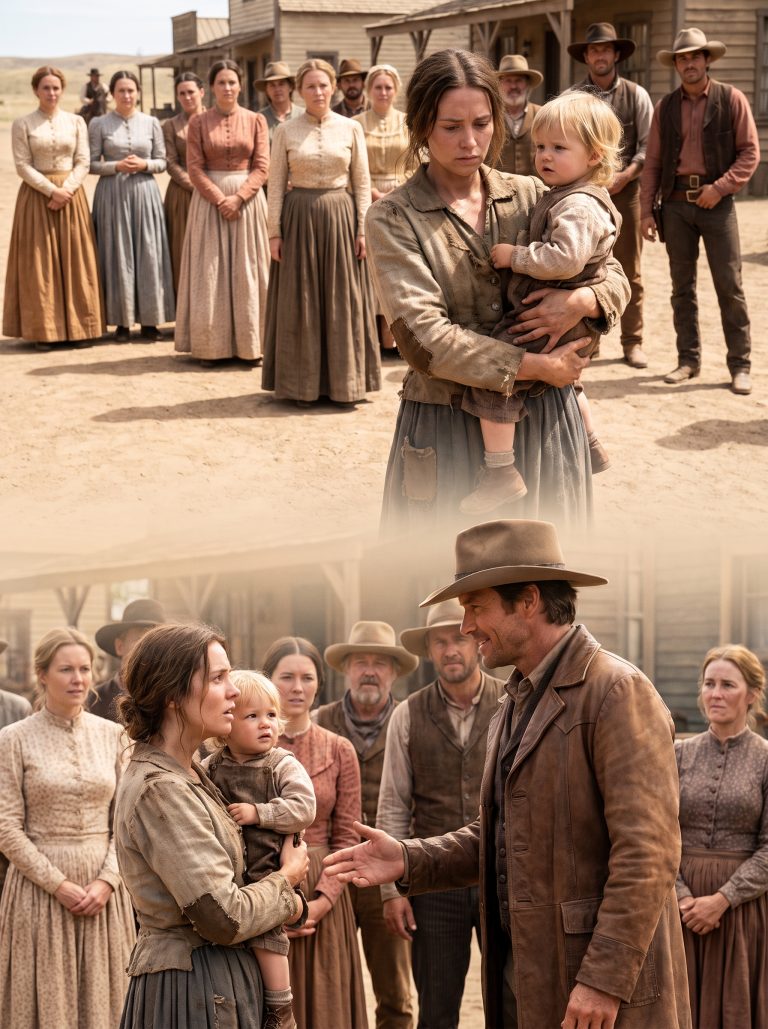
Five Callaway children waited on that road, and Caleb would learn all their names before the hour was out: Lucy, fifteen, holding a limp baby on her hip. Jack, eleven, gripping an axe with both shaking hands. Clara, eight, clutching a barking dog like it was the only warm thing left in the world. Baby Rosie, not yet two, gone quiet and still. And the one attached to his leg — small fingers frozen into something like iron, bare feet in the snow, blue lips — seven-year-old Sam.
“Sir, help us. Mama’s bleeding. Mama won’t wake up.”
Caleb tried to pull free. The boy held on.
“Kid, let go.”
“No. You gotta help. I’ll give you my papa’s knife — it’s the only thing I got left of him. Just help my mama. Please.”
That was the moment something cracked. Not broke — cracked, the way river ice cracks in March, slow and quiet and impossible to stop once it starts.
He should have ridden away. He’d ridden away from worse. But Lucy — steady as stone even with a baby who might already be dead in her arms — looked him dead in the eye and told him the truth plain: their mother was two hours unconscious on a kitchen floor, their baby sister hadn’t made a sound in forty minutes, and she could not carry a dying infant and drag four children through a blizzard by herself.
“I ain’t asking for charity,” she said. “If you got any decency left in whatever’s eating you up inside, you’ll get off that horse.”
He got off the horse.
What Caleb didn’t know yet — what none of them told him on that road, shivering in the snow with a homestead falling apart a quarter mile up the hill — was that the mother’s fall wasn’t an accident. That the wood pile had three days left in the dead of a Montana winter. That a judge in town had already sent men to write down every sign of a struggling widow, building a case, quietly, patiently, to take these five children away before Christmas.
And Caleb McCord — who had sworn to never again let himself care about something he could lose — carried a baby that wasn’t breathing right against his own heartbeat, and felt something in his chest move for the first time in longer than he could remember.
He told himself he’d stay one night. Get the fire going. Ride out at dawn like he always did.
He had no idea that Sam — the boy still gripping his leg, the one who’d offered a stranger his dead father’s only keepsake without a second thought — was about to ask him something at dawn that would change the rest of both their lives.
And he had no idea that somewhere in that falling-apart cabin sat a wooden box holding the one piece of evidence that could either save this family — or get all of them killed before Christmas morning.
Follow to find out what happens when dawn breaks over the Callaway ranch.
Part 2
Dawn didn’t bring the goodbye Caleb had planned.
It brought Jack — eleven years old, no coat, dead father’s axe in hand, standing in the cabin doorway like he could hold the whole world up on his own if he just gripped the handle tight enough.
“You leaving?”
“Your mama told me to.”
“Good.”
But the boy’s voice cracked on the word, and by the time Caleb had one boot in the stirrup, Jack was telling him things an eleven-year-old should never have to carry alone — a wood pile that wouldn’t last the month, a deputy who’d come to the ranch and given their mother until after Christmas to sell the land or lose her children to the court, a father who’d supposedly frozen to death in a storm two winters back, except his horse walked home without a scratch on it.
“His horse don’t walk home calm and unhurt if a man got thrown,” Caleb said.
“That’s what Mama said too.”
There was a wooden box hidden in that cabin — a dead man’s journal, two years of entries, and a surveyor’s report that could unravel one of the richest, most powerful men in the territory. Jack didn’t say what was in it. Not yet. Trust wasn’t something you demanded from a boy who’d already learned that the last man who offered help sold his family out.
But by the time Caleb finished splitting wood that Jack couldn’t lift alone, something between them had shifted.
And when Sarah Callaway finally opened her door — rifle raised, a fresh bandage on her own forehead, refusing every ounce of help even as her ranch crumbled around five starving children — she gave Caleb three days. Sleep in the barn. Eat what we eat, which isn’t enough. And if my children start calling you anything other than Mr. McCord, you’re gone within the hour.
“They’ve lost one father,” she said. “They don’t need to lose another.”
What she didn’t know was that her own son had been sitting silent under the kitchen table for two years, holding a secret about the morning his father walked into that storm and never came back — a secret about a big man with a badge on his chest who’d threatened Will Callaway on his own front porch.
And what Caleb didn’t know, standing in that barn with a dead man’s journal against his heartbeat, was that in four days, five armed men would ride up that frozen road on Christmas Eve — and he’d have five bullets, one gun, and a promise to a seven-year-old boy standing between this family and everything they had left.
Part 3
Chapter One: The Weight of Silence
December 1887, Montana Territory.
The wind came down off the mountains like something with teeth, and Caleb McCord had learned, over seven weeks of drifting, that there was no coat thick enough to keep it out. It got in anyway. It always did — through the collar, through the cuffs, through the places where a man had stopped bothering to keep himself sealed shut.
Scout, his old bay gelding, plodded through the drifts with his head hung low, and Caleb figured even the horse had started wondering whether this particular direction was worth the effort. There wasn’t a destination. There hadn’t been one in longer than he cared to count. Just the next town, the next barn to sleep in, the next silence to sit inside of until it became something close to peace.
He was thirty-seven years old. Former Texas Ranger — a badge he’d turned in the morning after he dug his wife and four-year-old daughter out of the ashes of his own homestead, because the gang he’d been three counties away chasing had decided that burning a lawman’s family alive was a fitting kind of revenge. He’d left Texas within the month. Couldn’t stand the roads that led past his own front gate. Six years of drifting north and west, town by town, had put a lot of country between him and that grave — enough that by now Montana felt less like a strange place than just the latest one.
He still had the scar to prove it — a ruined map of melted skin across his right palm, earned digging through embers that were still hot enough to sear bone. Some mornings he pressed his thumb into it just to remember that he could still feel something.
That morning, on a frozen trail outside a town he hadn’t bothered to learn the name of, the thing he felt was a scream.
It came before he saw them — high, thin, and so raw it seemed to cut straight through the wind rather than travel on it. He pulled Scout up short. Every instinct in him, worn smooth by long practice, said the same thing it always said: keep riding.
He kicked Scout forward instead. He would spend a long time afterward wondering why.
Five children waited in the middle of the road, and it took Caleb only a moment to sort out who was who. The oldest, fifteen-year-old Lucy, held a baby — Rosie, not yet two — on her hip with arms shaking from more than the cold. Behind her, eleven-year-old Jack gripped a woodcutting axe in both hands, feet planted wide, jaw set like he intended to swing it at anything that came too close. Eight-year-old Clara clutched a barking, frantic dog against her chest like a shield. And in front of all of them — barefoot in the snow, shaking so hard his teeth rattled — stood the youngest boy old enough to run: seven-year-old Sam.
He crossed the last few feet at a dead run and grabbed Caleb’s boot in the stirrup with both hands, locking on with a grip that had no business belonging to a child that small.
“Sir, help us! Mama’s bleeding. Mama won’t wake up. Please, sir. Please.”
Scout spooked, sidestepping in the snow. Caleb reached for the reins with one hand and tried to shake the boy loose with the other.
“Kid, let go.”
“No, you gotta help. I can’t—”
“I’m just passing through. Let go of my leg.”
The boy looked up. Brown eyes, too big for his face, carrying something that hit Caleb harder than the cold ever had.
“Mama’s on the floor,” he whispered. “There’s blood on her head. Lucy tried to fix it, but Mama won’t open her eyes. And Rosie stopped crying. And I’m cold, and I’m scared, and you’re the only person on this road.”
Caleb’s jaw locked so tight it ached. He pulled the reins left, turned Scout around, and made it exactly four steps before Lucy’s voice stopped him.
“Mister.”
Her tone was steady in a way that had nothing to do with calm and everything to do with practice — the steadiness of someone who’d learned to swallow panic because there was nobody left to be calm for her.
“My name’s Lucy Callaway. That’s my brother Sam on your leg. Our mama fell this morning, hit her head on the stove. She’s been unconscious two hours. Our baby sister stopped crying forty minutes ago, and I don’t know if she’s alive because I can’t feel her breathing through my coat.”
Caleb stopped Scout. Didn’t turn around. Couldn’t, yet.
“I ain’t asking for charity,” Lucy went on. “I’ve been taking care of this family since my papa died two winters back. I can handle most things. But I can’t carry a baby who might be dying and drag four children through a snowstorm and stop my mama’s bleeding, all at the same time.”
Her voice cracked, just barely, on the last word. She caught it. Shoved it back down. Straightened her spine like it cost her something to do it.
“Our ranch is a quarter mile up that hill. If you won’t help, say so and ride on. We’ll manage. We always manage. But if you’ve got any decency left in whatever’s eating you up inside, you’ll get off that horse and carry my sister before it’s too late.”
Jack raised his axe an inch. “Lucy, we don’t need him. I can handle it.”
“Jack, your hands are shaking so bad you can’t hold that axe straight.”
“Shut your mouth. I can handle it.”
“You’re eleven. You haven’t slept in two days. You can’t handle everything just because Papa told you to watch over us. Papa didn’t mean for you to kill yourself trying.”
Something in Jack’s face came apart for exactly one second before he rebuilt it, brick by brick — too young for the weight he was carrying, too proud to set it down.
Clara stepped forward next, freckled and smiling like she’d decided a long time ago that smiling was easier than letting anyone see her fall apart. The dog squirmed in her arms.
“Mister, my name’s Clara. This here’s Pepper. Are you a good person?”
“No.”
“That ain’t true. Mama says you can tell by looking at someone’s eyes. Yours look like they’ve been crying a real long time, even if your face forgot how. That means you got a heart in there somewhere. You’re just keeping it locked up.”
Something twisted in Caleb’s chest, hard enough that he had to look away from her. He looked instead at Sam, at the blue fingers still locked around his boot, at Jack holding an axe he could barely lift, at Lucy with a baby who might already be gone.
He turned Scout around a second time. Got two more steps.
“Mister.” Sam’s voice, small and broken behind him. “Please. I’ll give you my papa’s knife. It’s the only thing I got left of him. But you can have it. Just help my mama.”
Caleb stopped.
A boy of seven, offering the one thing he had left of his dead father, to a stranger who was actively riding away from him.
Caleb’s hand found the scar on his palm without his permission and pressed until the old burn ached fresh. Beth had been four when she died. She used to grab his leg exactly like this when he came home from rangering, hold on with both fists, and say, Papa, don’t leave again. Stay with me. The size didn’t matter. It was the grip that was the same — the refusal to let go.
He’d always left. There had always been a job, a badge, something that mattered more than staying.
And then there had been nothing left to stay for.
“Where’s this ranch,” he heard himself say.
Lucy’s shoulders dropped — one inch, no more, but it was the first inch of relief she’d allowed herself in two hours of holding her family together through sheer refusal to break.
Chapter Two: What the Snow Buried
The Callaway homestead came into view over the crest of a hill that had clearly, once, been someone’s pride. A fence line snapped and leaning. A barn door hanging off one hinge. Two cows standing exposed in the open with their ribs showing through dull coats. No smoke from the chimney — the fire had gone cold hours ago.
But the porch had been swept clean. A tin can of dead, frozen flowers sat on the railing.
Someone had been fighting to keep this place breathing long after any reasonable person would have stopped.
Inside, Sarah Callaway lay on the kitchen floor beside a dead stove, red-brown hair loose around a gash on her forehead, skin gone the gray-white of a woman whose body was quietly deciding whether to keep fighting. Her hands — even unconscious, even bleeding — were scarred and calloused in a way that told the whole story of two years spent doing the work of three people, alone.
But she was breathing.
Caleb worked fast and without asking permission, because permission wasn’t something that mattered anymore. He handed the baby to Lucy — skin to skin, put her against your chest, cover both of you — and sent Jack for his siblings, and when Jack stood frozen in the doorway with his father’s axe raised like Caleb was one more threat to be met with violence, Caleb didn’t raise his voice.
“You want to fight me about it, or you want to save your mama?”
It was Lucy, gentle from the bed, who finally lowered the axe for him. “Papa would want us to let him help.”
He built the fire. Cleaned the wound — ugly, but shallow; she’d fainted from exhaustion and hunger and struck her head on the way down. He went looking for the woodpile and found barely a day and a half of fuel, rationed carefully by a woman trying to stretch impossible math across an entire Montana winter.
And when Sam finally spoke from the bed, small and terrified in the quiet — “Is mama going to die?” — Caleb told him no, and meant it with a certainty he had no right to feel yet.
It was Sam’s next words that stopped the room cold.
“Papa died,” Sam said. “Mama said Papa just went to sleep and didn’t wake up, but I know that ain’t true. I heard Mama crying. I heard her say they killed him. That somebody killed Papa and nobody cares.”
“Sam, don’t,” Lucy said, too fast.
“But Lucy—”
“I said don’t. We don’t talk about that. Mama said we don’t talk about that to anybody.”
Clara, from the corner, added quietly: “Especially not strangers. Even ones with sad eyes.”
Caleb filed it away. Didn’t push. Five children, a mother bleeding on the floor, a father nobody would explain, and fear running underneath all of it — the kind of fear that came from something worse than winter.
He told them he was going for more wood. Sam sat up fast.
“You promise? Because Papa went out one morning and promised he’d come back, and he didn’t. He never came back.”
Caleb’s throat closed around something he hadn’t let himself feel in longer than he could say.
“I’ll be back, Sam. You swear?”
“I swear.”
He walked outside into a wind that hit like a closed fist and stood on the porch with one boot already halfway toward Scout, halfway toward the road, halfway toward the only life he knew how to live anymore — the leaving kind.
From inside, Rosie started to cry. Weak. Thin. Alive.
The sound his own daughter would have made, if he’d gotten home before the fire instead of after.
Caleb pulled his boot out of the stirrup and went back for the wood.
Chapter Three: The First Night
Sarah Callaway came awake slow, the way a person does after a blow to the head — the ceiling swimming into focus, the ache behind her eyes arriving before the memory of how it got there. For a moment she didn’t know what hour it was, or what house, or why her skull throbbed like a second heartbeat.
Then she heard breathing that wasn’t hers. Wasn’t any of her children’s.
She turned her head, slow, careful, and saw a stranger sitting by the stove with her youngest son asleep against his chest.
Everything came back at once — the fall, the blood, the cold — and with it a fear so total it burned straight through the fog in her skull. She was on her feet before the dizziness caught up with her, one hand braced hard against the wall while the room tilted, the other already closing around the iron poker by the stove.
“Get your hands off my boy.”
Her voice came out raw, but underneath the rasp ran something sharp enough to cut. Blood had soaked fresh through her bandage from the sudden movement, and she swayed on her feet, but the poker didn’t waver — held the way a woman holds something when she’d rather collapse than let it show.
Sam scrambled off Caleb’s lap and ran to her. She caught him one-armed, never lowered the poker, never took her eyes off the man who’d apparently spent the night keeping her family’s fire burning.
“Who are you? What are you doing in my house?”
“Name’s Caleb McCord. Your children found me on the road. You were unconscious, bleeding, your baby was hypothermic. I built the fire, cleaned your wound. Didn’t ask for your help. You were dying on the floor.”
Sarah’s eyes cut to the bedroom, to Rosie pink and breathing steady in Lucy’s arms. For one raw second her face gave way completely — gratitude too large to hide — before she caught it and rebuilt the wall.
“You need to leave. Now.”
“It’s three in the morning. Blizzard’s building.”
“I don’t care if the sky is falling. I don’t know you. I don’t let strangers sleep in my house with my children.”
“He saved Rosie,” Lucy called from the bedroom. “He put her inside his coat, against his skin. That’s what saved her.”
Sarah’s grip on the poker tightened, gratitude and fear wrestling behind her eyes, and fear winning — because fear had been winning in this house for two years.
“I’ve had men offer help before,” she said, each word measured like currency she couldn’t afford to spend carelessly. “Every one of them wanted something. The last one wanted my land. The one before that wanted me. So forgive me if I don’t trust a drifter who walks into my house while I’m unconscious and holds my son in the dark.”
“I’ll sleep in the barn.”
“You’ll sleep on the road.”
“Your barn door’s hanging off one hinge. Your woodpile’s got three days left. Your fences are down and your cattle are starving. You’ve got five children, a head wound, and a blizzard coming. You want me gone, I’ll be gone at first light. But right now, at three in the morning, you need somebody between your family and that cold. Even if you hate it.”
Something in Sarah’s raised poker dropped an inch. She caught herself and lifted it back up.
“The barn,” she said through her teeth. “Not the house. And you’re gone at dawn. First light, Mr. McCord. We were fine before you came. We’ll be fine after you leave.”
Caleb picked up his coat. Stopped at the door with his hand on the latch.
“Your boy Sam said something on the road. Said his mama told him somebody killed his papa. Said nobody cares.”
Sarah’s face went white.
“Sam remembers too much.”
“Maybe. Or maybe he’s scared, and he doesn’t understand why his mama won’t tell anyone what really happened.”
“Get out of my house, Mr. McCord.”
He went. But through the barn wall, later, he heard the poker hit the floor. Heard her knees find the wood. Heard the sound of a woman who’d been running on pure will for four hours finally, quietly, running out.
“Your papa was the kindest man who ever lived,” he heard her whisper to Lucy, so soft it wasn’t meant to travel. “And they killed him for it.”
Dawn broke gray and flat. Caleb was saddling Scout when the cabin door opened and Jack stood there — no coat, axe in hand, jaw set in an imitation of a man he hadn’t gotten to be yet.
“You leaving?”
“Your mama told me to.”
“Good.”
But it didn’t sound good. It sounded like a boy watching one more thing walk out of his life, and hating that some part of him wanted it to stay.
“We don’t need you,” Jack said. “Papa taught me everything. I can chop wood, fix fences, shoot Papa’s rifle. I’m the man of this house.”
“I can see that.”
“So you can go.”
Caleb swung up into the saddle and looked down at scrawny arms, chapped hands, dark circles carved under eyes too young to carry them. A boy holding an axe he could barely swing, and a weight that would crush most grown men.
“Your papa’s knife,” Caleb said. “Sam offered it to me on the road. Don’t let him give it away. A boy needs something of his father’s to hold onto.”
Jack’s lip trembled. He bit down on it hard enough to draw blood. “Don’t tell me how to raise my brother.”
“Wasn’t telling. Just saying.”
Caleb turned Scout toward the gate. Got there before Jack’s voice stopped him again, smaller this time.
“Mr. McCord. The woodpile — I’ve been trying to chop enough, but the axe is too heavy and I can’t leave the little ones long enough to haul a full load. Mama don’t sleep anymore. She gets up at four and works till midnight and still can’t keep up. The fence broke last month, we lost three cattle. Barn roof leaks. Well’s freezing over.”
The words kept coming, faster now, the way a boy talks when he’s been holding a dam shut with both hands and it finally gives.
“There’s a deputy who came last week. Big man, mean face. Told Mama she had until after Christmas to sell the land or he’d come back with papers from the court. Said a woman alone with five children in winter was a danger to them. Said the judge would place us with proper families.”
Jack’s axe touched the ground. His shoulders dropped, eleven years old and finally, visibly, out of fight.
“I told Mama I could handle it. Told her we’d be fine. But we ain’t fine. And Papa’s dead and nobody will tell me why, and Mama cries every night when she thinks we’re sleeping, and I don’t know what to do anymore.”
Caleb sat on his horse at the gate of a dying ranch with $2.40 in his pocket, five bullets in his gun, and six years of running at his back. This wasn’t his family. This wasn’t his fight.
But Jack was standing in that doorway with his dead father’s axe and his dead father’s responsibilities, wearing the exact expression Caleb had worn the morning after the fire, when he’d understood for the first time what alone actually meant.
He dismounted. “Where’s the axe head loose. I can see it wobbling from here.”
“I don’t — Papa kept the tools in the barn.”
“Show me.”
“But Mama said—”
“Your mama said I leave at dawn. It’s past dawn. I’m still here.”
Chapter Four: The Journal
The morning stretched on longer than Caleb had planned for. What started as a look at one loose axe head turned into the better part of a day — the barn door needed rehanging, the sagging fence line needed resetting, and every finished task seemed to uncover two more that couldn’t wait for spring. By the time the light started going gray again, he’d been on the Callaway ranch a full day and a night, and he still hadn’t left.
They worked the woodpile last, Caleb swinging while Jack hauled, and somewhere in the rhythm of it the boy started talking the way children do when their hands are busy and their guard comes down without them noticing.
He talked about his father teaching him to swing an axe on Saturday mornings before sunrise. About how Will Callaway had met Sarah — she’d thrown a book at his head in a Billings general store because he wouldn’t move from the shelf she wanted, and he’d known right then she was the one. Married three weeks later. Regretted it for six months, loved him for the next twelve years, by Sarah’s own account.
Then, carefully, like testing ice: “Papa’s land sits below the richest old-growth timber in the territory. Briggs Timber Company’s been trying to buy it for years. Papa always said no.”
“Briggs. That connected to the judge who came asking about your mama?”
Jack nodded. “Judge Harlon Briggs. Same man. Owns the timber company, sits on the bench, controls the sheriff.”
“And your papa died two winters back.”
“Went out to haul timber in a storm. That’s what they said. Horse threw him, he froze before anyone found him.” Jack’s voice went flat, the recitation of a story he’d never once believed. “Found his body three days later. His horse was home in the barn. Not a scratch on it.”
Caleb set the axe down. “A horse throws a man in a storm, that horse doesn’t walk home calm and unhurt.”
“That’s what Mama said. She went to the sheriff. He called it an accident. Went to the doctor. He said exposure. Went to the judge himself and asked him to investigate her own husband’s death.” Jack laughed, and there was nothing funny in it. “Briggs told the whole town Mama was hysterical. A grieving widow making wild accusations. People stopped talking to us after that. Store cut our credit. Church stopped coming around.”
The pieces settled into place in Caleb’s mind with the cold, familiar click of a puzzle he’d seen assembled before, years ago, wearing a badge — a man dead under convenient circumstances, a judge who wanted the land, a widow being systematically isolated and starved out, five children turned into leverage.
“Did your papa keep any records? A journal? Anything showing what he knew?”
Jack’s hand went to his pocket and pulled back like it had touched fire. “I can’t talk about that. Mama said never talk about Papa’s things. Not to anyone. Especially someone who’s helping. Last man who offered help went straight to Briggs and told him everything.”
Caleb didn’t push. Trust wasn’t something you demanded — it was something you earned, swing by swing, log by log.
By the time they hauled the last load in, the woodpile had doubled, and Sarah stood on the porch watching both of them, arms crossed, face a carefully controlled mask over something that wasn’t quite as cold as she wanted it to look.
“I told you to leave at dawn.”
“I heard you. That was yesterday.”
“Then why are you still here, Mr. McCord?”
“Because your son showed me where the good pine is, and your woodpile needed filling.”
Sarah looked at the wood. At her son, flushed from work and more alive-looking than he’d been in months. She sent Jack inside and stepped closer to Caleb, close enough to see the pulse jumping in her throat.
“I know what you’re doing,” she said quietly. “Making yourself useful. Necessary. Showing my children what it feels like to have a man around, so that when you leave — and you will leave — the hole you leave behind is bigger than the one that was already there.”
“That’s not what I’m doing.”
“Then what do you want from us? I have nothing left to give. No money, no land I’m willing to sell. And if you’re after something else, I’ll put a bullet in you before you get close enough to try.”
Her voice cracked on the last word, the way Lucy’s had on the road, the way Jack’s had at the gate. This family had learned, together, to catch everything before it fell.
“I want nothing from you,” Caleb said.
“Nobody wants nothing.”
“I did. For six years. And it nearly killed me.”
Sarah searched his face the way her daughter had searched it on the road — hunting for the lie, the angle, the trap she’d been trained by hard experience to expect.
“Three days,” she said finally. “You sleep in the barn. You eat what we eat, which is not enough. And if my children start calling you anything other than Mr. McCord, you’re gone that hour. They’ve lost one father. They don’t need to lose another.”
That same evening, it was Lucy who brought him to Sam — the boy still hadn’t eaten, still hadn’t spoken, and was sitting under the kitchen table clutching his father’s knife with a stare that went nowhere. Caleb lay down on the floor beside him, both of them staring up at the underside of the table, and told him, quiet enough that only Sam could hear, that he’d stopped talking too, once, for three months after his own daughter died.
“I stopped because the words hurt too much,” Caleb said. “Like if I stayed quiet, maybe it wasn’t real. Maybe she’d come back.”
Sam’s fingers moved on the knife handle. Barely. But they moved.
“She didn’t come back,” Caleb said. “And eventually I had to start talking again. Not because the hurt went away — it never goes away — but because staying quiet was its own kind of dying.”
A tear slid down Sam’s cheek. He let it fall.
“Whatever you saw that morning,” Caleb said, “whatever scared you into going quiet — it’s not your fault. None of this is your fault. And the man you saw, the big man with the star — he can’t hurt you. Not while I’m here.”
Sam’s whole body went rigid.
“You know who he is, don’t you? Was it the deputy named Marsh?”
Sam’s face came apart. He dropped the knife, grabbed two fistfuls of Caleb’s shirt, and cried — not the loud crying of a tantrum but the silent, shaking kind that comes from carrying a secret for two years and finally being allowed to set it down.
“He pushed Papa,” Sam whispered into Caleb’s chest. “The big man pushed Papa and said if he didn’t sell the land, something bad would happen. Papa said get off my property. The big man laughed. Then Papa left in the storm and he never came back.”
Sarah’s bread knife hit the counter. She stood at the edge of the table, white-faced, staring down at her son.
“Sam. Baby, what did you say?”
“I’m sorry, Mama. I was scared. He said if I told anybody he’d come back. He said he’d take us all away.”
She pulled him into her arms and held him hard enough that he gasped, rocking, whispering that none of it was his fault, that he’d only been five, too young to carry something like that alone, and when she looked up at Caleb over her son’s head, her eyes weren’t full of tears.
They were full of fire.
“Floyd Marsh,” she said. “Briggs’s deputy. He came to the house that morning. I didn’t know — Will never told me. He just kissed me goodbye and walked into the storm.”
She left and came back holding a wooden box.
“You asked Jack about records. I hear everything that happens on this property.” She opened it — a leather journal, thick with two years of entries, letters, and a folded document bearing an official seal. “Will kept a journal. Everything he knew about Briggs, the timber company, the land deals, who was paying who. Gave it to me the week before he died. Told me if anything happened, this box was my weapon.”
The sealed document was a surveyor’s report, paid for privately by Will Callaway, proving that Briggs Timber had been logging illegally on federal land upstream — the same clear-cutting whose runoff had been flooding the valley every spring, killing livestock, poisoning wells.
“Why didn’t you take this to the authorities?”
Sarah’s laugh was the bitterest sound Caleb had heard from her yet. “Who? The sheriff works for Briggs. The judge is Briggs. The territorial office is two hundred miles through mountain passes closed October to April. Every person in this town who might’ve stood with me is either too scared or too indebted to speak.”
“Anyone at all?”
“Hank Prescott. The blacksmith — Will’s closest friend. He believes me. But Briggs holds his mortgage.” A pause. “And Doc Shaw examined Will’s body. Told me privately the injuries didn’t match a horse throw. Said it looked like he’d been struck from behind before the fall. He won’t say it publicly. He’s got a family. He’s scared.”
“Scared men can be brave if they’ve got someone standing with them.”
“Pretty words, Mr. McCord. I’ve been standing alone two years and nobody’s gotten brave yet.”
He took the journal that night and rode into town in the dark, under a frozen moon, and knocked on Hank Prescott’s back door to a shotgun barrel and a voice like gravel.
“Sarah don’t send people. Sarah don’t trust people.”
“She trusts you. Said you were Will’s best friend. I’m carrying his journal. She asked me to bring it.”
The door opened. Hank Prescott was sixty-eight years old with arms like railroad ties and eyes that had seen enough lies in this town to recognize truth on sight. He took the journal like it was made of glass, and when Caleb told him about Sam’s testimony — the deputy at the house, the threat, the wound on the back of Will’s skull that Doc Shaw had found and been ordered to bury — something in the old man broke open.
“Will was the best man I ever knew,” Hank said. “Braver than me. Stood up to Briggs when nobody else would. And they killed him for it. I’ve been carrying that guilt for two years like a stone in my chest.”
Three days after Will’s funeral, Briggs had stood in that very shop and told Hank to keep his head down. Hank had. He’d looked Sarah in the eye at her husband’s funeral, five children beside her, and said nothing.
“Are you still scared?” Caleb asked.
“Terrified.”
“Good. Brave men are always terrified. Cowards don’t feel anything.”
Hank agreed to copy every page of the journal that night. He also told Caleb something else — Doc Shaw had already written to the territorial marshal’s office in Helena, care of a man named Robert Aldridge, the one federal lawman in the territory Briggs hadn’t managed to buy or scare off. Shaw had sent his real, undestroyed examination notes along with the letter. Mail was slow in winter. It could be weeks before anyone responded — if the letter even made it through the passes at all.
“Aldridge investigated a land grab up near Bozeman two years back,” Hank said. “Judge lost his bench over it. If Shaw’s letter reaches him, he’ll come.”
“If.”
“If,” Hank agreed. “Winter roads don’t care much about timing.”
Christmas was four days away. Briggs had given Sarah until then to sign the land over — or lose her children to the court.
Chapter Five: Christmas Eve
They came before dawn on Christmas Eve — five riders moving fast up the frozen road, Deputy Floyd Marsh in front, four hired men behind him who did ugly work for money and didn’t ask questions.
Sarah met them on the porch in her best dress, rifle across her chest, five children arranged behind her exactly the way she’d ordered — stay behind me, no matter what. Jack had put on his father’s coat, three sizes too big, and worn it anyway, because Will Callaway would have worn it, and Jack intended to finish what his father started.
Marsh’s message was simple, wrapped in the practiced sympathy of a man used to being obeyed: sign the land over by noon Christmas Day, or the custody papers would be filed and this all “goes away peaceful.”
“She’ll be there,” Caleb said. “And she’ll have evidence, testimony, witnesses. She’ll have everything she needs to show this territory what Judge Harlon Briggs really is.”
Something flickered behind Marsh’s eyes for the first time — not quite fear, but its cousin. The recognition that the broken widow he’d been bullying for two years wasn’t broken anymore.
That night, Sarah baked Christmas cookies because her children deserved one normal evening before the fight, and Caleb rode to Hank’s shop in daylight this time, done hiding. Hank had spent the days since knocking on doors — the Henderson family, whose barn had flooded from the timber runoff; Martha Ferguson, hauling water from the creek for six months after her well went bad; Tom Grady, whose son came home from the timber camp with a crushed hand and ten dollars. All of them, finally, willing to speak.
“Nothing from Helena,” Hank said, before Caleb could ask. “Sent my nephew to check the mail rider twice this week. Nothing yet.”
“Might not come at all.”
“Might not.” Hank didn’t look happy about saying it. “Doesn’t change what happens tomorrow either way. We stand up with what we’ve got.”
That evening at the Callaway table, Sam handed Caleb a folded drawing — five stick children, a woman, and a tall man in a brown hat holding the smallest one’s hand. Above them, in careful, uneven letters: FAMILY.
“That’s us,” Sam said. “You’re in it because you’re with us now.”
Caleb folded it into his coat, against his chest, beside a dead man’s journal and beside his own heartbeat.
Later, alone at the table after the children slept, Sarah asked him to tell her about Annie. About Beth. He did — the first time he’d said their names out loud to another living person in longer than he wanted to admit — and Sarah took his scarred hand in both of hers and asked him the only question that mattered.
“Are you fighting for us because we remind you of what you lost? Or because of who we are?”
“Three days ago,” Caleb said, “I was fighting because you reminded me. Now I’m fighting because Lucy sings hymns when she’s scared. Because Jack sharpens a knife he’ll never use, because it’s all he has left of his father. Because Clara tells a dog everything’s going to be okay and means it. Because Rosie reached for me and I wanted to reach back. Because Sam drew a picture of a family and put me in it.”
He looked at her.
“I’m not fighting for ghosts anymore. I’m fighting for you. All of you. Because you’re worth it.”
She kissed him then — quick, fierce, tasting of cinnamon and tears — and told him not to die tomorrow.
“I’ll do my best.”
“That’s not good enough.”
“Then I won’t die. How’s that?”
“Better.”
Chapter Six: The Courthouse
They rode into town together on Christmas morning, seven of them — Sarah in her best dress, the only nice thing she owned, worn once at Will’s funeral and now worn to fight the man who’d killed him. Jack in his father’s oversized coat. Sam tucked warm inside Caleb’s own, close against his chest.
Hank Prescott waited on the courthouse steps in his Sunday coat. Beside him stood Doc Shaw, hands trembling but eyes clear, dressed like a man attending his own funeral and making peace with it. Behind them, a ragged congregation of people who’d stayed silent for two years and had finally run out of silence to give — Henderson, Martha Ferguson, Tom Grady, Margaret Olsen from the general store.
“We’re here, Sarah,” Hank said. “Should have been here two years ago.”
Inside, Judge Harlon Briggs sat behind the bench in his black robes, watching the crowd fill the courtroom, and something uneasy crept into his face as he realized, one person at a time, that he no longer controlled the room. His lawyer opened with a smooth recitation of everything wrong with Sarah Callaway — the disrepair, the malnourishment, the “unknown male vagrant” she’d been harboring, her “documented history of erratic accusations.”
Sarah stood, hands shaking against the table, and told the truth plain.
“My ranch is struggling because my husband was murdered two years ago, and this town turned its back on me when I tried to find out why.”
The courtroom went dead silent.
She set Will’s journal on the bench. Called Doc Shaw, who stood on unsteady legs and, for the first time in two years, told the truth about the wound on the back of Will Callaway’s skull — a wound no horse ever made. She called Hank Prescott, who confessed to seeing the timber runoff and keeping quiet out of fear for his mortgage. One by one, Henderson, Martha Ferguson, and the others stood and said, out loud, what they’d been whispering for two years.
Briggs’s gavel went useless in his hand.
It was Marshal Robert Aldridge — the very man Hank had spoken of by the forge fire, the one Briggs had never managed to buy — who finished it. He’d arrived from Helena with two deputies and nine days of quiet investigation already behind him, Shaw’s letter having reached him after all. Federal seizure of Briggs Timber Company, effective immediately. A recommendation that the territorial governor remove Briggs from the bench pending criminal investigation.
“The custody petition is dismissed,” Briggs said, and the words came out hollow — a man watching his empire collapse in real time.
Sarah’s knees buckled. Caleb caught her.
“Mama,” Lucy said. “Did we win?”
“Yeah, babies,” Sarah whispered. “We won.”
Chapter Seven: Finishing What He Started
Spring came slow that year, stubborn as the woman who owned the ranch it covered, but it came. By May the fences stood straight again. The barn roof held. A garden pushed green shoots through dark soil, and a second cow grazed in a pen bought with compensation funds from the territorial investigation into Briggs Timber.
Jack learned real blacksmithing from Hank every Saturday, his arms filling out, his face losing the desperate tightness it had worn since his father died. He still carried Will’s knife. He didn’t need to sharpen it every night anymore.
Lucy turned sixteen. Sarah baked a cake; Clara decorated it with wildflowers; Jack carved a clumsy wooden horse with more love in it than skill.
Rosie called Caleb “Kub” because she couldn’t manage the L, and he answered to it every single time.
Sam talked now — constantly, joyfully, to anyone who would listen — two years of silence pouring out in an endless river of observations about horses and dogs and snow.
One evening in late May, fixing a hinge on the cabin door, Sam stood beside him and asked the question he’d clearly been building up to.
“Lucy calls you Mr. McCord. Jack calls you Caleb. Clara calls you cowboy man. Rosie calls you Kub.” He paused, suddenly serious. “Can I call you Papa?”
Caleb’s hands stopped on the hinge.
“I know you’re not my real papa,” Sam said quickly. “My real papa’s in heaven and I love him forever. But you’re here, and you stayed, and you carried me in the snow, and you promised you’d come back and you did. Every time you did.” He took Caleb’s scarred hand in both of his small ones. “Mama says family is the people who show up. You showed up, Mr. Caleb. You showed up and you stayed.”
Caleb knelt to meet him eye to eye — this boy who’d grabbed his leg in the snow five months ago and pulled him back from the dead.
“Sam, I would be honored.”
Sam threw both arms around his neck. Over the boy’s shoulder, Caleb saw Sarah standing in the doorway with one hand pressed to her mouth, tears running — not grief this time, but something closer to relief, the kind that comes when a thing you thought was broken for good quietly starts working again.
They gathered on the porch that evening, all seven of them — five children, their mother, and the man who’d ridden into a snowstorm with a dead heart and no destination and found, instead, exactly the family he hadn’t believed he still deserved. Pepper circled their feet the whole time, barking at nothing, certain that whatever this was, he ought to be part of it too.
That night, after the children slept, Caleb sat at the kitchen table with a small carving in his hand — a wooden doll he’d started for Beth six years ago and never finished, carried across every territory, through every winter, through seven weeks of silence and all the years of grief that came after.
He picked up Jack’s knife and started carving again.
“What’s that?” Sarah asked softly.
“Something I started a long time ago for someone I loved very much.”
“Are you finishing it?”
The wood curled away clean and pale under the blade.
“Yeah,” he said. “I’m finishing it for Rosie.”
Sarah set down her mending and put her hand on his arm. She didn’t say anything else. She didn’t need to.
Six years ago, Caleb McCord had lost everything to fire. Five months ago, a barefoot boy had grabbed his leg in the snow and refused to let go. And now he sat at a kitchen table that had become his own, carving a wooden doll for a little girl who called him Kub, surrounded by a family he’d almost ridden straight past.
The grief hadn’t left. It never would. Annie and Beth lived in every stroke of the knife, in every ridge of the scar on his palm, in every breath he still took.
But grief and love, it turned out, could live in the same chest.
A man could carry his dead and still hold his living.
Caleb McCord had been thirty seconds too late once — too late to save the family he’d built.
He would never be late again.
THE END