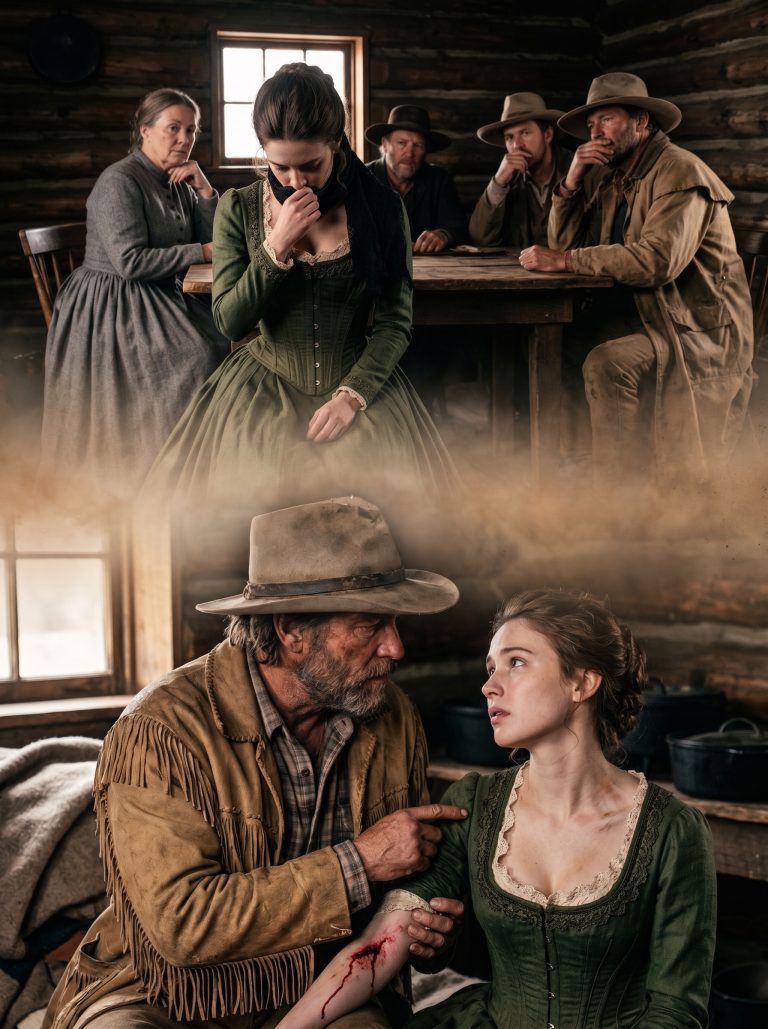
A Poor Widow Lost Everything in a Montana Blizzard, Until a Millionaire Cowboy Exposed the Town’s Darkest Lie

Part 1
The medicine bottle slipped from Elena Marsh’s bleeding fingers and shattered against the frozen ground, its last brown drops soaking into the snow like a wound that would not close.
For a moment she only stared at it.
Behind her, seven-year-old Noah coughed into his sleeve, the sound thin and wet and far too familiar. “Mama? Is the medicine gone?”
Elena closed her eyes. The truth would break him. A lie would break her.
“We’ll find more,” she said, though the voice didn’t sound like her own.
The storm had taken everything else before dawn: the roof, the stove, the quilt she’d mended by candlelight, the walls that had never been warm enough but had still been theirs. Now the last of Noah’s medicine lay soaking into the snow, and in Copper Hollow, medicine was not something offered freely to a woman the town had taken to calling the widow with the curse.
Not since Doctor Alden had turned her away at his own door.
Not since mothers pulled their children across the street at the sound of Noah’s cough, as though grief itself were catching.
Elena pushed herself upright, swaying as the wind tore at her torn skirt. Blood ran cold down her forehead from a gash she hadn’t noticed happening.
“Where do we go now?” Noah asked, teeth chattering.
She had no answer for him.
Near the tree line, half swallowed by drifting snow, a single line of boot prints led away from the ruined cabin, fresh enough that the storm hadn’t buried them yet, pointing toward the cabin rather than away from it, as though someone had stood there watching before the storm finished its work. Elena blinked, and when she looked again the wind had already smoothed them over. She told herself it was exhaustion playing tricks. She would remember, later, that it was not.
Then a horse snorted beyond the broken fence line.
A rider sat at the edge of the ruined yard, wrapped in a dark coat, hat low against the snow. Elena’s spine straightened before she recognized him: Miguel Ortiz, foreman to Nathaniel Cross.
“Mrs. Marsh,” he called. “Storm took out the north road. Mr. Cross sent me to check on the homesteads.”
Elena almost laughed. Nathaniel Cross, richest man in three counties, and the loneliest, if the stories were true. A man who never smiled at church suppers, never shook a hand unless business demanded it.
“As you can see,” she said, “there’s nothing left to check.”
Miguel’s eyes moved from the wreckage to Noah to the blood on her hands. “Mr. Cross has room. Warm beds. Medicine, if the boy needs it.”
“I don’t take charity.”
“Didn’t say charity.” Miguel’s voice gentled. “Said a debt.”
The wind seemed to hold its breath.
“I don’t owe Nathaniel Cross anything.”
“No, ma’am. But your husband once did.”
Elena stopped breathing. Daniel. His name sounded strange in the open air, here among the broken beams and spilled medicine.
“He never mentioned Nathaniel Cross.”
“Reckon Mr. Cross can explain that better than I can.”
Noah coughed again, doubling over, and that decided it before Elena’s pride could argue further.
The Cross ranch rose out of the snow like a house built for a family that had never arrived. Deep porches, tall windows, lamplight glowing behind most of the glass, though far too many windows stayed dark.
Nathaniel Cross came down the steps with a faint limp to meet them. He was broad-shouldered, dark-haired, silver already threading his temples, and he did not smile. He looked at Elena, then at the blood on her hands, then at Noah, and something crossed his face too quickly to name.
“Mrs. Marsh,” he said.
“I didn’t have much choice.”
“No,” he agreed. “Reckon you didn’t.” He nodded toward the barn. “Stove’s lit in there. Clean hay, warm blankets. Doctor Alden’s on his way. I sent for him the moment Miguel rode out, before he even reached you.”
Elena’s brows lifted. “You sent for a doctor before you knew we needed one?”
“I’ve kept a doctor on standby every winter for three years,” Nathaniel said, “paid him to be ready to ride the moment Miguel found you in trouble.” He did not explain further.
Inside, a gray gelding stretched his neck toward Noah as if he’d been waiting all day for exactly this boy. “That one,” Noah whispered, and when Nathaniel lifted him down to touch the horse’s nose, the boy laughed, a sound so bright it struck Elena like a blow, because she hadn’t heard it in weeks.
Nathaniel watched the boy laugh, and for one unguarded second his face wasn’t cold at all. It was grief.
“You’re wondering if his cough is catching,” Elena said quietly.
“No.”
“The town does.”
“The town is full of fools,” Nathaniel said, and no one in Copper Hollow had ever said such a thing to her, not once, not even kindly.
Doctor Alden arrived within the hour, dosed Noah with syrup and camphor, and left a full bottle of medicine on the shelf with instructions written in a careful hand, the first kindness the boy’s cough had earned him in a year.
“Then what do you believe in, Mr. Cross?” Elena asked, once the doctor had gone.
He looked at Noah a long moment before answering.
“Debts,” he said. “And promises.”
Before Elena could ask what her dead husband could possibly have promised a man like this, Miguel appeared in the barn doorway, snow on his shoulders, his face gone grim.
“Boss,” he said. “Rider coming up from town. It’s Judge Vance.”
Part 2
Nathaniel stepped in front of Elena before the buggy reached the yard, not to hide her, she realized, but to take the first blow himself.
Judge Silas Vance climbed down in a coat too clean for winter roads. He owned the bank, presided over the court, and smiled every Sunday from the front pew while the town pretended not to fear him.
“The rumors were true,” Vance said. “The cursed widow found a rich fool to shelter her.”
“Careful,” Nathaniel warned.
Vance produced a folded paper. “Mrs. Marsh’s property has been deemed unsafe. The court has concerns about the boy’s welfare.”
Elena’s blood went to ice. “My son is not your concern.”
“When a mother cannot provide proper shelter or medicine,” Vance said, “the court has an obligation.”
Nathaniel’s gaze caught on the paper’s wax seal, a small railroad mark stamped into the corner. “Where did that seal come from?”
Vance’s composure flickered, just once. “This is a warning, not an arrest,” he said, folding the paper away. “Charity from a bachelor rancher won’t protect that boy forever.” He looked at Elena with something close to satisfaction. “Your husband should have learned when to stay silent.”
Then he was gone, buggy tracks filling with snow before Elena’s knees gave out.
Nathaniel caught her elbow. “What did he mean about Daniel?”
That night, with Noah asleep beneath three blankets, Nathaniel finally told her.
Ten years ago he’d worked the railroad. A tunnel collapsed; seventeen men died; the company blamed him for cutting corners. Everyone believed it, everyone except Daniel Marsh, who testified that the company had ignored Nathaniel’s own warnings, that the blame had been forged to protect the owners. The inquest ruined Nathaniel’s name anyway, but Daniel’s testimony planted the first crack in the lie that eventually cleared it.
“And Vance?” Elena asked.
“Major shareholder in that same railroad.”
Elena pressed a hand over her mouth. The town hadn’t turned on her over cholera. They’d been guided to. The refused medicine, the debts that appeared from nowhere, the closed doors, all of it revenge, aimed at a dead man through his widow and son.
“Daniel made me promise,” Nathaniel said, “that if anything happened to him, I’d watch over you both. I gave my word before he ever left for that railroad camp, before either of us knew it would come to this.”
“For three years?”
“From a distance. I told myself distance kept you safer. I was wrong.”
Elena studied him: the doctor sent before he was asked, the stove already lit, the debts on her account at the mercantile that always seemed to settle themselves. “The flour that appeared on my step last winter. The man who paid off the bank note and never gave his name.”
“That was me,” Nathaniel admitted. “All three years of it was me. I told myself I was only keeping a promise. I don’t know when it stopped being only that.”
He sat with that admission a while, turning it over as if it surprised him too. Later, after Elena had banked the fire and settled beside Noah, Nathaniel stood in the barn doorway and watched the two of them sleep, the boy’s fist curled in his mother’s sleeve, and did not go to his own bed for a long time. In his coat pocket, worn soft from years of handling, was a scrap of cloth torn from a quilt he’d once found abandoned on Elena’s fence line after a windstorm, mended edge and all. He had never told her he’d kept it.
Outside, far past the fence line, something moved along the treeline, a shape darker than the shadows around it, gone before either of them could be certain they’d seen it at all. Nathaniel’s hand went to the window and stayed there a long moment before he let the curtain fall.
“Someone’s been watching this ranch for a week,” he said quietly. “I thought it was one of Vance’s men.”
A rider came pounding up the drive before dawn: Miguel, breathless. “Doctor Alden’s been beaten near the edge of town. Vance’s men caught him sending a wire to the territorial marshal. He says Vance is coming for Noah before sunrise. Says there’s a legal petition already filed, cholera madness, unfit mother. Sheriff Coleman rides at first light.”
Elena’s arms tightened around her son.
Nathaniel’s face went very still. “There’s one way to stop him before dawn, the only way that would hold up in Vance’s own courtroom.” His jaw worked as though the words cost him something.
“Marry me.”
Part 3
The barn went silent. Noah, jolted awake by the noise and Miguel’s urgent voice, buried his face against his mother’s shoulder and went very still.
“As my wife,” Nathaniel said, “you and Noah come under my name. Your death certificate for Daniel is on file with the county; you are lawfully a widow, free to remarry under territorial law, and no man, not even Vance, can undo a marriage properly witnessed by clergy before dawn. Vance’s petition against Elena Marsh becomes worthless. He’d have to start again against Elena Cross, against my lawyers, my land, everything I have.”
“You’d marry me to win a court fight?”
“No.” His voice softened, and that frightened her more than the offer had. “I’d marry you because I should have stood beside you years ago, and because I don’t intend to spend what’s left of my life keeping a promise from the far side of a fence.”
Noah looked between them. “Would Mr. Nathaniel be my papa?”
Nathaniel knelt to the boy’s height. “I could never replace your real father. But I can stand where he’d stand, between you and anyone trying to hurt you.”
Noah studied him, then nodded. “I think Papa would like you.”
Father Dominic had ridden out with the beaten doctor at first light, half to tend Alden’s cuts and half because word of Vance’s petition had already reached the church. Bruised and limping, Alden held Elena’s hand a moment before the ceremony began.
“I was afraid,” he admitted quietly. “Not of your boy. Of Judge Vance. I’ve been ashamed of that since the day I turned you away, and I mean to spend the rest of my practice making it right.” He insisted on standing witness anyway.
Father Dominic opened his worn prayer book without being asked. “A marriage witnessed by clergy and two others stands the moment it’s spoken,” he said. “We shouldn’t waste the minutes God has given us.”
The ceremony took less than ten minutes: a widow in a torn dress, a rancher with blood on his sleeve, a sick boy clutching his mother’s skirt, holy words spoken in a barn that smelled of hay and fear. When Nathaniel slid his late mother’s plain gold band onto Elena’s finger, his hand trembled, and that was what undid her, not the vow, but the tremor. This powerful, silent man, afraid she’d pull away.
Sheriff Coleman arrived with the custody order at dawn to find a marriage already standing in his way.
“This paper names Elena Marsh,” he said slowly, looking between husband and wife.
“This petition claims Noah has no safe guardian,” Nathaniel said calmly. “That was true yesterday. It isn’t true now. He has a lawful home, a physician willing to testify to his care, and two legal guardians standing in this yard. She’s Elena Cross now, witnessed by Father Dominic and Doctor Alden, filed with the county clerk within the hour. If Judge Vance wishes to challenge that, he’ll do it before another court, not on my front porch. Tell him if he comes for my family again, he’d better bring more than lies.”
Coleman rode back to town without the boy.
It did not end there. Vance struck with paper instead of riders: notices claiming Elena had stolen medical supplies, that Nathaniel had coerced her into marriage, that Doctor Alden’s confession was bought. By evening half the town whispered that the plague widow had trapped the richest man in three counties.
Noah’s cough eased that week under Doctor Alden’s steady doses, then broke entirely by the second, the fever gone, the color back in his face, though Elena kept the fresh bottle Alden had left, empty now, on the shelf out of habit long after he no longer needed it.
“I’m going to town,” Elena told Nathaniel the next morning.
“No.”
“You didn’t even ask why.”
“I know why. You want the bank records, Daniel’s accounts, proof of the forged debts.”
“Vance underestimates me. He expects you to fight, expects Alden to confess, expects Miguel to ride for the marshal. He does not expect me to walk into his bank myself. It’s market day; half the town will be on that street by noon, close enough to hear anything said too loudly through an open window. A man like Vance likes an audience. I mean to give him one he doesn’t choose.”
“That isn’t courage. That’s walking into a trap.”
Elena placed her hand flat against his chest, over the hard, frightened beat of his heart. “Daniel stood up for you when it was dangerous. Now I have to stand up for him.”
Nathaniel closed his eyes. “I am not losing you too.”
“You won’t,” she said.
“Come back to me,” he said, and let her go, because he understood, finally, that love was not the same as a cage.
The whispers followed her all the way to the bank. Vance received her with a smile that made her skin crawl, his office window cracked open to let out the woodstove’s heat, exactly as it always was on market day, a habit half the town knew, and one Elena had counted on.
“Mrs. Cross. What an unexpected pleasure.”
“I came for my husband’s accounts. Daniel Marsh’s.”
“I’m afraid I cannot release private documents.”
“Then release the forged debts you built in his name after the tunnel collapse.” She kept her voice pitched to carry, and did not step back from the window.
Vance’s smile vanished for one honest second before returning, colder. “You should have stayed on the ranch.” He opened a drawer and drew out a set of shackles. “You walked in here thinking you were brave. All you’ve done is make this easier.”
“You murdered my husband,” Elena said, loud enough now that the words spilled out over the market-day street below.
“Your husband signed his own death warrant the day he testified against men more powerful than himself.”
It was the confession she’d needed. Below the open window, market day had brought half the town within easy earshot, and more than one head had already turned toward the judge’s raised voice.
Vance realized his mistake too late. He lunged; Elena threw the inkwell and ran for the door, but a clerk caught her arm before she reached it. Pain shot through her shoulder.
The door burst open anyway.
It was not Nathaniel who filled the doorway first. A territorial marshal’s badge caught the light before the man behind it did, and then Elena saw his face, weathered and bearded and achingly familiar, a face she had buried three years ago in a shallow grave outside a railroad camp, when a wagon accident and a fire had left nothing whole enough to bring home, and a coroner’s certificate had made the grief official.
“Daniel,” she whispered.
Her husband did not move to embrace her. His eyes were wet and terrified and pleading all at once. “I can explain,” he said. “I swear to God, Elena, I can explain.”
He explained it later, in the marshal’s office, with Vance in chains down the hall and Nathaniel standing rigid and silent by the door, one hand braced on the frame as though the floor might give way beneath him.
“There was no wagon accident,” Daniel started. “Not really. I arranged the wreckage myself, the night before I was meant to disappear for good.”
“Why?” Elena’s voice was barely a breath.
“After I testified for Nathaniel, Vance’s associates made it plain, quietly and patiently, that my family would suffer for it over years, in ways no court could ever prove or stop.” He looked down at his hands. “A federal agent was already building a fraud case against the railroad. He offered me the only way out that didn’t end with you and Noah as leverage: vanish completely, let the town grieve me clean, and help build the case from inside Vance’s own operation.”
Nathaniel’s jaw tightened. “You let everyone believe you were dead so a dead man’s silence would be safer than a living man’s testimony.”
“Once I’d officially died, Vance believed there was nothing left to fear from me,” Daniel said. “A letter, a visit, even a rumor that I lived, would have told him exactly what leverage remained. So I stayed close instead, the only way that was safe. Watching from tree lines and rooftops. Mending fences after dark. Leaving flour and settled bank notes with no name attached. Near enough to see my son grow. Never near enough to be seen.”
Elena’s hands curled into fists. “The flour. The debts. That wasn’t only Nathaniel.”
“Some of it was him,” Daniel admitted. “Some of it was me. I don’t think either of us always knew whose kindness you were thanking.”
“And these past two weeks?” Nathaniel asked. “The shape at the treeline.”
“I’d intercepted the marshal’s wires. I knew Vance meant to move against Elena before our case was ready. I’d been circling closer than I should have for days, waiting for exactly the wrong moment to happen. When word came she’d walked into that bank alone, I was close enough to reach it.”
“You let me bury you,” Elena said, and the words came out broken rather than angry, because anger required a strength she didn’t have left. “You let him fall in love with your widow.”
Daniel looked at Nathaniel for a long moment. Whatever passed between the two men was old and complicated and, Elena understood slowly, not unkind.
“Miguel’s reports told me enough over the years,” Daniel said quietly. “That the boy was laughing again, for the first time, in the Cross barn. That you’d stopped flinching when someone knocked at the door. I did what I set out to do. I kept you both alive. But I don’t have the right to call that a marriage anymore, Elena. Not after what it cost you to survive it.”
“Don’t,” Nathaniel said quietly, “do this for my sake.”
“I’m not,” Daniel said, and for the first time he almost smiled. “I’m doing it because Noah calls you Papa now, and because a man doesn’t get to return from the dead and demand the life he left behind. I gave that up the day I let you grieve me. The least I owe you is not taking it back.”
The marshal’s papers, filed that same week, made it plain and legal: Daniel Marsh, presumed dead under a coroner’s certificate and properly mourned, had left Elena a lawful widow, and territorial statute held that a widow who remarried in good faith on the strength of that certificate kept her second marriage standing even if the first husband later reappeared. Daniel’s return did not undo the marriage; it only meant he had to sign, willingly, the paper relinquishing any claim to reopen it. He signed it without being asked twice.
He would stay in the territory only long enough to testify against what remained of Vance’s network, and then he would go, not out of banishment, but because some debts, once paid, are better left closed than reopened.
Vance’s trial lasted into the summer, the forged railroad ledgers and Daniel’s testimony together enough to convict him on fraud and conspiracy charges the territory had been trying to make stick for a decade. He was sentenced to the territorial prison and died there eighteen months later, still insisting to the last that the tunnel collapse had been an act of God and not of men. No one in Copper Hollow mourned him.
Spring came slower that year, but it came.
Doctor Alden stayed in Copper Hollow and never refused a patient again, not once, for the rest of his practicing years, as if two years of cowardice had bought him a lifetime of penance he intended to spend in full.
Rebecca Hale, who had crossed the street rather than let her daughter near Noah’s cough, was the first to walk up the Cross ranch drive with an apology and a basket of bread. She was not the last.
“We were wrong,” she said, unable to look up from the floor. “Sorry will never be enough.”
“Fear explains cruelty,” Elena told her. “It doesn’t excuse it.” She looked out at Noah, laughing with Rebecca’s daughter over a wooden horse Nathaniel had carved for him. “If this town wants forgiveness, it will have to become a place where no widow is left to freeze and no child is denied medicine because a powerful man wills it. Help me build that place, and we’ll call it enough.”
By the time the old schoolhouse reopened that spring, half of Copper Hollow had a hand in fixing its windows and stove. Nathaniel paid for the books and kept his name off every plaque, because Elena told him the children didn’t need to learn gratitude toward money; they needed to learn courage.
Daniel came once, quietly, before he left the territory for good. He watched his son ride a gray gelding in careful circles under Miguel’s instruction, sat with him an hour by the creek without ever saying who he truly was, and then found Elena alone by the barn at dusk.
“He’s happy,” Daniel said.
“He is.”
“That was always the only thing I was trying to buy him. I just didn’t know the price would be this high.” He looked toward the house, gold light spilling from windows that no longer stood dark and empty. “Take care of him. Both of them.”
“I will,” Elena said. “I already do.”
He rode out before Noah woke, and though Elena told her son the truth of it years later, when he was old enough to hold it without breaking, Noah only ever called one man Papa in the house where he grew up: the one who had kept a stove lit in a barn for a stranger’s family, on the strength of nothing but a debt he didn’t have to pay and a promise he refused to break.
That evening, months into a marriage that had begun in a barn full of fear and slowly, quietly, become something neither of them had dared name at first, Nathaniel found Elena watching the last of the light fade gold over the north pasture.
“Are you all right?” he asked.
“I keep thinking,” she said, “that everyone in this story tried to decide what I could survive without asking me. Daniel decided I’d survive better grieving him. Vance decided I’d survive better afraid. Even you decided, once, that I’d survive better if you stayed away.”
“I know.”
“I don’t want to be decided for anymore.” She took his hand, the same hand that had trembled putting a ring on her finger in a barn full of fear. “I want to choose. So I’m choosing you, Nathaniel Cross. Not because a judge left me no way out, and not because a dead man gave his blessing on his way out of town. Because when you look at me, I don’t feel cursed. I feel seen. I’m not a widow, or a burden, or a debt. I’m simply Elena.”
Nathaniel drew her close, resting his forehead against hers the way he had the night of their wedding, when neither of them had yet believed it would last.
“Then let me spend the rest of it earning that,” he said.
Behind them, the ranch house glowed against the darkening hills, not the tomb it had been for so many silent years, but a home, finally, with firewood stacked high and medicine on the shelf and a boy’s laughter still ringing faintly from the stable.
Some debts, Elena had learned, could never truly be repaid. But they could be honored, by living, at last, like a woman no longer waiting to be told she was allowed to.