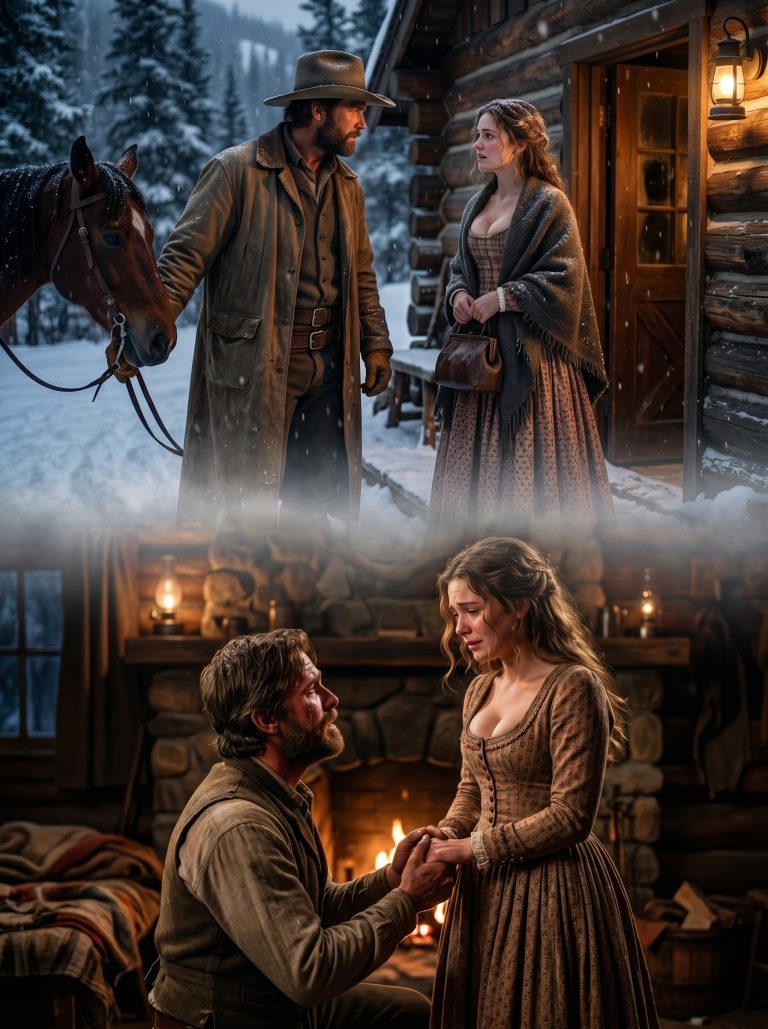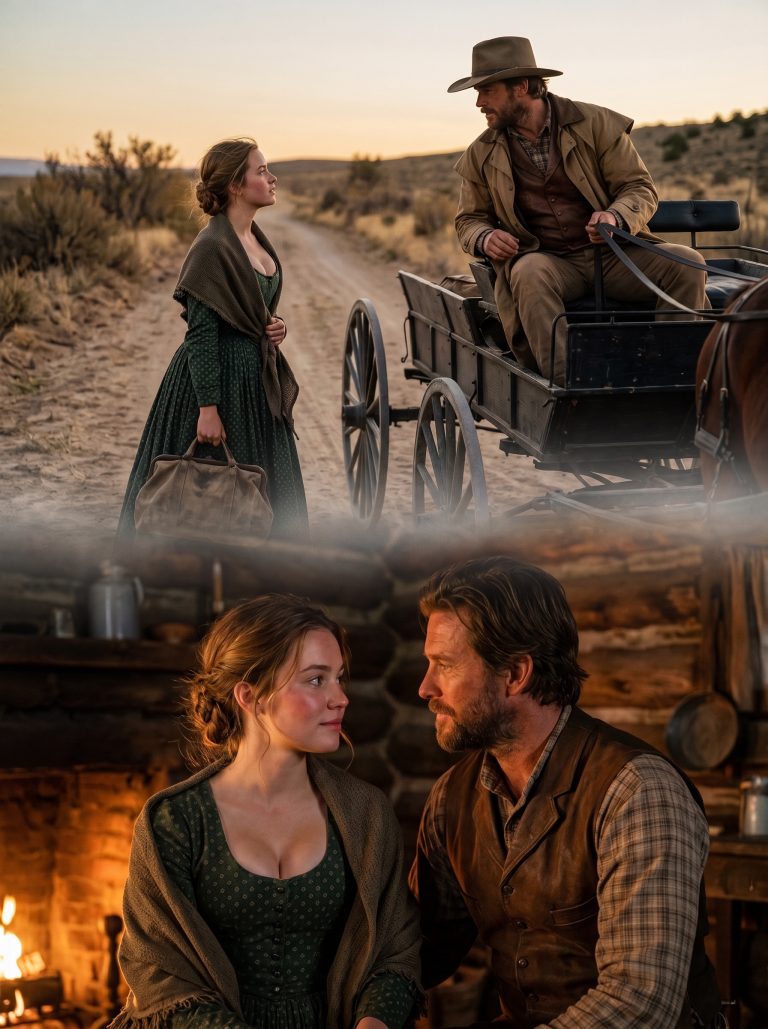
A Pregnant Widow Took In Two Orphans for $1—Until a Cowboy’s Hidden Secret Changed Their Fate

Part 1
She had exactly one dollar left in the world, and she was going to spend it on two children she’d never met.
That’s how it started. Not with hope. Not with some warm feeling about doing good. With arithmetic. Mave Holloway was twenty-nine years old, seven months pregnant, and completely alone on a Montana cattle ranch in January of 1886. Four months earlier, her husband Thomas had been thrown from a horse. He’d walked home on his own two feet, gone quiet in a way she’d never seen before, and was dead of pneumonia within the week.
She stood at her kitchen window that morning and watched the sky press down over the hills like a lid being lowered, slow and deliberate, and she thought about the fact that the frontier didn’t care whether she lived or died. It just kept being cold.
On the table behind her sat one silver dollar. That was the whole estate. Not a hidden stash, not a forgotten envelope — she’d searched every coat pocket, every ledger, every corner of the barn. A life built over six years, and this was what remained of it: a single coin, and a stack of debts her husband had never told her about. There was a bank loan against the property. There was a private note held by a man named Gerald Puit, who’d shown up two weeks after the funeral with the careful politeness of someone who’d done this before. He’d told her, without raising his voice, that he expected to be repaid by spring — or he’d take the ranch through the courts.
She needed hands. Not hired men, because she had nothing to pay hired men with. She needed someone who could drive fence posts and haul water and do the hundred other things a woman who was about to give birth had no business doing alone in the dead of winter.
So she wrote in the back of her ledger: What can you actually offer? And underneath it: A roof. A fire. Food for now. Work that matters.
Then she put on her coat and drove eight miles into Harland Creek, to the orphan station everyone in town whispered about and nobody had a good word for.
The woman running it, Mrs. Aldridge, studied Mave’s belly and told her flatly that she was out of her mind. And maybe she was. But she asked to see the children anyway. Mrs. Aldridge hesitated — the particular hesitation of someone about to hand over damaged goods. Then she told her about a sixteen-year-old boy named Colton Reed, sent back from four placements in two years because he was “difficult.” And about his nine-year-old sister Elsie, who barely spoke and had been passed over every single time because families wanted the girls who smiled easy.
“What did Colton do to get sent back?” Mave asked.
“He pushed back on a foreman hard enough the man threatened to press charges.”
“What had the foreman done to earn that?”
Mrs. Aldridge blinked like nobody had ever asked her that question before. It turned out the foreman had been cutting the younger children’s food rations.
Mave met them in the back room. A boy, tall for sixteen, with a scar along his jaw. His eyes went straight to her stomach before settling on her face — not with pity, just the flat, assessing look of someone taking inventory. Beside him sat a small girl with two braids. She shut her book without hurrying and studied Mave with an expression far too old for nine.
Mave didn’t dress it up. She told them exactly what she had and exactly what she needed, and she told them it would be hard, and she wouldn’t pretend otherwise.
The boy asked one question that told her everything.
“You take both of us?”
“Yes.”
He glanced at his sister. Something passed between them that Mave couldn’t follow. Then he turned back to her and said, “All right.” Nothing more.
She paid her last dollar to Mrs. Aldridge’s desk and drove two strangers home through a Montana winter with a baby coming in eight weeks and a debt she had no real plan to pay.
What she didn’t know yet was buried in a locked drawer and hanging on a peg by the fireplace. It would take weeks to surface. The two children she’d just brought into her house were not strangers to this land at all.
They were connected to it in a way that would break something open in all of them before the winter was through.
Part 2
The first three weeks went the way Mave expected them to — friction, mostly. Colton was opinionated and didn’t take direction well. Half the time, though, his opinion was right, which made it worse. Elsie barely spoke, but she noticed everything. Which hen was off her feed. Which fence post was rotting from the inside. Which look on Mave’s face meant she was in pain and hiding it.
It was the small things that started catching in Mave’s chest like a splinter she couldn’t quite dig out.
The way Colton went rigid whenever Thomas’s name came up. The way Elsie’s eyes drifted, again and again, to the old buffalo coat hanging by the fireplace — not the glance of someone looking at an unfamiliar object, but the look of someone recognizing something. Recognizing it specifically.
On the fifth night, Mave woke to voices down the hall. She stood outside their door in the cold and heard the two of them arguing in low, careful tones.
“She’s going to figure it out eventually,” Elsie said.
“Maybe,” Colton answered. “And when she does, that’s when we figure out what we do next.”
“It’s the same coat, Colt.”
A long pause.
“I know,” he said. His voice had gone flat in a way she’d never heard from him. “I know it’s the same coat.”
Mave stood in that hallway with her hand against the wall. Her heart was doing something strange in her chest. She hadn’t understood a single detail of what she’d just heard — and yet somehow she already knew she’d overheard the edge of something far larger than a coat.
The next morning, while Colton was out on the fence line, she went to Thomas’s desk. To the bottom drawer she hadn’t been able to bring herself to sort through since the funeral. And she started reading.
It took her an hour to find it: a letter from 1879, addressed to a law office in Billings, written in a hand that wasn’t Thomas’s — younger, rougher. Her eyes moved down the page once, then went back to the top and moved down it again, because the name staring back at her didn’t belong to the man she’d buried on the ridge.
Elias Reed.
She sat back and glanced through the doorway at the coat hanging by the fire.
Reed.
Colton Reed. Elsie Reed.
The letter described two siblings left at a county station while their older brother went to “make arrangements” — and never came back for them. He’d changed his name. Built a new life, in a new town, with a new wife. And never once gone back for the two children he’d left behind.
The man Mave had buried on the ridge, the man she’d grieved for four months, the man whose ledger she’d been fighting to save — he was the brother who had abandoned the two orphans now sleeping down her hallway.
She folded the letter and slid it into her apron pocket. For a long time, she didn’t move. She had no idea yet whether telling Colton the truth would break the fragile thing they were only just starting to build — or whether keeping it from him would break it faster.
Part 3
Mave told him that evening, after Elsie had gone to bed. She set two cups of coffee on the table, sat across from Colton, and said only, “I need to talk to you about something.”
Something shifted in his face before she’d said another word. Not surprise. Weariness — the look of a person who has spent his whole life waiting for a door to swing shut on him, and has just heard the hinge start to creak.
She told him plainly. No decoration, no softening. She thought he’d earned that much.
When she finished, the kitchen went very quiet. Colton sat with his elbows on the table and his head down, staring at the wood grain like it might rearrange itself into a different answer.
“How long did you know?” she asked.
“The coat,” he said finally. “I recognized it the day we came in. He had it in Billings. Before he left.” A pause. “I wasn’t sure. Then I found some of his old paperwork in the barn. A bill of sale with the name Reed on it. Wasn’t hard to connect.”
“You were going to keep it from me.”
“Yeah.”
“Why?”
His eyes met hers, steady even though his voice wasn’t quite. “Because the last four times someone found out something about us that complicated things, we were back at the station inside a week.”
The words sat between them like something with weight.
Mave turned her coffee cup a slow half-circle on the table. “He was your brother,” she said.
“He was somebody who shared my name for about six years and then decided that was enough of that.” The bitterness in Colton’s voice was old — worn smooth at the edges the way something gets when you’ve carried it a long time and stopped expecting it to hurt fresh. “I don’t need anything from knowing it. Doesn’t change what happened.”
“No,” Mave agreed quietly. “It doesn’t.”
She asked about Elsie. Whether she knew. Whether she was all right. And something in Colton’s tightly held composure cracked, just slightly, just for a second, before his eyes dropped back to the table.
“She’s had a long time to think about him being gone,” he said. “The reason doesn’t change much.”
“And you?”
“Same.”
Mave studied him for a long moment — this sixteen-year-old boy who had been left twice now, once by a brother who vanished into a new name, and once by every family who’d sent him back for having the audacity to defend a hungry child. And she said the only thing she knew for certain.
“You’re not going back to the station.”
His head came up sharply.
“This doesn’t change your situation,” she said. “You’re here because you’re here. Not because of who Thomas was or wasn’t. Whatever he did — that was his account. It’s got nothing to do with you.”
Colton studied her for a long moment, something complicated moving behind his eyes. Then he turned away, toward the window, toward the dark.
“Okay,” he said. Just that.
“I mean it,” Mave said.
“I know,” he answered. “I can tell when someone means something.”
She told Elsie the next morning, sitting at the kitchen table with the fire going and snow falling past the window. Elsie listened without crying — which Mave had half-expected and had been wrong to expect. The girl simply sat with her hands folded, her eyes down, absorbing it the way she absorbed everything: unhurried, at her own pace.
“Is that why you wanted to know about the coat?” Elsie asked when Mave finished.
“Yes.”
“I knew it was his,” Elsie said. “I wasn’t sure you’d want us here if I said something.”
“I would have wanted to know,” Mave said. “I know that now.”
Elsie unfolded her hands and folded them again. “He never came back,” she said — not an accusation, not grief in any sharp form, just a fact she had been living inside of long enough to have built a whole life around its edges.
“No,” Mave said. “He didn’t.”
They sat together a while, not talking, the fire cracking softly. And then, out of nowhere, Elsie said, “He was a bad cook. I remember that. He burned everything.”
Mave watched her.
“That’s about the only thing I clearly remember about him,” Elsie went on. “Colton used to say he could burn water.”
Mave let out a breath that was almost a laugh, and Elsie’s mouth curved just slightly at the corner. It wasn’t healing. It wasn’t fine. It was a long way from either of those things. But something had shifted in the house — some pressure that had been building since the first night had finally found somewhere to go.
The secret was out. The ranch was still standing. And for the first time in a long time, Mave Holloway was not alone in carrying it.
Nobody mentioned it again after that. That was how things worked in that house, Mave was learning — things got said, acknowledged, set down somewhere solid, and then you moved on, because the cows still needed water and the debts on Thomas’s ledger didn’t care about anyone’s feelings, and neither did February.
But something had changed in the air of the place. Colton worked the same brutal hours, made the same blunt assessments about fence lines and feed stores, but there was something fractionally less guarded in how he moved through the rooms — fractionally less like a man waiting to be told to leave. Elsie began offering small things unprompted: the hen count in the mornings, an opinion about which grain the blue hen actually preferred to eat, which she’d worked out through nothing but quiet observation.
The money problem, though, did not soften with time. It stayed exactly as sharp as it had always been.
Mave had written to three creditors in the first weeks of February. The letter to the Billings bank had been cordial and factual. The one to the feed supplier had taken four drafts to get the tone right — firm without sounding foolish. The one to Gerald Puit she’d written once, in a single sitting, because she’d learned that thinking too long about what to say to that man only made her angrier.
Puit wrote back in nine days. Six lines. He appreciated her communication. He’d be visiting the property in March to assess its condition — and hers.
That evening, while Mave cleaned a wire cut on Colton’s palm, she told him the number they owed. Not the vague figure she’d given him before — the real one.
The silence that followed was its own kind of answer.
“I need to show him real progress,” she said. “Not a letter that says I’m trying. I need him to see this ranch is viable.”
“What does viable look like to a man like Puit?”
“A functioning operation. Stock, or a plan for stock. Maintained buildings. Someone working the land who knows what they’re doing.”
Colton glanced down at his bandaged hand. “So you need me to look like I know what I’m doing.”
“You do know what you’re doing. Just not on paper.”
“I’m sixteen,” he said. “No contract. No wage. Nothing official.”
She hadn’t fully thought that through yet, and she said so. Then she offered him one — room, board, and ten percent of any profit from the spring cattle sale.
He considered it with the same unhurried care he gave everything. “That’s fair,” he said. “But you should know I’d have done it without the percentage.”
“I know,” Mave said. “That’s exactly why I’m offering it.”
Something in his face came close to warm. Not quite. But close.
The list of things to finish before Puit arrived grew long enough that Mave started keeping a second notebook just to track it. Fence sections. Loose shutters. A leaking water trough. Every morning began at four-thirty and every evening ended when the light was gone, sometimes later.
It was the second week of February when the trouble came from town instead of the ranch. Mave was loading the wagon outside the feed store when she overheard two women from the Ladies’ Aid Society discussing her — not quite to her face, but loud enough to be heard.
People are concerned, one of them said. You’re alone out there. Expecting. And you’ve taken in a sixteen-year-old boy nobody knows anything about.
Mave crossed the street and told them plainly that the boy was working harder than any hired hand she’d had in six years, and that if anyone had specific concerns, they were welcome to come see for themselves instead of trading rumors on a boardwalk.
She was angrier than she let herself show, all the way home. When she told Colton that evening — not because she had to, but because she thought he deserved to know — he listened without expression.
“Does it change anything?” he asked.
“No.”
“Then it doesn’t matter.” He said it with the flat certainty of someone who’d spent his whole life being talked about and had long since calibrated exactly how much of his attention such talk deserved.
It was around this time that Mave discovered just how far Colton’s attention actually reached. He’d been tracking the fence line belonging to their neighbor without a word to anyone, a rancher named Burch, documenting every place it sagged or gave — not because anyone asked him to, but because, as he put it, “it’s the same fence line. Makes sense to know what’s happening on both sides of it.”
That instinct — watch everything, document everything, never be caught unprepared twice — would matter more than either of them yet understood.
Elsie fell sick in the middle of February, fast and hard, fever climbing before Mave even realized how bad it had gotten. Colton came in from the fields and went still when he saw Mave carrying broth down the hall.
“How bad?”
“Fever. Not serious yet. I’m watching it.”
“I can sit with her,” he said. “You’re eight months pregnant. If you’re going to be on your feet tonight, let me take the first watch.”
He sat with his sister past midnight. Mave woke at two to check and found him asleep in the chair beside the cot, arms crossed, head tipped back, a damp cloth folded neatly on the nightstand. The fever had broken. Elsie’s color was better.
What Colton had done during the long hours of that watch, it turned out, was go through Thomas’s old barn records — working out, entirely on his own, at three in the morning, exactly how many cattle the ranch could rebuild by summer if Mave found breeding stock instead of buying it outright.
“There’s a man in the next valley,” he told her over the numbers, pushing the paper toward her. “Harmon. Old, winding down his operation. You offer him a split — he boards his breeding herd on your land, you breed them to a leased bull, split the calves at market.”
“You’ve been thinking about this a while,” Mave said.
“Since the third day. When I knew we were staying.”
“You said when you knew — not when I asked you to stay.”
“Yeah.” His gaze held hers, steady. “I don’t rely on being asked. If I’m going to put my weight into something, I need to know I decided to.”
The visit to Harmon went about as well as anyone could have hoped for a skeptical old rancher looking at a pregnant widow and a teenage boy. Colton talked fence conditions and water quality with the flat authority of someone twice his age, and when Harmon tried to lowball the split, Colton read the negotiation instantly — “He needs to feel like he got something. He’s testing whether we’ll take a bad deal without thinking.” — and countered with a number that closed the deal clean.
They drove home with a signed agreement folded in Mave’s coat pocket.
“Good negotiation,” she told him.
“You set it up,” he said. “I just closed it.”
Three days later, reaching for old harness in the storage room, Mave’s hand caught on something solid behind a row of jars — a small locked tin, pushed to the very back of the highest shelf. She brought it to the kitchen table and worked the rusted clasp open with a length of wire.
Inside: a folded note in Thomas’s handwriting, and beneath it, wrapped in cloth, a quantity of banknotes. Not a fortune. Not nothing.
The note read: For what I couldn’t say in person. I know it’s not enough. It never was. But it’s what I had.
Unaddressed. Unsigned.
Colton read it without touching it, his face gone deliberately blank. “He knew,” he said finally, voice flat. “This whole time. He knew where we were.”
“Probably,” Mave said. “And he still didn’t.”
He turned to the window and stood there a long moment with his back to the room. Elsie came and stood beside the table and reached out to touch the edge of the note with one finger.
“Is it enough to help?” she asked.
“It helps,” Mave said.
“Then that’s something,” Elsie said — and it was, Mave thought, one of the most honest things she had ever heard a child say. This girl who had been left and left again, looking straight at the evidence of her brother’s failure and finding, somehow, a way to call it something and mean it.
“Put it toward Puit’s note,” Colton said, sitting back down. “Most pressing first.”
“That was my thinking,” Mave said.
Nobody said anything else about it. They ate dinner. The fire burned down to coals. Above the ridge, the sky had taken on a strange, suspended quality — not dark exactly, not gray exactly, but the particular shade of a sky holding something enormous back.
It announced itself three days before it arrived, the way these things do to people who’ve lived long enough in a place to read its language — horses standing with their hindquarters to the north, temperature dropping in hard steps instead of a gradual slide. By the third morning, the wind had become something else entirely: not gusts, but a sustained pressure against the walls, like the house was being squeezed and hadn’t yet been told how hard.
Mave woke before four to find the yard swallowed in horizontal snow, visibility down to fifteen feet. Colton was already dressed, already alert.
“It’s bad,” he said.
“Yes.”
“I need to get to the barn before the drift builds against the south wall.”
“Go,” she told him. “Tie off to the porch post.”
He was already doing it. He glanced back at her once, quick, the way you check on something you’re responsible for — and then he was gone into the white.
The pain started in the early afternoon. Low, sharp, entirely different from the weeks of backache she’d been carrying. Six weeks early. Six weeks meant lungs not fully ready, weight not where it needed to be. She finished the soup she was making anyway, because panicking would not improve the facts of the situation, and the facts of the situation were what they were.
When Colton came in and understood what was happening, she saw real fear cross his face before he controlled it — and she was glad she’d seen it, because it told her he was paying attention, and it was human, and it was honest.
“No one’s going for the doctor,” Mave said. “Eight miles, zero visibility. You know that.”
“Then what do we do?”
“We manage here. I’ll tell you exactly what to do, and you’ll do it.”
She had him read the relevant pages of an old medical guide aloud while she sat at the kitchen table, watching his eyes move down the page fast and careful, his expression staying level through instructions that would have unsteadied most grown men.
“You’re not scared?” he asked her at one point — not looking for reassurance, just wanting the honest answer.
“I’m very scared,” she said. “But I’ve found being scared and being capable aren’t exclusive.”
He nodded once. “Tell me what to get ready.”
The contractions closed to thirty minutes apart, then less. Elsie moved through the house in a high, focused quiet — boiling water before being asked, laying out clean cloth she’d stored away back in December without telling anyone why, building the fires higher than Mave had ever kept them.
Somewhere past nine that night, something changed in the quality of the pain — not more intense, but wrong at the edges in a way Mave recognized instantly.
“Colton.” Her voice was steady, but it was the steadiness of someone holding something too full to spill. “Something’s off. The guide. Page forty-one. Read it to me.”
He found the page. His hands were steady — she would think about that for a long time afterward, how steady his hands were. He read to her clearly, the way you’d want someone to read to you in a dark room when you needed the words to get in past whatever wall your body was building.
She listened. She understood. She told him what to do.
He did it.
He made two small mistakes. Both corrected the instant she told him, without apology, without hesitation — just correction, and forward motion, which was exactly right.
“Tell me how,” he said at the hardest moment, his dark eyes steady on hers. “It’s going to hurt.”
She told him. He did it. It hurt.
Then everything changed.
The first sound wasn’t a cry — smaller than that, a sound suspended between silence and protest, and for one unbearable second it didn’t develop into anything more. Colton went completely still. Mave’s whole body matched it, one held breath, the universe narrowing to this single room.
Then the sound opened up — small, sharp, entirely certain of itself.
Colton’s face did something Mave had never seen from him. All its careful layering fell away at once, and what was underneath was relief so total it looked almost like pain.
“She’s breathing,” he said.
“Yes.”
He glanced down at what he was holding. “She’s very small.”
“She’ll be bigger soon.”
He placed the baby in Mave’s arms with the exaggerated care of someone whose hands weren’t entirely trustworthy in that particular moment, and from the doorway, Elsie made a small involuntary sound — something wound tight for a very long time, finally letting go.
Mave named her Grace. Not for any grand reason, or not entirely — because in the long dark hours of the storm she had held onto the idea of something unearned, something given freely when she had nothing left to offer in return, and because the word felt true in her mouth when she said it.
Later, in the hallway, Mave heard Colton and Elsie’s voices, low and unhurried.
“You did good,” Elsie said.
“Don’t.”
“Why not?”
A pause. “I was scared the whole time.”
“That doesn’t mean you didn’t do good,” Elsie said. “Those aren’t the same thing.”
Outside, the blizzard raged on, burying every road out of the valley, reducing the world to the walls of that one house. Inside, there was fire, and warmth, and three people who had come through something together, and a child who had arrived six weeks early with nothing gentle about the circumstances and had announced herself to the room with the full force of her intentions.
The storm broke on the third morning. Colton was outside before full light, digging the barn free, checking the animals that had weathered three days shut in against the cold. Mave lay in bed with Grace on her chest and listened to the ranch slowly coming back to life around them.
The doctor arrived two days later once the road was passable. He examined Grace with the practiced thoroughness of a man who’d seen early births before, told Mave the baby was small but vigorous, the color good, the feeding response strong.
“Whoever helped in the delivery,” he said, glancing at Colton in the doorway, “did competently.”
Colton didn’t respond to the compliment out loud. But something in his posture shifted, just slightly — an acknowledgment he wasn’t going to put into words.
Spring came to the valley the way it always did in Montana — not with warmth exactly, but with the slow withdrawal of cold, mud replacing snow, the creek running loud with melt. The Harmon breeding herd arrived in April, fourteen cows and a leased bull, one of them carrying a calf Harmon had conveniently failed to mention.
“Bonus,” Colton said when Mave asked if it was a problem. “She’s built for it. She’ll be fine.”
He was right, as it turned out, about most things concerning cattle.
Then came the second threat — not from a blizzard this time, but from a bank in Helena, a loan Thomas had taken against the north pasture years before the main debt, structured separately so it hadn’t surfaced in the first accounting. A man named Aldis Prine arrived with the document and a sixty-day deadline: payment in full, or the bank pursued the property.
Mave asked to walk him through the operation before he made any assessment. That night, she and Colton worked until midnight drafting a letter outlining the timber stand on the unused north acreage — fifty acres of mature, merchantable growth Colton had been assessing on his own since February, knowledge earned during three months on a logging crew in Idaho when he was fourteen, one more hard-edged skill collected from one more difficult place he’d been sent.
“Prine doesn’t need a signed contract,” Colton told her. “He needs evidence you understand what you have and how to use it.”
When Prine walked the property the next morning, he asked about the timber stand specifically — exactly as Colton had predicted, having read the man’s plain coat and unshowy horse as the tells of someone who “needs his numbers to add up,” not someone chasing land for its own sake.
“Forty-five days,” Prine said finally, looking at the working cattle, the repaired fences, the evidence of a season’s hard labor. “Partial payment within forty-five days. Remainder by January, timber rights as secondary security.”
Workable. Not easy — but workable.
The town’s whispering never entirely stopped, but Mave met it head-on, appearing at the Ladies’ Aid Society with Grace in her arms, letting herself be seen, letting the ranch be described in the plain terms of what it actually was: a working operation, understaffed, undercapitalized, but functional. When she brought Colton into town in a secondhand coat she’d had properly fitted, three different men stopped to talk business with him while she was inside — proof enough that people were beginning to see what was actually standing in front of them instead of what they’d assumed.
By October, the fall market told the real story. Seventeen head of cattle — eleven Harmon calves, four steers she’d been holding all winter, two cheap yearlings bought off Harmon’s winding-down operation — went to auction in good condition, the calves fattened on a strong summer’s grass. A specialized buyer from Billings, drawn by Hennessy’s tip, studied animals Colton knew individually — which one favored her left foreleg in wet weather, which had been the runt at birth and outgrown every projection anyway — and paid seven percent above Mave’s threshold.
“You’ve got a good hand here,” the buyer told her.
“I know it,” Mave said.
The number cleared Puit’s remaining debt entirely and knocked a third off the Billings loan in one payment. What was left over was, for the first time in two years, genuine operating capital — not borrowed time, not emergency funds, but real ground to stand on.
That November, Colton asked to join a six-week cattle drive east through the passes before winter closed them, run by a trail boss named Harris who paid real wages in cash — money Colton promised to bring home in full toward the loan. Mave thought about everything he had been to that ranch over the past year: the fence lines, the arithmetic worked out at three in the morning, the night of the blizzard, the steady hands that had brought her daughter into the world.
“What do you want to do?” she asked him.
“I want to go,” he said. “I’ve never been past this valley.” A pause. “But I also want to come back. I want you to know that part.”
“I know that part,” Mave said. “You’re not Thomas.”
The name sat in the room, no longer heavy the way it used to be — just present, carrying what it carried.
“No,” Colton said, even and certain. “I’m not.”
“Then go,” Mave told him. “Come back in December.”
He came back on the fourteenth, taller somehow, sitting a horse differently than the boy who’d left. Elsie was in the yard before Mave reached the door, and she watched brother and sister take each other in, the kind of look that does the work words would only do worse. Then Elsie walked straight into him, and he held on.
He handed Mave an envelope on the porch. Heavier than she expected.
“Billings loan,” he said. “Harris paid a bonus on the drive. I negotiated it.”
“You taught me,” he added, before she could ask.
The confirmation came in February, one year to the month after the blizzard that had nearly taken all of them. The Billings bank acknowledged the structured repayment plan, outlined the balance across the agreed timeline, and noted that at the current rate, the loan would clear not in three years, but two.
Mave read it at the kitchen table with Grace in her lap pulling at the paper’s edge, Elsie across from her working through an arithmetic primer, Colton at the counter already thinking about the day’s first task.
She thought about the January before — the white sky, the single dollar on the table, a future that had looked like a wall with no door in it. People had asked her more than once, as the story moved through town the way stories do, whether she’d had faith, or instinct, or some particular wisdom that told her it would work out.
The truth was simpler and harder than that. She had been desperate, and she had looked at two children who were also desperate, and she had understood something most people never bother to learn: desperation isn’t weakness. It’s a form of attention. You see what’s actually standing in front of you, instead of what’s convenient to assume.
She had seen Colton — really seen him — and understood that the thing everyone else held against him was exactly the thing that made him worth trusting. Not in spite of what he’d survived. Because of it.
She had seen Elsie, and understood that quiet isn’t absence. Some people simply keep their whole selves in a room nobody has bothered to unlock.
She hadn’t been wise. She had been paying attention. And she had chosen — when everything was difficult, when there was no guarantee behind it — to extend trust anyway. Sometimes that kind of trust gets you nothing but the bill for the faith you placed in it. Thomas had been proof of that.
But even Thomas’s failure, in the specific, particular way the world sometimes works, had sent two children to a station eight miles from a ranch that needed them more than it needed anything else.
That didn’t excuse him. It didn’t make the years of damage undone. It simply meant that even broken things leave pieces behind — and sometimes the pieces matter more than whatever they came from.
“You going to read that all morning?” Colton asked from the counter.
“Bank in Billings,” Mave said, folding the letter. “Two years at the current rate.”
Something moved across his face — the look of news landing before a person’s fully braced for it. He gazed out the window at the ranch: the fence line holding, the barn standing solid, cattle moving in the pale morning light across the east pasture. He took it in the way a person takes in a place they intend to stay.
“All right,” he said, and picked up his coat, and went out to start the day.
Mave sat at the table with her daughter in her lap and the letter folded in her hand, and the sound of Elsie working steadily through her sums, and the ordinary sounds of the ranch outside the window. And she understood, finally, the whole of what they had built.
Not from wealth. Not from ease. Not from anything that came without cost.
From a dollar.
From a decision made by a desperate woman who, at the end of a calculation that offered no good options, chose to extend her hand to two people who had no particular reason to take it.
They took it anyway.
She held on.
That was the whole of the story — stripped of the blizzard and the debts and the long winter and the man buried on the ridge whose name she no longer said with anger. Four people who had each reached the end of what they could manage alone, and who had, through stubbornness and circumstance and the plain human refusal to accept that this was all there was, built something together that none of them could have built apart.
Not a perfect family. Not a healed one.
A real one.
The kind that doesn’t arrive wrapped and finished. The kind you build badly, and slowly, and together — out of whatever you actually have.
Outside, the morning was cold and clear. The ranch was standing. The work was waiting.
And that was enough.
That was more than enough.
THE END