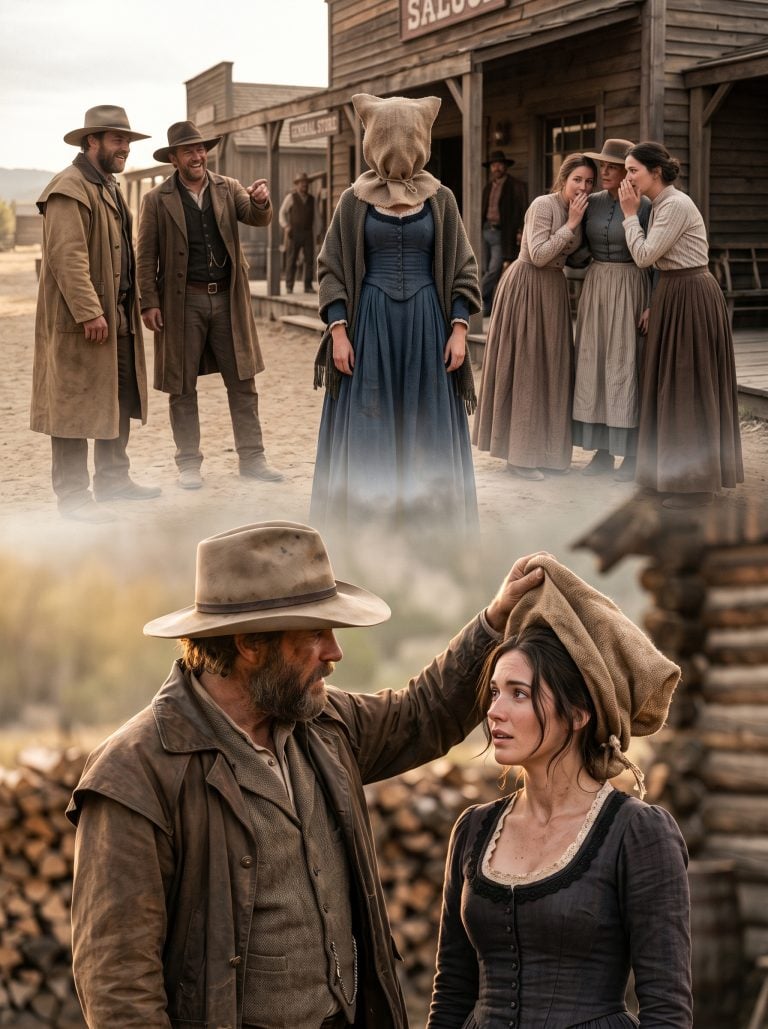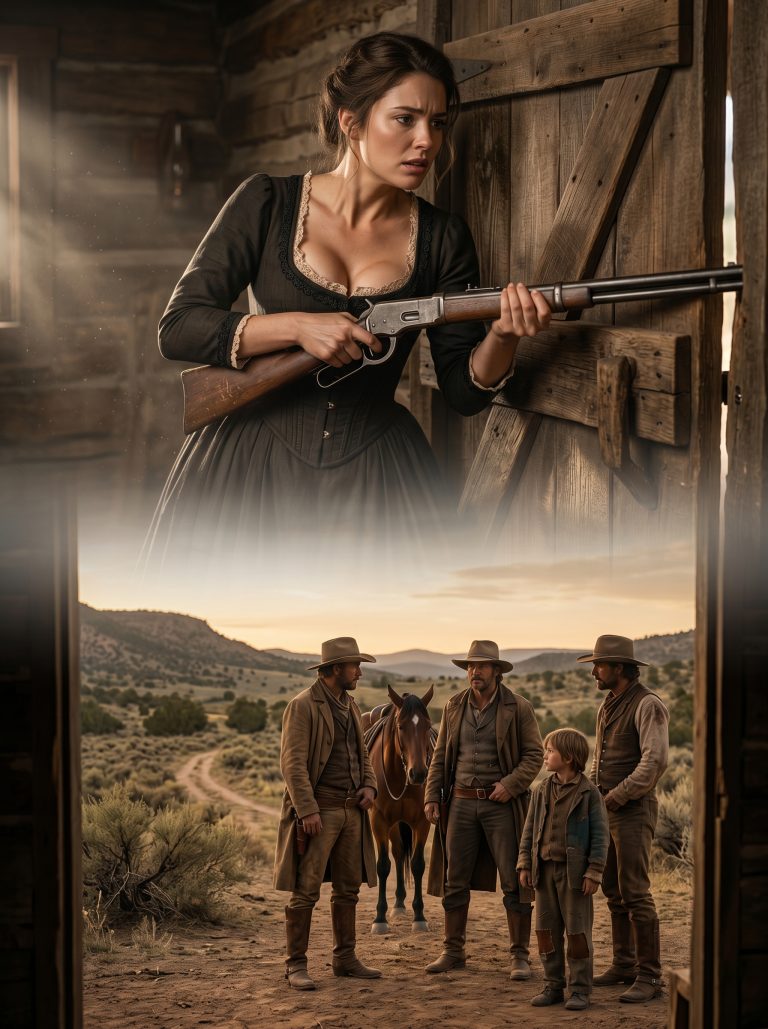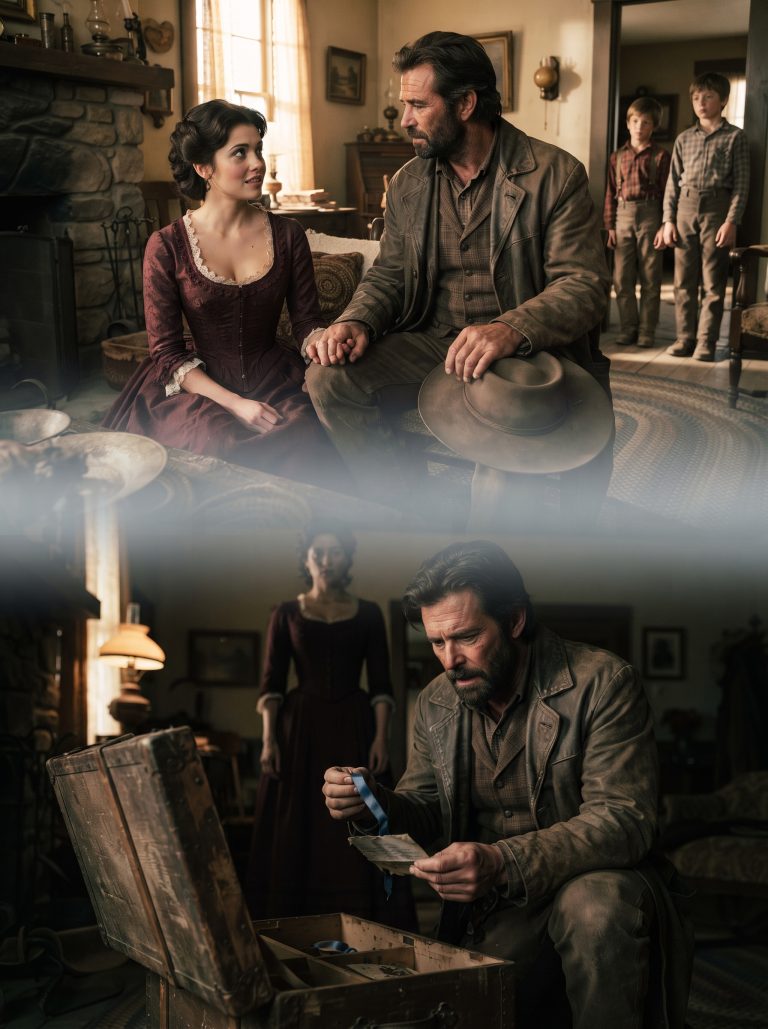
“Should I Eat in the Kitchen?” she whispered. The lonely rancher pulled out the chair beside him, never knowing that choice would save his land and lead him to love.

Part 1
The stagecoach left Mercy Calloway on the roadside a mile short of the Ashford ranch, the driver muttering something about a lame horse and no time to spare. She walked the rest, carpetbag in one hand, a leather ledger in the other, her boots gathering the pale dust of West Texas like a second skin.
The advertisement had been plain enough: Housekeeper wanted. Tending house and accounts. Room and board. Inquire Crestfall. Plain was what she needed. Plain didn’t ask questions about a widow’s past, or why she flinched at raised voices, or why she carried a ledger the way other women carried grief.
The ranch house came up out of the heat like something grown from the land itself — dark timber, deep-set windows, built by a man who expected hardship and meant to outlast it. A man stood on the porch watching her come, tall and unhurried, the kind of stillness that wasn’t idleness but readiness.
“Ma’am.” His voice matched the house. “Caleb Ashford.”
“Mercy Calloway.” She took his offered hand — brief, calloused, careful not to grip too hard.
A boy appeared in the doorway, seven or eight, all elbows and caution. “This is Wyatt,” Caleb said. “My brother’s boy.”
Wyatt studied her the way children study strangers who might be about to change everything. Mercy offered him a small smile and got a shy one back.
Inside, the house smelled of woodsmoke and the particular hollowness of a home missing a woman’s hand — not neglected, exactly, just unfinished. Caleb showed her a narrow room off the kitchen. “It’ll do,” she said, and meant it more than he could know.
“Supper’s at six,” he said, already turning. Then, pausing: “The last woman didn’t stay the month.”
It wasn’t unkind. It was only true.
“I don’t discourage easily, Mr. Ashford.”
He looked at her a moment longer than the words required, then nodded once and left her to it.
She cooked the way she always had — methodically, as if precision could stand in for belonging. Salt pork, biscuits, a gravy she thickened twice before it satisfied her. She set the table for two, because that was the shape of the world she’d learned: the man and the boy at the table, herself at the stove with what was left.
Caleb came in at six exactly, damp-haired from the pump, and stopped at the sight of two plates.
“You’re not eating?”
“After,” she said. It wasn’t a complaint. It was simply how things were.
He looked at the table. Then at her. Then he crossed to the cupboard, took down a third plate, a third fork, a third cup, and set them beside his own chair — not at the far end, not near the stove where a servant might be tolerated. Beside him.
“For you,” he said.
Mercy stared at the plate as though it might be a trick of the lamplight.
“Mr. Ashford, I don’t wish to presume—”
“You cooked it.” He pulled out the chair. “Folks who work, eat at the table. That’s how it’s done here.”
She had eaten in other people’s kitchens for the better part of six years — after the guests, after the family, after the good dishes had already gone around once. She had learned to want nothing so plainly visible as a chair.
She sat.
Wyatt grinned around a biscuit. “This is better than Uncle Caleb’s beans.”
“Wyatt.”
“Beans ain’t his gift,” the boy whispered, unrepentant, and for a moment something flickered at the corner of Caleb’s mouth that might, in a more talkative man, have been a smile.
After the plates were cleared — Caleb hauling the water himself, over her protest — he brought a small wooden box to the table and set it down.
“Accounts,” he said. “Thought you might want to see what you came for.”
She opened her ledger beside his tangle of receipts and bills, and for the first time since her husband’s mercantile had gone under, since the town had started calling her unfortunate and then careless, Mercy Calloway felt the old, steadying pull of numbers waiting to be made honest.
“Was your brother good at business?” she asked, before she could think better of it.
Caleb’s face went still. “Whatever he was good at, the flood didn’t give him a chance to prove it. I took the ranch over green. Thomas — Wyatt’s pa — he trusted easy. Left things a mess I’ve been trying to read ever since.”
Mercy said nothing. She only opened the box further, and began.
Part 2
By lamplight the discrepancies surfaced one by one, small and then not small at all.
“This payment to Crestfall Trust,” she said. “It’s listed twice — once as interest, once as a service adjustment.”
“Banker said terms shifted last winter.”
“Was that put in writing?”
Caleb’s jaw tightened. “Said he would.”
She turned another page. “This cattle sale — you shipped forty head?”
“Forty.”
“They paid for thirty-three.”
His eyes sharpened in the low light.
“And the freight on this wire — nearly double the posted rate.”
“Slocum handles freight.”
“Your foreman?”
Caleb nodded once, slow, like a man watching a fence line he’d trusted collapse in his mind post by post.
“Trust isn’t a receipt, Mr. Ashford,” Mercy said, more sharply than she meant to.
He looked at her a long moment — the look of a man deciding whether to take offense at a woman’s certainty. He didn’t.
“No,” he said. “It ain’t.”
By the time the lamp burned low, she had found enough to fill two pages and prove nothing outright. But patterns had saved her once before, back east, in the ruin of her husband’s ledgers — patterns other people had been too tired or too trusting to see.
“How long has this been happening?” Caleb asked.
“If these papers are whole — eighteen months. Maybe longer.”
He stood and braced both hands on the stove’s edge, head bowed. “My brother’s been dead two years.”
Mercy said nothing. She only closed her ledger gently, the way one closes a door on a room not yet ready to be entered, and let the silence hold what neither of them was prepared to say aloud.
Part 3
The days that followed reshaped the household without a single announcement. Caleb brought the week’s orders to Mercy before he brought them to his foreman, and Boone Slocum noticed.
He was a narrow-eyed man with a sunburned neck and a smile that arrived a half-second too late to be trusted. “Housekeeper doing sums now?” he said, the first morning he found her at the long table with the ledger open.
“Accurate sums,” Mercy said. “I find they hold up better.”
Slocum’s smile thinned to nothing, and from then on she felt him watching — not openly, but in the moved papers, the ink bottle knocked over though she’d left it capped, the word Wyatt brought back from the barn one afternoon, wide-eyed: a woman with too many sums can find herself without a roof.
Caleb heard that from his nephew’s mouth and said nothing. The next morning Slocum came back from the bunkhouse with a split lip, and no one asked why.
That evening, Mercy set a basin of water on the table without being asked.
“You shouldn’t strike a man on my account,” she said.
“Wasn’t on your account. He spoke under my roof.” Caleb dipped his knuckles in the water. “There’s a difference.”
“Not to me, there isn’t.”
He studied her. “You flinch when men raise their voices.”
Her hand went still over the cloth. “Most women with sense do.”
“That ain’t what I meant.”
She looked up. Something in his patience made the old wall in her feel suddenly thin.
“My husband left debts,” she said. “He died sudden, and people called him charming right up until the creditors came. After that they called me unfortunate. Then careless. As if I’d signed the notes myself.” She wrung the cloth. “There was a man who handled the liquidation of the store. Smooth-voiced. Called himself a friend of the family. By the time the dust settled, he’d walked away with the good stock and left me the debts with his name nowhere on a single page.”
“Did he have a name?”
“Silas Whitfield.” She said it the way one says a scar. “He left Ohio inside a year. I never traced where.”
Caleb’s expression changed. He knew that name — it belonged to the round-faced banker forty miles down the road in Crestfall — though he said nothing of it, and Mercy would not learn why his face had gone so still until weeks later.
It took another two weeks to find the proof that mattered. Wyatt found it first, the way children find things adults have trained themselves not to see.
“Miss Calloway,” he said one afternoon from the porch steps, “why’s Slocum put some sacks in Mr. Pike’s wagon? The gray one, with the cracked wheel. Comes by when Uncle Caleb’s out at the north pasture.”
Mercy’s pencil stopped. “How many times have you seen that?”
“Four. Maybe five.”
That night she told Caleb, and he reached for his hat.
“Alone,” she said, “you’ll get anger, not evidence. And if something happens to you out there in the dark, Wyatt loses the only father he has left.”
The word father stopped him more surely than any argument could have.
“What do you suggest?” he asked — and the asking, the plain willingness to be told something by a woman, warmed a place in her that had gone cold years before.
“We let him steal once more,” she said. “And this time, we count everything before he does.”
They marked the feed sacks with a single stitch of red thread, small enough to escape a hurried eye. Caleb sent word he’d be at the fence line all afternoon. Three days later, at half past two, Boone Slocum carried two marked sacks to the back gate, where the gray wagon rolled up from the lower road with Ezra Pike on the bench, coin already in hand.
A rider came down off the ridge before the coins finished changing hands — Caleb, and beside him Sheriff Tate of Crestfall, and a freight clerk named Ivers whom Mercy had written to four days earlier with copies of the falsified invoices.
Slocum ran. He didn’t get far. Pike, seeing the sheriff’s badge, only raised both hands from the wagon bench and surrendered without a fight, already talking fast about how little of this had been his idea.
“You’ve been robbed blind, Ashford,” the sheriff said, hauling Slocum up by the collar.
“No,” Caleb said, looking at Mercy across the yard, the ledger held against her chest like armor. “Not blind. Not anymore.”
Slocum spat into the dust before they dragged him to the wagon. “Think she saved you? She’ll leave soon as she finds a better roof. They always do.”
The yard went still. It was an old wound he’d found by accident, and it might have landed if Mercy hadn’t spent six years learning exactly how much weight other people’s cruelty was allowed to carry.
“I stayed long enough to count what you stole,” she said. “That’s more than you can say for yourself.”
The arrests should have ended it. They didn’t.
Two nights later, going through Slocum’s confession as relayed by Sheriff Tate, Mercy found the name that turned her blood to ice water: the Crestfall banker who had “adjusted” Caleb’s loan terms without a signed amendment, who had processed the false freight charges without asking a single question, was a Mr. Silas Whitfield — arrived in Texas four years prior, respected, round-faced, smooth-voiced, “a friend to every rancher who needed patience with a note.”
She sat with the name a long while before she brought it to Caleb.
“I need to go to the bank,” she said. “Tomorrow. With you.”
“You already broke Slocum. Bank trouble’s mine to settle.”
“It isn’t only yours.” She set her ledger flat on the table, hands steady though her voice was not. “The man who ruined my husband’s mercantile in Ohio called himself Silas Whitfield. He left before the creditors could ask why the good stock had vanished with him. I never found where he went.”
Caleb had known the name for weeks now, ever since she’d first spoken it by the stove. He’d said nothing then, telling himself it was likely only a coincidence of names. He couldn’t tell himself that any longer.
“That’s Crestfall’s banker,” he said quietly. “Same name. Same man, probably.”
“I think a man who profits from other people’s ruin doesn’t stop just because he’s crossed a state line. I think Boone Slocum needed someone smooth enough to move stolen coin through a legitimate ledger, and Whitfield needed a foreman careless enough not to ask what he was helping build.” She met Caleb’s eyes. “I think I was sent here by an advertisement in a boarding house, and he was sitting forty miles away the whole time, running the same trick on a different name.”
It wasn’t proof. Not yet. But she had learned that patterns, once seen, rarely stayed silent for long.
They rode to Crestfall the next morning. Whitfield received them in an office thick with cigar smoke, all smooth voice and polished wood, until Mercy set her ledger on his desk and said, without preamble, “I believe we’ve met before, Mr. Whitfield. Ohio. Calloway’s Mercantile. You called yourself a friend of the family, as I recall, right up until the day the shelves were empty and my husband’s name was the only one left on the notes.”
The color left his face by degrees, like a lamp being turned down.
“I don’t know what you mean,” he said, too quickly.
“I have his ledgers still,” Mercy said. “I kept every page, because it was the only thing anyone left me that told the truth. Your hand is distinctive, Mr. Whitfield. A banker ought to know that a signature is a kind of face. Yours hasn’t changed in six years.”
He tried excuses first — clerical confusion, a common name, the accusations of a grieving widow with an active imagination. When those didn’t move her, he tried something colder.
“A woman with your history,” he said, voice still smooth, “ought to think carefully before she makes accusations she can’t prove. It would be easy enough to remind this town that Calloway’s Mercantile failed under your management, not mine. Widows who lose everything are sometimes thought careless with their husbands’ books as well as their affections.”
“You may try that story,” Mercy said, without flinching, “once Sheriff Tate has read the confession Mr. Slocum already signed naming you as the man who taught him how to move stolen coin through an honest ledger.”
Whitfield’s smooth voice finally cracked into something uglier. “You arrest me, and half this county goes under with me. Every rancher within thirty miles owes this bank money, Ashford — yours included. Think hard before you let her burn this down.”
Whitfield’s hand moved toward the drawer of his desk — toward, she would learn later, a half-written letter meant to move funds out of the bank before morning — but Caleb’s palm came down flat over it first, without a word.
Sheriff Tate arrived minutes later with a warrant he had spent the previous night securing on the strength of Slocum’s confession and Ivers’s freight records, and Whitfield’s excuses had nowhere left to stand.
He was led out in handcuffs, and Mercy stood on the boardwalk with her ledger held against her chest, shaking in a way she was careful not to let show in her face.
“You knew,” Caleb said quietly, beside her. “Before we connected the two. You suspected, that first night, when you told me his name.”
“I suspected a coincidence of cruelty,” she said. “I didn’t dare hope it was the same man, because hoping for that kind of justice has cost me more than once.”
“And now?”
She looked at the jail door where Whitfield had disappeared. “Now I think some debts do get collected. Just later, and by different hands, than the ones who were owed.”
The ranch survived the winter that followed on discipline more than luck — fences mended, feed counted twice, the note renegotiated on terms that no longer bled quietly from the inside. Wyatt grew taller and louder in the ordinary way boys should. Mercy kept the ranch’s books in the evenings and rode into Crestfall twice a week to keep the school’s books as well, because she had learned that a woman could claim both independence and belonging under the same roof if the people inside it had the courage to make room.
On the first warm evening after the thaw, Caleb found her on the porch with the ledger closed on her lap for once, watching Wyatt fail spectacularly to teach a dog to fetch.
“I had a letter today,” he said. “Judge in Crestfall says the restitution from Whitfield’s accounts will clear what’s left of the note by summer. And there’s a separate matter — seems he had a file going back to Ohio. Your husband’s mercantile is named in it. Might be there’s money owed you yet, after all this time.”
Mercy sat with that for a while, the low sun gold along the fence posts. “I didn’t do any of this to be repaid,” she said at last.
“I know it. Doesn’t mean you can’t be.”
She looked at him — steady, unhurried, the same man who had reached into a cupboard on her first night and made room where none had been offered before, without knowing yet what that small kindness would go on to unmake and remake.
“Caleb,” she said, smiling softly, “I came here a widow with a ledger and nothing else worth calling mine. I didn’t expect to find the man who ruined my first life waiting at the far end of my second.”
“Didn’t expect a lot of things myself,” he said. “Didn’t expect a housekeeper to save my ranch and settle an old score I never knew you were owed, in the same season.”
“Sometimes,” Mercy said, “the same patterns that break a life are the ones that, followed far enough, finally close it properly.”
Caleb reached into his coat and drew out a folded paper — not offered out of guilt or debt, but a deed he’d had drawn up that would place her name beside his on the ranch’s title, unsigned, waiting only on her choice.
“I’m not asking because you’re owed anything,” he said. “I’m asking because when I set that third plate down the first night, I thought I was making room at the table. Turned out I was making room in my life, and I’d like it to stay that way, permanent, if you’ll have it.”
Mercy looked at the paper, and then at him, and let the ledger slide from her lap onto the chair beside her — the first time in years she had let it out of her hands without meaning to reach for it again right away.
“Ask me properly,” she said, “without the paper in your hand.”
He laughed — a real one, rare and full — and tucked the deed away.
“Mercy Calloway,” he said, “will you marry me? Not to keep the books. Not to raise Wyatt. Not to settle old debts, mine or yours. Just because I’d count it the honor of my life to sit beside you at supper till one of us is called home.”
“Yes,” she said, through a smile that had nothing guarded left in it. “Yes, Caleb Ashford. I will.”
They married that summer under the cottonwoods, small and plain the way both of them preferred their happiness — Wyatt nearly dropping the rings twice, Sheriff Tate and his wife among the guests, long tables set in the yard with more food than the ranch had seen in two hard years.
Late in the evening, Mercy slipped into the kitchen alone and found the old table standing where it always had, the chair beside Caleb’s place worn now from a year of suppers taken there without a second thought.
She remembered, with a clarity that still caught in her throat, the woman who had stood by that stove the first night, waiting to be told where she was allowed to eat.
A plate could be only a plate. A chair only a chair. But cruelty leaves debts that do get collected eventually, even when the collecting takes a strange, roundabout road — six years and half a country away from where a careless man thought he’d left his signature behind for good.
And sometimes, first and simplest of all, it starts with someone reaching into a cupboard for a third plate, and deciding that a person standing alone by the stove has always deserved a place among the living.
THE END