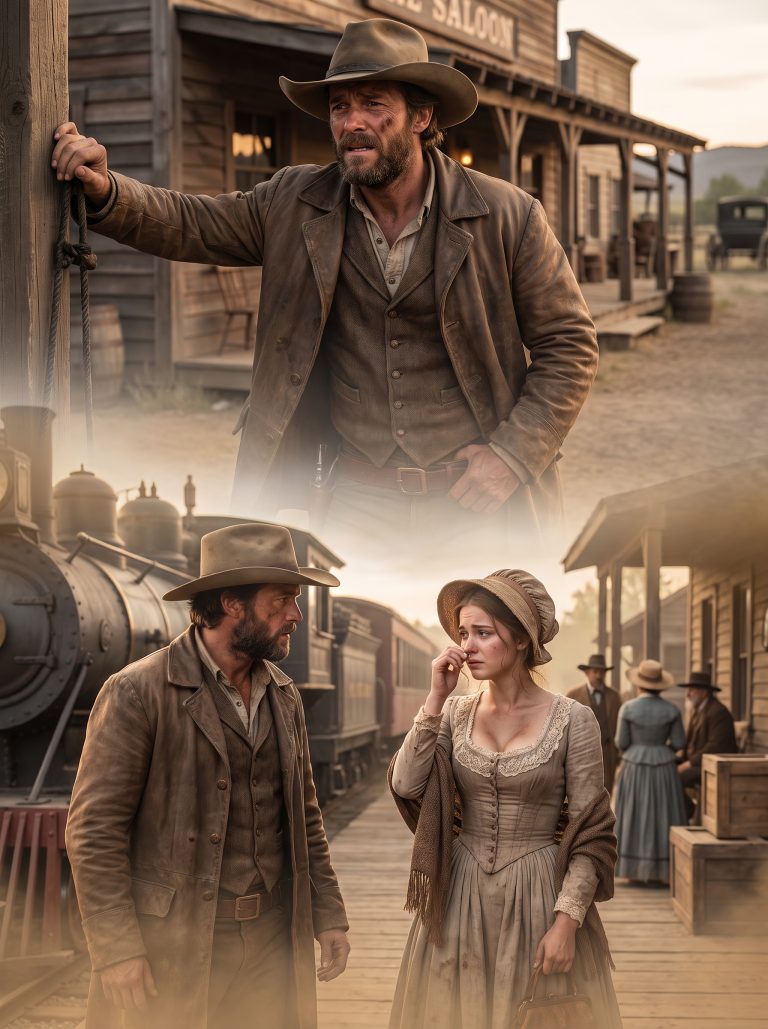
Brooding Cowboy Forced to Wed Sheriff’s Widow — Their First Kiss Ignited the Silent Plains

Part 2
The wedding was brief and joyless — a transaction dressed in Sunday clothes. Eleanor wore gray, not white; she would not mock her real marriage by pretending this one deserved ivory silk. Ezra’s mother’s ring, plain gold, felt like a shackle sliding onto her finger.
“You may kiss the bride,” Whitfield said, already closing his Bible as if eager to be done with the whole uncomfortable business.
Ezra’s lips brushed her cheek — respectful, careful, nothing like a claim. It was, absurdly, the kindest thing anyone had done for her all week.
They rode back to the ranch as strangers bound by paper. Ezra moved his few belongings — a saddlebag, a rifle, a single photograph he didn’t explain — into the room over the barn, and for a week they orbited each other with careful, deliberate distance: separate meals when they could manage it, separate silences when they couldn’t.
But distance is hard to maintain on a working ranch. Ezra had a quiet gift with horses and an even quieter competence with trouble. When wolves took two calves in the north pasture, he tracked the pack to their den by moonlight without being asked. When Otis Colton rode onto her land uninvited and called her “damaged goods for a damaged man,” Ezra didn’t reach for his gun — he simply stood between them, immovable as a fence post, until Otis found somewhere else to be.
“You didn’t have to do that,” Eleanor told him afterward.
“Didn’t do it for you,” Ezra said. “Did it because a woman shouldn’t have to defend her own porch from men too drunk to remember their manners. That’s not charity. That’s just decency.”
She found herself, against every instinct of caution, beginning to watch for him at the end of each day — the particular weight of his boots on the porch steps, the low murmur of his voice gentling a spooked horse. Grief had not left her. But it had begun, unwillingly, to share the room with something else.
Then, on the ninth night, a rider came hard up the drive, his horse lathered and his face grim.
“Mrs. Foster — Calloway — there are men camped at the Millbrook crossing,” Pete Alvarez, her foreman, said, breathless. “Six, maybe seven. Asking after a man with a scar. Say they work for someone called Vance.”
Ezra’s face went very still, the particular stillness of a man doing arithmetic with his own mortality.
“I should’ve known Vance would never stop looking,” he said quietly.
Eleanor felt something cold settle in her stomach — not only fear, but the stirring of a suspicion she hadn’t let herself examine.
“Ezra,” she said slowly, “what exactly did Vance’s son do, in that card game?”
He looked at her, surprised by the question’s edge. “Accused me of cheating. Drew on me when I called him a liar. Why?”
“Because,” Eleanor said, her voice tightening, “I’ve seen that name before. In my husband’s ledger.”