The Giant Montana Rancher Believed No Woman Could Love Him — Until a Homeless Widow Proposed Before the Entire Town

Part 1
In October of 1889, just weeks before Montana would enter the Union, Cedar Hollow was the kind of town where news traveled faster than weather, and weather traveled fast enough.
The first real storm of the season came without much warning — a hard, wet snow driven sideways by wind off the mountains, the kind that turned a ten-minute walk into a fight for your life if you were caught without shelter. Wagons rattled home before dusk. Lamps flared behind frosted windows. And through the gathering white rode a man whose shadow reached the boardwalk before he did.
Gideon Marsh was thirty-six, built like something the land itself had shaped rather than a woman had raised — six feet eight inches tall in his boots, shoulders wide enough to block a doorway, hands that could span a horse’s skull. He owned the largest cattle spread for sixty miles, land his father had cleared with an axe and a stubborn refusal to die. People in town called him many things. Rarely his name.
Mostly, they called him the giant.
He had heard every version of it — too big, too silent, too much — and had stopped flinching from the words the way other men stopped flinching from weather. What he had never stopped wanting, quietly, foolishly, was someone who wouldn’t look at him like a wall to walk around.
He was thinking of nothing so tender, however, on the evening the stagecoach limped into town with a cracked wheel, unloading its passengers into the first hard flurries of the storm.
One did not hurry toward shelter.
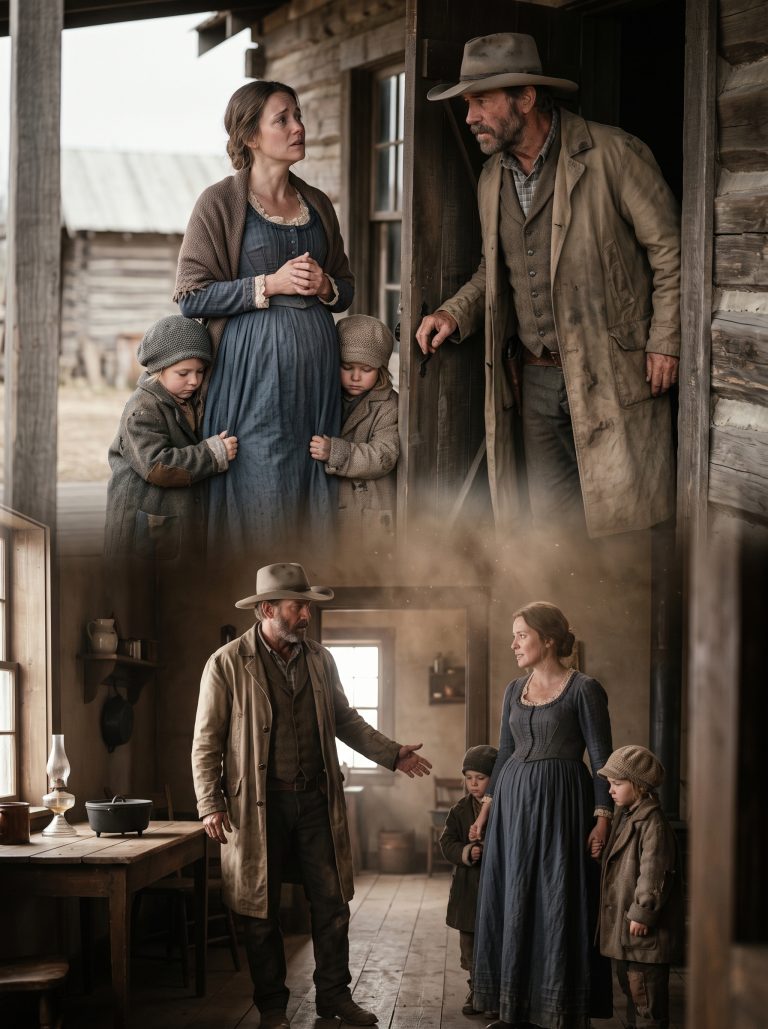
She stood beside her trunk with the stillness of someone who had already been told “no” by the whole world and was bracing for it again. Clara Bennett was twenty-five, dark-haired, dressed in mourning gray gone thin at the elbows. Three months earlier she had buried her husband, Thomas, dead of a fever that took him in nine days. Three months earlier she had also lost the eighty-acre homestead that came with him, signed away — she still did not fully understand how — to his two brothers, Silas and Warren Bennett, while she was too raw with grief to read fine print correctly.
She had come to Cedar Hollow because a cousin had once mentioned work here. The cousin, it turned out, had moved on eight months ago.
Clara tried the hotel. Full, the clerk said, not meeting her eyes. She tried the boarding house. The widow who ran it said she didn’t take in strangers with “complicated situations,” though Clara had said nothing of her situation at all — only that word seemed to travel ahead of her like smoke ahead of fire. She tried the church, and found the reverend away visiting a sick parishioner two counties over.
By the time the snow had begun to pile against the boardwalk in earnest and the wind had found its full voice, Clara stood alone on Main Street, still holding her own trunk because no one had offered to hold it for her, and beginning, with a cold and practical part of her mind, to wonder whether she would survive the night at all.
That was when the shadow fell over her.
She looked up. And up. And found herself looking into a face that the last hour of failure had taught her to expect cruelty from, and found none there at all.
“You’ve asked everyone in town,” Gideon said. It wasn’t a question. He’d been watching from the feed store, the way a man watches a storm building on the horizon — with the specific attention of someone who has learned not to look away from trouble.
“Not everyone,” Clara said, with what dignity she had left. “I haven’t asked you.”
Something in his face almost smiled. “I’ve got a line shack on the north section. Roof’s sound. Stove works. It’s yours if you want it.”
“What’s the price?”
“There isn’t one.”
“Men don’t offer things for nothing.”
“This one does.” He reached for her trunk, then stopped himself, waiting for her nod before he lifted it — lifted it as though it weighed what a letter weighs. “You’ll freeze arguing about it, though. This storm isn’t finished.”
She went. She told herself later it was only the cold that decided her, and told herself that lie for exactly as long as it took to reach the cabin and find the stove already stocked, a lamp already trimmed, a quilt already folded at the foot of a narrow bed — prepared, she realized slowly, before he had ever met her, out of some standing habit of a man who kept shelter ready because he had once needed it himself and no one had had one ready for him.
“Why?” she asked, when he set the trunk down and turned for the door, the storm still howling outside.
Gideon paused with his hand on the latch.
“Because nobody else did,” he said, and stepped out into the white.
Clara stood at the window long after his shape had dissolved into the storm, and felt, for the first time since Thomas’s funeral, something she had stopped expecting to feel again.
Safe.
She thought of the hotel clerk who wouldn’t meet her eyes, the boarding-house widow who’d spoken of “complications” no one had named to her, the reverend’s empty church. None of them had asked her a single honest question. The one man the whole town crossed the street to avoid had asked her exactly one — what happened — and then simply believed her answer.
The town feared him. The town called him strange, and large, and best avoided after dusk. The town, Clara thought, watching the last of the snow settle over his tracks, did not know a single true thing about Gideon Marsh.
She meant to find out.
Part 2
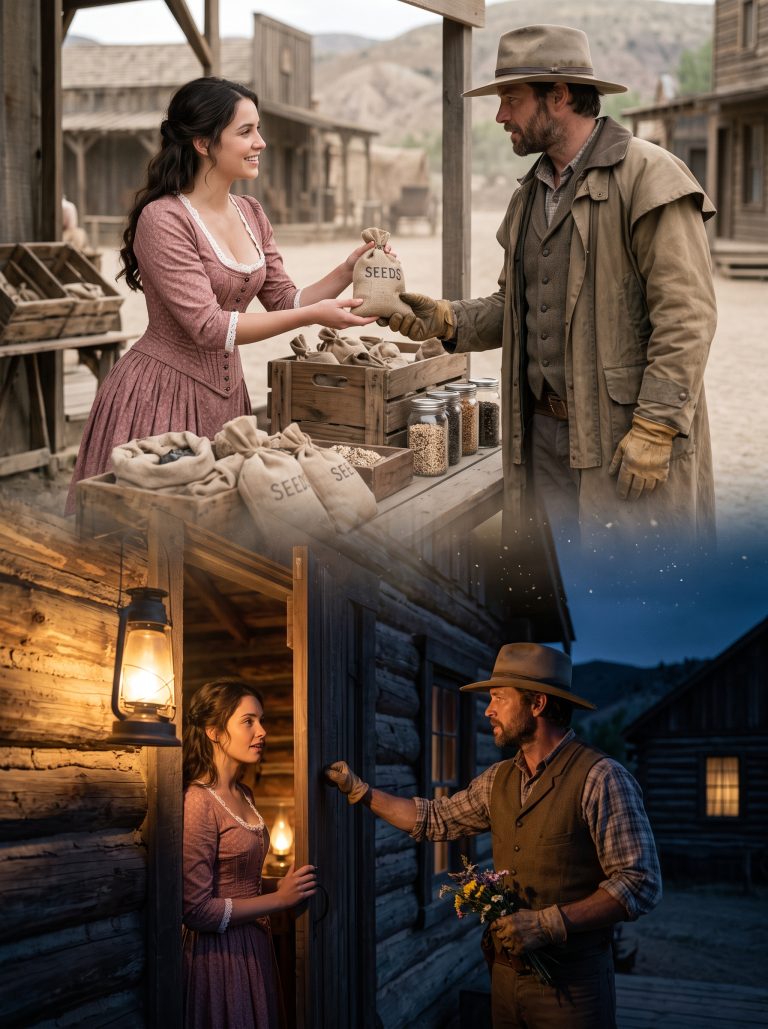
Winter loosened its grip slowly, the way it always did in that country, and by May, Cedar Hollow had thawed into a green, wet spring. Clara had not meant to stay past a week. She stayed the whole season, because she would not be idle in another person’s charity — she kept Gideon’s ledgers, mended the ranch hands’ shirts, and cooked when the bunkhouse ran short-handed, and slowly the shape of the man revealed itself the way a river reveals a stone bed once the flood passes.
That same spring, a hand rode in leading a mare so lamed she could barely bear weight, and the other men muttered that she was finished. Gideon spent an hour with her himself, his enormous hands moving like a man handling something made of glass, and then a week after that, and every day after that until, by the time the grass had gone properly green, the mare walked sound again. Clara never forgot it, because it was the same week she learned — the foreman let it slip, embarrassed, as if confessing a secret not his to tell — that the flour and coffee appearing on three widows’ porches every month, always after dark, always without a note, came from Gideon’s own stores.
“Why hide it?” she asked him once, on the porch, under a sky gone violet with dusk.
“Because a gift with your name on it isn’t a gift,” Gideon said. “It’s a debt.”
She was beginning to understand that everything about him ran that way — generosity with no hooks in it, strength that only ever bent toward gentleness. She noticed, too, how carefully he made himself smaller in rooms not built for him — how he ducked doorframes before he needed to, folded his shoulders in at church, spoke softer than his voice wanted to go, as if he had spent so many years apologizing for his own size that the habit had worn a groove into him no one had ever asked him to smooth back out. She was beginning, though she did not yet say it, even to herself, to love him.
Then, on a wet Tuesday in June, a wagon rolled into Cedar Hollow carrying two men Clara had hoped never to see again.
Silas Bennett stepped down first, narrow and sharp-eyed as a hawk deciding on a field mouse. Warren followed, heavier, quieter, the kind of quiet that came from letting his brother do the talking and the thinking both.
Silas smiled when he saw her — the smile of a man who believed the world still owed him whatever he decided to take.
“Clara,” he said. “We’ve been looking for you.”
Behind that smile, though, Clara noticed something she hadn’t seen in him before.
Fear.
Part 3
They found her again three nights later.
Clara had gone back to the cabin after supper and was banking the stove for the night when the knock came — not the quick, easy rap of a ranch hand, but three slow knocks, a pause, then two more, the kind of knock a person uses when they want you to know they’re not in a hurry to leave.
She opened the door only as far as the latch chain allowed.
Silas stood on the porch with Warren a step behind him, dusk shadowing both their faces.
“We need to talk about the homestead papers,” Silas said. “There’s a clause we overlooked. Without your signature releasing your dower rights, the transfer to us was never clean, and it needs to be.”
“You already have the land,” Clara said. “You have everything Thomas and I built. What more could a signature give you?”
“More than you’d think,” Silas said, and put his boot against the door the way he had once before, in a story Clara had told Gideon so many times by then that he had made her a promise about it without her even asking.
That promise arrived a moment later, from the dark beyond the porch steps.
“Move your foot.”
Gideon had come, as he often did without ceremony, to see whether she had enough wood laid in for the week. He stood at the edge of the lantern light, and something in his stillness made even Silas go quiet for a moment before he found his voice again.
“This is private family business,” Silas said.
“She told you to leave,” Gideon said. “That makes it mine.”
Warren tugged his brother’s sleeve. Silas shook him off, but he did step back, and the two of them left in their wagon without another word, though Silas’s parting look promised the matter was far from finished.
It was not.
They returned to town itself the following week, and this time they did not come after dark. Clara had gone in for supplies, and found Silas and Warren waiting for her outside the general store, in full view of anyone who cared to watch — and in a town like Cedar Hollow, plenty did.
“You’re making this difficult,” Silas said, loud enough to draw a small crowd.
“I owe you nothing,” Clara answered, just as loud, because she had decided, somewhere between the cabin door and this street, that she was done being quiet about what had been done to her.
It was Warren, not Silas, who broke first — heavier, slower, but not, Clara was beginning to realize, as hollow as she’d believed.
“It’s not for us, Clara,” he said, and Silas rounded on him with a look that could have stripped paint. Warren did not take the words back. “There’s a company. Kane Rail and Land. They’ve been buying up the survey line for a spur track through the valley — your valley. Thomas’s eighty acres lie directly along the proposed route. A man from the company came to us eight months ago and told us he’d forgive Silas’s debts — the whole note on our own place — if we secured your land and delivered a clean transfer. We didn’t take it from you out of greed alone. We took it because we were drowning, and Kane threw us a rope with a hook buried in it.”
Clara’s mouth had gone dry. “And now?”
“Now the rope’s tightening,” Warren said. “Kane needs your signature releasing your rights, or the whole route stalls. He’s told us plainly what happens to men who cost him a railroad.”
A murmur moved through the gathered crowd. Clara felt the old, familiar chill of being watched and judged and left to fend for herself in it — and then, for the second time in her life, she heard a voice cut through a street on her behalf.
“Kane Rail and Land.”
Every head turned. Gideon stood at the edge of the crowd, dust on his boots from the ride into town, and something had gone still and cold behind his eyes — a stillness Clara had never seen in him before, not even on the porch that night.
“You know the name?” Silas asked, wary now for a different reason.
“I know it,” Gideon said. “Augustus Kane bought the survey rights to my father’s north pasture nineteen years ago with a deed that turned out to be forged. My father spent everything he had left proving it in court and won — three months before it killed him. Kane never served a day for it. He simply moved his operation to the next valley and found the next family too tired or too frightened to fight back.”
The street had gone utterly silent.
“So here is what is going to happen,” Gideon said, to Silas, though his eyes were on Clara the whole time, asking without words whether she would let him say it. She nodded, once. “You are not going to threaten this woman into signing anything. And you—” his gaze shifted, not unkindly, to Warren, “—are not going to spend the rest of your life paying a debt to a man who profits from other men’s fear. There’s another way through this. But it isn’t through her.”
“There’s no other way,” Silas said, his voice cracking with something closer to despair than menace. “Kane owns the note on our farm outright. If we don’t deliver, he calls it due in full, and we lose everything we have left.”
“Then we take it to court,” Gideon said. “The same court that ruled against Kane once already.”
Part 4
Clara did not intend to simply stand aside and let the men around her fight this out on her behalf. She had spent a year learning her own worth too carefully to hand the fight to someone else now, however capable his hands were.
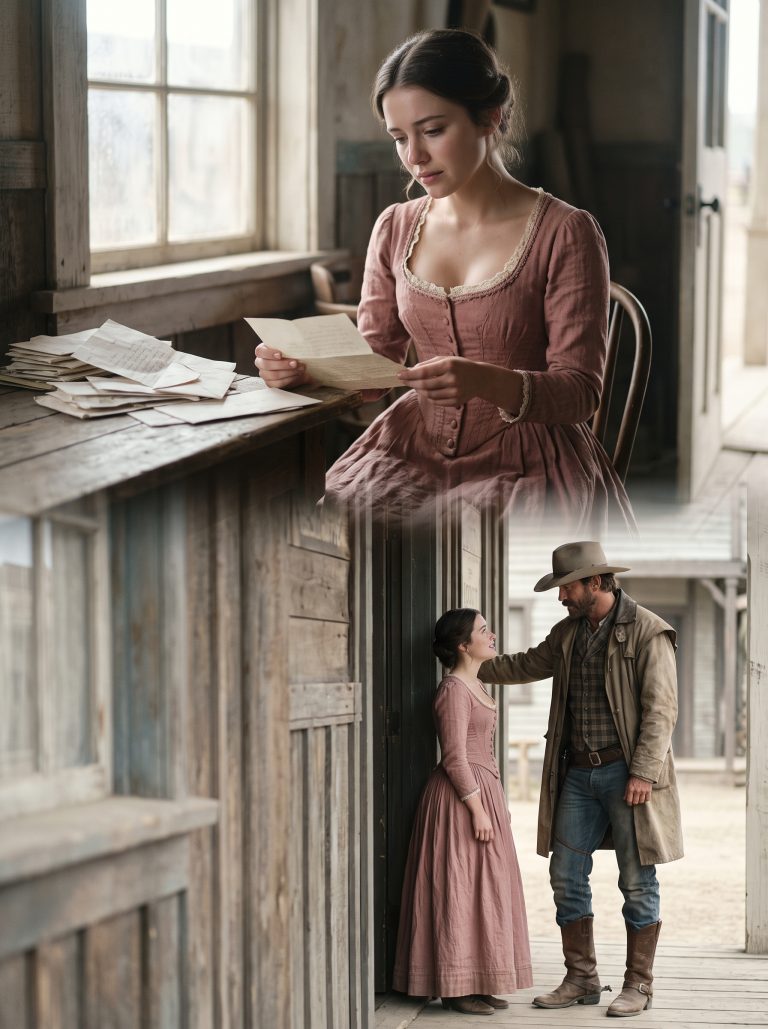
It was Clara, in fact, who found the first real thread. Going through Gideon’s ledgers one evening — a habit so old by then it was closer to breathing — she noticed an entry she almost skipped past: a payment from a survey office in Helena to the same lawyer who had drawn up the original transfer of Thomas’s homestead, dated a full month before Thomas had died. She brought it straight to Gideon rather than waiting for him to ask.
“The transfer was already being arranged,” she said, “before Thomas was even in the ground. Silas didn’t wait for grief to make me careless. Someone was already paying to make sure the papers would go through however I signed them.”
It was that ledger entry, more than anything Gideon or the lawyer had, that gave the old attorney — half-blind now but sharper than any three young ones — the trail he needed. He pulled the survey office’s records and found the same clerk’s hand behind both the payment to Thomas’s lawyer and, buried in an older file, the original forged deed used against Gideon’s father nineteen years before.
The surveyor whose name appeared on both documents, it turned out, had died twelve years earlier. Yet the newer deed bore his signature, copied with the same small, incorrect flourish on the final letter found on the deed Kane had used against Gideon’s father — a flourish the real man, records from the old court case showed, had never once made in twenty years of honest surveys. It was not proof by feeling. It was proof by comparison, laid side by side for a judge to see with his own eyes.
Gideon, in the meantime, had quietly begun arranging to mortgage part of the north range to cover the lawyer’s fees and the cost of pulling records from three counties — and had not mentioned it to Clara until the bank’s clerk let it slip in front of her by accident.
She confronted him that evening on the porch, angrier than he had ever seen her.
“You’d have mortgaged your own father’s land,” she said, “without telling me. As if this fight were only yours to pay for.”
“I didn’t want you carrying the cost of it,” Gideon said. “You’d already paid enough.”
“It isn’t yours to decide what I’ve paid enough of,” Clara said. “I am not a debt you’re settling, Gideon. I’m the woman who’s going to stand beside you in that courtroom, and I’d like to be asked, next time, before you sell off a piece of your father’s memory to protect me from a decision that was mine to share.”
He did not argue with her. He simply said, “You’re right,” which she noticed, even in her anger, was not a thing Gideon Marsh said easily to anyone.
Augustus Kane arrived in Cedar Hollow himself not long after, riding in a hired carriage far too fine for the mud of Main Street — neat, gray, unhurried, a man who dressed like a banker and moved like one accustomed to having doors opened for him rather than closed against him. He found Gideon at the livery.
“I understand you’ve taken an interest in my company’s survey line,” Kane said. “Name your price, and I’ll see to it my line never touches your range. The widow’s land, however, remains company business, and business it will stay, whether you’re paid or not.”
It was, Gideon understood at once, a carefully built offer — one that let him buy his own peace while leaving Clara exposed, and trust that a man might mistake the first for a victory.
“You’re offering to buy my silence,” Gideon said, “while telling me plainly that Clara’s land stays yours to take. You’ve mistaken me for a man who counts his own comfort as a fair trade for someone else’s.”
“You’ll cost yourself more than you gain.”
“I’ve already gained everything I wanted,” Gideon said. “You’re the only man left in this valley still counting what a thing costs before you ask whether it’s right.”
Kane left Cedar Hollow three days later, though not quietly — he sent men ahead of the court date to see whether Warren’s nerve might be bought back before he could testify. Warren refused them on his own porch, his wife beside him, Silas nowhere in sight to speak for him for once in his life.
“I kept thinking about what Gideon said in the street,” Warren told Clara afterward. “The moment you threatened her, it became my business. I didn’t understand, back then, why a man would choose to make somebody else’s trouble his own for nothing. I think I understand it now.”
The court date, when it came, turned mostly on paper rather than drama: the ledger entry Clara had found, the dead surveyor’s genuine signature pulled from the old case file, the matching forgery on both deeds laid side by side, and Warren’s testimony describing exactly how Kane’s man had coerced them, in exchange for leniency regarding his own role in the fraudulent transfer. Clara testified as well — steady, clear, and unflinching in a way that surprised even her — describing how little choice grief and threats together had left her.
The judge, reviewing evidence that traced a single pattern of fraud stretching back nearly twenty years, voided the transfer of Thomas’s homestead entirely and referred Augustus Kane’s company for a fraud investigation that, within the year, would end his business in the territory for good. The spur line was rerouted forty miles south, through land no one had bullied anyone out of.
Silas signed the settlement papers, took what little the court allowed him to keep, and left the territory without another word to anyone. Warren stayed, and came to Clara that autumn, hat in hand.
“I’m sorry, Clara. Truly.”
She had learned, that year, the difference between men who apologized to be forgiven and men who apologized because the truth had finally caught up with their conscience. She believed this was the second kind, and told him so. It was not friendship. It was, perhaps, the beginning of something smaller and more honest than that.
Part 5
By the time the leaves turned again, Clara had stopped pretending, even to herself, that what she felt for Gideon Marsh was gratitude wearing a borrowed coat.
She found him one evening by the corral, watching the mare he’d saved that spring run circles in the dusk for no reason but the joy of it.
“I keep thinking about the day you told Kane you’d already gained everything you wanted,” Clara said.
“I meant it.”
“I don’t think you fully knew, yet, what you meant.” She stepped closer. “I think you kept that old judgment ready the same way you keep flour for widows and medicine for orphans and a line shack ready for strangers in a storm. You’ve spent your whole life keeping yourself ready to stand between somebody and the thing that hurt you once. You just never let yourself hope the somebody would be worth standing for.”
“You were always worth standing for.”
“I know that now,” she said. “I don’t think you do.”
“I’ve spent my whole life being the largest thing in every room,” Gideon admitted. “People decided a long time ago that meant I was dangerous, or strange, or something to be managed rather than known. I’m still learning how to let someone look past that.”
“Then let me,” Clara said. “I’ve been looking for a year. I found a man who gives shelter without a price on it, who hides his own kindness like it’s shameful, who carried an old grief for nineteen years and turned it, when it mattered, into someone else’s rescue instead of his own excuse. I found the man I love, Gideon.”
“I love you,” he said, low and rough, as though the words had to be pried loose from somewhere he’d bricked them into years ago. “I have since the second week, when you insisted on carrying your own trunk up the porch steps rather than let me feel useful for nothing.”
“Then let’s be slow about the wedding,” Clara said, “and quick about deciding on it.”
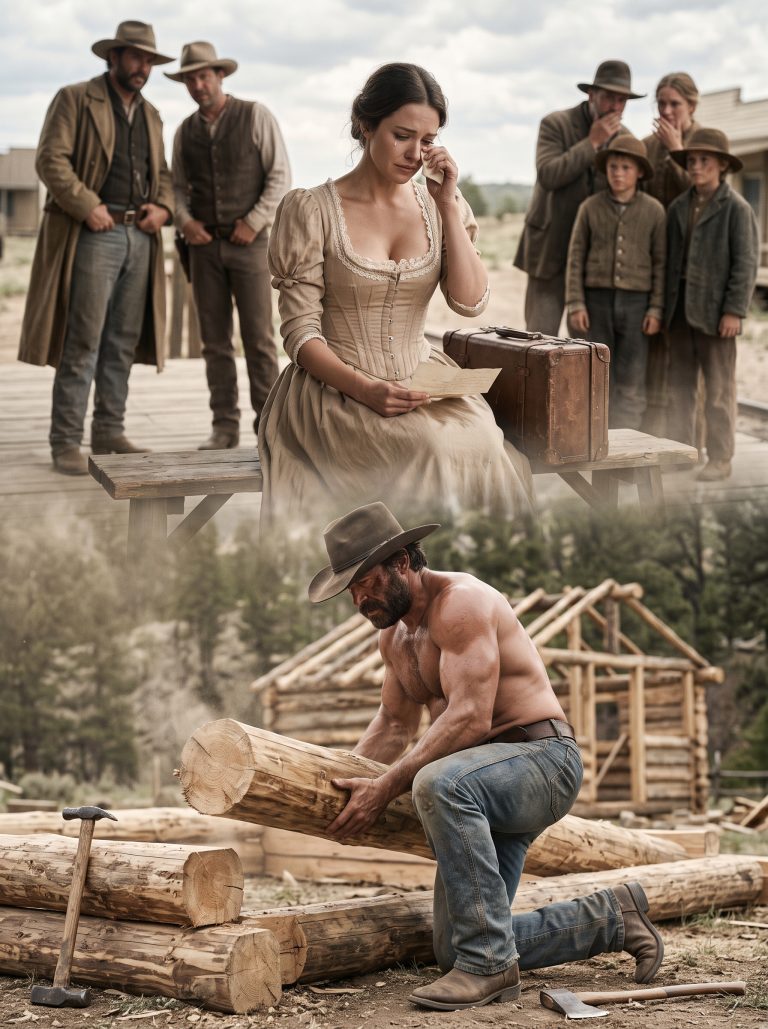
They married that November in the little clapboard church, with Warren standing near the back, sober-faced and welcome. Clara wore no jewels and no grand veil — only a plain dress and the particular kind of calm that comes from having survived the worst a person can survive and choosing, afterward, to trust again anyway.
Afterward, they turned the old line shack on the north section — the one that had first sheltered her — into something larger and sturdier, with a name painted plain across its new door.
Bennett House.
No Bennett had asked for the honor, and Clara insisted on it anyway. She named it for Thomas, and for the name his own brothers had turned into an instrument of shame — because she wanted that name, from then on, to shelter people rather than dispossess them, and because she had decided that some things taken away deserved to be given back, even if only in the shape of a word painted over a door.
It became a way station for anyone Cedar Hollow might once have turned from its doors — widows without deeds, families run off their land by men with forged papers and false confidence, travelers caught by weather with nowhere to go. Gideon paid the old lawyer a standing retainer to look, free of charge, at any land dispute a poor family in the valley brought him. Clara kept the ledgers, as she always had, and made certain every person who came through Bennett House left knowing exactly who had helped them and why.
Years later, a girl of perhaps ten — the daughter of a family Bennett House had sheltered after a bank failure took their farm — asked Clara, with the blunt honesty only children manage, why people in town used to call her husband “the giant” as though it were an unkind word.
Clara considered the question longer than the girl expected.
“Because they only ever measured him standing still,” she said finally. “A man looks very large, standing still in a doorway, if all you’ve ever seen him do is fill it up. It’s only once you watch him move — toward somebody who needs him, instead of away from somebody who frightens him — that you understand the size was never the frightening part at all. The frightening part, for most people, is realizing how small their own courage looks standing next to it.”
“Is that why you married him?”
“I married him,” Clara said, “because I watched a man the whole world had decided to be afraid of spend every day of his life making sure other people never had to be.”
The girl thought about that with the particular seriousness of a child turning over a coin to see both faces of it.
“I don’t think I’ll call anybody a giant again,” she said at last. “Not to mean it unkindly, anyway.”
“Good,” Clara said, and meant it for more people than the one child standing in front of her.
The town had spent years afraid of Gideon Marsh’s size, without ever once measuring the size of what he was willing to carry for someone else.
Clara had.
And in the end, that was the whole of the difference.