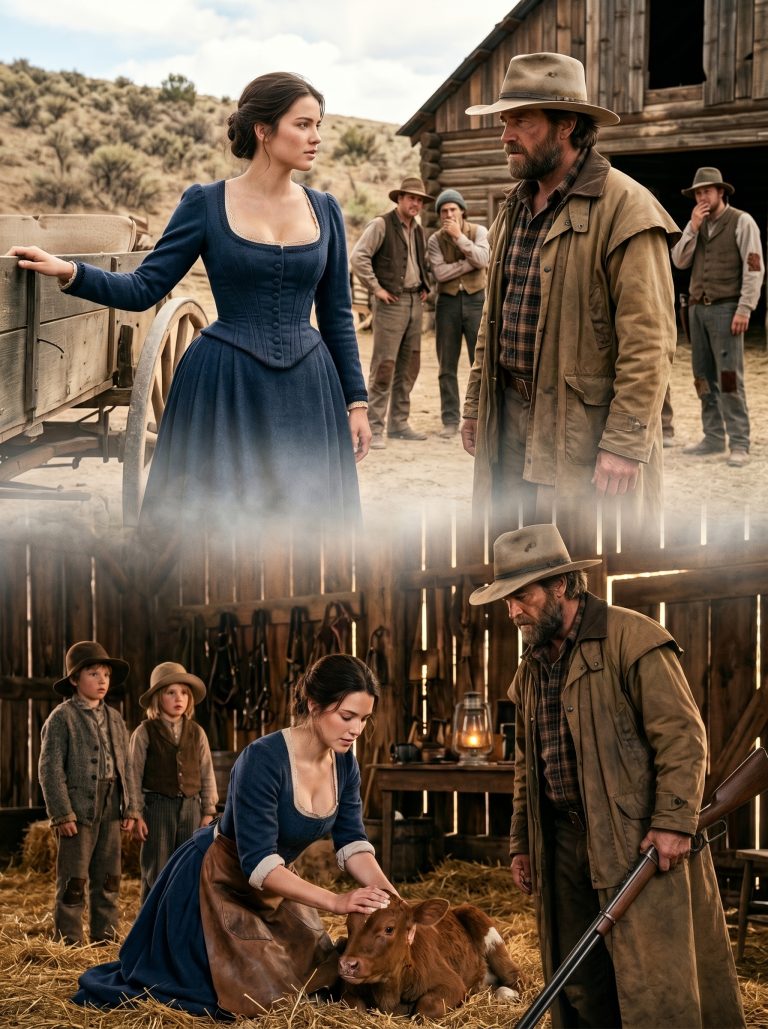
Everyone Mocked the Infertile Mountain Man for Buying a $1 Ranch… Until He Discovered a Pregnant Girl Hidden in the Stable

PART 1
The ranch cost Isaiah Grant one silver dollar, which was less than most men paid for a bottle of rye and more than he believed his future was worth.
He struck the bargain on a bitter November evening in Coppervein, Montana Territory, snow crouched in the peaks while the town below steamed with mud and whiskey. The Broken Wheel Saloon was thick with miners and freighters laughing too loud, the way men laugh when silence might tell the truth about them. Isaiah hadn’t belonged anywhere in ten years.
He stood at the bar in a bearskin coat, beard rimed with frost, left leg stiff from cold. Men gave him room unasked. He wanted only a bottle, a roof, and a valley low enough that snow wouldn’t bury him whole.
“You look like a man who ain’t scared of much,” said a narrow fellow beside him, wet-eyed, glancing at the door like he expected the devil through it.
“Scared of plenty,” Isaiah said. “Don’t advertise it.”
“Silas Pruitt.” His hands trembled as he shoved a folded deed across the bar. “Hundred acres at Sable Creek. Cabin, stable, timber, water. Old Whitcombe place.”
Isaiah looked up sharply. Every man in Coppervein knew the Whitcombe place, though few had laid eyes on it — a valley twenty miles west that didn’t welcome visitors. Some said fever took the family, some said gold was buried under the stable. Isaiah believed only in rotten roofs and men who invented ghosts to cover crimes.
“Why sell it in a saloon, if it’s worth anything?”
Pruitt’s hands shook harder. “I ain’t going back. Won it in a card game. Something watches from those trees — hoofbeats with no horses, lights in the stable. I got a train east in two hours and no use for cursed dirt.”
“Price?”
“One dollar.”
The bar went quiet. Even drunk men know a bargain sounding like a grave opening.
Isaiah checked the deed — taxes paid, boundaries marked — and laid a Morgan dollar on the wood. Pruitt snatched it like a starving dog, shoved the deed at his chest, and fled into the storm without finishing his drink.
The bartender spat into a brass pot. “You just bought yourself trouble.”
“Already carrying some,” Isaiah said.
By dusk he rode west with Samson and his mule, Otis. Snow turned to a wall before he crested the ridge. Below, he saw what he’d bought: a cabin leaning hard right, porch sagging, two windows boarded, a third dark and broken. A stable stood fifty yards off, doors clapping in the wind like hands applauding a funeral.
He felt no disappointment. He’d wanted shelter, not beauty — a place where no one would ask why a man of thirty-nine had no wife, no children, no name to carry forward.
A wild mustang had shattered his thigh ten years back near Helena. The doctor who saved his leg also told him he would never father children. Isaiah carried that sentence into the mountains and built a life around it, letting the world of cradles and supper tables carry on without him.
Now the world had handed him a one-dollar ranch.
The stable was nearest shelter. He shoved the doors open, led the animals in, lit a lantern. Yellow light spilled over broken stalls and warped floorboards. The air held old hay, wet leather, and something sharper underneath. Fear had a smell too.
Samson snorted. Isaiah went still.
A breath. Soft. Human.
His hand found the Colt at his hip but didn’t draw. “I know you’re there,” he said. “Come out easy. Bought this land today. Don’t aim to shoot anybody over it before supper.”
Straw shifted in the farthest stall. He lifted the lantern, took one step — and a figure burst up from the hay, blue steel flashing.
“One more step,” a woman’s voice hissed, “and I put you in the ground.”
The derringer in her shaking hands was oversized, double-barreled, aimed at his chest. She was young — twenty-two, maybe — dirt streaking her face, lips cracked from cold, hair tangled wet against her cheeks. A man’s canvas coat hung soaked from her shoulders, and beneath it her belly swelled heavy with a child close to term.
Isaiah’s breath caught — not from the gun. For ten years he’d trained himself never to look too long at a woman carrying a child.
“Put it down, miss,” he said. “Isaiah Grant. I came alone.”
“Duncan sent you.”
“Don’t know any Duncan.”
“Liar.”
“If I meant to lie, I’d have thought of a better one.”
The barrel wavered. She studied the scar in his beard, the melting snow on his shoulders, the limp he couldn’t hide.
“You’re not one of his deputies?”
“No.”
“You could be paid.”
“Could be. Haven’t been.”
For one strange second, humor almost touched her mouth. Then pain seized her whole body. The gun dropped into the straw; her knees folded. Isaiah caught her before she hit the ground.
She was burning with fever.
“Please,” she whispered, fingers clutching his coat. “My baby.”
Those two words broke through every wall he’d built in a decade. He stripped off the bearskin, wrapped her in it — she weighed too little beneath the child, starving, frozen, hunted if her terror told true. The stable would kill her before dawn.
He carried her fifty yards through screaming wind, his leg throwing black sparks across his vision. The cabin door gave under his shoulder. Inside was dust and cold — but it was walls.
He laid her on a rope bed, broke a chair for kindling, coaxed a fire alive, melted snow in a tin pot, fed her water one spoonful at a time.
“What’s your name?” he asked, as fever tossed her.
Her lashes fluttered. “Naomi,” she murmured. “Naomi Hargrove.”
Hargrove.
The valley seemed to answer the name. Isaiah looked toward the boarded window while the storm pressed the walls.
He hadn’t bought a ranch. He’d bought his way into somebody else’s war.
PART 2
For three days the blizzard buried the valley and gave Isaiah no choice but tenderness — a skill he’d never thought he had. In the mountains, skill meant reading killing clouds, sleeping light enough for a wolf’s step to wake you. In that ruined cabin, with Naomi burning on the bed, he learned tenderness took its own kind of strength.
He kept the fire high, brewed willow bark tea, spooned broth into her while she drifted, talked low about high lakes and eagles above the timberline. He didn’t know if she heard him.
Sometimes she cried out for Elias. Once, near dawn, she gripped his wrist and whispered, “Don’t let him erase us.”
“I won’t,” Isaiah said, though she was too deep in fever to hear it.
On the fourth morning the storm broke. Isaiah woke in his chair to the sound of Naomi shifting. Her eyes were open — pale green, clear now, ringed with exhaustion.
“You’re still here.”
“My cabin,” he said.
She stiffened. “My gun.”
“Mantel. Cleaned. Loaded. Out of your reach till you can sit up without fainting.”
“You gave it back?”
“Wasn’t mine to keep.”
Confusion crossed her face — she didn’t know what to do with a man who disarmed a delirious woman and handed the weapon back once the danger passed.
He brought her water. She drank, watching him over the cup’s rim. “Why help me?”
“Found you half-dead in my stable. Decent folk don’t step over the dying.”
“Decent folk are rarer than you’d think.”
“No argument there.”
“My name is Naomi Hargrove,” she said. “My father was Simeon Hargrove. This whole valley was ours. Sheriff Roy Duncan wanted the water rights for men behind the railroad. My father refused. Two days later he was shot outside the assay office, and Duncan called it a drunken quarrel. My father never drank.”
Old anger stirred in Isaiah. He’d known men like Duncan — men who wore the law like bandits wore masks.
“Duncan forged debts, froze our accounts, put guards on our house,” Naomi went on. “I married Elias in secret, fearing a forced guardianship once my father was gone. Duncan found out anyway. Elias was shot on the mill road a week later.”
“And you ran.”
“I have the marriage certificate and my father’s deed copies. If this child is registered before Judge Whitlow hears the land petitions, Duncan’s claim collapses. This baby is the Hargrove heir.” Her eyes found his. “You should leave before his riders come back.”
“Storm’s put five feet of snow between here and anywhere.”
“When it clears, then.”
“No,” Isaiah said, and outside, a rifle cracked the morning apart. The loft window shattered inward. Naomi screamed, curling over her belly, as five riders with tin stars broke from the timberline — and a voice shouted for Isaiah to send the woman out, or they’d burn the cabin down around her.
PART 3
Isaiah shoved the rocking chair against the wall for cover and yanked his Winchester off its pegs.
“Stay down,” he told her.
“Send out the woman, Grant!” the voice outside called. “Sheriff says your deed’s void, and she’s wanted for murder!”
Naomi went white.
“Tell your sheriff,” Isaiah shouted back, “he can come explain that himself.”
Gunfire answered. Bullets punched through timber; one struck the hearthstone and sent chips flying. Isaiah returned fire through a gap in the logs, aiming to make the approach costly rather than to kill. A rider cried out and dropped behind a fallen trunk. The rest scattered toward the trees.
Then Naomi made a sound that turned Isaiah’s blood cold — not fear this time. Pain.
“The baby,” she gasped, gripping the bedframe, sweat sliding down her face. “Isaiah, it’s coming.”
For one terrible second the whole world narrowed to impossibility: armed men outside, a broken cabin, a woman in labor, no doctor, no time. He’d delivered foals and calves and once a breech lamb in a blizzard that cost him two fingertips to frostbite. None of it seemed worth a damn now.
A bullet hit the door. He forced himself still.
“Naomi. Look at me.” She did. “I’m going to get us through this hour. Then the next. Understand?”
“Yes.”
“Burn them out!” someone shouted from the trees.
Isaiah kicked loose a lower plank at the side window and fired near a man running up with a lantern; the man dropped it in the wet slush, where it guttered out uselessly. Two more shots drove the riders back toward cover.
Then the door crashed inward. A broad deputy charged through swinging a shotgun. Isaiah had no time to bring the rifle around — he threw himself low instead, took the man’s legs, and the shotgun blast tore uselessly into the ceiling. They hit the floor hard enough to shake dust from the rafters. Isaiah broke the man’s wrist against the boards, struck him once behind the ear, and dragged him unconscious behind the overturned table.
The rest retreated into the timber, cursing. They would be back — but not before dark, and dark was hours off yet.
Isaiah barred the ruined door with a dresser, scrubbed his hands in boiling water, and went to the foot of the bed, where Naomi stared at him, terrified and furious with pain all at once.
“I can’t,” she cried.
“You can.”
“If something happens to me—”
“No,” he said, and there was no room in his voice for it. “You don’t leave that child. You fight.”
For two hours the cabin held its breath. The fight outside became distant next to the older, harder fight happening on the rope bed. Naomi labored with a courage that humbled him more than any gunfight ever had — cursing, sobbing, gripping his hand hard enough to grind bone. He talked her through every wave: Sable Creek running clear in spring, a child learning to walk in meadow grass, bread in an oven, a house with clean windows.
“Give him a world to come into,” he said. “Give him your hand to hold.”
Near sunset, a baby’s cry filled the cabin — sharp, furious, alive. A boy, red-faced, one small fist waving as though already prepared to argue with the world about its manners. Isaiah cleared his airway, tied the cord with clean thread, cut it with a blade passed through flame, and wrapped him in his own flannel shirt before laying him on Naomi’s chest.
She gathered the child with a sound half laugh, half prayer. “Ethan,” she whispered. “Ethan Isaiah Hargrove.”
Isaiah’s throat wouldn’t allow an answer. He busied his hands instead — tucking a second blanket around mother and son, banking the fire higher, checking the barred door for the third time though he knew it would hold until dark. Naomi watched him move through the small tasks of aftermath, her exhaustion so complete it looked almost like peace.
“You didn’t have to do any of this,” she said quietly. “Not the deed. Not the stable. Not this.”
“Didn’t have to,” he agreed. “Did anyway.”
“Why?”
He thought of an answer that wasn’t quite ready to be spoken aloud yet, so he gave her a smaller truth instead. “Man buys a ranch expecting quiet. Gets handed a war and a baby in the same week. Figures he ought to see how it ends.”
A tired smile crossed her face. “That’s not an answer.”
“No,” he admitted. “It ain’t.”
Outside, the last light went blue over snow, the deputies gone to fetch Duncan himself. Inside, Naomi held her son, and Isaiah sat with his rifle across his knees, understanding at last that the old ache in his chest had never been emptiness.
It had been room, waiting to be filled.
They left before dawn two days later. Naomi was too weak to ride and too stubborn to admit it, so Isaiah built a travois from stable poles and rawhide, padded with his bearskin and every blanket in the cabin. He’d already pulled the papers from beneath the tack room floorboards — marriage certificate, deed copies, a packet of letters proving Duncan’s threats — and sealed them in an oilcloth pouch he placed in Naomi’s hands, not his own saddlebag.
“They’re yours,” he said.
“Men keep forgetting that.”
“Reckon I won’t.”
He led Samson with the travois roped behind and walked the whole way, his bad leg burning worse with every mile, though he wouldn’t slow. At the creek crossing Naomi finally spoke from the travois: “You should ride.”
“No.”
“You’ll ruin that leg.”
“Was ruined when I got it.”
“If you fall,” she said, “we all stop.”
He mounted without another word.
They reached Coppervein by midday, into a town already gathering itself into a muddy spectacle. Judge Marcus Whitlow had come in on the morning train to hear land petitions, and word had spread that Sheriff Duncan meant to ride out and drag a fugitive widow back himself. So when Isaiah led a mule-drawn travois down the main street with Naomi Hargrove sitting upright and a newborn in her arms, every door in Coppervein opened.
Duncan stood outside the Broken Wheel in a black coat, tin star bright, ten armed men behind him. His eyes went to Naomi, then the child, then Isaiah.
“That’s far enough,” he called.
“Naomi Hargrove is wanted for the murder of her husband,” Duncan announced to the street. “Hand her over.”
“The only murderer wearing a badge in this street is you,” Isaiah said.
Naomi lifted the oilcloth pouch. “I have my marriage certificate. My father’s deeds. Letters in Sheriff Duncan’s own hand threatening my father over the water rights.”
Duncan’s smile vanished. “Lies.”
The town hall door opened, and Judge Whitlow stepped onto the boardwalk with two federal marshals behind him, visibly unhappy about weather before his coffee had cooled. “What is this?”
“Your Honor,” Naomi called, voice shaking but carrying, “I am the daughter of Simeon Hargrove, widow of Elias Hargrove, and mother of Ethan Isaiah Hargrove, lawful heir to the Hargrove estate. I ask the court’s protection.”
Duncan drew on her.
Isaiah’s Colt cleared leather faster than anyone believed a limping trapper could move. One shot took the sheriff through the shoulder and put him screaming in the mud. The marshals leveled their shotguns at the deputies, who raised their hands rather than die for a man already bleeding in the street.
Judge Whitlow read the papers on the spot, his face darkening page by page. By sunset Duncan was in irons; by nightfall three of his deputies were confessing against him; by morning telegrams were flying to the territorial capital, and men who’d bowed to Duncan for years discovered courage came easier once somebody else fired the first shot.
Naomi and Ethan were given a hotel room while the judge untangled the legal knots. Isaiah slept in a chair outside her door — not because she asked, but because he couldn’t yet make himself do otherwise.
Word of the shootout traveled through Coppervein faster than the telegraph lines could carry it east. Men who had never spoken to Isaiah Grant now nodded to him on the boardwalk. Women left baskets of bread and dried fruit outside the hotel room, addressed simply to “the widow and her boy.” A blacksmith offered, unasked, to shoe Samson for nothing. Isaiah accepted none of it easily — a decade of solitude had left him unused to a town’s gratitude — but he found he no longer had the heart to turn it away outright, not when it meant one less worry for Naomi.
On the third morning she found him there, rifle across his knees, eyes closed. “You look like a guard dog,” she said.
“Mean that kindly?”
“Haven’t decided.”
She studied him. “You don’t have to sit outside my door anymore.”
He understood dismissal even when it came gently. The wolf was caged. The work was done. He should have felt relief. Instead the hallway felt colder than any mountain pass.
“I’ll see you home to Sable Creek once the judge releases the house,” he said. “Then I’ll go.”
“Go where?”
“Timberline.”
“Why?”
“It’s where I belong.”
“No,” she said softly. “It’s where you hid.”
That struck true enough to anger him, which was how he knew it was true.
Over the following weeks the Hargrove estate was restored by court order, stolen records recovered, Duncan’s men removed from the farmhouse. Naomi walked its rooms holding Ethan, pausing at curtains her mother had chosen, faded but still hanging. The house was grander than the Whitcombe cabin but not showy — a wide porch, a stone springhouse, a kitchen with blue-painted cupboards, upstairs rooms that still smelled faintly of cedar and dust despite the years of neglect.
“My mother chose those curtains,” Naomi said once, standing in the front room with morning light through the glass.
Isaiah stood in the doorway, hat in hand. “They’re faded.”
“Yes.” Her smile trembled. “But still here.”
He repaired the back steps, the stable door, a cradle from the attic, sanding the rail smooth where time had split it — telling himself each task was only practical. A widow with an infant needed safe stairs and a stable that didn’t lean. The cradle, he told himself, was simply good wood going to waste otherwise.
She made him sit and eat supper every evening in return.
The first time she set a plate in front of him, he stared too long. “Been years since anyone fixed me supper.”
“You saved my life, delivered my son, faced down a sheriff, and mended my steps. I can manage stew.”
“You don’t owe me.”
“No,” she agreed. “I don’t.” That answer eased something in him more than gratitude ever could have.
Their days settled into rhythm — Isaiah outside teaching the two loyal ranch hands where snowmelt would flood the low pasture, Naomi inside writing to family friends and learning to nurse Ethan through hollow-eyed nights. Sometimes Isaiah took the baby when he wouldn’t settle. The first time, Naomi hesitated before laying him in Isaiah’s arms; Ethan fussed once, then quieted against his chest, and the small weight undid something in Isaiah that gunfire never had.
He began to notice small things he hadn’t let himself notice in a decade: the particular quiet of a house with a baby finally asleep, the smell of bread rising before dawn, the way Naomi hummed without seeming to know she did it while she worked. He said nothing of any of it, but he found reasons to be near the farmhouse more often than the fences strictly required, and Naomi, sharper than she let on, never once called him on it.
“You look frightened,” Naomi said gently.
“I am.”
“Of him?”
“Of wanting what ain’t mine.”
“Love is not theft, Isaiah.”
“Sometimes wanting feels like it.”
“Not here.”
One afternoon, mending a fence post within sight of the farmhouse, Isaiah heard Naomi laughing at something one of the ranch hands had said, a full, unguarded sound that carried clean across the pasture. He stopped work and simply listened until it faded, and found he had missed the sound of a woman’s laughter more than he’d ever let himself admit. That evening, when she called him in to supper, he came without being asked twice — something he noted about himself and said nothing of.
When Judge Whitlow came for a final supper before leaving Coppervein, he mentioned, almost in passing, that Isaiah remained lawful owner of the Whitcombe acreage by valid deed, free to keep it, sell it, or transfer it as he liked. Isaiah hadn’t thought of the dollar deed since the night he carried Naomi from the stable. After the judge left, he set it on her kitchen table.
“Should be yours. Part of your father’s valley.”
“Not legally.”
“Legally ain’t always rightly.”
She pushed it back. “You bought it.”
“For a dollar.”
“Then keep it. You need land — not because it makes a man worthy, but because roots need ground.” She looked at him steadily. “I’m asking you not to go back to the timberline. Not as payment. As a choice. I’m asking you to stay near mine.”
He didn’t answer right away. The offer sat between them on the table beside the deed, and for a long moment neither of them reached for either.
“I don’t know how to stay near a thing without wanting to keep it,” he said finally.
“Then don’t fight the wanting so hard.”
Spring came slow to the valley — snow off the creek banks, cottonwoods in pale leaf, green under the brown grass. Isaiah moved back into the old Whitcombe cabin once it was barely livable, though Naomi looked toward the dark valley more than once from her porch that first night. The next morning he found a basket at his door — bread, coffee, clean cloth, and a note in her careful hand: You are near enough to eat properly.
He rebuilt the ranch as a place that might stand, not a place to die in. Naomi came often with Ethan, sometimes with food, sometimes with a legal letter needing a second opinion, sometimes only pretending she’d come to inspect the south fence. He never teased her for it. She never pitied his limp.
“You can speak of him,” Isaiah told her once, of Elias.
“Some men don’t like hearing about the dead.”
“I ain’t some men.”
She told him then of Elias Hargrove — his easy laugh, his terrible singing, the little pine horses he used to carve and leave on windowsills. Isaiah listened to every word without interrupting once. Jealousy rose in him briefly, small and mean, and he let it pass without giving it a foothold. Love didn’t ask the dead to leave the room. It made space and lived on anyway, and somewhere in the listening, Isaiah understood he would rather know the whole of her, grief included, than only the parts that were easy to carry.
In May, Isaiah announced he’d ride to town for supplies. Naomi went quiet.
“You only go quiet when it’s something,” he said.
“I thought perhaps you meant to keep riding.”
“No.”
“I gave you your freedom. I meant to.”
“You did.”
“And if you wanted the mountains—”
“I don’t. The mountains were where I went when I believed no one needed me and had no right to need anyone back. That ain’t true anymore.”
“Who needs you?”
He looked at Ethan, then at her. “I do.”
Her eyes filled before he found the rest of the words. “Ask me,” she whispered.
“For what?”
“To stay closer than your own cabin.”
“Naomi—”
“I am not asking for a guard, or out of fear of Duncan, or because you delivered my son. I loved a good man and buried him, and I thought the loving part of me got buried too. It didn’t. It was only hurt.”
He touched her cheek, careful, as if handling something sacred. “I’m a barren man. Can’t give you children of my own blood.”
“You gave my son his first breath. That’s not less.”
“People will talk. Say I married you for land. Say Ethan isn’t mine.”
“Let them. He’ll know who rocked him when he cried.”
“I love you,” she said. “It frightens me too. But I’ve been hunted and widowed and frozen and dragged through a courthouse with my whole life in an oilcloth pouch. I’m tired of letting fear choose for me.”
Something broke loose in his chest, not quite laughter, not quite grief. “I love you. God help me, I love you and that boy so fierce it feels like weather.”
“Then come inside before it blows us both down.”
He laughed, low and unsteady, and for once let himself be pulled rather than braced against it. Whatever he had expected love to cost him after ten years of believing himself unfit for it, this was not it — this was only a woman’s hand in his, a baby asleep down the hall, and a house that no longer felt like borrowed shelter.
They married in June under the cottonwoods by Sable Creek, Naomi in her mother’s pale green dress let out at the seams, Isaiah in a borrowed black coat and boots polished so hard one of the hands declared them untrustworthy. Ethan slept through most of the ceremony, waking only to voice an opinion when the reverend pronounced them married. Half of Coppervein came, men who’d once looked away from a limping trapper now shaking his hand, women who’d left bread baskets at a hotel door now kissing Naomi’s cheek. Judge Whitlow rode up from the capital especially for it, and stood on the porch afterward warning, with a twinkle no one quite believed was entirely a joke, that any man who questioned the legitimacy of Ethan Isaiah Hargrove would answer to federal law and, more frighteningly, to his own wife.
Isaiah didn’t kiss her like a man claiming something. He kissed her like a man coming home.
Afterward there was venison and bread and beans and dried apple pie, and enough coffee to keep half the valley awake talking past midnight. Someone produced a fiddle. Naomi danced with Ethan balanced on her hip until he fell asleep mid-turn, and Isaiah, who had not danced with anyone in longer than he cared to count, found himself pulled into it anyway by hands too insistent to refuse, laughing at his own stiff feet in a way that surprised even him.
By autumn the one-dollar ranch had a new roof and straight fences and a stable full of warm horses. Isaiah put the deed in both their names, not because the law required it, but because he liked seeing the ink joined. The Hargrove land stayed Naomi’s and Ethan’s; Isaiah never once mistook stewardship for ownership.
The two ranches ran side by side through the years that followed, sharing hands at branding season, sharing a table most evenings, sharing a boy who grew up equally at home on either porch. Naomi’s account books balanced better than any in the county, a fact Judge Whitlow mentioned admiringly on his occasional visits north. Sheriff Duncan served his sentence at the territorial prison and was never spoken of in either house except as a lesson: that law without conscience was only another kind of weather to survive, and that a man’s badge never made his cruelty lawful, only louder.
Years later, when Ethan was old enough to run from the farmhouse to the stable on sturdy legs, he’d demand the story of his birth. Naomi would say, “You came in a storm.” Isaiah would add, “Loud as thunder and twice as bossy.” Ethan would ask if he’d been scared, and Isaiah — who had faced blizzards, bullets, and the long empty years of his own heart — would answer plainly.
“Terrified.”
Then the boy would climb into his lap as if that were exactly where he’d always belonged, and Naomi would watch them both from the kitchen doorway with the particular stillness of a woman who has stopped waiting for the world to take something else from her. She had learned, in that valley, that peace was not the absence of danger but the presence of people who would stand between you and it — and that she had, against every fear she once carried, finally found enough of them to call it home.
On winter nights, with snow over the valley and two chimneys glowing in the dark, Isaiah sometimes stood at the stable door and remembered the dollar in his palm, Pruitt’s fear, the gun pointed at his chest, and a woman’s desperate whisper. He’d thought he was buying a quiet place to die.
Instead, for one silver dollar, he’d bought a door back into life — and walked through it, at last, without looking back.