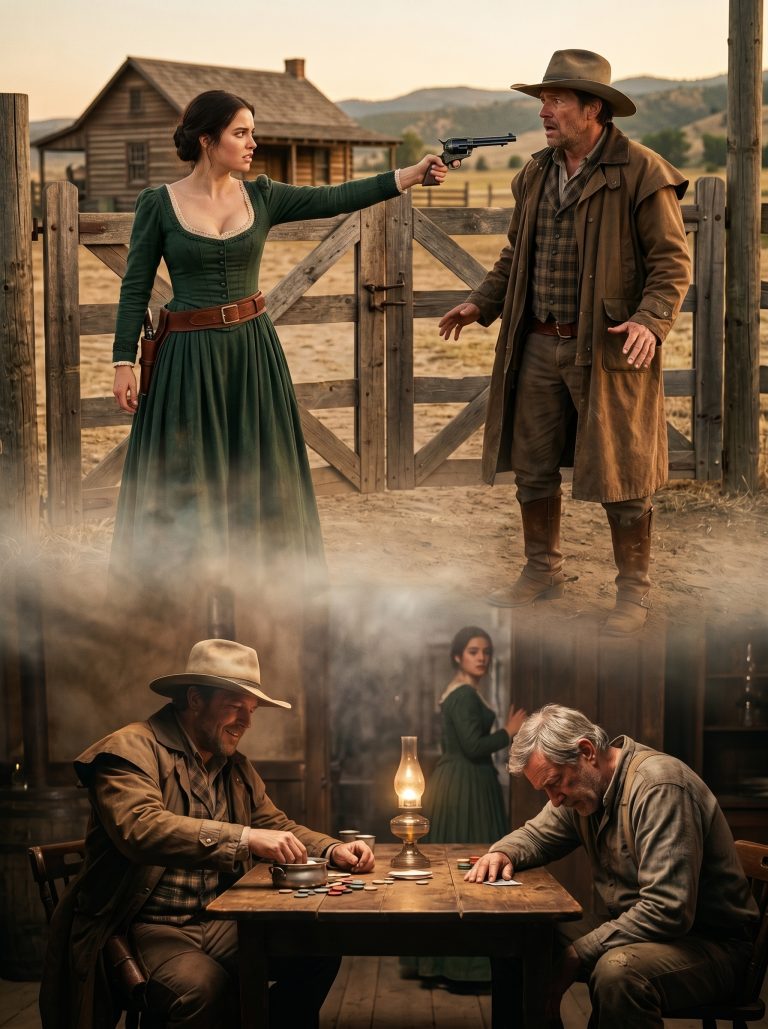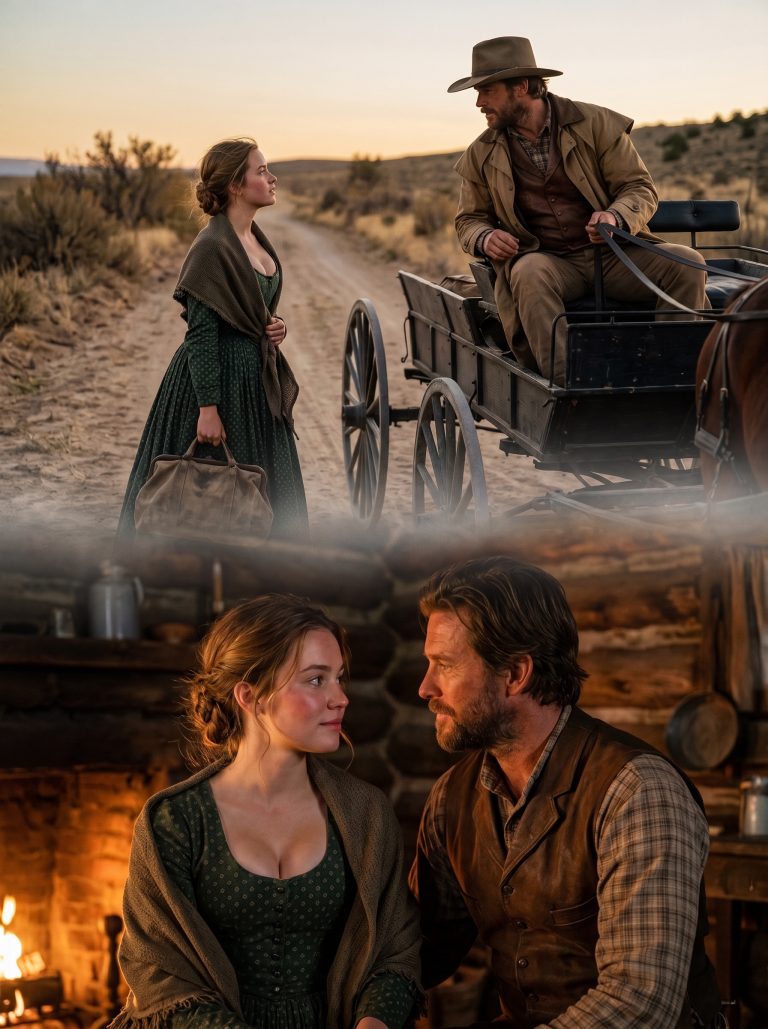
“Don’t Touch Her!” the Quiet Gunslinger warned—six outlaws laughed… until he reached for his revolver

Part 1
The summer of 1883 sat on Dodge City like a hand pressed flat against a throat.
Clara Whitmore had been walking the South Trail since before sunrise, a satchel against her ribs and a half-eaten biscuit in her pocket that Martha O’Neal had pushed into her hands three nights before, whispering, “Go, child. Go now, before he knows you’re gone.”
She heard the horses before she saw them — six sets of hooves cutting hard across the open plain, coming from the northwest as if the riders already knew which road she’d chosen.
“Miss Whitmore.” Thaddius Cain said her name the way a man sets down a trap.
Clara stopped. She did not turn.
“Figured you’d head for Hays,” Cain said, dismounting behind her. “Barrett thought Wichita. I know you better than that.”
She turned to face him — pale-eyed, unhurried, five of Barrett Silvers’s men fanned out behind him.
“You took something that doesn’t belong to you,” Cain said. “Mr. Silvers would like it returned.”
“There’s no misunderstanding,” Clara answered. “I know what that ledger is. I know what those names mean.”
Something cold moved behind Cain’s eyes — not surprise, but confirmation. He nodded to his men. Two came forward. Clara ran and made it twenty yards before a hand closed on her arm and the ground rose up to meet her palms.
They marched her back down the road, wrists pinned, the sun beating on all of them, when the stranger appeared — standing in the thin shade of a lightning-killed cottonwood, hat low, arms loose, utterly still.
“Afternoon,” Cain said.
The stranger’s eyes moved past him to Clara — the torn sleeve, the dust on her knees, the grip on her arms.
“Let her go.”
“This ain’t your business, friend.”
“I’m making it mine.”
Cain glanced at his men — six against one — and smiled at the arithmetic. “Ride on. There’s nothing here for you.”
The stranger looked at Clara instead. “You all right, ma’am?”
No one had asked her that in longer than she could remember.
“No,” she said. “I am not.”
“Last chance,” the stranger told Cain. “Let her go.”
Cain’s hand moved for his holster, and the world rearranged itself faster than Clara could follow. When it settled, Cain was staring down the barrel of a revolver six inches from his face, and the man holding it had not so much as raised his voice.
“Call them off.”
Cain’s men were already stepping back on their own accord. “Stand down,” Cain said, flat, controlled, a man practiced at losing without showing it.
“The satchel. Give it to her.”
Cain handed it over. Clara took it and held the weight of the ledger against her chest like something alive.
“Now walk back the way you came.” The stranger’s voice didn’t change. “Tell Silvers that Luke Emerson sends his regards.”
Something crossed Cain’s face — not fear exactly, but the look of a man realizing the board belonged to a different game than the one he thought he was playing. He looked once more at Clara. “This isn’t finished.”
“No,” she agreed. “It isn’t.”
They rode off. Clara let out the breath she’d been holding since the hoofbeats first reached her.
Luke Emerson holstered his revolver. “You hurt?”
“Knees. Palms. Nothing permanent.” She studied him — a man who had just faced down six armed men without firing a shot, and now stood asking questions the way another man might order coffee. “Why would you help me?”
He was quiet a moment, the dead cottonwood throwing its thin shadow between them. “I knew a girl once. Situation wasn’t unlike this one. I wasn’t in a position to do much about it.” His jaw tightened, just slightly. “I’ve tried not to waste a position since.”
There was something underneath the words Clara couldn’t yet name — a weight too old and too specific to be a stranger’s kindness alone. She filed it away the way she filed everything: carefully, for later.
“What’s in the satchel?” he asked.
“Evidence,” she said. “Of what Barrett Silvers has been doing. Three years of it. Every name.”
“How’d you get it?”
“I did his books. I couldn’t unknow what the numbers said.”
He nodded slowly, and something moved through his eyes that was not surprise. It looked, Clara thought, like grief — old, and carefully kept at a distance.
“The territorial office in Hays won’t do much,” he said. “You want a federal marshal. There’s one in Ellsworth. Man named James Ror. I know him.”
“Two of us, one horse?”
“Wouldn’t be the first time.” He started walking. “You’ll ride. I’ll lead.”
Clara fell into step beside him, the satchel heavy with three years of Barrett Silvers’s crimes.
“You could have ridden past,” she said.
“I don’t ride past things I can stop,” Luke said. “Not anymore.”
Somewhere ahead, his horse waited. Somewhere beyond that, a reckoning neither of them fully understood yet was already coming to meet them.
Part 2
They made seven miles before Luke’s mare came up favoring her left foreleg. In Millbrook, the liveryman called it a stone bruise — two days’ rest, or a lame horse in twenty miles. Luke traded the mare and what cash they had between them for a plain gray gelding, and they pressed on toward Ellsworth by dusk.
Walking, Clara had gone quiet — not frightened, but working something over.
“Cain knew which road I’d take,” she said finally. “He said Barrett thought Wichita, that he knew me better. But I never told a soul about Hays. Except Martha.”
Luke didn’t answer right away. “You think she sent you into his hands.”
“Cain came from the northwest. That road only connects if you already knew I wasn’t heading south.” Clara’s voice stayed level, though it cost her. “Martha pressed food into my hands and told me to run. And somehow Cain knew exactly where to look.”
“That’s a hard thing to think about a woman who helped you.”
“Yes,” Clara said. “It is.”
Six miles outside Ellsworth, they heard hoofbeats and pulled off into the scrub. Four of Silvers’s men passed at a hard canter, rifles across their saddles, riding straight for town.
“He’s already sent men ahead of us,” Clara said.
“Then we don’t use the front door.” She turned the gelding toward a back trail she hadn’t walked since she was a girl. “I grew up in Ellsworth, Luke. Before my father died and I went to Dodge for work. There’s a loading dock behind the marshal’s office.”
“You didn’t think to mention that?”
“You didn’t ask.”
They came into town from the east as the last light drained out of the sky, moving low between buildings. At a heavy iron-hinged door, Clara knocked three times.
A deputy answered, hand drifting toward his sidearm at the sight of them — until Luke said, “Tell Ror that Luke Emerson is asking.”
A minute later the door opened wider, and a tall, gray-templed man with a marshal’s star filled the frame.
“You look worse than the last time I saw you,” James Ror said.
“Seven years will do that.”
Ror’s eyes moved to Clara, to the satchel, and something in his face sharpened. “You’re the one with the ledger. Four of Silvers’s men already came through my front door tonight, telling me you were dangerous.”
“She’s more dangerous than she looks,” Luke said.
“I don’t doubt it.” Ror stepped back and bolted the door behind them. “Come in. Fast. We don’t have much time.”
Part 3
Ror spread the ledger copies across his desk and read by lamplight, his jaw tightening page by page.
“Forty-one names,” Clara said. “Column marked transport livestock. I have the coding key. I have the location of the originals — locked desk, back office, Silver Rail, Dodge City.”
“Three of these,” Ror said quietly, “are open missing-person cases in my jurisdiction. Filed by families. Never closed.”
“How are you still alive, Miss Whitmore?” he asked, looking up.
“Luck,” Clara said. “And three years of practice at being invisible.”
She told him about Martha, about the impossible geography of Cain’s shortcut. Ror’s face darkened further.
“If she’s been feeding him information,” he said, “Silvers knows more about this territory than he should.”
“We need to move tonight,” Luke said. “Not wait for federal authorization. Silvers has twenty-four hours to burn everything the moment he suspects.”
Ror studied Clara for a long moment. “You planned this.”
“I planned this for three years,” she said. “Tonight is just the last piece of it.”
They rode north under a moonless sky — three horses, three riders, no lanterns — and it was somewhere in that dark, quiet stretch between Ellsworth and Dodge, with nothing but hoofbeats and the enormous Kansas silence around them, that Clara finally asked the question she’d been carrying since the cottonwood tree.
“You said you knew a girl. Situation wasn’t unlike mine.”
Luke didn’t answer for the length of several breaths.
“Her name was Nora,” he said finally. “Worked a saloon outside Ellsworth, four years back, when I still wore a badge in this territory and thought that meant something. She came to me twice, said she’d found things in the books she didn’t understand. I told her to be careful. I told her I’d look into it when I had time.” His voice had gone very flat, the way a man’s voice goes when he has said the words often enough in his own head that saying them aloud costs him nothing new. “I didn’t have time. Three weeks later she was gone. No body. No trail. Just a line in a register somewhere, if there’d ever been a register to find.”
Clara had gone very still in the saddle.
“Nora,” she repeated. “Nora Whitmore?”
The horses stopped without either of them meaning to stop them.
“My sister,” Clara said. The words came out of her like something breaking loose from where it had been lodged a long time. “She left Ellsworth for saloon work four years ago. She wrote twice. Then she didn’t write again, and when I went looking, everyone told me she’d simply moved on — gone to Wichita, gone to Denver, gone wherever girls go when nobody wants to ask further questions.” Her hands had tightened on the reins. “I took the position at the Silver Rail because it was the only door still open to me that led anywhere near an answer. I told myself I was looking for evidence against Silvers. I was looking for her.”
Ror had gone quiet, watching the two of them the way a man watches a hand of cards he hadn’t expected to be dealt.
“You knew,” Clara said to Luke. It wasn’t an accusation. It was arithmetic, the kind she was good at. “On the trail. When you said you knew a girl. You already suspected.”
“I didn’t know,” Luke said. “Not for certain. Whitmore isn’t an uncommon name. But I’ve spent four years reading every ledger I could get my hands on out of every saloon between here and the territorial line, looking for one line that would tell me what happened to her. When Cain said your name on that road, something in me went very still, because I’d heard it before — from her, in a letter she showed me once, about a sister back in Ellsworth who kept her father’s books at fourteen and could add a column faster than any man in the county.” He looked at her now, steady, the theater entirely gone out of him. “I didn’t ride past you because I was a good man passing by chance, Clara. I rode toward you because for four years I’ve been failing to find your sister, and I wasn’t about to fail the second Whitmore standing on that road.”
The silence that followed held the weight of the whole plain around them.
“Is she in the ledger?” Clara asked. Her voice had dropped to something Ror had to lean in to hear.
“I don’t know,” Luke said honestly. “I haven’t had the originals. Only the copies you wrote from memory, and you told me yourself some of the early pages were cut before you ever saw them.”
“Then we finish this,” Clara said, and there was nothing broken in her voice now — only iron, freshly forged. “Whatever the originals say, we finish it tonight.”
They left the horses near a dry creek bed outside Dodge and came at the Silver Rail from the east, where a woodpile hid a window with a broken latch that Edmund Croft had used for years without ever thinking to fix it.
“Fifteen minutes,” Clara said. “If I’m not out, something’s gone wrong.”
“We’re not leaving you in there alone,” Luke said.
“You’re not leaving me anywhere, Luke. I’m going in on purpose.” She held his gaze in the dark. “I know that building better than anyone inside it. Tonight, that matters more than a gun. And there is something in that office I need to see with my own eyes before anyone else does.”
He didn’t argue further. He understood, now, exactly what she meant.
Before she went through the window, Luke caught her sleeve once, briefly. “If it’s not there,” he said, “if Silvers already moved it, you come back out. You don’t go looking further into that building for me. Not for Nora. Not for anything.”
“I know my own limits, Luke.”
“I’m not sure you do. Three years of watching your face stay blank has made you very good at hiding when you’ve stopped being careful.”
She almost smiled, in spite of everything. “Fifteen minutes,” she said again, and went through the window before he could argue further.
The window gave with a soft click. The corridor beyond smelled of lamp oil and cheap whiskey, three years of memory laid out under her feet — third floorboard from the left, then the one near the corner, both of them silent under her careful steps. The office door sat on its latch, the room beyond it dark and empty.
Left-hand drawer. False panel, second from the door, hinge worn smooth from use. The key was on its hook exactly where three years of watching had told her it would be.
She unlocked the drawer and lifted out the ledger — not a bound book but folded sections bound with a leather strap, Edmund Croft’s careful hand filling page after page. She did not read it there. She had promised herself, walking that dark corridor, that she would not let Barrett Silvers’s office be the place she learned her sister’s fate. That would happen in the light, in front of witnesses, where the truth could not be smoothed over or denied.
Footsteps sounded overhead — Silvers, and Cain’s voice beneath his, moving toward the front stairs. Clara pressed herself flat against the wall and did not breathe until the sound passed the corridor and faded.
She was three steps from the window when a second set of footsteps came up the back stairs instead of down the front — closer, unhurried, someone who belonged in that corridor and had no reason to expect anyone else in it. Clara had one breath to decide, and she used it: she stepped into the shadow behind the open office door rather than the window, because a woman caught mid-climb through a window could not explain herself, and a woman standing quietly in a dark office might yet talk her way past a man who did not already suspect her.
It was Edmund Croft. He came in reaching for the lamp out of habit, and Clara watched his hand stop an inch from the match the moment he registered the drawer standing open behind his desk.
“Miss Whitmore.” His voice was low, almost tired, a man arriving at a conclusion he’d perhaps expected for longer than he wanted to admit. “I did wonder, some months back, why my reconciliations kept coming out a half-page short of where I’d left them.”
“You knew,” Clara said. It was not quite a question.
“I suspected.” Croft did not move for the lamp again. “Some columns you reconcile, Miss Whitmore. I told you that myself, once. I never told you which ones, because I was a coward, and cowardice is a slower kind of dying than most men admit to themselves while they’re doing it.” He looked at the satchel under her arm, then at the open drawer, then back at her face, and something in his posture loosened, as though a weight he’d carried a long while had finally been set down by someone else’s hands. “Go on, then. Whatever’s in that ledger, it was always going to outlive the both of us keeping quiet about it.”
He did not call out. He did not reach for the lamp again until she was already through the window, and Clara understood, sliding out past the woodpile, that she had just been given something she had not asked for and had no way to repay — a small, late, insufficient kind of courage, offered by a man who had spent eleven years without any.
She was out the window, past the woodpile, into the alley, nearly running straight into Ror.
“You’ve got it,” he said. It wasn’t a question.
The front door of the Silver Rail crashed open behind them. Silvers stood in the doorway, Cain at his shoulder, two armed men fanning out on either side, and even across the distance Clara watched the exact moment he understood what had happened to him.
“Miss Whitmore,” he called out, smooth as ever. “I’d like my property returned.”
“It isn’t your property,” Clara said. “It’s evidence. And it’s the only thing left of forty-one people you decided didn’t matter.”
“Mr. Silvers,” Ror said, “I’m placing you under arrest.”
Cain’s hand moved for his gun, and Luke was already between him and Clara, not drawing, simply present, immovable. “Don’t,” he said, in the same quiet, exact voice he’d used on the South Trail.
Cain’s hand stopped.
“There are two ways this ends,” Ror said, loud enough for all of them. “One way, everybody lives. I strongly recommend that way.”
Silvers’s men raised their hands. Cain let go of his gun. And then the side door opened, and Martha O’Neal stepped out in her house clothes, as if she had come running the moment she heard the front door break.
“Clara,” Martha said. “I didn’t know what he’d—”
“Yes, you did,” Clara said. “You knew exactly.”
Martha’s chin dropped.
“How long?” Clara asked.
“Four years,” Martha whispered. “He bought my boarding house debt when my husband died. He said he only wanted information. Nothing that would hurt anyone.”
Four years. The number landed in Clara like a stone into still water, and she understood, with sudden and terrible clarity, exactly whose debt had first been bought and exactly whose disappearance had first taught Martha O’Neal to keep her silence.
“It started with my sister,” Clara said. “Didn’t it. Nora came to you. Before she vanished. She trusted you, the way I trusted you, because you were kind to girls who had nobody else.”
Martha’s face crumpled entirely. “She asked me what to do with what she’d found. I told her to go to Silvers and ask him honestly, because I believed — I truly believed — that a reasonable man would explain himself.” Her voice broke. “I was wrong about him from the very beginning, Clara, and I have spent four years too ashamed to admit that being wrong once cost a girl her life, so when he came to me afterward and told me what he needed, I told myself agreeing was different. Smaller. That it wasn’t the same mistake twice.”
“It was the same mistake,” Clara said. “Every time you told yourself it was smaller, it was the same mistake.”
Ror put irons on Cain, then on Silvers himself, who tried once more to speak of influence in Topeka before Ror cut him off flatly and finished the work in silence.
Judge Beaumont arrived with morning and two federal deputies, and spent the better part of an hour going through Clara’s documentation with precise, relentless questions she answered one after another without flinching. When at last he unfolded the original ledger and turned to the earliest pages — the ones Clara had never been permitted to see in three years of careful copying — the room went still around her.
Nora Whitmore’s name was there. Eleven months after she vanished, entered not under transport livestock but under a column of its own, one that told Clara, in Edmund Croft’s careful hand, everything she had spent three years both hoping and dreading to learn. There was no comfort in it. There was, at least, an end to not knowing, and Clara had learned by now that the two were not the same thing, though for a long time she had let herself believe they might be.
She did not cry in front of Beaumont. She read the entry twice, closed the ledger herself, and set her hand flat on its cover the way a person sets a hand on a grave.
“I’m sorry,” Luke said quietly, beside her.
“Don’t be,” Clara said. “You gave me the truth instead of a mystery. That’s worth more than you know.”
Beaumont issued a federal warrant for Judge Arthur Prentice before noon, took formal jurisdiction of the Silvers case, and told Clara plainly that her ledger — assembled alone, over three years, at a cost she alone had paid — was as thorough a piece of evidence as he had reviewed from any trained investigator in forty years on the bench.
“There are forty-one names in there,” Clara told him. “The case has to be about them. Not about me.”
“It will be about them,” Beaumont said. “It will also, unavoidably, be about you. Are you prepared for that?”
“Yes,” Clara said, and meant it.
Martha gave her full statement to Ror before the day was out, leaving nothing unspoken, and asked for nothing in return except that her words be entered exactly as she gave them.
“I know it won’t fix what I did,” she told Clara before the deputies took her in for further questioning, her sentence still to be determined by a court she no longer had any leverage over. “But I’m not going to let you carry the weight of what happened to Nora as if I had no part in building it.”
Clara looked at the woman who had once pressed food into her hands in the dark and told her to run, the same woman whose silence, four years earlier, had let a girl’s disappearance pass without so much as a question asked in the right direction.
“People are rarely only one of the things they do,” Clara said, and found, to her own surprise, that she believed it and still could not fully forgive it, and that both of those could be true in the same breath. “Tell them everything. Don’t leave anything out. That’s the only repair left available to you now.”
Outside the Silver Rail, morning had settled fully over Dodge City — a town waking up into a different shape than the one it had gone to sleep in, though it did not know that yet.
“It won’t bring her back,” Clara said quietly. “None of it will.”
“No,” Luke said. “It won’t. But it stops the next ledger from ever needing a column like that one. It stops the next Nora.”
“And the one after her.”
“Yes,” he said. “It does.”
Clara let out a slow breath, the satchel light now against her shoulder where the copies had already been surrendered into Ror’s keeping, the originals into Beaumont’s.
“You spent four years chasing a name in a ledger you couldn’t find,” she said. “I spent three years becoming invisible to get close enough to write one myself. We were doing the same work the whole time, on opposite ends of it, and neither of us knew the other existed.”
“No,” Luke agreed. “We didn’t.”
“What does that make of it? Luck? Something else?”
He considered the question with the same seriousness he gave everything. “I don’t know that it needs a name,” he said finally. “Grief goes looking for company whether we mean it to or not. Sometimes it finds it on a dead road outside Dodge City, six years too late to save the person who started it, and just in time to save the next one.”
Clara thought of the biscuit Martha had pressed into her hand three nights ago, of the eleven miles she’d walked before Cain caught her, of a stranger standing still beneath a lightning-killed cottonwood as though he’d been waiting there his whole life for exactly this road to bring exactly this woman past him.
Perhaps, in a way that owed nothing to fate and everything to two people who had each refused, in their own separate and stubborn ways, to look away from what had been done to someone they loved, it had.
“Ror mentioned Ellsworth is building a formal evidence office for financial crimes,” Clara said. “Said they’ve been looking for someone with the right skills.”
“Sounds like they found someone.”
“Maybe.”
“Not maybe,” Luke said.
She looked at the street, at the town rearranging itself around the news it did not yet know, and did not look away.
“I’ve been in a position for three years,” she said, echoing his own words back to him. “I didn’t waste it.”
“No,” Luke Emerson said. “You did not. Neither of us did — not you, and not me, and not even Martha, in the end, whatever it cost her to finally stop wasting it.”
The morning held them there together: two people who had each set out, years apart, to answer the same unbearable question, and who had found, at the end of it, not the sister either of them had hoped for, but the truth — and each other, and the certainty that the next name in the next ledger would never again go unanswered while either of them still had breath enough to answer it.