“Go Slow… It Hurts,” She Moaned—He Whispered, “I’ll D.i.e Before I Hurt You”

Part 3
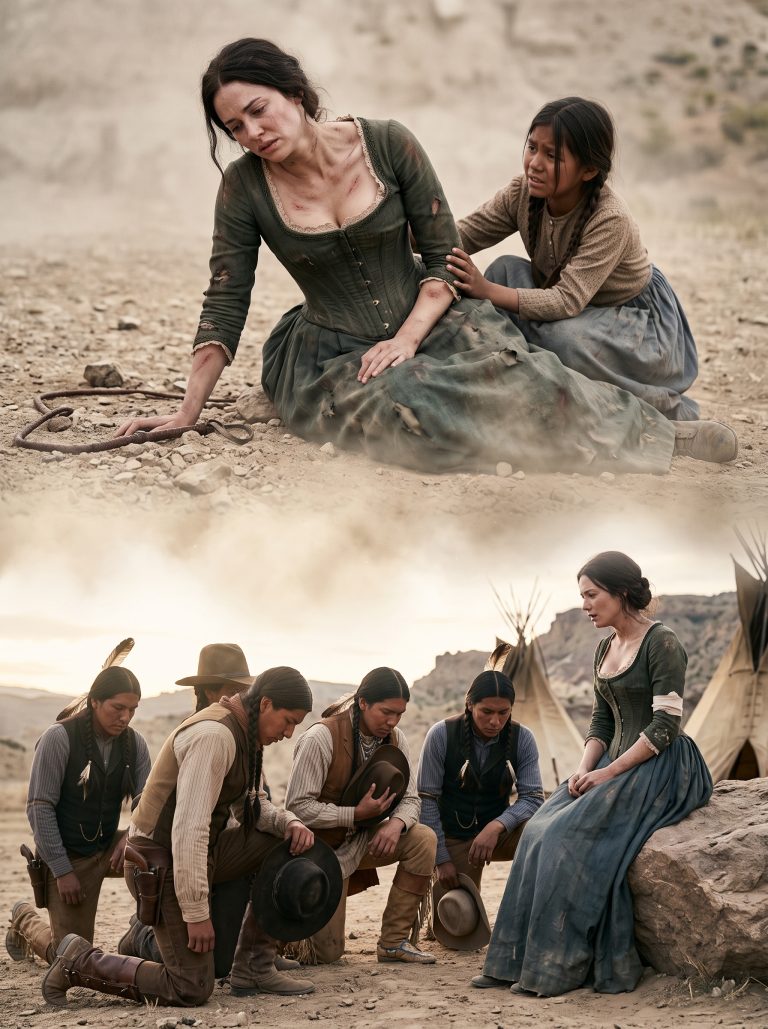
Three weeks passed like water finding its level — Elena adjusting, the camp absorbing her, her hands slowly forgetting they had ever been afraid to work. Mornings belonged to Wren and the other women: hide-scraping, bead-work, the endless quiet tasks that kept a camp alive. Afternoons belonged to Windrunner, who taught her to read deer tracks, to find water by the bend of the grass, to walk without announcing herself to every hawk on the horizon.
He never touched her without asking first, not even to help her down from a horse, and that alone rearranged something fundamental in how Elena understood men.
“Why do you help me like this?” she asked him once, in the shade of a boulder, sweat cooling on both their necks after a long morning’s ride. “You don’t know me. You owe me nothing.”
He was quiet long enough that she thought he wouldn’t answer. “My mother ran, once, like you. A trapper found her first and brought her to a fort, thinking he did good. The soldiers sent her back to the man who’d hurt her.” His jaw tightened. “She ran again. My father’s hunting party found her half-frozen that winter. She chose to stay with us after that — chose it every day, until she died. She told me once that freedom is worth more than safety bought with someone else’s permission.” He looked at Elena directly. “I could not walk past a woman running the way she once ran.”
Elena thought of her own mother, dead of fever years back, who had only ever taught her how to endure. Be dutiful. It will hurt at first. That’s normal. No one had ever told her a different story was possible — until now.
The Skeptic
Not everyone in camp welcomed her so easily, and Elena was glad of it — a village that agreed on everything felt less honest than one that argued.
The loudest doubt came from a young warrior named Fox, barely older than Elena herself, who had lost an uncle to a cavalry patrol two winters back and saw, in her pale skin and careful accent, only the shape of everyone who’d ever done his family harm.
“She eats our food. Sleeps under our watch,” he said one evening, not troubling to lower his voice as Elena passed with a water skin. “And when her father’s soldiers finally come, who do you think they will blame for hiding her?”
“I heard that,” Elena said, setting the water skin down and turning to face him instead of pretending she hadn’t. “You’re right to be careful. I would be too, in your place.”
Fox blinked, clearly having expected either tears or a retreat, not agreement.
“But I didn’t ask anyone to bleed for me,” she went on. “If soldiers come looking, I’ll walk out and meet them myself before I let this camp pay for my choices. That’s not a promise I’m making to earn your trust. It’s just true.”
He studied her a long moment, unconvinced but no longer sneering, and said nothing more that night. Windrunner, watching from across the fire, said nothing either — but later, alone, he told her it was the first time he’d seen Fox truly listen to anyone in months.
“You didn’t defend yourself,” he said. “You agreed with his fear instead. That took more courage than an argument would have.”
“I’ve spent my whole life being argued over,” Elena said. “I’d rather be understood.”
The Wildfire
The test of that trust came sooner than anyone wanted.
Lightning without rain struck the dry ridge above camp in the last hot week of summer, and by the time the smell of smoke reached the lodges, a wall of fire was already crawling down the grass toward the horse herd — thirty animals, penned in a bend of the creek with only one narrow gap for escape, and no time to argue about who should risk the smoke to open it.
Men were already running for water, for green branches to beat back the flames at the camp’s edge. It was Elena who reached the horse gap first, Fox arriving half a breath behind her, both of them coughing in the rising smoke.
“The latch is jammed,” she shouted. Windrunner’s mare — the one that had carried Elena to safety that first day — was screaming and rearing at the back of the herd, hemmed in by panicking animals with nowhere to go.
Fox wrenched at the gate while Elena climbed the rail fence and dropped in among the horses, doing exactly what Windrunner had spent a summer teaching her: moving slow, low, speaking instead of grabbing, letting the animals feel a calm that wasn’t really there. One by one she turned the lead mares toward the gap Fox had finally forced open, and the herd broke for the creek in a thundering, dust-choked river of bodies, Elena flattening herself against the fence rail as the last of them passed close enough to graze her shoulder.
When the smoke cleared enough to count heads, every horse had made it to the water. Fox stood in the creek shallows, breathing hard, staring at Elena with an expression that had nothing skeptical left in it.
“You could have run,” he said. “The gap was open enough for a person.”
“So could you,” Elena said.
He didn’t have an answer for that, and didn’t seem to need one. From then on, when the elders spoke of the woman who had come to them barefoot and bleeding, Fox was the first to add that she’d gone into a burning corral for horses that weren’t even hers.
The Debt
The trouble came on a cold, bright morning, dogs barking their stranger-bark before anyone saw the riders. Five men crested the ridge above the camp: her father, Garrett Hartwell, red-faced and furious; Silas Cobb beside him on a horse too small for his bulk; three others from Hollow Creek, armed and righteous.
“I know she’s here!” her father bellowed. “My daughter. I’ve come to take her home.”
Elder Two Rivers came out to meet them with quiet dignity, Windrunner at his side to translate, though her father hardly waited for words.
“That woman is my property,” he said, jabbing a finger at Elena, who had come out despite Windrunner’s warning hand on her arm. “Taken by your savages.”
“I wasn’t taken,” Elena said, stepping forward, her voice steadier than she felt. “I ran. I chose to leave.”
It was Silas who laughed, ugly and short. “Women don’t choose, girl. You belong to your father till you belong to me. That’s the arrangement.”
Arrangement. The word snagged wrong in Elena’s ear — too precise, too businesslike for a marriage supposedly built on her father’s love for her. She had heard that same careful word before, muttered between her father and Silas over a bottle of whiskey the week before her flight, back when she was meant to be asleep.
“What arrangement?” she said now, loud enough to carry. “Tell them, Father. Tell them what the arrangement actually is.”
Garrett Hartwell’s face went a shade darker. “That’s none of — ”
“He owes you money,” Elena said, the pieces she’d only half-understood that night finally locking into place. “Doesn’t he. That’s why the wedding couldn’t wait. That’s why it didn’t matter who I was marrying, only that it happened fast.” She looked at Silas. “You forgave his debt for me. I wasn’t a bride. I was payment.”
Silence dropped over the ridge like a dropped stone. Even the men from Hollow Creek exchanged uneasy looks — this, apparently, was news to them too.
Windrunner’s expression did not change, but something in his stance shifted, coiled tighter, angrier on her behalf than his careful control usually allowed. Two Rivers spoke into the quiet, and Windrunner translated, his voice flat and hard.
“My uncle says: a man who sells his daughter to erase his debts has no claim left to call himself her father. She stays. She chooses her own road, as is our way for every woman under our protection.”
“I don’t give a damn about your ways,” Garrett snarled, and lunged forward. Windrunner caught his wrist before he’d taken two steps, holding it with a strength that made the older man’s face twist in surprise and pain.
“You will not touch her,” Windrunner said. “Not here. Not ever again.”
It was Silas who broke first — not from courage, but from the sudden, humiliating knowledge that his secret was aired in front of witnesses. He drew his pistol, more out of panic than plan. Bowstrings answered before the shot ever left the barrel — a warning volley thudding into the dirt at his horse’s feet, close enough to make the animal rear and nearly throw him.
“The next ones do not miss,” Two Rivers said, and did not need translation for anyone to understand him.
“This isn’t finished,” Garrett spat, wrenching free, already backing toward his horse. “I’ll bring the cavalry. Burn this whole camp down to get her.”
“Then you will find smoke and nothing else,” Windrunner answered. “We move like wind. Your soldiers are slow and loud.”
The five men wheeled and rode, dust rising behind them, and the bows stayed drawn until the riders vanished over the horizon.
The Truth Windrunner Carried
That night, as the camp quietly prepared in case soldiers truly came, Elena found Windrunner alone at the edge of the firelight, his shoulders set in a way she hadn’t seen since the day they met.
“You’re afraid,” she said. It wasn’t a question.
“Not of soldiers.” He didn’t look at her. “You spoke a truth today that no one had said aloud. I have carried a truth of my own a long time, and never said it either.”
He told her, then, about his wife — a woman he’d always described, when he spoke of her at all, as killed in a cavalry raid on their camp. Tonight the story came out differently, slower, rougher at the edges. There had been no raid that year, not near their camp. There had been sickness instead — a fever brought in trade goods from a fort, the same fever that had taken half the children in the valley that winter, his wife among them. He had told the story of soldiers for so long, to himself as much as to anyone, that blaming an enemy had felt easier than admitting an illness no one could have stopped had simply taken her.
“Anger has a shape a man can fight,” he said quietly. “Grief does not. I chose the anger because it let me hate someone instead of just — losing her.”
Elena thought of her own father’s version of love, twisted into ownership, and of Silas’s version of marriage, twisted into a debt paid in a person. She understood, suddenly, how easily true grief could be reshaped into something that felt less helpless — even by a man as steady as Windrunner.
“You don’t have to hate anyone to have loved her,” Elena said. “Losing her wasn’t a debt either of you owed.”
He was quiet a long while. Then, for the first time since she’d known him, she watched something in him unclench — not forgetting, not forgiving what couldn’t be forgiven, only setting down a weight he hadn’t needed to carry.
What the Elder Decided
No cavalry came. Whatever story Garrett Hartwell told at the fort, a shamed man’s account of a runaway daughter and a debt he’d rather no one examined too closely, it seems, was not one he was eager to repeat to soldiers who might ask questions of their own. Weeks passed. Then a season. The camp moved with the buffalo, as it always had, and Elena moved with it, her hands growing sure at every task, her voice growing sure in the council fires where women’s opinions, she learned, were not just tolerated but expected.
In the spring, Elder Two Rivers named her formally before the whole band — not Wyaka Win borrowed from any single people’s sacred language, but simply, in the plain words the elder chose himself: Runs-Toward-Morning, for the woman who had run not away from something forever, but toward a life she’d built with her own two hands.
Windrunner courted her properly after that, in full view of the camp — small gifts, long walks, a new lodge raised by the community’s own hands as a wedding offering. Elena, in turn, spent a month’s evenings beading him a pair of winter moccasins, the pattern two paths that separated and always rejoined, a language everyone in camp could read even before she said a word.
Fox, of all people, was the one who taught her the proper way to smoke the hide for the wedding dress, grumbling the whole time that he was only doing it because Wren had asked twice and he was tired of hearing about it. Elena didn’t argue with the excuse. She understood by then that some people showed they’d changed their minds by deed rather than declaration, and that this, too, was its own kind of honesty.
They married at the turn of the season, Two Rivers speaking words of binding over a low fire while the whole band stood witness. There were no chains in the ceremony, no promise of ownership — only two people choosing, in front of everyone who mattered to them, to keep choosing each other. When the elder asked, as tradition required, whether any among them spoke against the joining, the silence that answered him was long enough that even Fox’s stillness became its own kind of blessing.
Afterward, sitting outside their new lodge as the fires burned low and the camp’s laughter rolled on without them, Windrunner turned Elena’s hand over in his and traced the old, faded scars still visible on her feet — the ones from that first desperate morning on the grass.
“Do you regret the road that brought you here?” he asked.
“I regret that I ever believed I had no other road to choose,” Elena said. “I don’t regret walking this one.”
Epilogue
Years later, when Runs-Toward-Morning told this story to her own daughter — a girl who would grow up moving easily between two languages and two worlds, who would call Fox uncle without anyone finding that strange — she did not tell it as a tale of rescue. She was careful about that.
“No one saved me,” she said. “A man gave me a hand to hold onto while I saved myself. Some people helped along the way, and some doubted me and changed their minds, and that’s how it should be — trust that’s earned means more than trust that’s given for free. Remember the difference.”
Her daughter, not yet old enough to understand debts or cages or the particular cruelty of a father who mistook his child for currency, only understood that her mother’s eyes went soft and proud whenever she told it, and that her father — steady, quiet, unhurried in all things — always found some reason to be sitting close by the fire when the story was told, listening as if it were new every single time.
Word had come, once, years after the wedding, that Garrett Hartwell had lost the last of his land to the debts he’d once tried to settle with his daughter’s future, and had drifted east to be forgotten by whoever would have him. Elena felt, on hearing it, neither triumph nor grief — only the quiet, settled knowledge that his choices had finally caught up to him without her needing to lift a hand against him at all. Some cages, she’d learned, close on their own builders in the end.
The prairie wind carried the tale out past the lodge poles, the way it carried every story eventually, and somewhere in that wind, if you listened for it, was the whole of what Elena Hartwell had learned in the space between fleeing and finding a home: that freedom was never the absence of every bond. It was the presence of a choice — made once, and then made again, every ordinary morning after.
— The End —