He Mocked the Ragged Woman, Asking If She Could Stop a Crying Baby—He Never Expected What She Did Next

PART 1
The cry had become part of the house.
It lived in the rafters with the smoke stains, trembled under the doorways, slipped through chinks in the log walls and across the frozen yard where cattle stood humped against the November wind. It was thin now. Tired. A thread of sound unraveling in the dark.
Amos Kestrel had not slept more than an hour at a stretch since Rebecca died.
His wife had been in the ground nine days. Their daughter had been in his arms almost every minute since, growing lighter as though sorrow were eating her. He’d tried goat’s milk, sugar water on a rag, ridden six miles for Mrs. Callender and eight more for the doctor, and both had looked at the baby with the careful faces people wore when they didn’t want to say death aloud in a house already full of it.
“Keep her warm,” the doctor said. “Feed her when she’ll take it. Pray when she won’t.”
Amos had done all three. It wasn’t enough.
On the fourth morning after the doctor’s second visit, Amos stood in his kitchen, shirt open at the throat, unshaved, the baby wrapped in Rebecca’s blue shawl against his chest. The stove had burned low; he’d forgotten to feed it. He’d forgotten coffee, bread, his own name, except when the child cried and he remembered he was her father and failing at it.
“Hush now,” he whispered, voice gone hoarse two days before. “Please, little one.”
The baby’s mouth opened against the shawl. No strength left for screaming. Just that small, awful pleading.
He’d buried Rebecca behind the cottonwoods, where she’d once wanted lilacs, digging her grave himself since the earth wasn’t yet frozen and no one else had loved her enough. He’d stood dry-eyed while the preacher spoke, something in him gone still and flat. But now, holding this motherless child he hadn’t yet named, afraid to name what God might take, Amos Kestrel bent over her and broke.
He didn’t hear footsteps at first.
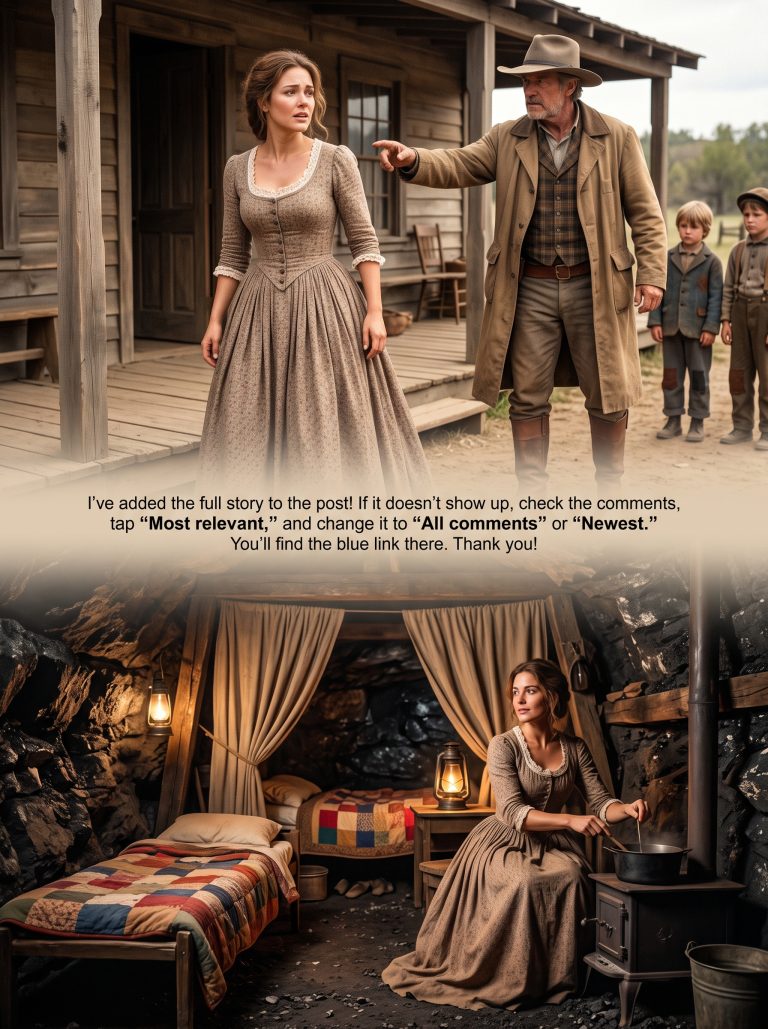
The woman had come up the road out of the gray morning like something the weather had made and nearly finished. She wore a brown dress patched at the elbows, a man’s coat too thin hanging from her shoulders.
She’d meant to pass the ranch and keep walking toward town. Then she heard the baby.
Willa Prescott stopped at the gate as if the cry had put a hand on her throat. A cabin a hundred miles east. Her own child, Nell, sick with diphtheria, too weak by the end to cry properly. That same thin note, that same fading hunger the world had failed to answer.
She crossed the yard without deciding to, climbed the porch, knocked once, hard.
When the door opened, Amos looked at her as a man looks at trouble when trouble beats silence. His eyes were red-rimmed and hollow.
Willa looked once at the child. “Give her to me.”
Amos’s arms tightened. Any other day he’d have shut the door on a stranger making demands. But the baby made that faint sound again.
“Can you quiet a crying child?”
Willa’s face steadied, like a woman taking hold of a rope before deep water. “I can try. Give her here.”
Amos looked at her hands — thin, chapped raw, but clean, a small scar crossing one knuckle. Hands that knew babies. So he gave his daughter to a stranger.
Willa tucked the child against the warmth beneath her coat. “There now,” she murmured. “I hear you, poor lamb.”
The cry hitched once. Then stopped.
The silence was so sudden Amos grabbed the doorframe.
Willa stepped into the kitchen as though she’d lived there all her life, sat near the stove, and looked up at him. “She’s starving.”
“I tried,” he said. “God help me, I tried everything.”
“I know. But she’s too weak to work for it. She needs patience. Warmth. Time.” She hesitated. “My own baby died in the spring. My milk hasn’t gone yet. If you’ll permit it, I can feed yours.”
“You can save her?”
“I don’t know,” Willa said, and because she didn’t lie, he believed her. “But I can give her what she’s asking for.”He turned away. “Do it.”
Behind him came sounds he hadn’t heard since Rebecca lived — a baby searching, fumbling, then feeding. Truly feeding. It went through him like an ax through ice. He sank into the chair opposite her, grief coming out rough and broken while a stranger sat in his kitchen giving his daughter back to life.
She didn’t look at him while he cried. That was the first kindness she gave him after saving the child.
By noon he knew her name. By evening, that she’d walked from a failed homestead near Antelope Creek after burying a husband, Micah, and a ten-month-old daughter in the same week. By midnight, that she wouldn’t sleep.
“You’ll fall over,” he told her.
“So will she, if I don’t watch her.”
“I can hold her.”
She looked at his work-cracked hands, washed twice before he’d touch the baby. “After the next feeding. Not before.”It wasn’t the tone of a servant, nor a guest. It was the tone of a woman who’d stepped into a dying room and found work only she could do.
Near dawn, Amos built the fire high. Willa dozed sitting upright, the baby warm against her. First light showed how young she was beneath the ruin of travel — not a girl, but not yet thirty, grief sharpening her cheekbones, her mouth tender when she looked at the child.
The baby lived because Willa Prescott had come. That was all he knew. It was enough.
“You’re staying,” he said.
Willa woke at once, eyes narrowing. “Am I?”
“If you will. I’ll pay wages. Whatever’s fair. She needs you.”
“She needs feeding,” Willa said. “That won’t last forever.”
“She needs living long enough to learn the difference.”
A shadow crossed her face, but she nodded. “I’ll stay for now.”
PART 2
He gave her the room meant for Rebecca’s sewing things, later a nursery. “Door has a latch. I won’t come in without knocking.”
Willa looked at him sharply. A woman alone on the road learned to measure men by what they assumed they had the right to take. Amos had offered a latch before she’d asked for one.
“All right,” she said.The room was plain to the point of insult — bare boards, a narrow bed, one window facing west. “I’ll patch that crack before night,” Amos said.
“I’ve slept under wagons. A crack won’t kill me.”
“But I’ll patch it.”
By sunset it was sealed with cloth and pine pitch. A blue glass bottle held three dried stems of prairie grass on the crate by the window — the best the winter land could offer. Willa stared at the arrangement until her eyes filled.
“I can take it away,” Amos said, misunderstanding.
“No. Leave it.”That night they ate at the same table. He’d burned the beans. She said nothing till he reached for the salt a third time.
“You always cook like this?”
“I don’t cook. Rebecca cooked.”
The name settled between them. Willa’s expression gentled. “She must have been tired, cooking for a man who considers beans a form of punishment.”
A sound came out of him, not quite laughter, but near enough to hurt. “She said worse.”
“Good. I like her.”
For the first time since Rebecca’s fever took hold, the kitchen didn’t feel like a room waiting for another funeral.
Willa changed the house without asking permission — not with ribbons and chatter, but starting with the baby. She taught Amos to heat bricks for the cradle, to hold the baby upright after feeding, to tell a hungry cry from a bellyache from lonely fussing.
“She has opinions,” Willa told him.
“She’s twelve days old.”
“Then she’s had twelve days to form them.”
“You might as well use my name,” he said, “if you’re saving my daughter’s life under my roof.”
A faint smile touched her mouth. “Call me Willa, since I’ve been ordering you about since I crossed your porch.”
“You have.”
“And you needed it.”
He couldn’t argue. Days passed; the baby’s skin lost its gray cast. Her cry grew stronger — a blessing and an alarm both. They still hadn’t named her, and Amos avoided the subject with the stubborn skill of a man dodging a debt collector.
She scrubbed the kitchen table pale beneath old grease, sorted Rebecca’s pantry jars with reverence, and did not throw away anything of the dead woman’s without asking. Other women in town had come through with casseroles and hushed voices, folding away Rebecca’s things as if to make the house less painful by making her vanish.
Willa did not vanish her. She washed the shawl, laid it in the baby’s basket, kept Rebecca’s Bible on the mantel, mended one of her aprons and wore it while cooking — not claiming it, but keeping it useful.
PART 3
One afternoon Amos found Willa standing before the shelf where three of Rebecca’s books leaned dusty against the wall.
“You read?” he asked.
“I was not raised by wolves.”
“I didn’t mean—”
“I know what you meant.” She softened it with a tired smile. “Yes, I read. My mother taught school before she married.”
“Rebecca read aloud in winter,” he said. “I mostly listened.”
“Mostly?”
“I fell asleep sometimes.”
“Then she was charitable not to throw the book at you.”
“She threatened.”
Willa’s smile deepened, then faded. “I had one book with me when I left home. Lost it crossing a creek.”
“What book?”
“A collection of poems. Nothing useful.”
Two days later, returning from town with flour and calico for baby napkins, Amos also brought a small, worn volume tied with string.
Willa stared at it. “Found it at Garrity’s store,” he said gruffly. “Pages are loose.”
It was not the book she’d lost — older, foxed at the edges, smelling of dust and cedar. Poems, though. Someone’s treasured castoff.
“You bought this?”
“Wasn’t much.”
To Amos, it was a practical answer. To Willa, it was a door opening in a wall she hadn’t known she still stood behind. She touched the cover as if it were warm. “Thank you.”
He nodded and went outside too quickly.
That evening he came in from the barn to find her reading aloud by lamplight, the baby asleep in her lap. Her voice was low, not polished, but steady. The words filled the cabin differently than the child’s crying had.
“You’re letting the cold in,” she said without looking up.
He shut the door. “I built that shelf too high. For Rebecca. But if your books are going there, I’ll build another lower.”
“My books,” Willa said softly, looking at the single volume.
“Book, then. There may be more.”
The first snow came hard. By mid-November the ranch lay under a white hush broken only by cattle bawling and the thud of Amos’s axe. He rose before light, broke ice in the trough, forked hay, and came back to coffee Willa had learned to make strong enough to suit him. She baked bread when there was flour enough, fried salt pork crisp, and took over the household accounts after finding he’d been keeping them on scraps of feed invoices.
“You’re three months behind at Garrity’s,” she told him.
“I know.”
“Men who mutter while adding sums are dangerous.”
“I fix his wagons sometimes.”
“That is not bookkeeping. That is hoping.”
Amos leaned in the doorway, watching her sharpen a pencil with a paring knife, the baby asleep nearby, cheeks rounder now.
“You’re good with figures,” he said.
“I kept accounts for Micah and me. Poor people count close or starve by accident.”
At the mention of her husband, silence came, not sharp but present. Amos had learned not to crowd grief. Some mornings she hummed while kneading dough. Some nights he heard her crying softly behind the latched door upstairs. He never spoke of it in the morning. He only made sure the fire hadn’t gone out. In turn, she never spoke when she found him standing at dusk by Rebecca’s grave behind the cottonwoods.
The town noticed anyway. Mrs. Callender came first, in a sleigh with a basket of biscuits and a face arranged for Christian concern. Amos was in the barn; Willa was changing the baby near the stove.
“My dear,” Mrs. Callender began, in the tone of a woman who had already decided Willa was not dear at all, “appearances must be considered. A widower with a strange woman living in his house.”
“You know me,” Willa said.
“I know your name.”
“That’s more than I knew of Mr. Kestrel when I fed his daughter and kept her breathing.”
“No one denies you have been useful.”
Useful. The word landed in Willa’s chest like a cold coin. Useful to Micah through fever until he died. Useful to Nell until Nell died. Useful now because her body could do what another woman’s could not.
Amos came in behind Mrs. Callender, having heard enough. “Willa Prescott is not a strange woman in this house,” he said. “She is the reason my daughter is alive.”
“I meant no insult.”
“Yes,” Amos said. “You did. If anyone in town has questions about her character, they can bring them to me and hear what I think of theirs.”
The baby chose that moment to wail. Willa lifted her. “Now see? She has opinions about appearances too.”
Mrs. Callender left the biscuits and took her concern home.
“They’ll talk worse now,” Willa said afterward.
“Likely.”
“That doesn’t trouble you?”
“Let them freeze their tongues on it.”
Something inside her warmed so fast it frightened her. She went upstairs early and did not read aloud.
By December, Amos had built the lower shelf. Willa placed her one book there, then Rebecca’s hymnal, then a household medical guide. The next week he brought another from town, then a primer. “For when she’s older,” he said, nodding at the baby.
“She is currently more interested in eating the corner of her blanket.”
“She’ll grow.”
“Yes,” Willa said. “She will.”
The baby’s first smile came during a storm that rattled the shutters. Amos swore it was a smile. Willa insisted it was wind. “A man sees what he wants,” she said, and regretted it the moment it left her mouth — teasing, but truth had a way of hiding inside jest.
That night she found him in the barn rubbing down a mare though the animal was already dry. “I spoke careless,” she said.
“No harm.”
“There was.” She stepped closer. “What do you want, Amos?”
“My daughter alive. My ranch solvent.”
“And after that?”
He looked at her then, truly looked, the kind of look that made the cold barn feel suddenly too small. “I don’t know how to want after that.”
She could not answer, because she did know. She had begun wanting again in small, dangerous ways — a cup of coffee before dawn, his step on the porch, the way he took the baby when her arms ached and never made her ask twice.
In late December, a letter came from the East. Rebecca’s mother, Cordelia Ashworth, arrived a week later in a hired sleigh with two trunks and grief sharpened into authority. She stepped into the kitchen and looked first at the baby, then at Willa, judgment immediate.
“I am grateful,” she said, “for any assistance you rendered during Mr. Kestrel’s difficulty.”
“His daughter’s difficulty,” Willa said.
“My granddaughter is an Ashworth as much as a Kestrel. Had I been informed sooner, I would have come sooner.”
It was accusation dressed for church. Cordelia crossed to the cradle, though Willa did not hand the baby over until the older woman asked, in a voice made brittle by effort, “May I hold her?”
Willa placed the child in her arms. The baby yawned. Cordelia’s face crumpled. “She has Rebecca’s mouth,” she whispered.
For one minute, there were no sides in the kitchen.
But grief rarely stayed soft. At supper, Cordelia stated her intention. “The child should come East with me in the spring. Doctors, nurses, proper schools. She can be raised as Rebecca would have wished.”
“No,” Amos said.
“You are alone here.”
“I’m not.”
Cordelia’s gaze moved to Willa. “Surely you do not intend to entrust Rebecca’s child permanently to a woman whose circumstances are unknown.”
“My circumstances are known,” Willa said quietly. “They are poor.”
“You meant worse.”
“Enough,” Amos said, but Willa rose too, the baby now fussing in the basket beside her.
“No. Let her say it plain.”
“Very well. I find you living in my dead daughter’s home, wearing her apron, nursing her child, occupying a place no one gave you by blood or law.”
Every word struck. Willa held straight. Then the baby began to fuss in earnest, and Willa lifted her, holding her close.
“This baby was dying when I walked up that road,” she said. “Not poorly. Dying. Your blood did not feed her. Your money did not warm her. My milk did. My arms did. His sleepless nights did. You grieve your daughter, and I will honor that because I have buried a child too. But you do not get to walk into this house and speak of me as if I stole a place beside a cradle. I was handed a dying baby and asked to try. You may be her grandmother. You may love her. There is room in a child’s life for all the true love she can get. But you will not take her from the only home where she has learned to live, simply because the woman keeping her alive offends your idea of proper.”
The room rang with silence. Amos looked at Willa as if seeing her for the first time — not because she had changed, but because something in him had finally caught up with what she’d been all along. Not a beggar. Not a temporary mercy. A woman standing between death and a child, refusing to yield.
Cordelia sat slowly, then pressed a handkerchief to her eyes. “I wanted something of Rebecca’s back,” she said.
Willa’s anger eased. “So did we.”
That was the beginning of peace, though not comfort. Cordelia stayed through January, paid Garrity’s store debt without asking, learned to hold the baby without fear. She and Willa moved around each other like women carrying lanterns in a powder room, careful of sparks. Once, Cordelia touched the lower bookshelf. “Amos built that,” Willa said. “For you?” Willa looked at the three books, now seven. “I think so.”
The serious trouble came in February, from weather and cattle and the hard indifference of the plains. A blizzard swept down, driving cattle through a weak fence near the ravine. Amos went out before dawn with two hired boys, leaving Willa with the baby and Cordelia in the house. He did not return by noon. By three, the wind screamed under the eaves.
At dusk one of the boys stumbled into the yard half-frozen. Amos had gone after a cow and calf near the ravine; the snow closed; the boy lost him.
Willa handed the baby to Cordelia. “I’m going.”
“You cannot.”
“I can ride.” She pulled on Amos’s spare coat.
“He would not want you risking yourself.”
“That man gave me a latch on my door when I had nothing. He put my book on a shelf. He stood between me and shame when half the county would have fed on it. I am not staying warm while he freezes.”
Cordelia looked at her a long moment, then said, “Take my fur collar. It is warmer.”
Willa rode out with the boy’s directions and a lantern the wind killed twice before she gave up on it. Snow cut her cheeks. The horse fought drifts belly-deep. She called Amos’s name until her throat burned, and found him by the ravine because his black gelding stood braced against the wind, reins trailing, refusing to leave him. Amos lay half-buried beside a calf wrapped in his own coat.
For one stunned second she thought him dead. Then he moved.
“Fool man,” she cried, dropping beside him.
“Calf was stuck.”
“You took off your coat? So would you!”
“Willa,” he managed, fever-hoarse.
“Yes. Who else would be fool enough to come after you?”
“Baby?”
“Safe.”
He nodded once, as if that was all that mattered, and slipped toward unconsciousness. Getting him home took every scrap of strength she had; the hired boy came back with a second horse and rope, and together they hauled him to the saddle.
For two days Amos burned and shivered in the bed he’d once shared with Rebecca. Willa sat beside him with mustard cloths and hot broth. “Stay,” she told him when fever pulled him under. “Do you hear me? I did not walk through that storm for you to make a liar of me.”
Once, in the deep of night, he turned his face toward her hand and whispered a name that wasn’t hers, then caught himself even in fever. “No. Not her. Willa.” Her heart broke in a new place.
By morning his fever eased. When he woke fully, she was asleep in the chair beside him, one hand still caught in his, the bandage around her wrist where the reins had burned through her glove. He had thought love, after Rebecca, would feel like betrayal. Instead it felt like finding a lantern still burning in a house he’d believed abandoned.
A week later, a letter arrived for Willa from an aunt in Kansas City, offering a room above a dressmaker’s shop and steady wages. She read it that evening while Amos watched from the doorway.
“What is it?”
“My mother’s sister. She heard Micah died. There’s work.”
“That’s good,” he said, though the words tasted like ash.
“Good?”
“You’d have people. Wages. A proper place. You wouldn’t be talked about, or snowed in thirty miles from a doctor, or tied to a widower’s grief and a ranch that may or may not survive spring.”
“And the baby?”
“She’s stronger now.”
“That is not an answer.”
“Do you want me to go?” she asked.
No — the word nearly tore out of him. Stay, because the house has learned your step. Stay, because I listen for your voice before dawn. But wanting was not the same as deserving.
“I want you free,” he said.
Her face closed. “That is a tidy answer, Amos Kestrel. A man can hide a great deal behind generosity.”
After that, the house was full of almost-said things. He had offered freedom and made it sound like dismissal. She had asked for truth and heard only sacrifice.
Cordelia found Willa folding baby linen with unnecessary force one afternoon. “My daughter once called Amos the most honorable coward in Montana Territory,” she said. “She said he would rather carry a burning stove than admit his hands were hot.”
Despite herself, Willa smiled, then it faded. “He thinks sending me away is noble.”
“Has he asked what you think?”
“No.”
“There, then.” Cordelia examined a tiny sleeve’s stitching. “Will you go?”
“I don’t know how to stay where I am only needed.”
“You are loved.”
“No one has said so.”
“This house says it so loudly I’m astonished the cattle don’t complain. But no, the man has not said it.”
“He said I was free.”
“Freedom is a fine gift. It is not a proposal.”
The spring thaw came early and violently. A section of bank near the lower pasture gave way, and Amos worked from dawn to dark with a lingering cough, trying to keep cattle from straying and calves from drowning in the muck. Willa saw him sway one afternoon while lifting rails.
“You’re not healed.”
“I’m standing.”
“Go inside, Willa,” he said, and heard his mistake as soon as it left him.
“I am not one of your cattle to be put where convenient.”
Rain began, cold and silver. “What would you have me say?” he asked.
“The truth.”
“The truth is I don’t want you in Kansas City. I don’t want your books gone from that shelf. I don’t want to learn the sound of this house without you in it. I don’t want my daughter reaching for you and finding air.” He looked away. “And I’ve no right to use any of that to bind you here.”
“You think love is a rope?”
“I think need can be.”
“Then you have not learned me at all.” Rain ran down her face, or tears did; he could not tell. “I have been needed before. Needed until my body was empty and the people needing me were still taken. Need is not enough to keep me. Duty is not enough. But being wanted — being chosen, and still allowed to choose back, that might.”
He took one step toward her, then stopped himself. “Willa.”
“Don’t stand there looking noble and miserable. Ask me what I want.”
“What do you want?”
“I want the baby named before God and town. I want my place with her honored, not whispered over. I want my own books and my own garden and my own say in the accounts. I want to remember Micah and Nell without feeling I betray them by laughing. I want Rebecca’s name spoken kindly in her own house. I want—” She faltered. “I want you. But not if you only offer me freedom from you.”
Amos dropped the maul he’d been holding. It hit the mud with a dull sound.
“I love you,” he said. “Not because you saved my daughter, though you did. Not because you keep my house, though it breathes because of you. I love your sharp tongue and your careful hands and the way you read as if words are bread. I love that you fight me when I’m wrong. I love that you made room for Rebecca instead of sweeping her away. I love that you walked through a blizzard calling me a fool and brought me home.” He drew breath. “I am asking you to stay. Not as help. As my wife, if you can bear the risk of it. As my daughter’s mother in every way the law and church can bless. And if Kansas City is still what you choose, I’ll hitch the team and take you to the train myself. I’ll hate every mile and say nothing to stop you.”
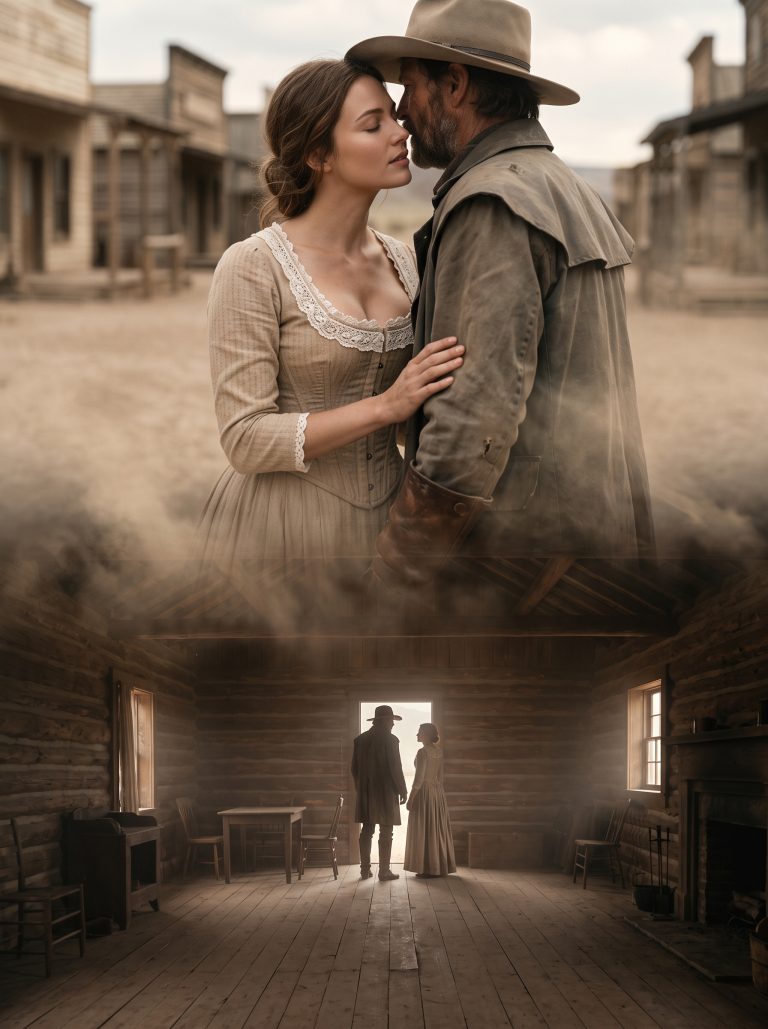
She began to cry. “You may begin,” she said through tears, “by kissing me before I lose patience entirely.”
He bent his head. The kiss was careful at first, then broke into something warmer, full of all the words they’d stored in silence. Rain fell on them; a calf bawled behind them with poor timing and great conviction.
Willa laughed against his mouth. “That calf has opinions.”
“She comes by it naturally.”
They were married three weeks later, when the roads dried enough for Reverend Holt to come and the neighbors pretended they had always approved. Mrs. Callender arrived with a cake and a face full of complicated surrender. Garrity brought coffee as a gift. Cordelia wore black silk softened at the throat with lace and held the baby while Willa dressed.
Willa’s gown was not white — a deep green wool Amos had bought after asking Mrs. Callender, with painful seriousness, what color made a woman look like spring after a hard winter. Around her neck, tucked beneath the collar, she wore a small ribbon that had belonged to Nell.
“You look beautiful,” Amos said in the kitchen doorway.
“You look terrified.”
“Of deserving it.”
“You don’t earn love like store credit, Amos.”
“I’m learning.”
“You’re slow.”
“But steady.”
The baby fussed from Cordelia’s arms during the vows until Willa reached for her, holding the child between them, one small fist fisted in green wool. When Reverend Holt asked for the child’s name before baptism, Amos looked at Willa. She nodded.
“Rebecca Hope Kestrel,” he said, voice thick but steady. “For the mother who gave her life, and the hope that came after.”
Cordelia wept openly. Willa kissed the baby’s brow. Amos’s hand found the small of her back, not claiming, only there — a place to lean if she wanted it. She did.
Spring opened fully. Willa planted beans, onions, and a stubborn row of flowers along the cabin wall, because a house should offer bees some hospitality. Amos widened the porch without mentioning he’d noticed she liked to sit there in the evenings. By summer she had twelve books, three ledgers, and a reputation in town for speaking plainly enough to make dishonest men sweat. She found two places where Garrity had overcharged Amos, and thereafter he called her Mrs. Kestrel with grave respect. Amos taught her to ride without gripping the reins like a death sentence; she taught him to read poetry aloud without sounding like he was apologizing to each word.
In autumn, Cordelia returned with a small piano, alarming every man involved in moving it. The first notes filled the house with such tender astonishment that Amos stood on the porch a while, looking toward the cottonwoods.
“Too much?” Willa asked, finding him there.
He shook his head. “Rebecca wanted music in this house. I told her one day.”
“One day came.”
Winter returned, but the house met it differently — jars in the pantry, split logs stacked high, curtains at the windows, books on the shelves, music in the parlor, a child learning to pull herself upright by gripping her father’s trouser leg. There was laughter now when the wind screamed. There were quiet nights when grief came and sat with them, and neither drove it out; they simply made room beside the fire.
On the first anniversary of the morning Willa had walked up the road, Amos found her by the cottonwoods, standing between two graves — Rebecca’s, and a smaller marker he’d carved himself for Nell, though the child’s body lay far away. Willa had not asked him to do it.
“Is it foolish?” he’d asked, setting it there.
She’d touched the carved name and wept too hard to answer. Now he came up behind her with the baby bundled in his arms.
“She wanted you,” he said, and the child reached for Willa, making an impatient sound.
“She always wants what she wants,” Willa said, taking her.
“Comes by it naturally.”
The cottonwoods rattled bare branches overhead. Beyond them, the ranch stretched into pale winter sunlight — barn, corrals, smoke lifting from the chimney, the porch Amos had widened, the windows Willa had curtained, the home neither of them had expected to find.
“I thought that road was the end of me,” Willa said.
“I thought this house was finished.”
The baby patted her cheek with a mittened hand. Willa kissed her fingers. “Turns out we were both mistaken.”
Amos wrapped one arm around his wife and one around the child who had cried them into each other’s lives, and together they stood until the cold pressed them back toward the house — where the stove waited, the piano waited, the books waited on their shelves, and Rebecca’s blue shawl lay folded over the cradle, not as a relic of sorrow now, but as part of the family’s keeping.