She Came to Cook One Simple Meal—But Changed a Father and His Six Sons Forever

Part 1
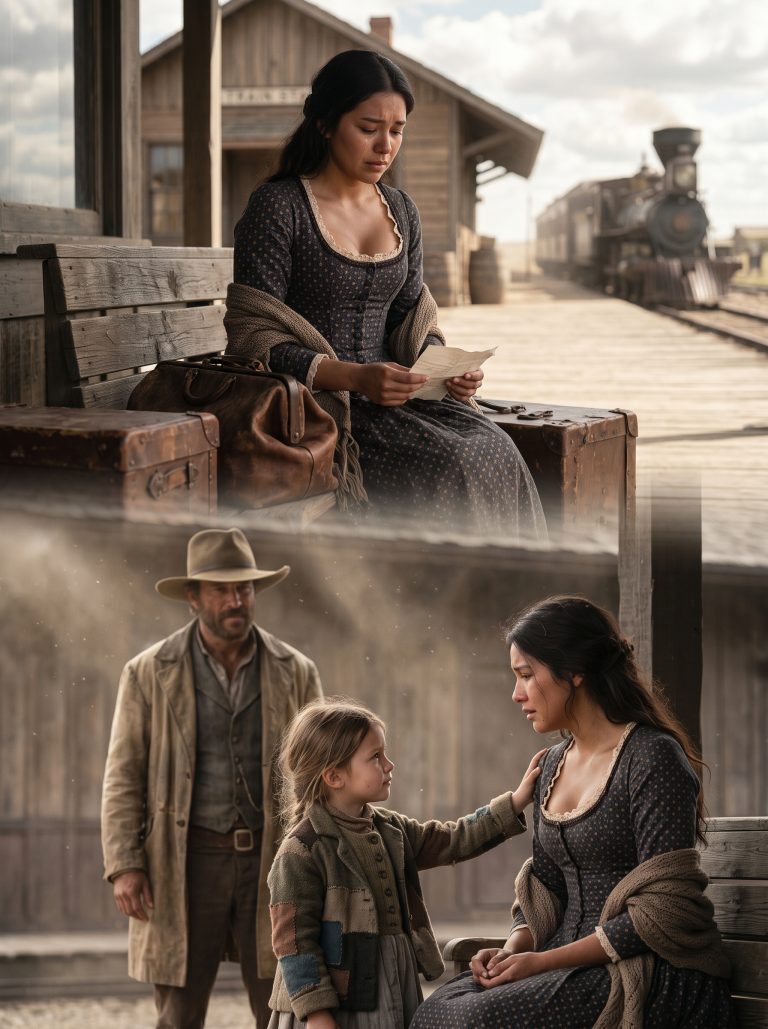
Clara Doyle came to Calder Ranch with a borrowed satchel, a roll of kitchen knives wrapped in oilcloth, and eleven days left before the bank in Marrow Creek turned her late husband’s debts into a public shame.
The wagon driver said little on the long road out. He only pointed once, with his chin, toward a line of low hills. “Calder land starts there.”
Clara looked. Wyoming stretched wide and wind-scoured, sage crowding the roadside, cattle moving like slow dark thoughts across dry grass. It was beautiful in the way that offered no comfort at all.
She had not eaten since the morning before. That was not unusual anymore. Hunger had become one more line in a ledger she balanced daily, alongside rent, coal, and the impossible accounting of what Thomas Doyle had left behind when his heart gave out in a card room, two unpaid notes in his coat and one more lie still warm on his tongue.
She had cried for three weeks. Then she had opened his books. After that, crying had seemed like an extravagance she could no longer afford.
Thirty-two years old, widowed ten months, and no longer foolish enough to mistake charm for kindness — that was Clara now. Thomas had worn charm like a good coat, meant to make people step aside for him. He’d called her “sharp” when her arithmetic saved him money, and “too sharp” when it uncovered what he wanted buried.
When Mrs. Hollis at the boardinghouse had slid a four-line contract across the table, Clara had read it and simply said, “I can leave within the hour.”
Six sons, ages nine to twenty. Wages first of the month. Room and board.
Beneath it, in a different hand: No attachment. No sentiment. Food only. Signed, Jonah Calder.
The ranch house, when she reached it, had good bones under a layer of neglect — a sagging porch rail, a pump handle lashed with rope where a bolt should be, a kitchen garden gone to weeds. Grief, she thought, could rot a house as surely as water.
A man stood on the porch and did not come down to help her. Jonah Calder was tall, broad, his face built around a hard jaw and eyes the color of storm water. He looked at her satchel. “That all?”
“My knives are wrapped separately.”
“Didn’t ask about knives.”
“No,” she said. “But you hired a cook.”
He turned and walked inside. She followed.
The kitchen was not filthy — it was worse. It was the wreckage of people who had tried and failed and never learned the word for their failure. Salt sat in a sugar tin. A flour sack had a mouse hole tied shut with twine. The flue hadn’t been cleaned in months.
“I’ll need the root cellar,” Clara said.
He pointed, arms crossed. “I’ll be with the herd. Boys come in at dusk.”
He called toward the yard. “Silas. Carry water for Mrs. Doyle.”
A boy of sixteen appeared, dark-haired, guarded eyes already narrowed against the world. He took the buckets without complaint and said nothing else.
By dusk she’d cleaned the flue, found the cellar better stocked than anyone in the house seemed to know — potatoes, dried beans, a ham hock, jars of tomatoes — and set beans to simmer with cornbread rising in the skillet. Once, bending over the flour bin, the room tilted briefly around her; she steadied herself against the table and kept working, because stopping had never once solved anything. The kitchen filled, for the first time in a long while, with the smell of a house being fed.
The boys came in one after another, youngest to oldest, as if the order had become a habit that outlived the reason for it. Sam, the smallest at nine, stopped dead in the doorway, freckled and wide-eyed.
“It smells like Ma’s kitchen,” he said, and the room went still behind him. Toby and Micah filed in, uncertain what to do with the silence. Reuben came next, restless hands going quiet for once. Silas came in just after, touching Sam’s shoulder once on his way to the washbasin without a word.
Gideon came last of all — twenty, and already carrying a man’s tiredness in the set of his shoulders. He saw his youngest brother frozen in the doorway and steered him gently toward the basin, not meeting Clara’s eyes.
“Wash up, Sam.”
“I did.”
“Again.”
Jonah came in behind them. He looked at the table: six places set for his sons, one at the head for himself. None for Clara. She stood at the stove with the serving spoon, telling herself that was simply the shape of the agreement.
When the meal was nearly done, Sam looked up. “Aren’t you eating?”
“After,” Clara said, and her voice came out thinner than she meant it to.
Jonah’s spoon stopped moving. He looked at the table, then at her, then stood, filled a bowl as full as his sons’ had been filled, and set it at the empty place by the stove.
“Sit down.”
It was not gentle. It was a command thrown against the whole shape of her hunger — and she sat, and no one remarked on it, and something small and fierce shifted in the room.
That night, in a narrow room that smelled of cedar, Clara did her arithmetic. One month’s wages minus rent minus Thomas’s last note left little. But little, she thought, was not nothing.
By the fifth morning she found the ranch ledger sitting between a tobacco tin and a broken pocket watch. It was not fraudulent — she knew fraudulent, she’d lived inside it for years. This was only neglected: a June cattle sale entered twice, interest calculated on the original balance instead of the reduced one. Someone had overstated what Jonah owed the bank by nearly sixty dollars.
At supper, after the boys had gone, she told him plainly.
“You read my books,” he said, jaw tightening.
“It fell open.”
“Convenient.”
“Yes,” she said. “But sixty dollars is sixty dollars.”
He didn’t answer. But in the morning, the ledger sat on the table beside a freshly sharpened pencil.
Part 2
Rain came the following week, heavy enough to drown the yard in mud. It kept the boys indoors and gave Clara her first real look at how hungry the house had been — not only for food, but for order, for someone to notice the difference between Reuben’s mischief and his worry.
By midweek, all six boys had flour on their hands and biscuits rising under Clara’s instruction. Jonah stopped in the doorway when he saw it, and for one breath his whole face opened before it shut again.
“Barn roof’s leaking,” he said.
“Then you’ll need coffee first,” Clara answered, and poured it before he could refuse.
“Silas and I will see to the roof this morning,” Gideon said, and Silas nodded, already reaching for his coat — the first task anyone had handed him that week that wasn’t simply carrying water.
By midday the leak was patched, canvas and pitch holding against the worst of the rain, and Gideon was back in the kitchen drying off when Jonah brought down a tin box of his late wife Margaret’s papers — a land deed still in her name, and beneath it, an old, half-folded note recording a payment credit on the mortgage that had never made it into the bank’s later accounting.
“This matters,” Clara said. “Combined with the ledger error, you owe far less than you think.”
Before he could answer, a carriage came up the muddy road, and behind it, a second wagon whose driver Clara recognized in the set of his shoulders before she saw his face.
Vance Ashworth. Thomas’s last creditor — the man who’d arrived two days after the funeral with no paperwork and perfect confidence, informing her that grief did not cancel obligations.
“You know him,” Jonah said.
“Yes. My husband borrowed from him. Informally. That was always the point — nothing on paper, everything owed.”
Jonah’s eyes went from the wagon to her face. “What do you need?”
Not why didn’t you tell me. Not what have you brought to my door. Clara felt the question land somewhere she hadn’t expected.
“The credit note. Margaret’s deed. My summary of the ledger error. And someone who can ride to Marrow Creek before dark.”
“Gideon,” Jonah said, and his eldest son was already moving.
She wrote to a solicitor named Adeline Fairweather, a woman her father had once mentioned with real respect. Gideon rode out into the rain with the packet inside his coat.
When the carriages reached the porch, five of Jonah’s six sons gathered behind Clara and Jonah without being called — Gideon already gone toward Marrow Creek — even small Sam trying to look fierce with his hair plastered flat by rain. Silas stood nearest the steps, arms crossed in an unconscious echo of his father.
The bank agent, Pruitt, began with soft apologies. Vance Ashworth’s eyes moved from Clara to Jonah to the line of boys, and something in his face recalculated. He had expected a grieving rancher and a debt-ridden cook. He had not expected a household standing together.
“The matter need not become unpleasant,” Vance said.
“It already has,” said Jonah.
They left after ten useless minutes, promising to return. Clara watched the mud swallow their wheel tracks and felt, for the first time in a year, that she was not standing alone against it.
Part 3
Adeline Fairweather arrived the next afternoon with mud to her hem and spectacles she used like a weapon. She read Clara’s summary, the credit note, and Margaret’s deed in the sitting room while rain dripped from her coat onto the rug.
“I know Vance Ashworth’s work,” she said. “Just enough paper to frighten the desperate. Never enough to survive a judge.”
“Can you stop him?” Jonah asked.
“I can make him regret arriving.”
The meeting took place at the kitchen table three days later, because Clara insisted the kitchen was where the household had learned to tell the truth. Pruitt opened with bank language. Adeline answered with property law. Vance, finding no ground in figures, turned to softer weapons.
“Thomas always said you thought yourself cleverer than was becoming in a wife,” he said to Clara, smiling the way he had smiled in Mrs. Hollis’s parlor.
The room went dangerously quiet. Reuben half-rose from his chair before Gideon caught his sleeve, and Silas, standing near the doorway, took one step further into the room without quite meaning to.
Jonah moved from the wall and stood beside Clara’s chair. “Then Thomas was wrong,” he said, without raising his voice. “Mrs. Doyle is exactly as clever as the situation requires.”
Adeline set down her pen. “Mr. Ashworth, if your legal position depends on insulting a widow who has done more accurate accounting in a week than your bank agent managed in two years, I’d advise silence.”
By evening, the ledger error was corrected, the bank’s inventory notice withdrawn, and Pruitt dismissed from the Second Territorial Bank for what Adeline dryly called “habitual arithmetic in the bank’s favor.” But although Vance left without the land, he had not exhausted his schemes. Three days later, a letter arrived at the ranch, addressed not to Jonah but to Adeline, demanding a hearing on the rightful heir to Margaret Calder’s inherited land. Vance claimed that Margaret’s deed had been issued under a disputed transfer from her father’s estate. As her elder half-brother — wrongly disinherited, he wrote, in favor of a second wife’s children — he intended to challenge that original transfer in court.
Jonah went pale reading it. “I never knew Margaret had a brother.”
“Neither, I think, did she,” Clara said slowly, because something about the claim didn’t sit right in her mind the way true things sat. A man who truly wanted land quietly bought debts and waited. He did not announce a blood claim in a letter a solicitor could pick apart. Unless he had nothing else left to try.
That night, Clara opened the recipe tin she had left untouched for weeks, meaning only to look for a molasses cake recipe Sam had been begging for. Instead, tucked beneath the folded papers in Margaret’s hand, she found an older letter — brittle, signed by Margaret’s father, addressed to Margaret herself, meant to be read only after his death.
My daughter — if ever a man named Vance Ashworth comes asking after this land, know that he was never denied out of favor for another wife. He was removed from my will the year he forged my signature on a note to a Cheyenne bank, and tried to sell timber rights that were never his to sell. I could not prove it to a court without shaming us both, so I let the world believe it was simple preference. But you must know the truth, in case truth is ever needed to defend what’s yours.
Clara sat very still at the kitchen table, the lamp burning low, and understood the whole shape of it at once. Vance Ashworth had not built an empire from cleverness alone. It rested on one old fraud no one had ever been able to prove, repeated in smaller ways on smaller people ever since. Thomas’s debt. The bank’s error. Now this claim on the land. He was not a mastermind who had arranged Clara’s arrival at Calder Ranch from the beginning; he was simply a man who took whatever coincidence handed him and pressed it for all it was worth. By chance, he’d learned that his sister’s widower owed a bank he could quietly buy influence in, and that the widower’s new cook happened to owe him. No plan had been necessary. Patience and other people’s papers were enough.
She woke Jonah before dawn and put the letter in his hands.
“He forged a note thirty years ago,” she said. “Your father-in-law knew it. He wrote this down so the knowing wouldn’t die with him.”
Jonah read it twice, his jaw working. “This may be enough to end it.”
“If Adeline can authenticate the handwriting and connect it to the old bank record, yes. A forged note. A man disinherited for exactly the fraud he’s committing again. A judge won’t need to hear much else.”
He looked up at her, something raw moving under the surface of his face. “You keep finding the thing that saves us.”
“I only find the paper,” Clara said. “What you do with it is what saves this family.”
Adeline authenticated the letter within the week, cross-checked against a Cheyenne bank clerk’s decades-old record that still, miraculously, existed in a dusty file that Gideon retrieved after riding two full days to Cheyenne and back. Vance Ashworth’s claim collapsed before it ever reached a judge’s bench. He did not return to Calder land again. Clara heard, much later, that he’d tried the same maneuver on a rancher two counties over, and that this time, word of Marrow Creek had traveled ahead of him, and no one opened their door.
Clara’s one-month contract had quietly ended in February. No one had spoken of her leaving, and she had not raised it either, though she noticed the date pass and noticed, too, that noticing it no longer frightened her.
Spring came slowly to the ranch that year, the way healing does — not as a single thaw but as many small ones. The garden was cleared. The trough was mended properly instead of patched. Margaret’s recipe tin stayed on the kitchen shelf, joined by Clara’s own notes tucked in beside it, one household’s memory resting next to another’s instead of erasing it.
Jonah asked her to marry him on the porch at dusk in March, wearing, Clara noted, his good shirt since noon.
“I thought it was subtle,” he said, mildly betrayed by his own clothing.
“It was not.”
He asked her plainly — not for the ranch, not for the boys, though the boys loved her, and not to settle an obligation, but because he wanted to build the rest of his life with a woman who told him the truth even when it cost her comfort to say it.
“And my work?” she asked.
“Yours.”
“My name on the accounts?”
“Doyle or Calder, whichever you choose. Adeline can make it legal enough to frighten any banker in the territory.”
She laughed, and said yes, and the cheer that came from inside the house — six boys badly pretending not to have been watching through the window — was immediate and entirely unconvincing as an accident.
They married in the sitting room in April, because Sam insisted the kitchen would make everyone hungry before the vows were finished. Clara wore her old black dress with a new collar and a blue ribbon Sam had chosen because it looked, he said, “like sky after bad weather.” When Adeline asked if she came to this marriage freely, Clara answered without a breath of hesitation.
“Yes.”
That evening she served a meal so large even Reuben admitted defeat, and the household ate together at a table with enough chairs for everyone, following a rule Jonah had once added to a four-line contract in his own hand: no person in this house shall eat standing from what remains, unless by choice. Silas, who rarely said much at any table, quietly refilled Clara’s coffee before she’d noticed it was empty — the same small, unasked-for kindness he’d carried water with on her first day, grown into something steadier now.
Clara thought, watching the lamp light move over her husband’s face and the loud, ordinary noise of six boys arguing over cards in the next room, that she had come to this ranch starving in more ways than one, and that the thing which had finally fed her was not luck, or love alone, but the plain, patient work of two people willing to put the truth on the table before anything else — the ledger, the letter, the whole broken history of what other people had tried to bury. A house did not heal because grief left it. It healed because someone kept opening the books, kept insisting that the truth, however old or inconvenient, deserved to be found and set right.
She had come to Calder Ranch to cook. She stayed to live — and to teach six boys, and one careful, guarded man, that nothing false could survive long at a table where every account was finally, patiently, made honest.