In the Middle of a Deadly Blizzard, She Chose to Save One Comanche Baby — Days Later, 100 Warriors Came Looking for Her

Part 1
The blizzard swallowed everything.
Fence posts vanished under drifts. Pines bowed low, groaning beneath white weight. The sky pressed down like a lid closing over the world.
Eleanor Hayes had just driven the last nail into a shutter when she heard it — not the wind, not ice cracking off the eaves, not the barn’s tired complaints against the storm.
A cry. Thin. Human.
She went still, breath fogging in front of her. It came again, closer, ragged and small, like a heartbeat trying to force its way through the wind.
She didn’t think. She grabbed her coat and pushed out into the whiteout, the cold clawing at her face as if it had a grudge to settle. She followed the sound more than her eyes, boot after boot sinking through crust and powder.
Ten paces past the paddock fence, she nearly fell over him.
A bundle, half-buried, wrapped in a faded red blanket stitched with patterns she recognized at once — Comanche work, careful and deliberate, not the kind of thing wrapped around a child by accident.
The bundle moved. Wailed.
Eleanor dropped to her knees in the snow.
Inside was a baby, no more than eight or nine months old, skin gone the color of old candle wax, a shallow cut crusted dark above his brow. Around his neck hung a cord threaded through a carved piece of bone.
She didn’t remember deciding to run. She only remembered the door slamming shut behind her, the fire roaring back to life, and her own voice — a voice she hadn’t used since her son died five winters back — humming something without words. Her mother had been the closest thing the valley once had to a midwife, and Eleanor had learned at her elbow from the age of fourteen, before grief had quietly walked her back from other people’s doorways and left the skill sitting unused, like a tool hung on a nail.
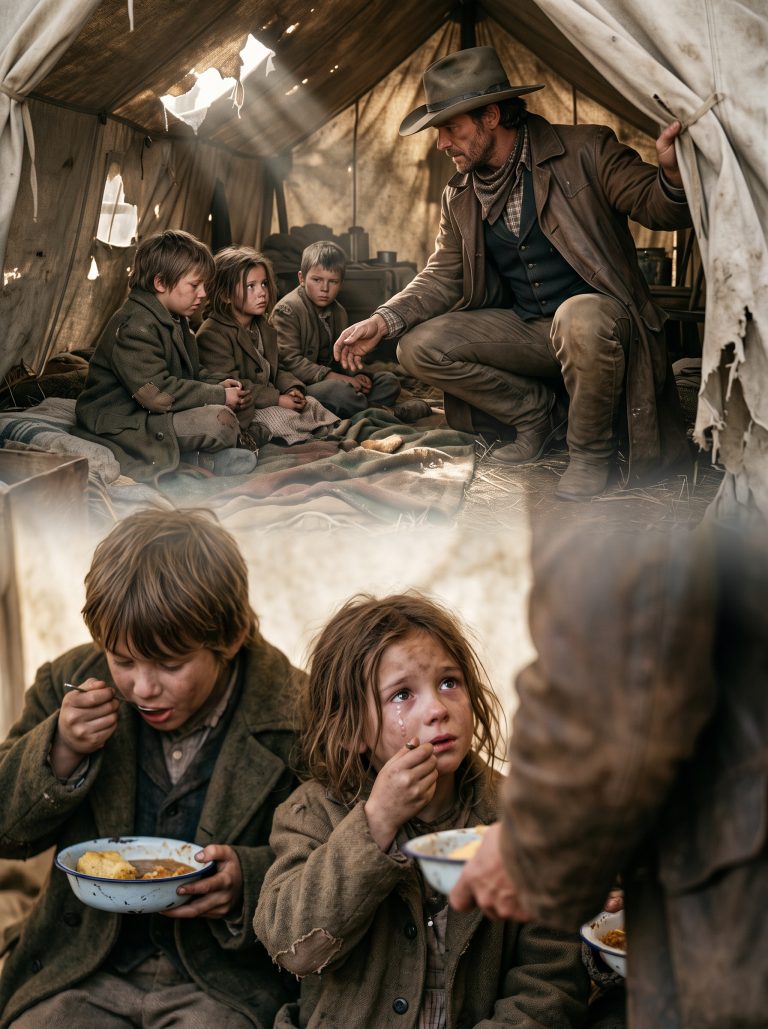
The storm raged twelve more hours. Eleanor didn’t sleep. She held two fingers against the baby’s wrist all night, counting a pulse that kept threatening to slip away from her. Fever came at dawn, sweat beading on skin still cold underneath. She pressed damp cloths to his forehead and talked to him the way she used to talk to a child who was no longer in this world.
By midday the wind had thinned to a hiss and the baby’s cry had strengthened from a whisper to something that could fill a room. Eleanor allowed herself to breathe.
When she changed his wrappings, she found bruising along one arm, a graze at his hip — the marks of a fall, or of having been carried at a hard run through brush. He was not the kind of lost that happens by accident. Someone had run with this child. Someone had wrapped him with care even while running.
That afternoon, hooves crossed her yard. One rider.
She tucked the baby beneath a quilt in the back room, laid her palm on his chest until she felt the rise and fall settle into rhythm, then stepped onto the porch.
Silas Crane reined in his horse, breath clouding above a face already red from whiskey and cold. He farmed sixty acres east of her and was sober perhaps one day in ten.
“Roof still standing?” he called.
“It is.”
“Fella in town said he saw fresh tracks headed this way, night before the storm broke. You see anybody?”
“Just snow, Silas.”
He squinted past her toward the shuttered windows for a moment too long, then clicked his tongue at his horse and rode off toward the ridge.
That night the baby wouldn’t settle. Not hunger, not cold — something closer to fear, the kind that doesn’t need words to explain itself. Eleanor walked slow circles around the room with him, singing scraps of lullabies she’d buried along with her own son, and somewhere in the singing she stopped being able to tell whose child she was comforting.
The next afternoon, Ruth Bellamy came by with a loaf of bread and a face full of questions she didn’t bother to disguise as concern.
“You’ve been quiet,” Ruth said, eyes moving past Eleanor’s shoulder into the house. “Nobody’s stopped by?”
“Nobody who’d interest you.”
Ruth smiled the way people smile when they’ve already decided what they believe. “You’d know if somebody had.”
Eleanor took the bread, thanked her, and closed the door before the smile could turn into a question she’d have to lie about twice.
That night, she made a decision the storm had already made for her. She could not hide a living child forever — the snow would melt, and melted snow told the truth about tracks. But she found, turning the thought over by the fire, that she had no intention of surrendering him either.
He had wrapped his whole fist around one of her fingers earlier that evening, grip far stronger than a starved, storm-battered infant had any right to have, and stared up at her as though he were memorizing the shape of her face for later use.
For the first time in five years, something in the world needed her to still be standing in the morning.
She sharpened the kitchen knife. She moved the rifle down from the mantel to the table within reach, and she checked it twice before she let herself sit.
Past midnight, she dozed sitting upright by the door and woke to the sound of hooves — not one rider this time, but three, moving without hurry, without the careless noise of men who didn’t already know exactly where they were going.
She looked through the gap in the shutter.
Buffalo hides. Painted faces. Horses that made almost no sound on the snow crust, as if they’d been trained their whole lives never to announce themselves.
One man dismounted near the chicken coop and crouched, running a gloved hand along a drift, reading it the way Eleanor might read a letter.
They’re following his trail back to me, she thought, and her stomach dropped through the floor.
The man rose, turned toward her window, and inclined his head — not a greeting exactly, more like a debt being acknowledged.
Then all three turned their horses and rode back the way they’d come, leaving no further mark on the snow than they had to.
Eleanor held the baby tighter and, not quite believing her own voice, whispered against his hair: “They know you’re here. And they didn’t take you.”
Sleep never came that night either. She only sat with the rifle within reach, waiting to learn what the gesture had meant.
Part 2
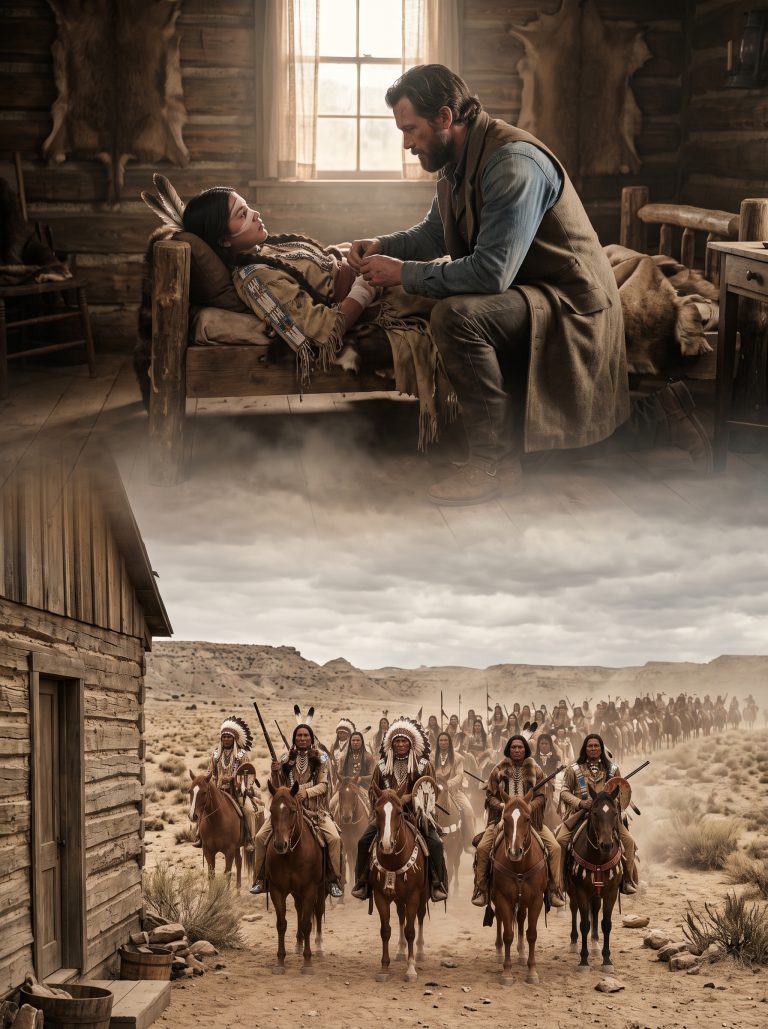
On the third day, the sound came again — not three horses this time, but what felt like hundreds, a low roll of thunder moving over the ridge under a clear sky.
Eleanor carried the baby out onto the porch to meet whatever was coming, because hiding from a hundred riders had never once, in the whole history of the world, worked.
These were the last years when a line like this could still cross open country without the army riding out to meet it, and a line of Comanche warriors crested the rise now, mounted, silent, more than she could easily count. At their head rode a man in a dark red cloak, his braids threaded with silver, a scar tracing white along his jaw. He stopped fifty yards out, dismounted alone, and walked the rest of the way on foot.
He climbed her porch steps and looked at the child in her arms for a long moment before he spoke.
“You saved my son.”
“I did,” Eleanor said.
“He was not left in the storm by chance.” His eyes didn’t leave the baby’s face. “His mother is dead. We were struck in an ambush two nights before the blizzard, and in the breaking of our camp, I carried him myself — until the men hunting us closed too near to outrun with a crying child in my arms. I left him where I believed a door would find him, then rode to pull the hunters away from that door instead of toward it. The storm took my tracks after that. For two days I did not know if I had guessed right, or only left my son to freeze believing I had saved him.”
“I heard him crying.”
“You heard something calling,” he said, “and you answered it, instead of turning back inside where it was warm. That is not a small thing, in either of our worlds.”
The silence between them stretched long enough that the wind filled it.
“Will you give him back to me?” he finally asked.
Eleanor looked down at the small, fierce face pressed against her collarbone. “Will you take him from me if I say I’m not ready?”
He studied her — not with anger, but with something closer to recognition. “No,” he said. “I will not.”
“I wasn’t trying to keep what isn’t mine,” she said. “I’m only telling you the truth. I’m not ready to lose him tonight.”
“You have not lost him,” the man said. “You are the reason he still breathes to be argued over.”
He crouched, touched the boy’s small foot with two fingers, gentle as a man handling something that could still break.
“You are part of his story now, whether either of us planned it.”
“What does that mean, where you come from?”
“It means you are blood,” he said simply. “And blood is not left behind, even when it isn’t born of the same body.”
A woman stepped forward from among the riders — Tabitha Sings-in-Winter, as Eleanor would come to know her — carrying a cradleboard and a length of leather threaded with a new carved bead.
The man — Standing Elk, chief of his people — lifted the old bone cord from around his son’s neck and replaced it with the new one.
“I am giving him a new name today,” he said. “I will give you one as well.”
“What name?”
“Mother Who Hears.”
Then the warriors turned as one and rode back over the ridge, taking the thunder with them and leaving an unbearable quiet behind.
The boy would go with them in the morning. Eleanor understood that without being told twice.
For one more night, though, he was hers.
And on that particular night, in that particular winter, it was enough.
Part 3
She did not sleep that last night either. She lay beside him with one hand resting flat against his chest, memorizing the rhythm of it the way she had memorized her own son’s, once, in a life that already felt like someone else’s.
At sunrise she wrapped him in a shawl she hadn’t touched in years and carried him out to the porch, bracing for hoofbeats that didn’t come. The land lay silent. No riders. Just the enormous quiet that follows any kind of parting.
She rocked him slowly. “Little Hawk,” she whispered, trying the name she would have given him if the world had let her keep that right. “That’s what I would have called you.”
A single horse came out of the treeline. Tabitha, riding alone.
“His father is waiting,” she said, reining in. “He does not want to take a child out of your hands. That is not our way.”
“Can I see where he’s going?” Eleanor asked, before she could think better of it.
They rode together — through pine stands, across a half-frozen creek, up a rise that opened onto a wide clearing where hide tents stood in loose rows, smoke curling up into a sky gone the pale blue of new ice. Children in fur-lined moccasins chased each other between the tents. Dogs slept in patches of sun as if the whole camp had agreed, collectively, to survive winter through sheer stubbornness.
Standing Elk rose as they approached, no weapon in sight.
“You waited,” Eleanor said.
“I wait for what is mine,” he said. “And for what is sacred. Sometimes those are not the same thing at the same time.”
He took the boy into his arms, hands visibly unsteady, and for a moment the fierce, careful chief looked like nothing more than a father who had believed, for two full days, that he’d buried his only son in the snow.
Eleanor stepped back to let him have that moment. He stopped her before she could retreat further and pressed a cloth-wrapped object into her hands — a medallion of bone and turquoise, carved in a pattern she didn’t recognize but understood anyway.
“He will know your name,” he said.
“I already know mine,” Tabitha added, quiet. “Among my people, you will be spoken of as the Woman Who Heard Him.”
Eleanor bowed her head, unable to answer that with anything that felt sufficient, and simply said, “Tell him, when he’s old enough to hear it — he didn’t only survive because of me. I’ve been more alive these three days than I have been in five years. He saved something in me too.”
She rode home alone. The house looked the same and felt entirely different, the way a room does after someone has died in it, except in reverse — it felt as though someone had, impossibly, arrived.
She hung the medallion above the mantel where the morning light would find it. And every Sunday after that, without missing one, she baked two loaves of cornbread — one for her own table, one left on the flat stone by the creek.
It always disappeared by nightfall.
On the fifteenth day, Tabitha returned with the boy wrapped against her chest, his color grayish, his breathing shallow. “The cut on his brow closed too fast on the outside,” she said, pulling back a corner of the wrapping to show skin gone red and hot around a wound that had swollen instead of healed. “By last night he would not nurse, and by this morning he would not wake easily. We feared it would take him after all. He cried when they tried to remove the red shawl you’d wrapped him in first. He knew the smell of it.”
Eleanor didn’t wait for permission. She took him inside, sat with him through another long night the way she had the first one, and by morning the fever had broken.
“He is not here to stay,” Tabitha said as she prepared to leave with him. “But he will be here, in some form, to be loved. That much I can promise you.”
Weeks folded into months. Three small tents appeared, periodically, at the edge of Eleanor’s land — not as a threat, not in secrecy, just as a presence, the way family arrives without needing an invitation each time. They shared stew and long silences that somehow said more than conversation would have.
Eleanor’s own reputation shifted in town without her seeking it. She was summoned to Pinto Crossing to deliver a breech baby and did the work calmly, competently, and the child lived. People began calling her a healer in tones that mixed respect with unease. When Ruth Bellamy finally worked up the nerve to ask, straight out, whether Eleanor still “saw Indians,” Eleanor answered, “I don’t see races out here, Ruth. I see people who show up, and people who don’t.”
Summers passed. A carved wooden bird would appear by the creek some mornings, no explanation attached, none needed. A moccasin, too small for anyone but a toddler, turned up on her windowsill one day with a strip of hide tucked inside bearing five uneven English letters someone had clearly worked hard to shape: he speaks your name.
Then, one bright morning nearly two years after the storm, hoofprints marked her yard again. Before Eleanor had even reached the porch rail, a small boy came running toward her on his own two legs, faster than she’d ever seen him move, as though he’d been practicing the run the whole three months since she’d last held him.
“Ma,” he said, the word landing in the cold air like something solid.
The whole camp fell silent around it.
That was the year Eleanor stopped waiting for him to be given to her and started simply expecting him — the way you expect winter, the way you expect the sun to come back around after it goes.
The following spring brought a hard test of everything the two of them had built without a name for it. A fever swept through the valley — the kind that didn’t care about the color of a man’s skin or which side of a treaty line his tent stood on — and it moved through Standing Elk’s camp before anyone had a chance to shut a door against it. Eleanor rode out the moment word reached her, saddlebags loaded with what little she had that might help: clean linen, boiled water, willow bark for the fevers, and the dried herbs and remedies she’d been gathering and testing on her own household for years.
She stayed eleven days. She lost two patients she couldn’t save — an old woman and an infant not yet given a name — and she carried both losses home with her the way she carried every loss, quietly, without letting anyone see the weight of it. But she did not lose Little Hawk, though for one night his fever climbed high enough that Tabitha sat across from her without speaking, both of them simply watching his chest rise and fall by firelight, bracing for the same outcome they’d braced for once already, years before, in a house buried under snow.
He woke at dawn asking for cornbread, and Eleanor laughed for the first time in eleven days, a sound that startled even her.
Word of those eleven days traveled faster than she expected. Silas Crane, sober for once, showed up at her door that autumn with his own boy running a fever and nowhere else steady enough to bring him. Eleanor didn’t ask what had changed his mind about “strangers” and “tracks in the snow.” She simply let him in, the same way she had once opened her door to a child the storm had delivered, and treated the boy, and sent them both home two days later with instructions and a jar of the willow bark tea. Silas never mentioned it to anyone in town, and neither did she, but he stopped riding past her fence with that particular squint in his eye, and some winters he left firewood stacked by her door without being asked.
Ruth Bellamy took longer to come around, and never fully did — some doors, Eleanor came to understand, simply don’t open twice — but even Ruth, in her way, stopped repeating the old rumors once half the valley had either been treated by Eleanor Hayes or knew someone who had.
It was another two years before Standing Elk told her the truth, and he told it to her not as a confession but as a debt finally being settled out loud.
It happened on an ordinary evening, both of them sitting by her fire while the boy — six years old by then, moving easily between two names and two languages — slept in the back room with a dog he’d more or less adopted from her barn.
“You have never asked me why I brought my son to your door instead of any other,” Standing Elk said. “Most in your position would have asked at once.”
“I assumed it was the storm,” Eleanor said. “That you were simply close to my land when the trouble found you.”
“We were three miles from my own camp when the trouble found us,” he said. “Your cabin was not close. It was chosen — long before that night, though the night decided when.”
Eleanor set down her cup.
“I told you once that I left him where I believed a door would find him,” Standing Elk went on. “I did not tell you it was your door I meant from the start, or that I stayed beyond your paddock fence after I set him down, longer than was wise with men behind me. The storm was too thick to see clearly, but I saw a shape cross from your house into the snow, and then the shape did not come back out empty-handed. Even from that distance, in that whiteout, I could not tell you whether what she carried back inside still breathed, or was only being carried in to be kept from the wolves until morning. I knew he had been found. I did not know he had been found in time. Only then did I ride east, so the men tracking us would follow my horse instead of your fence line.”
“Twenty winters ago,” he went on, “before you were his wife, before the war made trading into something men were ashamed of, I was a young man caught in a blizzard not unlike the one that brought my son to you. I was half-frozen, alone, an enemy on land that was not mine to be found on. A man came out into that storm anyway. He carried me inside. He fed me. He never told a soul I had been there, though it would have cost him nothing but the truth to hand me over.”
“My husband,” Eleanor said slowly.
“Your husband,” he agreed. “He asked for nothing in return, which among my people is its own kind of debt — the kind that can never be paid back directly, only forward, to whoever needs it next. I swore that night that if the day ever came when my blood needed shelter and I could not give it myself, I would bring it to his door.”
“You told your people he had died with his mother,” Eleanor said, understanding arriving in pieces. “Not because you believed it.”
“I let the wider camp believe it, yes,” Standing Elk said. “Grief that ends in a death is simple — people know how to stand around it, how to let a man alone with it. Grief that ends in a living son given away to a settler’s house is not simple at all; it invites questions I was not ready to answer, and judgment from men who had lost sons of their own that winter and buried them properly. Only my sister and two of the old men on the council ever knew the truth — the ones who would keep a secret the way they keep a fire, tended but not spoken of. I told the rest the story that let both worlds keep their pride intact. Only the truth was owed to you, and I am giving it to you now, because you have more than earned it.”
Eleanor sat with that for a long moment, watching the fire instead of him. “So it was never an accident that I heard him crying.”
“No,” Standing Elk said. “It was the last debt of a man who is no longer alive to pay it himself. I only carried it the rest of the way for him.”
She thought of her husband, gone eight years now, who had never once mentioned a stranger sheltered from a storm, who had simply lived his whole life as though kindness owed to a man freezing in his path required no retelling afterward. She thought of her own son, buried under the same pines where she would one day be buried herself, and of how grief had made her certain, for five long years, that she had nothing left in her worth needing.
“He never told me,” she said.
“Some debts are carried quietly,” Standing Elk said, “so that the person who owns them can spend a whole life believing they gave something away for nothing — when in truth, they were only planting it somewhere it would grow back, later, for someone else.”
Eleanor was quiet for a long while after that, turning the fire’s light over in her mind the way she might turn a coin, checking both faces of it.
“Then it was never chance,” she finally said. “Not the storm bringing him to my fence line. Not the tracks Silas saw. Not even the ambush that killed his mother — you’re telling me you already knew, before any of it happened, where he’d end up if the worst came.”
“I knew where I would take him, if it came to that,” Standing Elk said. “I did not know the worst would come so soon, or so cruelly. No man plans for his wife to die defending a camp two nights before a blizzard. But when it did come, I did not have to decide where to run. That decision had already been made for me twenty winters earlier, by a man with no reason to help me except that I needed helping.”
“You could have told me sooner.”
“I could have,” he agreed. “But a debt spoken aloud too early sounds like a transaction. I wanted you to love him first, before you understood why he’d been given to you to love. I wanted the boy to be your son before he was ever explained to you as an obligation someone else owed your husband.”
Eleanor looked toward the back room, where Little Hawk slept with one arm thrown over the dog’s back, entirely unaware that the story of how he’d come to have two mothers and two homes had just quietly finished being told without him.
“And if I hadn’t answered that first night,” she said. “If I’d stayed inside, told myself it was only the wind.”
“Then I would have found another door,” Standing Elk said simply. “There is always another door, if a man is willing to keep walking in the cold long enough to find it. But I am glad, for both our sakes, that it was yours.”
They sat together without speaking after that, the way two people do when a long-carried weight has finally been set down between them and neither one quite knows what to do with the sudden lightness. Outside, snow had begun again, soft and unhurried, nothing at all like the storm that had first brought them together — just an ordinary winter doing what winters do, indifferent to the debts and gifts that pass, generation to generation, beneath its cover.
Eleanor never married again, and she never left the valley. The boy — who answered to his father’s name among his own people, and to Little Hawk whenever he crossed Eleanor’s threshold — grew up moving between two homes the way other children moved between rooms in the same house. He learned to track deer from his father and to set a broken bone from Eleanor, and he never once, in all the years that followed, seemed to find those two educations to be in conflict.
When Standing Elk grew old, it was Eleanor who sat with him through his last fever, the same way she had once sat with his son through a fever no one expected either of them to survive. When she herself grew old, it was Little Hawk — a grown man by then, with children of his own who called her Ma the way he had — who built the fire in her hearth each winter and made sure two loaves of cornbread still made it to the flat stone by the creek, even after her hands could no longer manage the kneading.
She died on a quiet morning many years later, in the same bed where she’d once counted a stranger’s pulse against her fingers through an entire storm. They buried her not in the churchyard in town, but beneath the pines near the creek, at her own long-standing request, in ground that belonged to no single people but had been shared, quietly and without ceremony, for most of her life.
On the wood marking her grave, one of Little Hawk’s youngest children carved the only word he had learned to shape on his own, in a hand still learning how to hold a knife steady:
Ma.
The kindness her husband had once given a freezing stranger had never vanished. It had simply traveled quietly through twenty winters, carried by a man who never forgot it, and returned at last — not as a payment settled, but as the family Eleanor had believed, for five long years, she would never be given again.
— end —