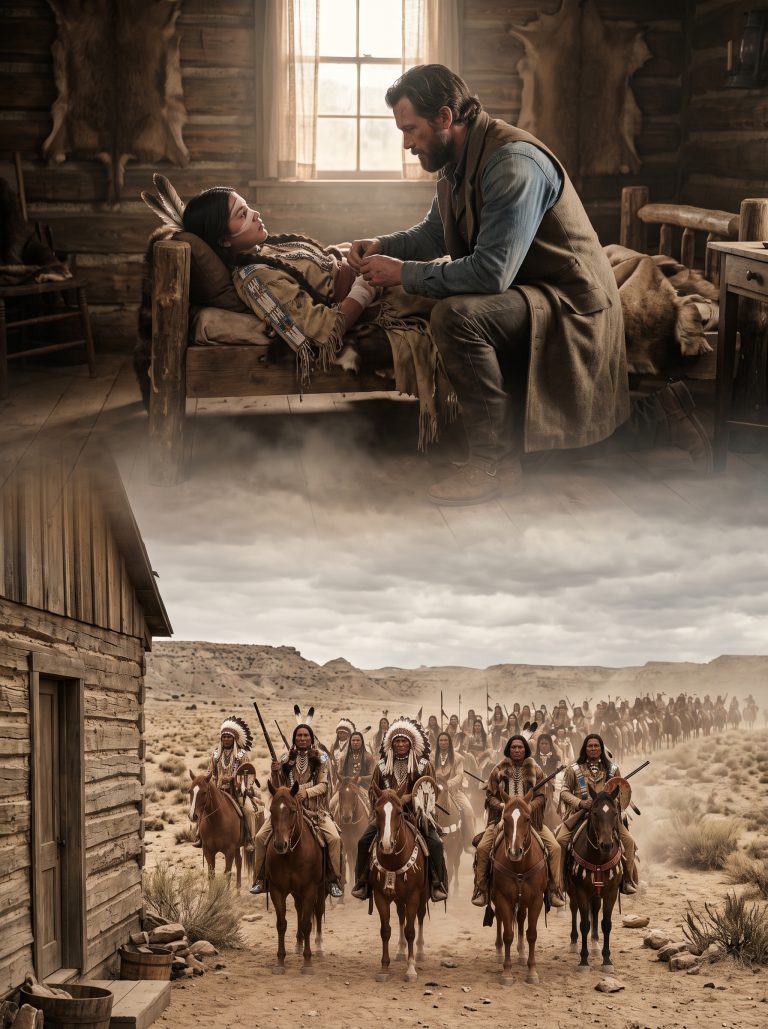
Mail-Order Bride Walked Into a Burned Cabin—What She Found Inside Changed 8 Hungry Children’s Lives Forever

Part 1
Abigail Reed had read the letter so many times the folds had gone soft as cloth. My dear Abigail, I count the days until the ninth of September, when you arrive at Kearney station… The handwriting belonged to Ethan Cole, a homesteader she had never met, a stranger who had written to her for eight months with a patience that felt like the opposite of everything Philadelphia had taught her about men.
She was twenty-five, orphaned two years past when a tenement fire took her parents and left her the debts they couldn’t pay. She had spent those two years in a textile mill, in a boarding house with thin walls, watching the city slowly close its fist around her. When she saw Ethan’s notice in the paper — seeks a woman of good character to help build something lasting — she hadn’t believed in romance. She had believed in the one door that didn’t lead back to the mill.
Ethan’s letters were plain and unhurried. He wrote about brutal winters and rich summers, about loneliness and the eight miles to his nearest neighbor, and he had sent her passage money without being asked, along with a promise: if she didn’t want him once she arrived, he would see her safely home. A man who handed a woman her own way out wasn’t a man trying to trap her. That was what had decided her.
So she rode the train through Chicago, through Omaha, through a Nebraska so wide it made the whole East look like something she’d invented. An old widow she met at a station stop told her, “The frontier doesn’t care if you can play piano. It cares if you can work, and if you can bend without breaking.” Abigail turned the words over for the rest of the journey.
Kearney was smaller and rougher than the letters had painted it — a scatter of raw timber buildings holding their own against an ocean of grass. She stepped onto the platform and scanned the crowd for a tall, bearded man in a blue shirt.
No one came.
The station agent knew of Ethan Cole but hadn’t seen him that day; farm work didn’t run on train schedules, he said, and returned to his ledger. Abigail spent the afternoon fighting down her unease, until a broad-shouldered woman loading a wagon outside the general store introduced herself as Nora Whitfield, a neighbor of Ethan’s.
“That’s not like Sam — like Ethan,” Nora corrected herself, frowning. “He’s been fixing that cabin for weeks for you. Let me and Hiram ride out and check on him. You wait at the hotel.”
Abigail waited through a sleepless night at Mrs. Doyle’s hotel, rereading letters that held no hint of danger, no warning at all. Morning brought Nora back at a hard gallop, her face bloodless.
“The homestead’s burned,” she said. “Burned to the ground. There’s blood, and signs of a fight, and Ethan’s nowhere. Hiram’s still out there looking.”
The ride out felt like watching a future die one mile at a time. What remained of the Cole homestead was worse than any words could have prepared her for — a collapsed chimney, a skeleton of a barn, a child’s rocking chair half-melted in the ash. Hiram Whitfield met them with his jaw set hard.
“This wasn’t Indians,” he said, before Nora could ask. “Too careful. Too deliberate. This was men who knew exactly what they wanted.”
He explained, grimly, what a woman fresh off the train from Philadelphia had no reason to know: that for months, organized raiders had been working the scattered homesteads of the territory, robbing and burning, and that the law out here was thin as smoke.
Abigail walked the ruin anyway, matching what was left against everything Ethan had described in his letters — the workshop, the well, the root cellar he’d dug with his own hands. Near the collapsed workshop she found its door, fresh scratches gouged into the dirt around the frame.
“Hiram,” she called. “Come here.”
Below, in a space the fire hadn’t touched, came a sound too human to be anything but a child.
“Please don’t hurt us,” a boy’s voice whispered from the dark. “We didn’t do anything wrong.”
One by one, eight children climbed into the daylight — filthy, gray with smoke and hunger, the oldest no more than fourteen and already standing between his siblings and the world with a rusted knife shaking in his hand. The smallest, a girl of three, clutched a corn-husk doll worn to threads.
“I’m Noah,” the oldest said warily. “These are my brothers and sisters. The bad men came at night. Our folks — ” His voice caught. “They wouldn’t wake up. We buried them ourselves. Then we ran here.”
Abigail knelt in the ash so she wouldn’t tower over them, and felt something in her rearrange itself completely. She had crossed a continent to become one man’s wife. Instead she was kneeling before eight children who had no one left at all.
“You’re coming with me,” she said. “All of you. We’ll figure out the rest together.”
Part 2
Nora called it madness, and by every practical measure, she was right. Abigail had forty-seven dollars, no house, no husband, no experience raising even one child, let alone eight, and winter was coming on fast. But watching Noah tuck a blanket around his little sister’s shoulders in the hotel room that night, Abigail understood that walking away simply wasn’t a door that existed for her anymore.
The next morning she went to the land office. Ethan Cole had filed a claim but never proved it up; the improvements — what little the fire had spared, including the root cellar — could reduce her burden, the clerk said, but she’d still have to live on the land, build, and cultivate it, alone, for five years.
She signed anyway.
The children, when told, cried and argued in equal measure — that was where the bad men had come from, Levi whispered — but Noah, hardening himself into the role he’d never asked for, began listing what they had: good water year-round, wild game, rich soil near the creek, Clara’s knowledge of roots and berries, Grace’s steady hands for sewing and cooking.
It wasn’t hope, exactly. It was something to build a hope out of.
Hiram helped her buy tools on credit. Nora gave blankets and old pots. Mrs. Doyle sent them off with bread and dried apples. Then Dr. Samuel Bennett, the town physician, made her an offer that changed everything: if she could shelter and treat the scattered families who had no doctor within a day’s ride, he’d pay her a small monthly fee and teach her what she needed to know.
“It won’t be much,” he said. “But it might be enough to start.”
She spent the following days learning wound care, fevers, and childbirth by lamplight, the way she’d once learned to stretch a week’s wages — hungrily, because she had to.
On a crisp October morning, Abigail Reed and eight children who were no longer strangers to her loaded a borrowed wagon and rode back toward the blackened ruin that would become, however unlikely it seemed, the first shape of a life she had chosen for herself.
Part 3
The first weeks were nothing but labor. They widened the root cellar into cramped sleeping quarters, salvaged lumber for platforms, stitched canvas for privacy, stuffed bedding with dry grass until their arms bled from the cutting. Abigail’s soft mill-worn hands turned rough and strong. She discovered that work done toward a purpose she’d chosen wore a person out differently than work sold to strangers.
Winter came early and taught them everything survival required. Noah read the sky for storms. Clara knew which bark and roots stretched thin rations further. Grace kept the household running through fear and cold with the calm of someone twice her age. When five-year-old Caleb’s fever spiked on the fourth night of the first snow, Abigail sat with him three nights straight, using everything Dr. Bennett had taught her, and when his eyes finally opened clear, she understood she hadn’t just tended a child. She had refused to let death take one more thing from this family.
Word spread that there was shelter to be found northeast of Kearney — a place where a wound could be cleaned, a fever watched, a message sent for help. Their first true patient arrived during a blizzard: a settler named Frank Doss, whose wife’s labor had gone on eighteen hours too long. Abigail had never delivered a child in her life. She did it anyway, with Grace boiling water and Clara laying out cloths and Noah holding the lamp steady, and near dawn a baby girl slid into her hands crying loud and strong.
That birth became their foundation. Grateful patients paid in coin, in milk cows, in preserves and coats and word passed farmer to farmer. What had begun as nine desperate strangers in a cellar became, by spring, something the whole scattered community had a stake in keeping alive.
By April, Abigail hired local men to raise a proper house above the ashes — among them a Swedish immigrant named Anders Lund, who had lost his own family to fever the year before and worked for people building something real as if it might mend something in him too. Dr. Bennett noticed Clara’s steady hands during a workman’s injury and told Abigail, plainly, that the girl had a gift worth training. The thought of sending twelve-year-old Clara away to study terrified Abigail and thrilled her in the same breath — but denying her that future would only repeat the smallness Abigail herself had once escaped.
Success drew attention, and not all of it was kind. In June, Frank Doss rode out with a warning: men in Kearney were asking pointed questions about the homestead — how many people, what supplies, how much money. Not curiosity. Reconnaissance.
Abigail called the family together and gave them the choice plainly. Noah answered for all of them: they would stay, and they would fight for it.
They spent the summer turning the half-finished house into something defensible — reinforced windows, cleared sightlines, drilled positions, water and ammunition stored against a siege none of them wanted to believe was coming.
It came at dawn in July. Ten mounted men rode out of the mist like they already owned what they’d come to take. Their leader called himself Colonel Kane and demanded tribute for “operating on his territory,” his voice carrying the lazy confidence of a man who had done this before and never lost.
Abigail stood on the porch, rifle steady, and refused him.
The fight that followed was twenty minutes of gunfire and smoke that seared itself into every one of them permanently. Noah dropped a man from the upper window. Anders and his crew forced three others to ground from the barn. When one raider broke through a side window, twelve-year-old Clara felled him with an iron skillet and calmly began bandaging her own grazed arm before anyone could reach her.
It was when Kane himself tried to ride the yard down that Abigail’s world tilted sideways.
He’d lost his hat in the charge, and for one raw second, close enough to see his face clearly, she saw not a stranger but a man whose photograph had never existed, whose voice she’d only ever imagined from careful handwriting — and whose bearing, whose scar along the jaw that Ethan had once mentioned taking from a horse as a boy, told her exactly who she was looking at.
Ethan Cole was not dead. Ethan Cole was Colonel Kane.
There had been no attack on an innocent homesteader that September night. There had been a partnership gone wrong — a man who’d used a mail-order bride’s passage money and a stranger’s trust as cover while he ran raids across the territory with men he called partners, until his own crew turned on him for a larger cut and burned his homestead to erase the evidence, believing him dead in the fire he’d meant to walk away from. He had survived. He had simply gone back to what he was better at than farming.
The knowledge didn’t loosen Abigail’s hands on the rifle. If anything it steadied them, because it burned away the last soft, hopeful corner of her that had ever wondered what might have been.
“You,” she said, and something in her voice made even his own men flinch.
He smiled the same thin smile the letters had never once contained. “Abigail. You were supposed to be my wife.”
“I was supposed to be a stranger you could rob without a body to answer for,” she said. “Instead I found eight children in your cellar, burying their own parents because your greed came calling before I did.”
His smile faltered — real surprise, maybe the only honest thing left in him. He hadn’t known about the children. It didn’t matter. His silence answered every question she still had.
“Burn them out,” he said again, weaker now, and his own men, sensing the collapse of a plan already gone to pieces, didn’t obey with the same conviction as before.
Abigail fired. The shot took him through the shoulder and threw him from the saddle into the mud, and with their leader down and half their number dead, wounded, or losing their nerve, the rest broke and ran, leaving him behind along with every illusion they’d carried about who they were robbing.
She stood over him afterward, breathing hard, the smoke still thick in the air.
“This isn’t over,” he rasped, the same words every cornered man seemed to reach for.
“It is for you,” she said. “You wrote me letters about building something lasting. I believed you meant it. I built it anyway — just not with you.” She looked past him at the children checking each other for wounds in the yard, at Noah reloading with hands that no longer shook. “That’s the part you never understood. You thought a home was something you could burn down and walk away from. It’s not a place. It’s the people who refuse to leave when it’s hard.”
Territorial marshals came for Kane within the week; what the law couldn’t prove about a dead man’s disappearance, it had no trouble proving about a raider caught with a bullet in his shoulder and a face half the county could now identify.
The homestead held. It grew. Through the following years the way station became a medical outpost, then a supply depot, then a town its neighbors started calling Havenridge without anyone quite deciding to name it that — it simply happened, the way true things do. Clara went east to study medicine and came home a doctor. Noah became the county’s shrewdest trader and, eventually, its mayor. Grace ran the household and half its surgeries. The younger ones grew into teachers, farmers, artists, each carrying some piece of the same stubborn refusal that had once knelt in the ashes and decided not to walk away.
Late in her life, Abigail received a letter from a young bride out in Oregon Territory, newly widowed by violence she hadn’t seen coming, six frightened children hidden in her own ruined homestead, asking how anyone found the strength to save children when they could barely save themselves.
Abigail wrote back the only true thing she knew:
You don’t find the strength by looking for it. You do what must be done, one day at a time, until you discover you’ve become someone you never knew you could be. The life you were promised may never come. But the one you build with your own hands, out of whoever needs you most — that one is yours to keep.
She had come west chasing a stranger’s promise of safety. What she found instead was that the man who wrote it had never meant to keep it — and that the family she built from his wreckage was truer, and stronger, than anything his letters had ever described.