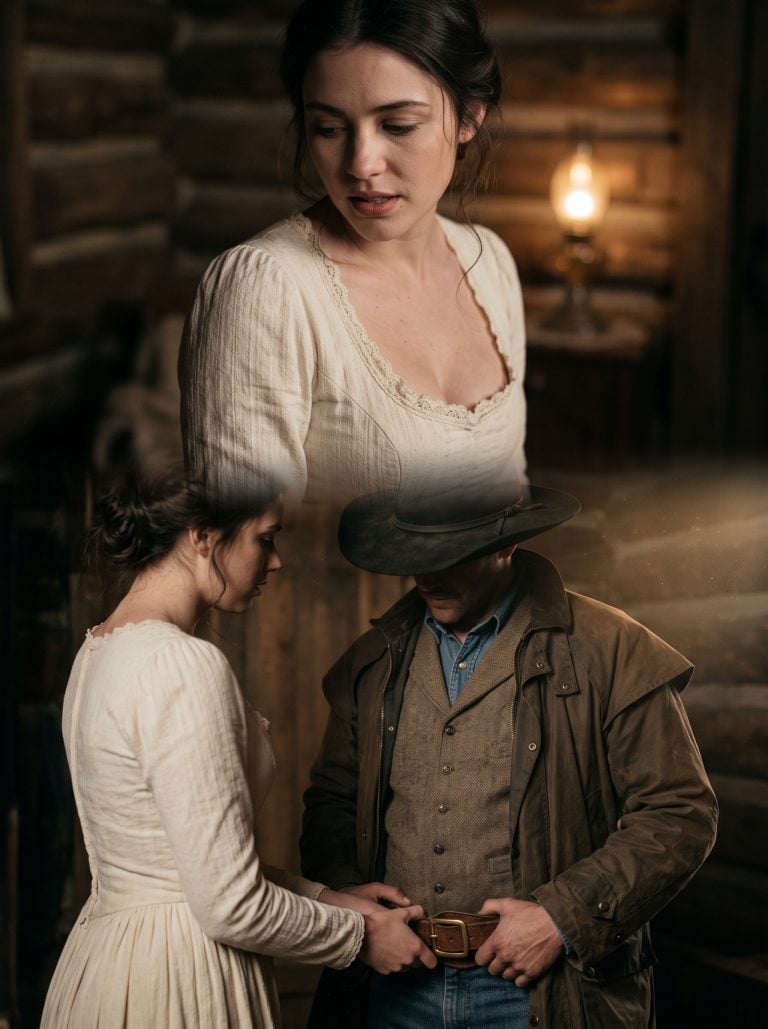
They Thought She Was Alone…” Five Men Threatened Her… Unaware Her Brother Was A Famous Gunslinger

Part 1
Elena Ashford did not cry at the grave, and she did not cry the morning after, when the ranch hands came to ask what she wanted done with her husband’s horse. She had run out of tears somewhere between the moment Sheriff Otis Pruitt took off his hat in her doorway and the moment she understood, from the careful way he avoided her eyes, that he did not believe his own story any more than she did.
Nathaniel Ashford had not fallen from a cliff. He had ridden the Bitterroot canyons since he was nine years old, blindfolded half the time, for the sport of it. A man like that did not misjudge a ledge in broad daylight.
She buried him under the cottonwood on the rise above Ashford Hollow, and three days later Caleb Rourke sent a man to the funeral instead of coming himself — a boy of twenty with a new hat and old eyes, who watched her the whole service like he was pricing the furniture. A week after that, Rourke came himself, with four riders and an envelope he never quite managed to make her take.
“This is a hard country for a woman alone,” he said from the saddle, not dismounting. “I’d hate to see something happen to what’s left of you out here.”
“Ashford Hollow isn’t for sale, Mr. Rourke.”
He smiled the way men like him always smiled — a door opening onto an empty room. “Think on it,” he said, and rode off, and the next morning two of his riders were parked at her fence line before breakfast, watching, saying nothing, there and not-there the way a held knife is there and not-there. It went on for nearly two weeks. Gates left open. Cattle scattered into the canyon. A dead crow nailed to her mailbox post with no note attached, because no note was needed.
Sheriff Pruitt gave her sympathy and nothing else. “Sitting at a fence isn’t a crime I can hang a man for, Mrs. Ashford.”
So she went looking through Nathaniel’s papers, the way a woman goes looking for the shape of a man’s silence. She found nothing in the ledger the first two times. The third time, she noticed a six-month gap in the water-rights receipts and a series of unexplained payments entered under income — money coming in, not going out. Beside them, Nathaniel had written an inspector’s name, crossed it out, and replaced it with two initials she didn’t recognize: S.W.
The fourth time, folded into the spine of his mother’s Bible, she found a surveyor’s document, notarized in Laramie, dated seven months before he died. It showed, plainly and in Nathaniel’s own careful hand of correction, that the eastern canyon — the land Rourke had fenced and grazed and spoken of for three years as though it had always been his — had never belonged to Rourke at all. It belonged to Ashford Hollow. It had always belonged to Ashford Hollow.
Nathaniel had known. Nathaniel had said nothing.
She rode eleven miles to the telegraph office that same evening and sent word to the only person she could think to send it to: Nathaniel’s brother, a man she had met twice in eleven years of marriage, who had left Wyoming at nineteen and never once come back for anything, not even his own father’s funeral.
The reply came two days later.
COMING. ONE WEEK. DO NOTHING. — G.
He arrived in four.
His name was Gideon, and he was leaner than she remembered, and harder around the mouth, and when he stepped down off his horse in her yard she saw Nathaniel in him the way you see a river in its reflection — close enough to ache, not close enough to touch.
“How bad,” he said. Not a question.
“Bad,” she said. “Come inside. I’ll show you everything.”
She spread the survey document on the kitchen table and told him about Rourke, about the fence-line riders, about the crow on the mailbox, about Sheriff Pruitt’s careful uselessness. Gideon listened without interrupting, arms crossed, and when she finished he was quiet long enough that she began to doubt the wire she’d sent had been the right call after all.
“You went to the law,” he said finally.
“The law gave me nothing shaped like something, so I’d go home satisfied.”
Something moved behind his eyes — recognition, maybe, or old anger finding a new place to stand. “That’s not new law behavior,” he said. “That’s paid law behavior.” He looked at her steadily. “Nathaniel wrote to me twice this spring. Both times he said he was handling something. Both times he said not to worry.” A muscle worked in his jaw. “I should have come in the spring.”
“You’re here now,” Elena said, and surprised herself with how much she meant it.
“I’m going to sleep in the bunkhouse,” Gideon said. “I’m going to watch how Rourke’s men move for a few days. And then we are going to find out exactly who is underneath all of this, because a man like Rourke doesn’t get land filed clean through a corrupt survey without a judge’s hand on the paper somewhere.”
Elena put her palm flat on Nathaniel’s document. “I am not looking to start a war, Gideon. I am looking to keep my land and find out what happened to my husband. If you cannot hold those two things separate, I need you to ride back out the way you came.”
“I can hold them separate,” Gideon said quietly. “I’ve had a great deal of practice holding things separate. It’s the one skill eleven years of Pinkerton work actually taught me that was worth learning.”
She studied him for a long moment — this stranger with her husband’s bones under his face. “All right,” she said. “Then let’s find out who really killed him.”