A Little Boy Shielded His Baby Sister From the Freezing Cold—Then a Rancher Made a Life-Changing Choice

Part 1
The boy stood in the snow with a broken axe handle in his fist and nothing else between his sister and the dark.
The Nebraska plains had vanished under a white, roaring storm. Wind tore down from the north with a sound like something alive, scouring the stage road until the ruts disappeared and the fence posts looked like the ribs of something dead. Caleb Turner was nine years old, and his hands had stopped hurting an hour ago. He knew that was bad. He stayed anyway.
Behind him, in a produce crate wedged against the overturned wagon, his baby sister Wren cried in thin, exhausted bursts.
Two days earlier their mother had been alive. Two days earlier their father had been laughing at the mules and promising hot supper in Larkspur by nightfall. Then the axle had snapped — not worn through, Caleb would later learn, but shaved thin from beneath, where no one but a man lying on his back with a knife would have thought to look — and the wagon had gone over on the ice.
His father never woke. His mother lasted until the gray hour before dawn, long enough to press Caleb’s hand around the crate handle and whisper, “Don’t let go of her.” He hadn’t. He wouldn’t.
When the shape came out of the whiteout, Caleb raised the axe handle like a rifle.
“Don’t come closer!”
The rider reined up. Steam rolled off the horse in sheets. The man was broad-shouldered, dark-bearded, a revolver at his hip that he did not touch. He studied the wrecked wagon, the two shapes half-buried beneath the snowdrifts on the far side of the road, and last of all the boy standing guard over a crying baby with a stick he could barely lift.
“Name’s Ezra Holt,” he said, and lowered himself to one knee in the snow, a grown man kneeling before a child with a weapon. “I’m not here to take her from you, son. I’m here to help you keep her.”
It took another quarter hour of Caleb’s shaking refusals and Ezra’s patient, unmoving calm before the axe handle finally dropped. Ezra worked fast after that — dry wool from his saddlebag, broth from his canteen touched drop by drop to Wren’s lips, the baby bundled inside his own coat against his chest. He lifted Caleb onto the horse behind him without asking permission, because the boy was past arguing and both of them knew it.
Ezra had buried a wife and a daughter of his own, four years back, under a lone elm east of his ranch house. He had told himself since then that a man who let himself love something twice was a fool. He looked down at the boy’s white knuckles locked around his sister’s blanket and understood, riding home through the storm, that he was about to be a fool again.
The ranch gate stood open when they arrived — he’d latched it himself two mornings before. Fresh tracks cut toward the barn.
He set Caleb on the porch with Wren and told him not to move for anything.
Inside the barn, lantern light showed him three strangers among his hay bales, rifles loose in their hands, the easy sprawl of men who’d already decided the place was theirs. The tallest one grinned.
“Storm drove us in, is all.”
“Latch doesn’t blow itself open,” Ezra said.
The baby cried outside. All three men turned toward the sound with an interest that had nothing to do with hospitality, and something in Ezra went cold and simple.
“Get out,” he said. “Now.”
“Three of us,” the tall one said, hand drifting toward his belt. “One of you.”
“Then you’d best be quick.”
He put the lantern out with his first shot and did the rest of it in the dark, by memory and instinct — a gun-butt to a jaw, a bullet through a shoulder, a barrel leveled at a heaving chest until the last man understood the conversation was over. They rode off into the storm cursing him. Ezra didn’t watch them go. He was already walking back to the porch, to the boy who’d sat exactly where he’d been told, still holding his sister like the world might try to take her twice in one night.
“You kept your word,” Caleb said.
“I mean to keep on keeping it,” Ezra told him, and didn’t yet understand how much that would cost.
Part 2
County business found them within the week, the way it always did.
Caleb had a mother’s sister — Della Voss, a schoolteacher lodging above the mercantile in Larkspur — and Ezra rode the children in to find her, only to arrive at the exact moment the boarding-house owner, a sharp-tongued widow named Mrs. Odell, was putting Della bodily into the street over a missing silver watch.
“I stole nothing,” Della said, on her knees in the snow, dignity holding where her voice nearly didn’t.
Then she saw Caleb running toward her and forgot the watch entirely.
Ezra paid what was owed, told Mrs. Odell to keep her opinions behind her teeth, and stood by while the county clerk explained, with real regret and no flexibility, that an unemployed woman under suspicion of theft and a widowed rancher living alone could not, between them, keep two orphaned children. The baby might go to a family in Omaha. The boy to a home near Wichita. Separately. Immediately.
“No,” Caleb said, and it was the same word he’d said to Ezra in the storm, and it broke something open in the rancher’s chest all over again.
“I’ll marry her,” Ezra said, before he’d finished deciding to.
The clerk blinked. Della stared at him like he’d lost his mind, which he privately agreed he might have.
“You don’t arrange a woman’s life like a land deal,” she said.
“No,” he agreed. “I’m asking you. Do you love them enough to take shelter from a man you don’t much like, so nobody splits them in half tonight?”
She looked at Caleb’s white, hopeful, terrified face. At Wren asleep against her own shoulder. At the carpetbag that held everything she owned in the world.
“I won’t be shamed for being poor,” she said. “I won’t lose my say over these children. And your bed is your own business, not mine, unless I say otherwise.”
“Agreed to all of it.”
“Then yes.”
They were married before the church stove burned low. By the next morning, the gossips of Larkspur had already decided Ezra Holt had either been trapped by a scheming woman or had bought himself a cheap one — nobody could agree which, and nobody asked the two children who mattered most.
Part 3
The ranch gave Della a hundred small wars before it gave her peace.
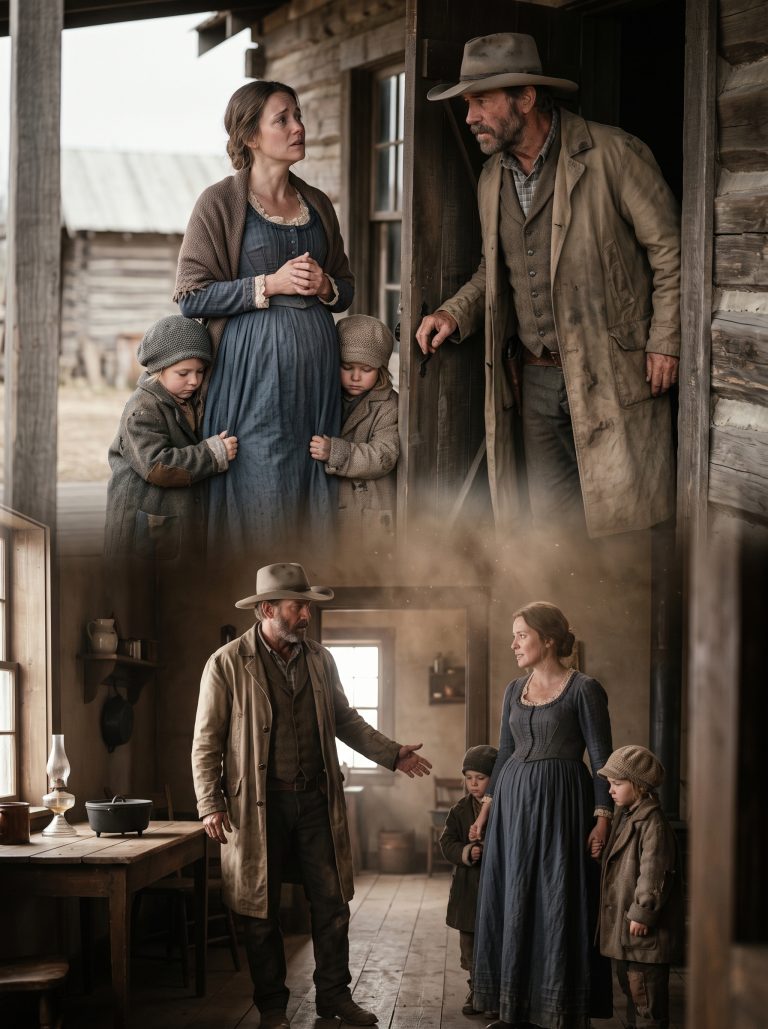
Wren wouldn’t take the bottle unless Della sang. Caleb wouldn’t sleep in a bed, only on the floor beside the cradle, one hand always touching the wood as if to prove it was still there in the morning. Ezra had forgotten, in four years of silence, how much noise a house could hold — and how much a woman’s presence could change the weight of a room she only meant to pass through.
On the third day she opened a locked door looking for linens and found a child’s room frozen in time: an iron bed, a painted cradle, a rag doll on the shelf, a quilt folded with a precision that only grief could manage.
“I’m sorry,” she said, backing out.
“It’s just a room,” Ezra said, too fast, too flat.
“No,” Della said. “It isn’t.” And she left it at that, which was somehow worse and better than an argument.
It was Ezra who came to offer an apology two nights later, after he’d said something cruel about her having nowhere else to go and watched it land exactly as hard as he’d feared.
“You think less of yourself for wanting anyone inside your walls at all,” Della told him, not looking up from Caleb’s torn coat in her lap.
“You always cut that deep?”
“Only when men hand me the knife.”
He laughed before he could stop himself, and for the first time saw her without the humiliation of that first morning tightening her face — tired, wary, and unmistakably alive.
That was the night she told him about the watch that had never been a theft, and about Silas Crane.
“He held my brother-in-law Thomas’s debt note,” she said. “Thomas kept Crane’s accounts for a season, back when Crane still called it a land office and not a banking house. He kept asking where Thomas and Joanna were headed. Joanna wrote to me before they left Missouri — said Thomas had copied out Crane’s private ledger before he quit the job, page by page, over months, and that if anything happened to them, I should trust no one who came asking after a red book.”
Ezra went very still. “The wagon axle,” he said slowly. “It didn’t just snap. It was cut.”
He’d noticed it at the wreck and told himself the ice had done it. Now, saying it aloud, he understood he’d been lying to himself for a week. Crane hadn’t discovered the missing pages until after the Turners were already two days down the road — by then, chasing them quietly was safer than raising a hue and cry over a bookkeeper nobody official knew was missing anything. So Crane had sent riders instead of a posse, and one of them had gone at the axle with a knife rather than a gun, meaning to strand the wagon, not wreck it. The storm had done the rest on its own.
That night, woken by a nightmare, Caleb finally said the rest of it in a whisper, held tight in Della’s arms in the hayloft. “Pa hid the red book under the wagon seat before we ever left Missouri. Said bad men would come looking for it on the road.”
At dawn Ezra rode to the wreck alone and found it — oilcloth-wrapped, frozen fast beneath the shattered seat. Inside were two things bound together. The first was Thomas Turner’s copied ledger: months of names, payments, and forged land claims, patiently transcribed in a careful, worried hand. The second was a single torn page in a rougher script, not Thomas’s — a courier’s note meant for Crane, which Thomas must have lifted or intercepted before they fled Missouri and tucked inside his own book for safekeeping: Turner fled with copied records. Riders sent toward Larkspur road.
Crane had known before the Turners ever reached Larkspur — though not before they’d already left Missouri behind. The storm hadn’t caused the accident. It had only covered it.
Crane came to the ranch that afternoon, polished and pleasant, two riders behind him, to inform Ezra that a man’s debts attached to his estate and that certain family papers might rightly belong to him. He looked Della over like an item on a ledger of his own.
“Mrs. Holt. You’ve improved your circumstances quickly.”
Ezra crossed the yard in four strides and told him, very quietly, to speak to his wife with respect. Crane smiled, unbothered, and mentioned — almost gently — that he also held the mortgage on Ezra’s ranch, and that debts, like storms, tended to find a way through.
He left. Nothing in his words was a threat a lawyer couldn’t unwrite. But the two riders who’d trailed him had gotten a look at the barn, the fences, the whole unguarded spread — and men who worked for Crane had learned to read his moods without waiting for orders. That night, without any instruction Crane would ever put his name to, the barn burned.
They fought it together, Della hauling water until her hands blistered, Caleb dragging blankets, Ezra pulling burning tack out with bare hands, and still lost most of it by dawn — hay, feed, tools, two horses badly burned, a whole winter’s margin turned to black beams against a pale sky.
Caleb tried to take the blame. Della tried to take the blame. Ezra refused both of them the comfort of it.
“Men like Crane don’t come because of what you did wrong,” he said. “They come because they want what you have. Don’t hand him your guilt on top of everything else.”
Crane’s petition arrived by noon: unfit mother, unstable rancher, unpaid debts, a request that the children be removed pending review. The hearing was set for three days out. Della was sick behind the woodpile and furious at herself for it.
“If they take them, Caleb won’t survive it,” she whispered.
“Then we don’t let them,” Ezra said, and for once she believed a promise completely.
At the hearing, Crane’s lawyer painted Ezra as violent, the fire as proof, the marriage as suspiciously fast. Mrs. Odell testified to the missing watch. And then Mrs. Sharp — the woman it had supposedly been stolen from — stood up in tears and admitted she’d found it in her own sewing basket days ago, and that Mrs. Odell had asked her to stay quiet about it until after the hearing.
The room came apart. Mrs. Odell went scarlet. Crane’s composure thinned by exactly one visible degree.
Then Ezra laid the ledger on the judge’s bench — Thomas’s careful transcriptions, and beneath them the torn courier’s page in the hired man’s own crude hand, naming the axle, naming the road, naming Crane. The room went silent in a different way.
“This is fabricated,” Crane said, too loud, too fast.
“Say that again under oath,” Ezra told him, and Crane, wisely, didn’t.
The judge ordered the sheriff to hold him. That was when the shouting started outside.
“The baby’s gone!”
Wren had been asleep in a side room under a deputy’s wife’s watch. A stranger in a borrowed court clerk’s coat had put his head in the door minutes earlier, claiming the judge wanted her signature on the record downstairs — and by the time she realized no such record existed, she’d been gone from the room five full minutes. She returned to an open window, snow blowing across the floor, and an empty cradle. Caleb made a sound Della had never heard a child make. Crane, for one unguarded second before the sheriff’s hand closed on his collar, allowed himself to smile — and Ezra saw it.
The sheriff dragged Crane into the judge’s chambers and shut the door. Faced with the ledger, a fresh kidnapping charge, and Ezra’s barely restrained fury pacing the small room, Crane’s composure finally broke. He gave up the location fast: the old grain mill on the north creek, where the ice ran thin and treacherous. “She won’t be hurt if I walk free,” he said, and the sheriff, grim-faced, made no such promise.
They rode into a second storm to get her back — Ezra, Della, the sheriff, two deputies, and Caleb, who would not be left behind and would not be argued with.
At the mill they found one of Crane’s hired men still mounted near the frozen creek, his horse blowing steam, Wren screaming in one arm and a pistol in his other hand. Della stepped forward, and the man’s gun came up toward the bundle, not her.
It was Caleb who moved next — small, steady, hands open, walking into the open the way Ezra had once walked toward him.
“I know how to hold her right,” he said. “She cries when strangers do it wrong.”
The man’s eyes dropped to the baby despite himself. That half-second was all Ezra needed. He put a bullet into the rotten mill beam above the rider’s head instead of the man himself. Wood cracked and gave way, and the falling timber startled the horse into a hard sideways lurch. The hired man grabbed for the reins with both hands just to keep his seat, and for one unguarded moment Wren nearly slipped from the crook of his arm entirely. Caleb was already moving — he caught the trailing edge of his sister’s blanket and pulled hard, and between the horse’s stumbling and the boy’s grip, Wren came loose. Della closed the last few steps at a dead run and caught the baby against her chest a heartbeat before the hired man, off balance and cursing, got a hand back on his pistol and fired wild into the snow.
Ezra went down on one knee, blood spreading dark through his coat.
“Shoulder,” he managed, when Della reached him screaming his name. “Had worse.”
“You are the worst liar I have ever met,” she said, pressing both hands to the wound, shaking too hard to be gentle about it. “Don’t you dare leave me standing over one more grave on this land.”
“Wasn’t planning on it,” he told her. The wound stripped away the last of his caution. “I love you.”
“Been true since you stood in my kitchen with grief on your face and a baby on your hip and made the whole house feel less like a tomb,” he added, and even bleeding, he got the whole sentence out.
“Then live long enough to say it when you’re not bleeding into the snow,” Della said, and bent her forehead to his, and he did.
Fever held him for two days. Crane, facing a ledger that spoke louder than any lawyer he could hire, was sent on to Wichita to await trial. Mrs. Odell left town within the week. The judge dismissed the custody petition outright and granted Ezra and Della permanent guardianship, adoption to follow as soon as the papers could be drawn.
On the third night, Ezra’s fever broke, and he woke to find Della’s hand locked around his and Caleb asleep against his uninjured side, one arm slung protectively over him — still keeping watch somehow, even in sleep, even safe.
“You disobeyed me at the mill,” Ezra rasped.
“I saved Wren,” Caleb said, unrepentant.
“You could’ve been shot.”
“So could you.”
Della, watching from the doorway with the baby on her hip, decided this family would either be the death of her or the making of her, and found she no longer minded which.
Spring came slow across the plains that year, the way it does after a hard winter, but it came. The barn was rebuilt by neighbors who’d judged Della wrongly and wanted, in their own quiet way, to say so without saying so. She began teaching again — Caleb first, then half the ranch children within riding distance. Ezra reopened his daughter’s old room, on Della’s condition that the rag doll stay exactly where it was, and Wren slept there under a quilt that had waited four years for someone small enough to need it.
On the first warm day, Ezra took Della to the elm where his first wife and daughter were buried, and told her plainly what he hadn’t been able to say with a bullet still in him.
“I thought loving them again would finish the man losing them started to break,” he said.
“No,” she said. “Losing them only wounded him. You did the rest yourself, refusing to let anyone else in.”
He looked toward the house, where Caleb was chasing a chicken across the yard and Wren was banging a spoon against a tin cup on the porch, delighted with the noise of it, delighted with all of it.
“Stay,” he said. “Not because you’ve nowhere else to go. Because I’m asking.”
“I know the difference now,” Della told him, and touched his jaw, and kissed him first.
That night the wind came up again across the plains, the way it always would come, sooner or later, storm following storm the way it does in that country. But the house didn’t feel lonely inside it. Caleb slept in his own bed for the first time without one hand on the cradle, trusting, finally, that morning would come and nothing would be missing from it. Wren slept beneath the quilt that had once belonged to Ezra’s little girl, warm and unafraid. And Ezra Holt stood at the window with his wife inside the circle of his arms, watching the snow start to fall on land that had once nearly cost him everything and had instead, in the strangest and hardest way, given it all back.
“Storm’s coming,” he said.
“I know,” Della answered. “I’m not afraid of that kind anymore.”
Because they had already learned, all four of them, the thing the wrecked wagon and the burned barn and the frozen creek had each in turn tried to teach: that a family isn’t the one thing the storm can’t touch. It’s the thing that stands back up, together, every single time it does.
THE END