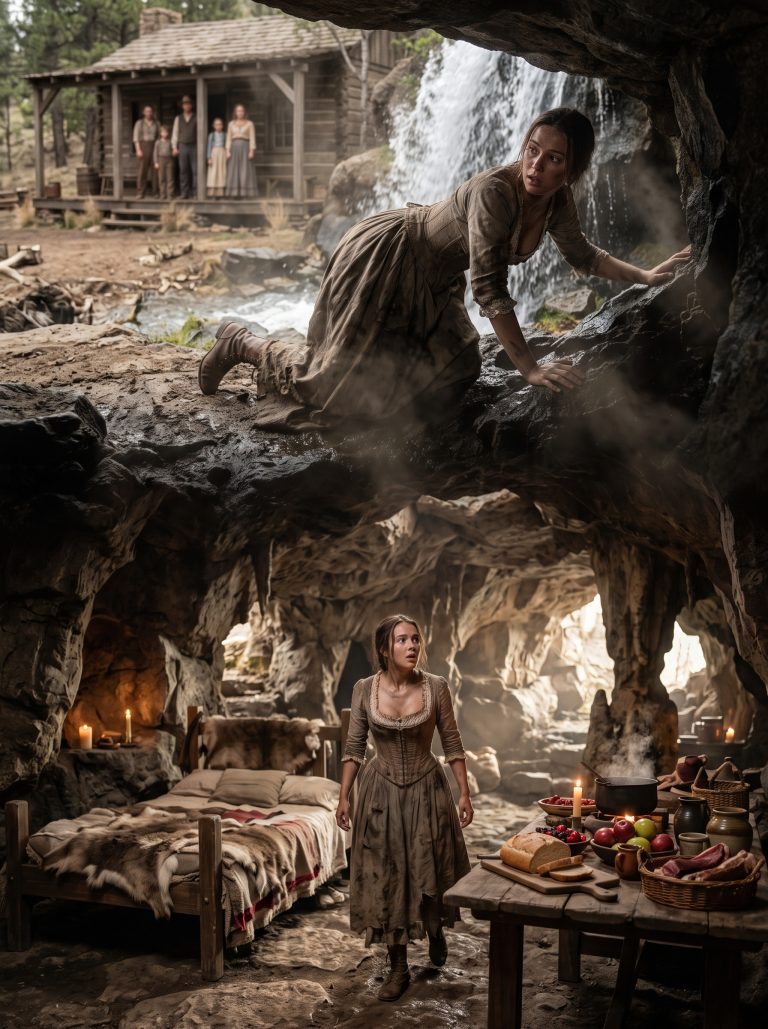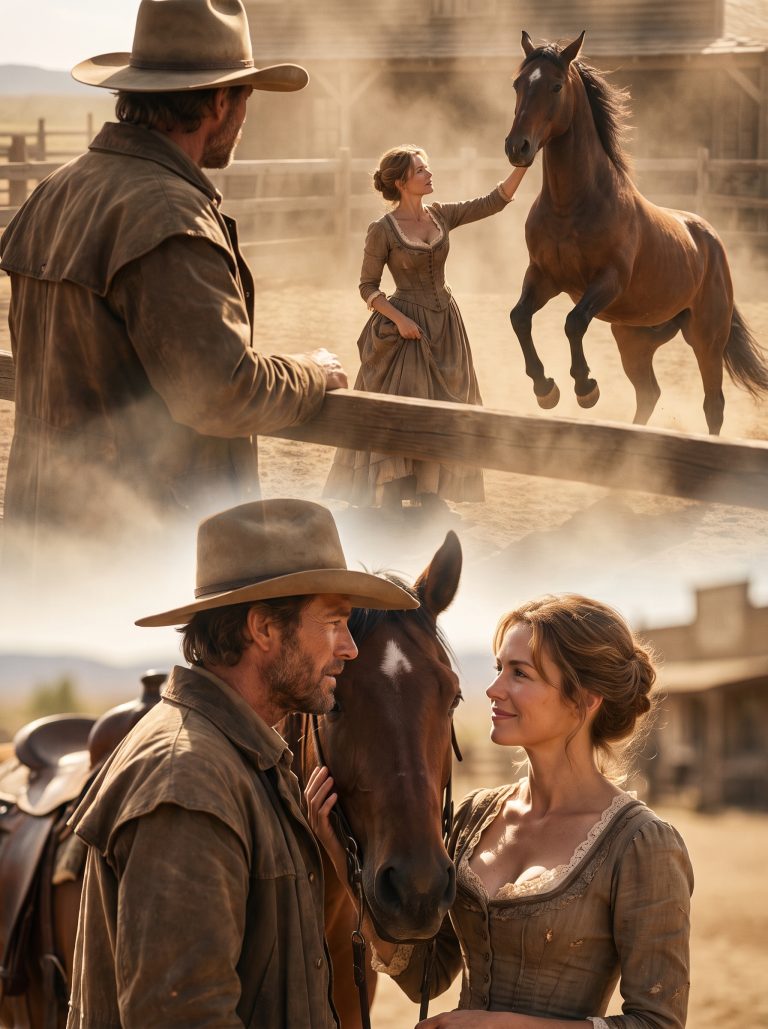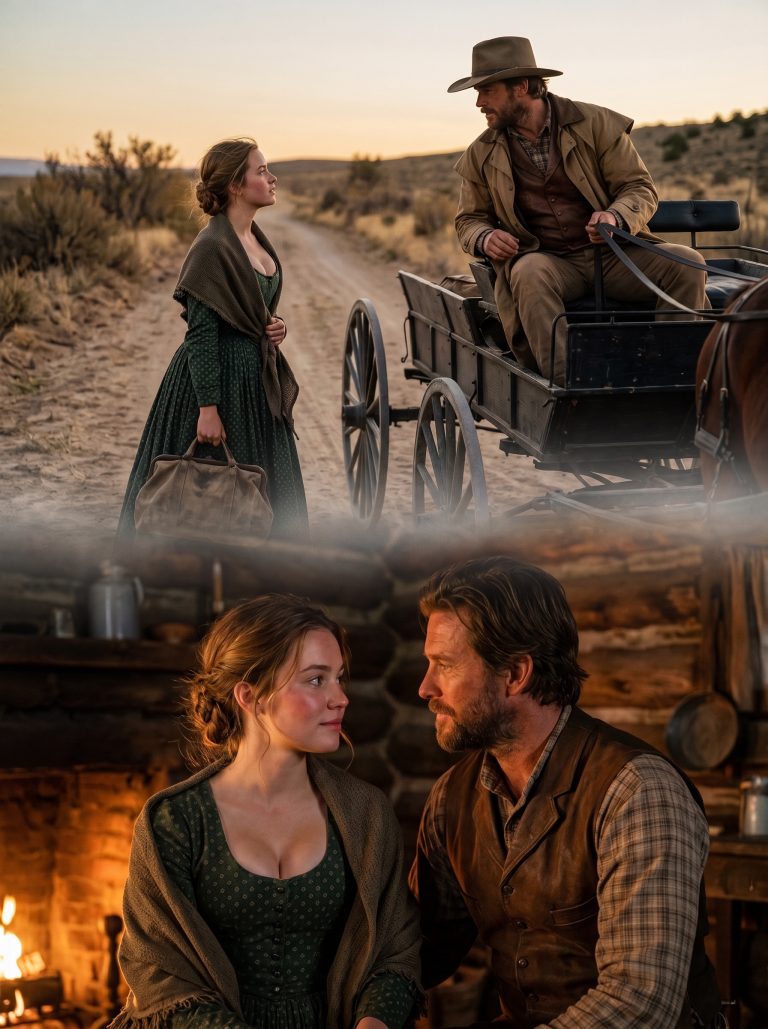
“I can’t… it’s my first night,” the trembling bride whispered—then slowly reached for the cowboy’s belt in the dark.

Part 1
The coach wheels shrieked over the frozen ruts like something being skinned alive. Outside, Montana had turned the color of ash, the sun already sinking behind a wall of gray cloud that promised worse before morning.
Clara Jenkins sat alone inside, eighteen years old and freezing in a bridal dress that had looked like hope in a St. Louis shop window three weeks ago. Now the lace had gone stiff with frost, and the thin satin beneath did nothing against the cold pouring through the floorboards. The dress had cost more than her father earned in a month. It had been paid for by a man she had never met, so that she would arrive looking like something worth marrying instead of something that had been sold.
Three letters. That was all she had of Amos Reed — three short pages about land and cattle and a house that needed a wife in it. No warmth in any of them. Her father had read the last one twice, then signed the papers before supper was cold. The farm had been dying for three years. Reed’s money had looked like salvation to him. To Clara, it had felt like a sentence being read aloud.
The coach lurched and stopped.
“End of the line, miss.”
She pushed the door open herself before the driver could bother.
The wind hit her like an open hand. Bears Hollow was barely a town — a crooked row of buildings half-buried in snow, smoke leaking from tin chimneys, men on the boardwalks who turned to watch her step down as if she were livestock arriving on schedule. The dress that was supposed to protect her only made things worse. It told every man on that street exactly what she was there for.
She hurried into the depot, where a potbellied stove glowed red and a thin clerk looked up over his spectacles.
“I’m here to meet Mr. Amos Reed,” she said. “I’m Clara Jenkins.”
Something crossed his face that wasn’t surprise. It was pity, and pity was worse.
“Mr. Reed passed two nights back,” he said, cleaning his glasses slowly, as if that might soften it. “Knife fight over cards.”
The floor seemed to tilt under her. “What happens to me now?”
“He didn’t own much. A room over the saloon. Some debts.” The clerk folded his hands. “Nothing left for you, miss. There’s work for women at the Lucky Ace, if you’re asking.”
She understood exactly what kind of work he meant, and her stomach turned to stone.
Outside, the piano from the saloon spilled drunken noise into the street. Two miners came off the porch as she passed, reeking of whiskey, calling her Reed’s pretty little bride, lost and unclaimed. A hand closed on her arm. She tore free, lace ripping, and ran until she found a black gap between two buildings and pressed herself into it, breath tearing out of her in white clouds.
Footsteps followed. A shape filled the mouth of the alley.
“Knew you’d wait for me,” the miner said, and lunged.
His arms locked around her, slamming her against the wall hard enough to send sparks across her vision. She screamed, and the wind ate the sound whole — until another voice cut through the dark.
“Let her go.”
A tall man stood at the alley’s mouth, hat low, a worn sheepskin coat over broad shoulders. He carried no visible weapon, but something in the stillness of him made the miner’s grip loosen.
“She ain’t worth it,” the miner spat, shoving Clara aside before stumbling back toward the light.
She slid down the wall into the snow, shaking too hard to stand. The stranger didn’t rush to her. He looked up at the sky instead, reading it like a man reads a letter he’s received before.
“Storm’s coming,” he said. Then, looking down at her: “Stay here tonight, you won’t see morning.”
His name was Silas. He said little else as he lifted her onto his horse and turned it toward the hills, his arm around her waist as steady and impersonal as a man securing a sack of grain. The town disappeared behind a curtain of snow. For hours the horse climbed through black pine and drifting white, until at last a small cabin appeared, hunched against a hillside, a thread of smoke rising from its chimney.
Inside, it was barely warmer than the storm — a rusted stove, a single rough bed heaped with quilts. One bed. Clara noticed it and said nothing.
Silas fed the stove, made coffee without asking her a single question, and when she finally found the nerve to ask where she would sleep, he only nodded at the bed.
“You take it. I’ll take the floor.”
He laid a buffalo robe by the door, set his rifle across his knees, and sat down to wait out the night. Clara climbed onto the cot in her ruined dress and pulled the quilts to her chin. When the grief of the day finally caught up to her — the dead groom, the alley, the cold, the shame — she wept quietly into the dark.
Silas heard every sound of it. He said nothing at all. He simply sat by the door until the crying stopped and sleep took her, the rifle never leaving his lap.
Part 2
Morning came hard and gray. Frost feathered the inside of the window, and when Clara pushed the door, the world beyond it had vanished into a wall of driving white.
“You’re not going anywhere today,” Silas said, and dropped the bar back into place.
So the storm kept them. One day became two, then three, then five. Silas checked his traps and tended the horse; Clara melted snow for water and learned to keep the stove alive. They spoke little, but the silence between them changed shape — from the silence of strangers into something closer to trust. He moved slower around her, so she wouldn’t flinch. She stopped flinching.
On the fifth morning the sky cracked open into hard blue, and Silas stood in the doorway studying it the way another man might study a debt finally paid.
“Storm’s done,” he said.
That night, by the fire, Clara told him the truth she hadn’t told anyone. “My father sold me,” she said. “He called it marriage. It was money. Just money.”
Silas was quiet for a long moment. Then, low: “I know a thing or two about being sold.”
She looked up. He didn’t explain, and she didn’t push. But something in the way he said it stayed with her — a weight behind the words that didn’t belong to a man simply passing through a stranger’s misfortune.
Later, when she finally slept, Silas sat awake by the dying stove and took a folded paper from the inside of his coat. He looked at it a long while in the firelight — at the letterhead, at her name written in another man’s hand — before he pushed it back out of sight and did not look at it again.
Part 3
Weeks slid by, and the snow began to give up its grip on the mountainside, dripping in silver threads from the eaves. Something had settled into the cabin that hadn’t been there before — not quite peace, but its early shape.
One afternoon Silas rode down to Bears Hollow for supplies and came back with something Clara hadn’t asked for: her trunk.
“Had to argue the depot man out of it,” he said, setting it down. “Figured you’d need it.”
That night she opened it to find her mother’s small velvet box, and inside it, a plain gold ring. She turned it in the firelight, then looked up at him.
“You’ve been kind to me,” she said.
“I’m practical,” he answered, the same way he always turned away a kindness before it could be named.
“Were you ever married?”
His hand stilled. For a long moment the fire was the only thing that moved. “I was,” he said finally. “She left. Liked my brother’s life better than mine.” He said it flat, like a fact filed away long ago, and offered nothing more.
Clara didn’t press. She thought she understood him now — two people who had each been left behind in their own way, finding something unclaimed and honest in each other. She was wrong about how unclaimed it was, though she would not learn that for two more weeks.
It happened by accident. Mending a tear in his coat lining, she found the folded paper he had looked at that night by the fire and forgotten to hide again. She unfolded it before she could stop herself.
Contract of Recovery — Reed Estate, Bears Hollow. Bearer authorized to locate and return bonded passenger C. Jenkins. Fee upon delivery: $60, plus expenses. Signed, E. Reed.
Her hands went cold in a way the mountain never had managed.
She was still holding it when Silas came through the door with an armful of wood. He saw her face, and the wood dropped from his arms without a sound.
“You were paid to bring me back,” she said. Her voice didn’t shake. It had gone somewhere flatter and harder than shaking. “That night in the alley. You weren’t passing through. You were already looking for me.”
He didn’t deny it. That, more than anything, told her it was true.
“Ethan hired me before the storm,” he said. “I was a day behind you when you got off that coach. I saw the men in the alley before you screamed. I could’ve let it happen and collected you after, easy money, no trouble.” He met her eyes. “I didn’t. And then the storm came, and I told myself one more day wouldn’t matter. Then it was five days. Then it was weeks, and I stopped telling myself anything, because I already knew I wasn’t taking you anywhere you didn’t choose to go.”
“You should have told me.”
“I know it.”
“You let me think—” Her voice finally cracked. “You let me believe you found me by chance.”
“I did find you by chance,” he said quietly. “The chance was that I still had a conscience left when I needed one.” He nodded at the paper still trembling in her hand. “I never sent word to Ethan that I had you. Far as the Reed estate knows, I lost your trail in the storm and never picked it back up. That paper’s the only proof I ever took the job at all. I kept it because I couldn’t decide if I deserved to burn it.”
Clara looked at the fire, and for one terrible second she wanted to throw the contract into it and pretend the whole conversation had never happened. Instead she folded it and set it on the table between them, because some things were not hers to burn on his behalf.
“I need to think,” she said, and walked outside into the cold alone, the ring from her mother’s box still cold in her palm, the only thing in that cabin she was certain had never been bought.
She didn’t get long to think.
Three days later, hoofbeats came up the trail — more than one horse, moving fast. Silas was at the window before she reached it, and what he saw made his jaw go tight.
“Ethan,” he said. “And he’s not alone.”
Ethan Reed came through the door before Silas could bar it, two hired men behind him, a folded copy of the same contract in his fist.
“You had her the whole time,” Ethan said, eyes moving from Silas to Clara and back, understanding arriving on his face like a slow poison. “Sixty dollars wasn’t enough for you, so you decided to keep the merchandise for yourself.”
“She’s not merchandise,” Silas said. “She never was.”
“She’s bonded property of the Reed estate, same as the mule and the wagon my brother left behind. You took my money to bring her back, and instead you’ve been keeping her warm all winter.” Ethan’s hand went to his belt. “That makes you a thief, Silas. Man can hang for that out here.”
“Try it,” Silas said, stepping between him and Clara, “and see how far you get.”
The fight that followed was short and ugly — fists, then a blade, a line of red opening across Silas’s ribs before he drove Ethan into the dirt floor. One of the hired men reached for a pistol on the table, and it was Clara who moved first, snatching it up before his hand closed on it and leveling it at Ethan’s chest with both hands steady.
“I am not property,” she said. “I never was, and no piece of paper my father signed or your brother bought makes it true.”
Into that silence walked a fourth stranger, unhurried, a tin star catching the lamplight on his coat.
“Marshal’s business,” the man said, and the two hired men backed away from their own weapons without being told twice. He looked over the scene — Ethan bleeding on the floor, Clara with the pistol still raised, Silas holding his side — and then he held out his hand for the paper still lying on the table.
He read it twice. “Bonded passenger,” he said slowly, like he was tasting something spoiled. “I’ve seen three of these come through this territory since spring, all signed by Reed men, all claiming ownership over women who never signed a thing themselves.” He looked at Ethan. “There’s no bond of law behind this paper, son. A woman isn’t a debt that transfers hands. Your brother’s estate can claim his boots and his cattle. It can’t claim a person, and it never could. What it can claim is a charge of fraud, coercion, and running an unlawful trade in human beings — which is exactly what I intend to write up, unless somebody talks me out of it.”
Ethan said nothing. There was nothing left to say.
Silas stepped forward, wincing against the cut in his side, and set his own copy of the recovery contract on the table beside Ethan’s. “There’s more of these,” he said. “I’ve done two other jobs like this one for the Reed family before I ever met her. Women brought back to towns they’d run from, paid for like livestock, and I took the money same as anyone. I can give you names. I can give you towns. If it stops one more girl from ending up in an alley in Bears Hollow, it’s worth whatever it costs me.”
The marshal studied him for a long moment. “That’ll cost you a trip to the circuit court, at minimum,” he said. “Might cost you more.”
“Then it costs me more,” Silas said.
He didn’t look at Clara when he said it, and that, more than anything else, was what told her it was true — that this wasn’t a man buying his way back into her good opinion. It was a man choosing, in front of a marshal and at real cost to himself, to tear down the very system that had once put a price on her head.
Ethan was taken back to Bears Hollow in irons. Silas gave his testimony to the circuit court that spring, and it cost him three weeks away from the cabin and every dollar he’d saved from harder winters, but it closed down the Reed estate’s trade in “bonded passengers” for good, and two other women besides Clara were never delivered to men who thought they’d been bought.
Clara didn’t forgive him all at once. Trust, once it’s been shown to have a price tag hidden in its lining, takes longer to rebuild than it took to break. But she watched him choose, again and again, in the small ordinary ways that mattered more than any single grand gesture — staying when it would have been easier to run, telling her the truth even when the truth cost him standing in town, never once asking her to be grateful.
One evening in early summer, she found him by the creek, sharpening an ax that didn’t need sharpening, the way he did when his hands needed something to do while his mind worked something else out.
“I burned the dress,” she told him. She’d carried it all winter without knowing why, until she finally understood: it was the last thing that had ever tried to tell her what she was worth. She’d built a small fire that morning and watched the lace curl into ash and scatter over the melting snow.
Silas set the ax down. “Good,” he said.
“I kept the ring,” she added, and held up her mother’s ring, plain gold, worn smooth by another woman’s hard years. “This one, nobody bought me with. She earned it herself, same as I mean to.”
He didn’t say anything clever back. He just reached for her hand, the way he’d once reached down from the saddle to pull her out of a Bears Hollow street that wanted to swallow her whole, and this time she took it because she wanted to, not because the storm gave her no other choice.
Years later, a cabin stood in a green meadow high above the old trail, built by two sets of hands instead of one. Silas came up from the creek one afternoon to find Clara on the porch, sketching a wild mustang in charcoal on a scrap of pine board — the same horse, it turned out, he’d once drawn in secret in a notebook he’d never shown anyone.
He wrapped his arms around her shoulders. She leaned back into him without flinching, the way she once could not have imagined doing with any man alive.
Near the door hung his old leather belt, worn soft with age. It was the same one she had once watched him coil by the door on the first night in that freezing cabin, back when she had still believed a man’s kindness was something owed to whoever had paid the highest price for her.
She looked at it now and smiled.
“I used to think everything out here had a price on it,” she said. “Even me.”
Silas kissed the top of her head. “Nothing worth having ever did,” he said. “You just had to stay alive long enough to find that out.”
THE END