“No Man Would Ever Want Her,” They Laughed—Until the Most Feared Mountain Man Took Her as His Wife and Exposed the Truth They Tried to Destroy.

Part 1
The letter came with the morning post, and before Samuel Hartley had finished reading it, a slow, ugly smile had already spread across his face.
It should have been joy. The name signed at the bottom — Ezra Calloway — belonged to the wealthiest rancher in three counties, a man who had carved a homestead out of raw mountain country with nothing but stubbornness and two hands. Any father in Cedar Hollow would have wept with gratitude to receive such a letter.
Samuel did not weep. He grinned the way a man grins when he realizes he has been handed a weapon.
“Well?” his wife Martha leaned in, eyes sharp with curiosity. Across the room, his daughters Rebecca and Sarah stopped their needlework, sensing something worth hearing.
“Ezra Calloway has written,” Samuel said, drawing the moment out like a man savoring a good meal, “asking for a bride.”
Rebecca sat up straighter. “Has he asked for me?”
“Or me,” Sarah said. “Rebecca’s far too proud for a mountain man.”
Samuel let the silence stretch one breath longer than it needed to.
“He has asked for Clara.”
The room went still. Then it broke apart into laughter — Rebecca doubled over, Sarah clapping her hands, Martha biting back her own delighted disbelief. Clara. Plain, serious Clara, with her rough hands and her sharp tongue and her infuriating habit of telling the truth at the worst possible moments. The daughter who had never once fit the family she’d been born into.
“The poor man must be desperate,” Sarah gasped.
“Or blind,” Rebecca added, wiping her eyes.
Samuel tapped the letter against his palm, already scheming. “He thinks he’s chosen himself a meek little bride. Let him find out otherwise. We’ll be rid of her, and it will look like a blessing instead of a banishment.”
Clara heard none of this — not directly. She was in the back bedroom, as she was every morning, warming water for her grandmother Agnes, whose joints had grown too stiff to manage alone. She heard the laughter through the wall before she understood its cause, and when Samuel’s voice carried through — burden… rid of her… he has no idea what he’s getting — something in her chest went very quiet and very still.
She did not cry. She had learned long ago that tears only fed them.
Behind her, propped against her pillows, Grandmother Agnes had gone very quiet too, her sharp old eyes fixed on nothing in particular, her mouth pressed into a thin, unreadable line.
“They mean to send you off as a joke,” Agnes said finally, her voice low.
“I heard,” Clara said, wringing out the cloth with hands that did not shake.
“And what will you do with that?”
Clara considered the question longer than she expected to. “I don’t know yet. But I won’t let them see it break me. If they want to be rid of me, I’ll go. Not as their punishment. As my own choosing.”
Something flickered across the old woman’s face — not pity, but something closer to pride, quickly hidden. “Good girl,” Agnes murmured, and said nothing more, though her eyes followed Clara a long while after she’d left the room.
That night at dinner, Samuel delivered the news with theatrical warmth. “Clara, you’ve received a marriage proposal. I’ve already accepted on your behalf.”
“When do I leave?” Clara asked, without flinching.
Samuel’s smile faltered, just slightly, at her calm. “Monday. Five days.”
Five days to leave behind the only home she’d known, and the only people who had never once seen her clearly.
Perhaps, she thought, that was exactly the point.
In the next valley, Ezra Calloway stood on his porch and looked out over fields he had built board by board, fence post by fence post. Ten years of solitude had given him land, cattle, and a reputation — everything, it seemed, except someone to share it with.
He thought often of a market day five years past, when a poor old man had been falsely accused of theft and the crowd had turned away rather than defend him. One young woman had not turned away. She had stood her ground, found the truth, and given the old man her own coin without waiting to be thanked.
He had never learned her name that day. He had never forgotten her face.
When he’d finally written his letter, he had not asked for beauty or obedience. He had asked, carefully, discreetly, through an old family friend who still had connections in Cedar Hollow, for word of a young woman with courage in her hands and fire in her heart.
He did not yet know how close that letter would come to being wasted on people who could not see what they had.
Monday was five days away. Neither Clara nor Ezra yet understood how much those five days — and the quiet old woman watching from her sickbed — would change everything.
Part 2
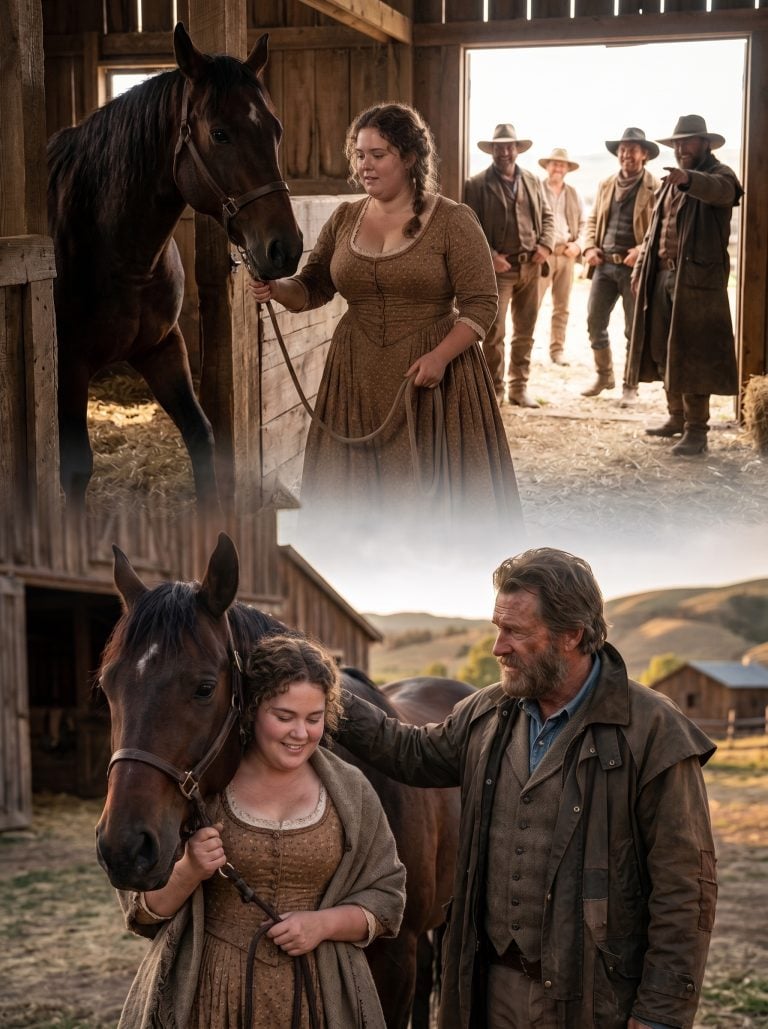
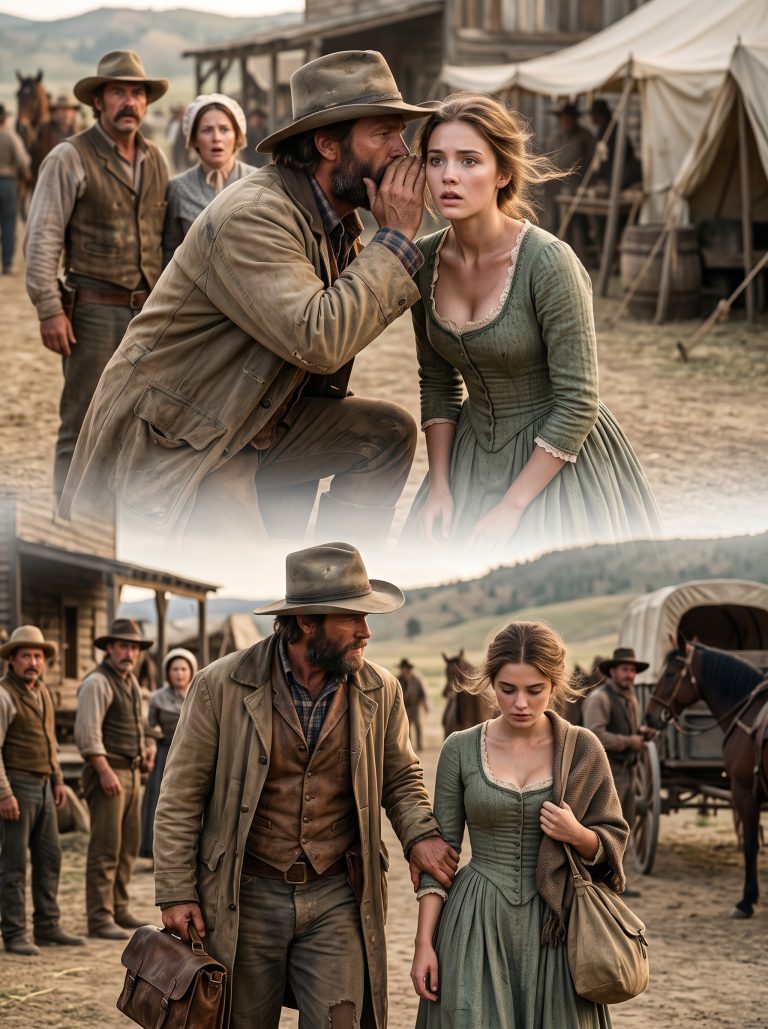
Clara arrived at the Calloway homestead just past noon, dust still clinging to her traveling dress, her chin held high though her stomach had not stopped turning since dawn.
Ezra came out to meet the wagon himself, wiping work-roughened hands on a cloth, making no pretense of having dressed for the occasion. He was taller than she remembered from the market, broader, but the eyes were the same — steady, brown, unhurried.
“Miss Clara,” he said. “Welcome.”
“Thank you, Mr. Calloway,” she managed, and dropped a small, stiff curtsy that felt foolish the moment she’d finished it.
Inside, the house surprised her — warm, unpolished, full of books and honest wear, nothing like the cold perfection of her father’s parlor. Ezra poured her coffee and sat a careful distance away, leaving her room to breathe.
“May I ask why you chose me?” Clara finally said. “You could have had either of my sisters.”
“Because I saw you,” Ezra answered simply. “Five years ago, in the market. I never forgot it.”
Clara’s throat tightened. “My family didn’t send me because they thought well of me. They sent me to be rid of me.”
Ezra didn’t flinch. “I suspected as much. But your family isn’t the measure of your worth.”
It was a small sentence. It landed like a stone lifted off her chest.
“I don’t want a silent wife,” he went on. “I want the woman who stood up for a stranger when no one else would. Give me a few weeks. No pressure, no promises. We learn each other honestly, and then we choose — together — whether this marriage happens at all.”
Clara looked up, startled. “You’d give me a choice?”
“You’re not a parcel being handed off, Clara. You’re a person.”
No one had ever said such a thing to her.
“Then I accept,” she said quietly. “We’ll learn each other.”
Over the following days, Clara found herself walking the fields beside him, pointing out a poorly placed irrigation trough near the south fence, sketching a better line in the dirt without waiting to be asked. She braced, out of old habit, for mockery.
None came. He knelt beside her instead, asking questions, taking her answers seriously.
For the first time in her life, her mind was treated as an asset rather than an inconvenience — and something in Clara, long frozen shut, began, very quietly, to thaw.
Part 3
The weeks that followed reshaped Clara more thoroughly than she could have predicted.
She rose with Ezra before dawn and learned the workings of the homestead — not as a guest being shown around, but as someone whose opinion mattered to the running of it. She redrew the irrigation lines herself, walked the fence rows with the foreman, and began keeping her own ledger of which fields drained too fast and which pastures were overgrazed. She spoke with the wives of the ranch hands and learned, within a month, exactly what they needed most: a place for their children to learn letters and numbers instead of trailing after their parents all day, underfoot and unschooled.
“Then we build one,” Ezra said, when she mentioned it, as though it were the simplest thing in the world.
“You mean it?”
“I don’t ask questions I don’t intend to answer.”
Clara laughed — a real laugh, unguarded, the kind she hadn’t allowed herself since childhood.
One evening, beneath a sky just beginning to fill with stars, Ezra took her hand on the porch.
“I have a confession,” he said. “I didn’t plan to fall for you this quickly. But I have.”
“I feel the same,” Clara whispered, and when he kissed her, gentle and unhurried, it felt less like a beginning and more like something that had been waiting, patiently, to happen.
They married on a clear Saturday morning in the small church at Cedar Hollow. Ranch hands and their families filled the pews. Neighbors Clara had once helped in town arrived with small, handmade gifts — a quilt square, a carved spoon, a jar of preserves. Her own family did not come. They sent a single cold letter of congratulations, which Clara read once and dropped into the fire without ceremony.
She felt nothing as it burned. Not grief. Not anger.
Only quiet.
Three months into the marriage, peace was interrupted by the sound of a familiar carriage on the road.
Samuel Hartley stepped down looking smaller than Clara remembered, his eyes darting over the healthy cattle, the new schoolhouse rising near the barns, the general air of a homestead thriving under careful hands. Every detail seemed to strike him like an accusation.
“Clara,” he said, hat in hand. “I need to speak with you. Our family is in trouble. The magistrate’s been arrested — records seized, an investigation opened. We may lose everything. If you could ask your husband for help—”
Clara felt something in her go very cold and very clear.
“You warned me never to interfere with the magistrate’s business,” she said. “I told you for years his arrangements weren’t clean. You silenced me every time. Now the consequences have found you, and you want me to undo them.”
“You’re still my daughter.”
“No,” Clara said. “A daughter is loved. Supported. Seen. I was never that to you.”
Ezra stepped up beside her, his voice level. “My wife speaks the truth, Mr. Hartley. You didn’t send her here out of love. You sent her here because you underestimated her — and me.”
Samuel drove away in a cloud of dust, and Clara did not watch the carriage until it disappeared. She had already turned toward the schoolhouse, toward the life she had chosen for herself.
It was two winters later, on a night when snow gathered thick along the porch rail, that the truth finally surfaced — not from Samuel, but from a letter that arrived from Cedar Hollow bearing news that Grandmother Agnes had passed peacefully in her sleep, and that she had left behind, addressed specifically to Clara, a sealed envelope.
Clara opened it by the fire, Ezra beside her, and read words that made her hands go still.
My dear Clara,
By the time you read this, I will be past explaining myself in person, so I will explain it here instead, and I hope you’ll forgive an old woman her scheming.
I was at that market too, five years before Ezra ever wrote his letter — further back in the crowd than you noticed, watching you defend a stranger nobody else would look at twice. I wrote to an old friend of mine that same week, a woman who happened to be Ezra Calloway’s aunt, and I did not stop mentioning you to her for five years. I never told you, because I did not want you carrying a debt to me, or waiting on a stranger’s letter instead of building your own strength.
I also knew what your father was doing with the magistrate. I had known for longer than I care to admit, and I had kept quiet the way frightened old women often do, until the day I heard them laughing about sending you away as a joke. That was the day I stopped being quiet. What records I could gather over the years, I sent — anonymously — to the circuit judge in the county seat. It was not swift justice, and it was not owed to you as a gift; it was owed to every family your father had ever wronged, including our own.
I did not orchestrate your marriage, Clara. Ezra chose you on his own, for exactly the reasons he should have. But I will admit, gladly, that I made certain the door was standing open when the moment came — and that I made certain your father’s cruelties would not go on forever unanswered.
You were never a burden in that house. You were the only one of us with the courage to be honest in it. I am sorry it took me so long to match your courage with my own.
With all my love, and no more secrets between us — Grandmother Agnes
Clara read it twice, then a third time, and found she was crying — not the old, familiar grief, but something wider and warmer, grief and gratitude tangled together.
“She knew,” Clara said softly. “All those years, caring for her — she was the only one who ever really saw me, and I never knew she was doing something about it.”
Ezra took the letter gently from her hands and read it himself, his jaw tightening at the mention of the magistrate, then softening at the closing lines.
“She gave you room to become yourself first,” he said. “That’s not manipulation, Clara. That’s the rarest kind of love there is — the kind that doesn’t need credit.”
Clara looked into the fire a long while. “I used to think no one in that house ever really looked at me.”
“One of them did,” Ezra said. “She just knew better than to let you see it too soon.”
The schoolhouse opened fully that spring. Fourteen children gathered at its door on the first morning, nervous and clean-faced, unsure whether they were allowed to touch the slates waiting for them.
Clara stood at the front of the room, her braided hair neat, her calloused hands folded before her — hands her mother had once called ugly, hands Ezra had called strong, hands that, it turned out, Grandmother Agnes had been quietly proud of all along.
“Good morning,” Clara said. “This place was built so that every one of you would have the chance to learn — not just letters and numbers, but how to think for yourselves, how to tell the truth when it costs you something, and how to build a life that’s truly your own.”
A boy near the front raised his hand and asked, very seriously, whether they’d be learning about cattle weights, because his father said numbers mattered most when money was involved.
Clara smiled. “Yes. We’ll absolutely learn cattle weights.”
From the doorway, Ezra watched her with the same quiet ache of pride he’d felt every day since a dusty market afternoon five years before it had begun.
Word of the Hartley investigation continued to spread through the county that year — old debts questioned, unfair land transfers unwound, families who had been quietly pressured into bad arrangements finally finding their voices now that the magistrate who’d shielded Samuel no longer sat in judgment. Samuel lost his influence first, then his fortune, then, slowly, the respectability he had built his entire cruelty around. Martha wrote twice, each letter colder and more desperate than the last. Clara read them and set them aside, unanswered, without any of the old ache such silence would once have cost her.
Not every voice from that house deserved a reply. She had learned, finally, which ones did.
Late one summer evening, long after the schoolhouse had emptied for the day, Clara stood on the porch beside Ezra and watched the fields turn gold under a lowering sun. The water channels she had first sketched in the dirt years ago carried the last light like ribbons across the land.
“Do you ever wonder,” Ezra asked, “what would have happened if they hadn’t sent you?”
“I used to,” Clara admitted. “Now I think about what my grandmother did instead — how she spent years making room for a door she never told me was open, just so I’d have to walk through it on my own two feet.”
“They meant to shame you,” Ezra said.
“They freed me,” Clara answered. “Without meaning to. And she made certain the freedom would last.”
He drew her closer, resting his chin against her hair. “Then be proud of it, Clara Calloway. All of it — the fire your family never wanted, and the grandmother who protected it without ever asking for thanks.”
Clara closed her eyes and let the evening settle around her — the smell of turned earth, the far-off laughter of children who had, at last, been given somewhere to belong.
She had once believed her worth needed proving to the people who raised her. She understood now that it never had. It only needed someone patient enough to notice it, and brave enough — in her grandmother’s case, quietly, for years, without credit — to make sure the rest of the world got the chance to notice it too.
The girl they had sent away as a joke was gone. In her place stood a woman who had built a schoolhouse, redrawn a water line, and learned, finally, that love worth having never needs to diminish you to prove itself.
Clara Calloway was home.
And this time, she had built it herself.
— THE END —