“We Want Her as Our Mommy!” The Mountain Man’s Twins Chose the Widow Everyone Laughed At

Part 1
Dust hung over Millbrook’s main street like the town had exhaled it and forgotten to breathe back in. It was the first Sunday after harvest, the kind of bright, merciless morning when church let out and everyone wanted somebody else’s shame to chew on with lunch.
Rosalind Danvers stood behind her bakery counter in the back corner of Pruitt’s Dry Goods, sliding cinnamon loaves from a blackened pan. Flour dusted her strong forearms. A loose braid, dark as burnt sugar, had come undone at her shoulder. She was tall — taller than most men in Millbrook — and built like she’d been made to carry things, which, as it turned out, she had.
“There she is,” said Constance Pruitt, the banker’s wife, from beneath a parasol she never lowered indoors. “Poor Walter must have felt he’d married a plow horse.”
A ripple of laughter moved through the store. Rosalind kept slicing bread. She had learned, in the two years since Walter’s wagon went off the road at Crow’s Pass, that flinching only fed them.
“Too big to court,” another woman murmured. “Too proud to leave.”
The land was the real insult, though nobody said it plainly. Forty acres of black valley soil along Stonebridge Creek, water that never froze even in January, ground rich enough that half the county wanted it and one widow refused to sell it. Walter was buried under the sycamore by the south fence. Rosalind had dug part of the grave herself.
The bell above the door slammed against the frame.
A man filled the doorway — not stepped into it, filled it, shoulders blocking the light. He wore worn buckskin under a bear-hide coat, a rifle slung easy across his back like a limb. His beard was rough, his eyes the gray of a storm still deciding what it wanted to be.
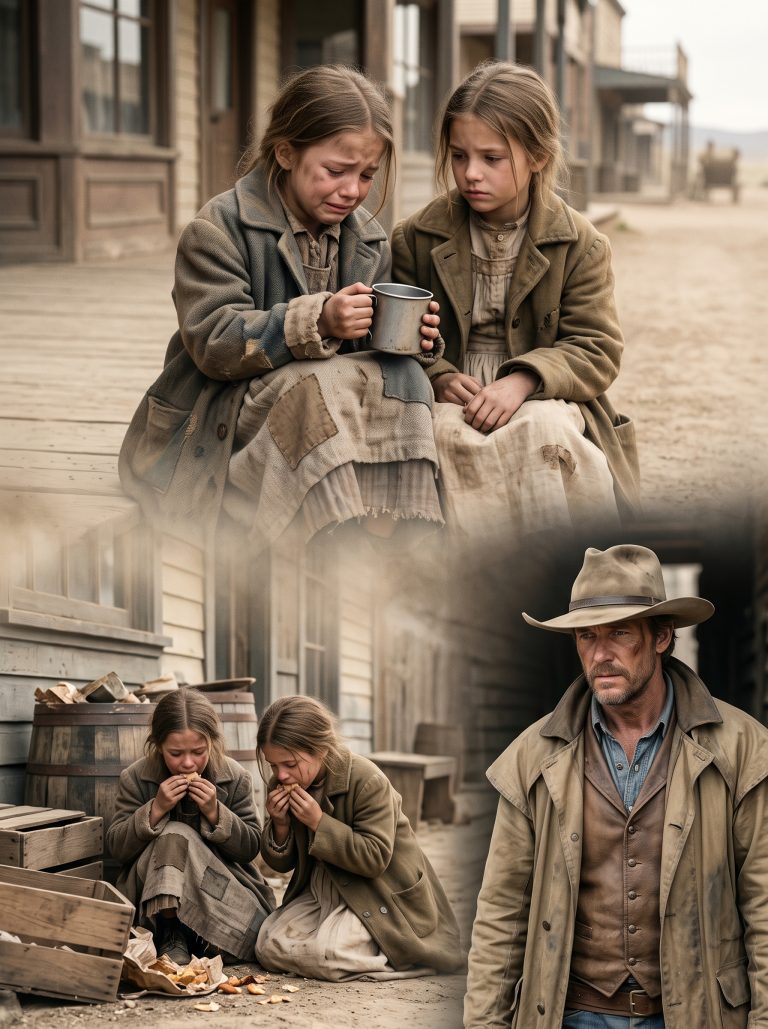
Two girls clung to his coat, identical, maybe seven, hair tangled, feet bare inside boots two sizes too big. One held a dead cicada like a trophy. The other bared her teeth at a woman who stared too long.
“Ezra Calder,” someone whispered, like the name itself might bite.
He lived up past Widow’s Ridge, the story went — trapper, scout, widower. His wife had died bringing the girls into the world, and he’d raised them in the timber ever since, coming down only when winter or necessity forced him.
He crossed to the counter and dropped a stack of pelts. “Flour. Salt. Coffee. Kerosene. Whatever winter wheat you’ve got.”
While her father haggled, one girl slipped free and climbed a shelf of canned peaches like it owed her money. The other crouched under the calico table, hissing when the storekeeper reached for a broom.
“Control them,” Constance snapped, “or cage them.”
Rosalind stepped around the counter with two warm loaves in her hands. She didn’t hurry. Wild things distrusted eagerness as much as cruelty.
“Climbing usually means a body hasn’t been fed proper,” she said, crouching to the girl’s height, holding out the bread.
The girl on the shelf swung down and landed silent as a cat. Both of them stared at the bread, then at Rosalind, then bit in at the same moment. Something in their faces cracked open — the shock of being handed something sweet without a lecture attached.
“Thank the lady,” Ezra said.
“We want her,” one girl said around a mouthful.
The store went dead silent. Then Constance’s laugh cut through it, delighted and cruel. “A mountain savage and Rosalind Danvers. I suppose the leftover pieces find each other.”
Ezra’s head turned toward her, slow, and Constance stopped laughing.
Rosalind straightened. “I’m not for sale,” she told the girls gently, “but you may have more bread when you’re in town, provided you leave Mr. Pruitt’s shelves standing.”
Ezra set a silver dollar on the counter, more than the goods were worth, and said nothing else. His eyes met hers on the way out — not sliding over her the way other men’s did, cataloguing what to disapprove of, but landing and staying, like he’d found the whole picture and seen no need to edit it.
By sundown the story had grown teeth, the way stories did in Millbrook.
Rosalind was hitching her wagon behind the store when a shadow detached itself from the livery. Nathaniel Vance, silver spurs, sandy hair slicked flat, the biggest cattle spread north of the river and, everyone knew, still hungry for more.
“Winter’s coming hard this year,” he said, leaning on her wagon bed. “That’s too much land for a widow alone.”
“I’ve managed two winters without your worry.”
“Walter never understood land,” Vance said. “Fine man. Poor businessman.” His smile thinned. “Accidents happen to the stubborn, Rosalind. Wagons go off passes. You ought to remember that better than most.”
Cold slid down her spine. “What do you know about Walter’s accident?”
“Only what everyone knows.” He tipped his hat. “Crow’s Pass is a dangerous road.”
That night, Rosalind took her late husband’s shotgun down from above the mantle, cleaned both barrels, and set it loaded by the bed. Outside, the wind moved through the sycamore where Walter lay, and for the first time in two years, she let herself wonder if the wind was the only thing that had killed him.
Part 2
Three days later, Ezra Calder walked into the store just as Vance leaned over Rosalind’s counter, voice low and ugly. “Sell me the creek and go east. Somewhere no one expects you to be pleasing.”
“I’d sleep in my own barn first.”
Ezra crossed the floor without hurry. “Heard a man talking about accidents,” he said. “I dislike the word.”
He lifted Vance off his boots by the vest, one hand, easy as lifting grain. “I know the difference,” Ezra said quietly, “between an axle that snaps and one somebody saws halfway through.”
Vance went pale for exactly one second too long.
Outside, walking beside her wagon, Ezra told her what he’d seen two years back, hunting near Crow’s Pass — the wagon’s rear axle lying in the brush, its wood cut clean and deliberate, not splintered the way a fall would leave it. He’d told the sheriff. The sheriff had told him grief made men see patterns.
That night, in the farmhouse kitchen, Rosalind pried up the loose flagstone by the hearth and drew out Walter’s ledger, wrapped in oilcloth. Vance’s name filled page after page in red ink — loans, cattle debts, a final note: if unpaid by December, north range and water rights forfeit. The debt had vanished the week Walter died.
But beneath Vance’s entries, in Walter’s smallest handwriting, ran a second column of numbers she almost missed — bank drafts, initialed A.P., dated the same weeks. Money moving from the bank to Vance, not from him.
Before she could ask what it meant, one of the twins — Wren — went rigid at the window. “Smoke. Barn.”
They found two of Vance’s hired men soaking the barn boards in kerosene. In the fight that followed, Ezra took a graze to the ribs, each twin sank her teeth into one of the men’s ankles, and Rosalind hauled a screaming horse out through smoke with her own two hands. When the fire died, the captured men swore Vance had paid them — and one, shaking, added something stranger: “Said the money weren’t even his to spend. Said it came from higher up.”
Rosalind looked at the ledger’s second column and felt the ground shift under a story she’d believed for two years.
Part 3
Sheriff Boone locked Vance up on Rosalind’s testimony and the hired men’s confession, and for one clean afternoon, Millbrook believed the story was finished. Cruel man, greedy man, dead husband avenged. Constance Pruitt sniffed that no decent woman sheltered an unrelated man and his savages under one roof, and half the town nodded like that settled something.
Rosalind didn’t argue. She was too busy staring at the ledger.
That night, by lamplight, she laid Walter’s book open on the kitchen table and Ezra leaned over her shoulder, his ribs bandaged, one of the twins asleep against each of his boots.
“A.P.,” she said. “Initials. Bank drafts to Vance, going back three years. Vance didn’t have that kind of money of his own — you said so yourself, he was drowning in debt to Walter. So where did this money come from?”
Ezra’s jaw tightened. “Aldous Pruitt.”
The banker. Constance’s husband. The mildest man in Millbrook, the one who’d stood at Walter’s funeral with his hat pressed to his chest and murmured about God’s plans.
“Why would the banker fund the man who owed my husband money?”
Ezra was quiet a moment. Then: “Because a debtor who owes you is a man you can point in any direction you like.”
They rode into town at first light with the ledger between them. Sheriff Boone, to his credit, didn’t argue when Rosalind laid the second column across his desk and asked him to compare it against the bank’s own deposit book — a book Aldous Pruitt, as town banker, had never imagined a baker’s widow would think to request.
The numbers matched. Every draft to Vance traced back to Pruitt’s personal account, not the bank’s — money he couldn’t explain without explaining why he’d been funding a man’s debts to a rival, on the exact schedule Walter had been threatening to call in Vance’s collateral. The records proved the money trail. They didn’t yet prove a murder. For that, Boone still needed Vance to talk.
It was Boone, digging deeper through county filings that afternoon, who found the rest: a survey map, filed only six months earlier, showing a proposed rail spur cutting straight through Stonebridge Creek — Rosalind’s land, and only Rosalind’s land, since Vance’s spread sat too far east to matter. Tucked behind the official filing was older correspondence, nearly three years old, between Pruitt and a railroad surveyor discussing the route in confidence, long before any public map existed. A spur meant a depot. A depot meant the whole town’s trade routed through Pruitt’s bank instead of the county seat’s. Pruitt had known which land he’d need years before he ever filed a map for it, and he’d needed the widow gone and the creek in friendlier hands — hands he’d bought and cornered with debt, then pointed at a wagon on a mountain road.
Vance, dragged from his cell to answer for it, didn’t even have the stomach to lie well. “He’d been carrying my notes at the bank for years, quiet-like, never called them in,” he said, voice cracking. “When Walter threatened to foreclose on my north range, Pruitt said he’d erase every dollar I owed him if I made Walter’s wagon look like an accident. After it was done, he forged a satisfaction notice on Walter’s private loan too, so it’d look like I’d already paid the man off clean. I didn’t ask questions I didn’t want answered.”
“That’s why the debt vanished,” Rosalind said slowly. “Not because Walter died. Because Pruitt forged a paper saying it was already settled.”
Boone’s jaw was tight. “I should have listened to Ezra two years ago,” he admitted, not looking at either of them. “A man’s dead because I mistook certainty for grief.”
“And the barn?” Rosalind asked. “The fire?”
“He said if you started digging in that ledger, better it burn with everything in it.”
Constance Pruitt, in the doorway of the sheriff’s office, made a sound like something breaking that had never once believed it was breakable.
Aldous Pruitt did not go quietly. Rosalind had insisted on being there when Boone’s men came for him at the bank, ledger in hand, refusing to let anyone else finish what her husband had started writing. Pruitt tore open a hidden drawer beneath his desk, seized a pistol, and fired before Boone could reach him. The shot went wide. Ezra, a half-step behind the sheriff, didn’t hesitate — he was on Pruitt before the echo cleared, wrist wrenched behind his back, pistol clattering across the floorboards.
By the time the territorial marshal arrived from the county seat, Millbrook had a new story to tell — not a scandalous widow and her mountain man, but a banker who had arranged the murder of a landowner for a rail spur and a dry goods fortune, and a rancher too far in debt to say no. Constance Pruitt left town within the month, taking her parasol and her opinions with her. Nobody missed either.
Snow came early that year, and Ezra prepared to leave for the ridge anyway, out of some old instinct that said a man who cared for a woman owed her his absence more than his presence.
“You won’t make it before dark,” Rosalind said, arms crossed in the kitchen doorway.
“I’ve made worse crossings.”
“With two girls who cried themselves to sleep the last time you rode off to hunt a man alone?”
He set down his bedroll. On the stairs, Wren and Sparrow stopped pretending not to listen.
“I fear plenty of things,” Ezra said finally. “Fire near my daughters. Debt collectors with guns. I don’t fear Constance Pruitt’s opinion of my manners.” His voice roughened. “I fear staying in this house and wanting to keep it. I fear those girls looking at you like you hung the moon, and me not being able to promise the moon stays.”
“Nobody’s asking you to promise a moon,” Rosalind said. “I’m asking you to stay for supper. The rest we can decide with daylight, same as always.”
Something in his shoulders came down, like a weight he’d been holding since his wife died had finally been offered somewhere to sit.
He stayed for supper. Then he stayed for the winter. Then, in spring, when the court had thrown out Pruitt’s forged satisfaction notice and restored Walter’s original note in full, Vance — stripped of Pruitt’s money and facing prison besides — had no way left to pay what he owed. The north range and its water rights, pledged as collateral from the start, passed to Rosalind by the same lawful debt her husband had written into his ledger two years before. Ezra found her by the sycamore that spring, where she’d planted hardy wildflowers over Walter’s grave, the kind that didn’t ask for gentle winters.
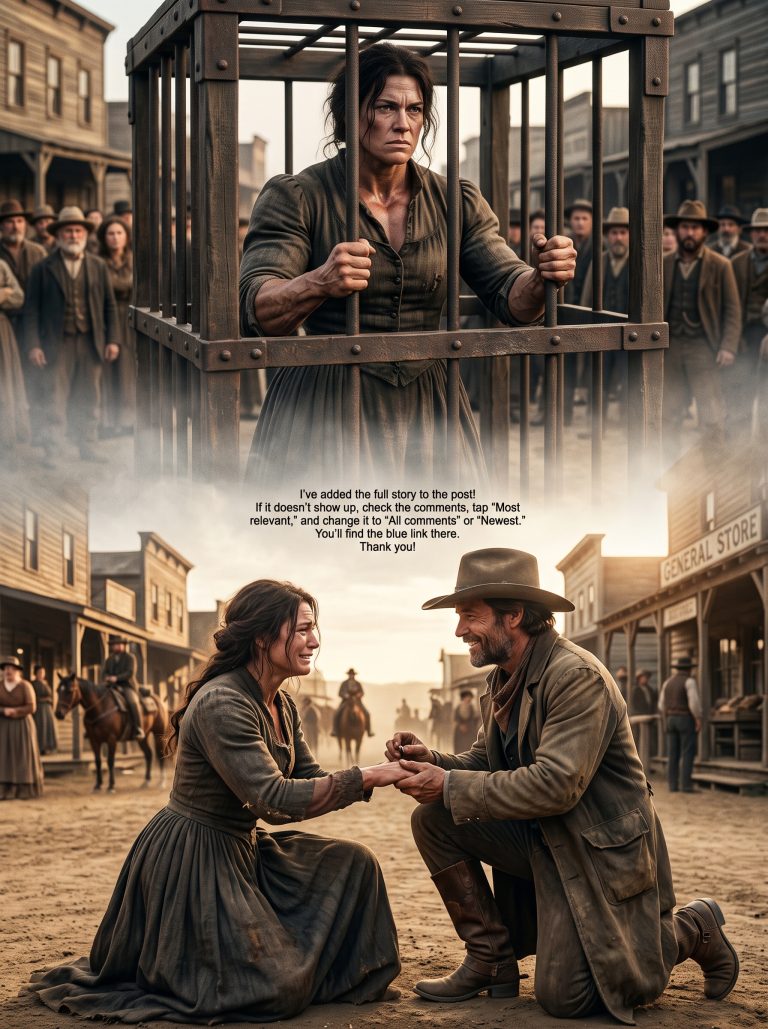
He didn’t have a jeweler’s ring. He had a band of mountain silver he’d carried without knowing why, a thin dark seam running through it like a storm caught mid-breath.
“I have no fine speech,” he said.
“You’ve managed a few good ones.”
“This one’s the one that matters.” He looked toward the house, where two girls were very obviously not stacking firewood behind the rain barrel. “I can offer you daughters who steal biscuits, a cabin on a ridge for when I need to go be silent at trees, and whatever years I’m given. You were never too much, Rosalind. You were only waiting on a life big enough to hold you.”
“Yes,” she said, before he’d finished asking. “But I’m not moving to a ridge full of wolves.”
“Wouldn’t dare ask.”
The girls came out of hiding whooping loud enough to startle the horses, and Rosalind laughed — the real kind, deep and unashamed, the kind Millbrook had spent two years telling her was too much for polite company.
Word came from the county seat that summer that the railroad company, unwilling to build a depot on land tangled up in a banker’s murder trial, had abandoned the Stonebridge route entirely and taken its spur south instead. So they married in the field above the creek that no railroad would ever cut through. Boone came too, quieter than usual, still trying to make amends for the two years he’d spent mistaking a grieving man’s certainty for nonsense. Half the women who’d once laughed at the size of her hands ate her wedding bread in respectful silence, because grudge had never yet ruined an appetite. When the preacher asked who gave the bride away, Rosalind answered before anyone else could.
“No one,” she said. “I stand here by my own will.”
Years later, people in Millbrook would tell the story wrong, the way people always did — that a mountain man had rescued a widow nobody wanted, that a banker had simply gone mad, that greed alone explained a murder plotted in ink and silence for three patient years. But those who’d actually read the second column of Walter Danvers’s ledger knew the truer shape of it: that the men who’d called Rosalind too much had been, every one of them, men too small to stand next to something honest without needing to own or ruin it.
Rosalind had not been chosen because no one else wanted her.
She’d been chosen because Ezra Calder had the sense to want exactly what smaller men feared — a woman whose strength wasn’t a flaw to be managed, but the reason the whole valley, in the end, still had a creek worth fighting for.