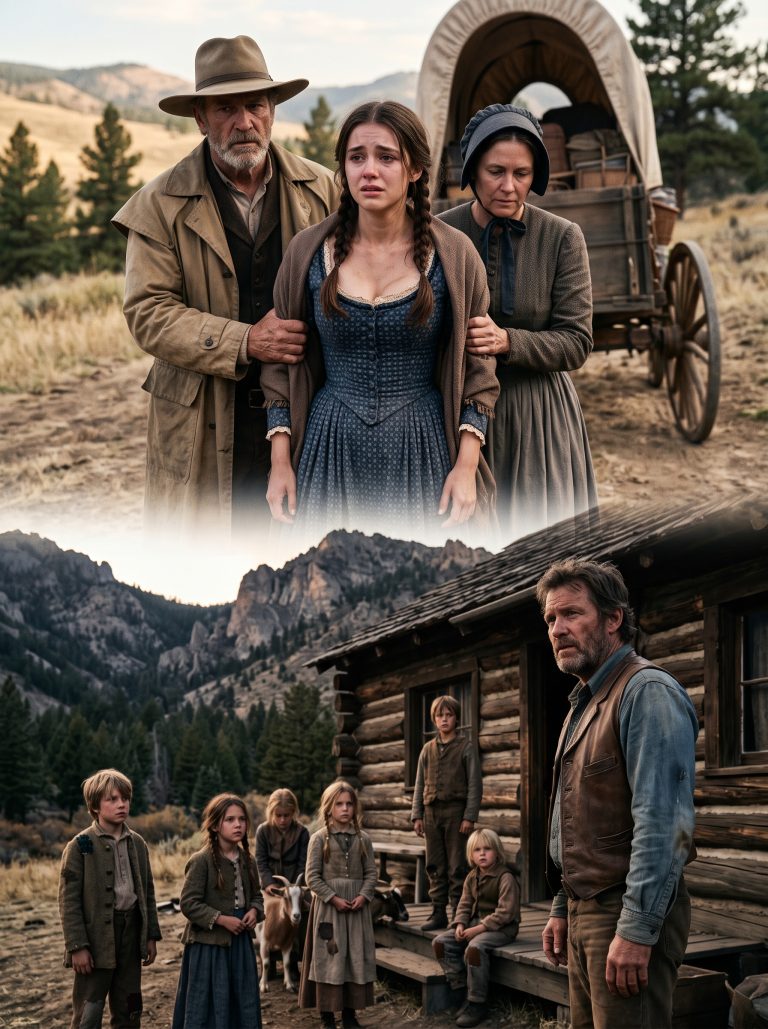
“We Have No One Left…” — Too Starved to Cry, Until a Cowboy Vowed, “I’ll Protect You”

Part 1
She was fourteen, and she had not cried once.
Not when she found her mother’s body half-buried in the snow. Not when she pried her father’s frozen arm away from where it curled protectively around her little sister and understood, all at once, what that stillness meant. Not when she turned to four younger siblings in the dark, swallowed everything threatening to come up her throat, and said the only sentence that mattered: “We have to walk now.”
Twelve miles. A Montana blizzard. A four-year-old on her hip who had stopped making sound an hour before.
By the time Dorothy Callaway raised her fist to knock on a stranger’s door, it was three in the morning, and the cold had stopped feeling like weather and started feeling like an enemy with intent.
The man who opened that door had not been sleeping either.
Caleb Stone hadn’t slept properly in four years — not since the fever that took his wife in a single terrible week, not since he’d learned that a house can be exactly the same size and feel a thousand times emptier. He sat most nights at his kitchen table with coffee gone cold, both palms flat against the wood, doing the specific, exhausting work of not remembering. He’d gotten good at it. Or told himself he had. In four years he had not once asked another living soul for help — not with the ranch, not with the grief, not with anything — and had long since mistaken that silence for strength instead of what it actually was.
The knock that came that night didn’t sound like a knock. It sounded like something breaking.
He crossed the room in three strides and pulled the door open into a wall of cold that hit like a blade — and found a girl on his porch in a coat too thin for the season, snow caked in her hair, lips gone the color of a bruise. A child slack against her shoulder. Behind her, four more shapes standing so still and so silent in the dark they looked like grave markers.
Dorothy’s eyes were the thing that stopped him. Not scared. Emptied. The particular hollowness of someone who has already seen the worst thing life has and is still, somehow, standing upright.
“Our parents died,” she said. Her voice didn’t shake — everything else did, her hands, her shoulders, the child on her hip — but her voice came out flat and final. “We have nowhere left to go.”
Three seconds. That’s how long Caleb Stone stood frozen in his own doorway.
Then he stepped back.
“Get inside.”
They came in like ghosts — small, wet bootprints tracking across a floor that hadn’t heard a child’s footstep in years. The oldest boy, maybe eleven, scanned the room like he was cataloging exits. A girl of nine took inventory of every shelf with unsettling precision. A boy of six lingered at the door, looking back out at the snow like he expected someone to still be following.
“Close the door, son,” Caleb said.
The boy turned to him with eyes far too serious for six years old.
“My name is Eli,” he said. “Not son.”
Caleb closed it himself.
He built up the fire without a word, because there was nothing to say yet that wouldn’t sound hollow next to what these children had just walked through. The youngest — Rose, four years old, not hurt, just cold, the oldest girl said without looking up — made a small sound and curled tighter toward the flames. Nobody spoke. Nobody moved except to drift toward the warmth the way animals do, without pride, without asking.
By the time he set plates of eggs and salt pork and cornbread in front of five children who hadn’t eaten since the morning before, Caleb Stone had already learned their names. Dorothy. Henry, who insisted three separate times that he was fine. Agnes, who informed him — flatly, factually — that his firewood supply was roughly forty percent below where it should be for this stage of winter, and that this was a concern, though a manageable one. Eli, who asked him, without warning, whether losing someone felt like a hole in your chest.
Yeah, Caleb told him. It feels like a hole.
Does it stop?
He could have lied. It would have been easy. Instead he told a six-year-old the truth: It changes.
He didn’t know it yet, but that answer — the choice to tell a grieving child something true instead of something comfortable — was the first thread in something that was about to become much bigger than one cold night and one open door.
Because at sunrise, a horse would come up his lane. And the man riding it would be carrying a document that could take all five of these children away again.
Part 2
Sheriff Dale Whitfield dismounted in the snow just after first light, hat in both hands, looking at Caleb’s house like a man carrying news he didn’t enjoy delivering.
“Five orphan children,” he said. “No listed kin. No legal guardian. That’s not a situation I can look away from, Caleb. That’s a situation the territorial court has opinions about.”
“What kind of opinions?”
“The kind that involve a church home in Helena.”
Caleb didn’t blink. “You ever been to one of those homes, Dale?”
“No.”
“Then don’t tell me it’s set up for them.”
Whitfield studied him a long moment, the wind cutting sharp between them. “You understand what you’re saying. Single man. No wife. No family of your own. The court will have things to say.”
“Let them say it.”
“You could lose.”
“I know. And then those children get sent to Helena anyway — except now they’ve had someone ripped away from them twice.”
Whitfield’s voice went hard, deliberate, the voice of a man trying to make someone see something painful before it’s too late. “Having something and losing it is worse than never having it at all.”
He gave Caleb one week before he’d have to make it official. One week to prove, to a judge who had never met him, that a bachelor rancher with a house full of strangers’ children deserved to keep them.
That single week wasn’t the whole fight — only the deadline to prove he intended to fight at all. On the seventh day, Fitch filed the guardianship petition, entering it on Judge Harmon’s docket. The hearing itself, tied to the judge’s circuit, wouldn’t come for another twelve days.
Caleb spent that first week collecting character references — a reverend unsure a man who never attended church deserved his signature, a merchant weighing business honesty against fatherhood, a rancher’s wife who arrived with a basket of bread and a conviction no one in town dared argue with. He spent it teaching Henry to read a horse’s mood, and watching Dorothy hold herself together in front of everyone, only to fall apart alone in the kitchen at midnight, when she thought no one could hear.
Then, ten days after that first knock on his door — three days after the petition had gone in — a second horse came up the lane at a pace that meant trouble, not courtesy.
Whitfield again. Snow on his hat. An expression Caleb hadn’t seen on him before.
“There’s a man,” he said. “Arrived on the evening stage. Been asking around town about the Callaway children since he got off.” He held out a folded document. “Says his name is Franklin Callaway. Says he’s their uncle.”
Behind Caleb, a pencil snapped clean in half in Dorothy’s hand.
She had been waiting — somewhere in the back of her mind, without ever saying it out loud — for exactly this. Because she had already learned, in the worst week of her life, that nothing good arrives uncontested.
The only question left now was whether blood would beat a door that had opened at three in the morning.
Part 3
Caleb took the document and read it once, then again, slow, the way a man rereads something he needs to be dead certain of. He set it down on the table with the same careful hand he’d use on a rifle or a foal’s bad leg — the kind of weight you don’t rush.
He looked at Dorothy.
“We knew this was possible,” he said.
Her jaw stayed a hard, straight line. Her spine hadn’t moved an inch since the pencil snapped in her fist.
“I know,” she said. “It doesn’t change anything about what we’re doing.”
“I know that too.”
But something in her eyes had shifted — not fear, something harder and more finished than fear. The look of a girl who’d learned early that safety was only ever borrowed, and had decided, right there in that kitchen, she was done being surprised when the bill came due.
“I know whose roof this is,” she said. “I know who let us in out of the cold.”
Outside, the snow kept coming down, patient as a debt collector, the way Montana winter always did — not all at once, but inch by inch, changing the rules of staying alive a little more each hour.
The Man With Her Father’s Jaw
Franklin Callaway was staying at Mallister’s boarding house, and by mid-morning the whole town had split down the grain of an old argument. Blood is blood, some said, certain the court had no choice but to side with him. Others — a merchant named Aldridge, who muttered something under his breath he wouldn’t repeat, and Constance Hail, who’d already picked her side — thought different.
Caleb rode into town and found Franklin on a bench outside the boarding house, hat in his hands, watching the street like a man who’d arrived somewhere and wasn’t yet sure what arriving meant.
Broad through the shoulders, the way Callaway men seemed to run. Gray at the temples. A face weathered by a life spent outdoors.
“You’re Stone,” he said.
“I am.”
“I’m not here to make trouble.”
“You filed a legal claim on five children,” Caleb said. “That’s trouble whether you meant it to be or not.”
Franklin turned his hat over in rough hands. “I was up at a logging camp near Coeur d’Alene. No fixed address — camp mail only went down to the post twice a month, and only if somebody happened to be riding that way. The letter about Thomas and Ruth sat in a general store the better part of three weeks before it found me.”
“I’m listening.”
“I sold my share of the winter contract to cover the fare,” he went on. “Camp doesn’t pay a man to walk off mid-season — that was the only cash I had. Eleven hard days of travel, most of it on credit I still owe a stage line in Butte.” He looked down at the hat in his hands. “I’m not saying that so you’ll feel sorry for me. I’m saying it so you understand why I wasn’t already here.” His voice had the flat, rehearsed sound of a man who’d said these words to himself alone on a long ride and never found them quite enough. “Last time I saw those children, Dorothy was eleven. Never even met Rose.” He looked up. “But Thomas was my brother — my only one. Those children are all I’ve got left of him. I can’t just—” His voice caught at the edge, and he reined it back before it broke. “I can’t walk away from that.”
Caleb studied him a long moment — not with hostility, but the careful weighing of a man deciding whether another man’s grief made him dangerous, or just made him human.
“I’m not asking you to walk away from it,” Caleb finally said. “I’m asking you to think about what’s right for them. Not what’s right for you. There’s a difference. A big one.”
He rode home without resolving a thing, which was likely all the moment deserved. That evening, Fitch — the family’s careful, precise lawyer — laid out the stakes without softening them.
“The hearing is in nine days,” Fitch said. “Franklin Callaway’s lawyer is competent, and he’s going to argue blood claim with everything he has.” He looked at Caleb over his spectacles. “Dorothy’s testimony is going to be the most important thing in that room. Not your character references. Not your income statement.”
“There’s something else,” Fitch said, setting his pen down. “Voss is going to pull your financial records. All of them.”
Caleb’s jaw tightened, just slightly — the stillness of a man bracing for a hit he’d known was coming and had hoped, foolish as it was, might pass him by.
“Then let him pull them.”
“Caleb.” Fitch’s voice went careful. “You still owe Dr. Reeves in Billings for your wife’s care. Near three hundred dollars, by my count. That’s not something you can bury for nine days.”
“It’s not anyone’s business.”
“It’s about to be everyone’s business. A judge weighing ‘stable income’ is going to find that debt whether you hand it to him or Voss does. And a man who hides a debt looks like a man hiding something worse.”
Caleb said nothing for a long moment. Four years paying that account down alone, a few dollars at a time, telling no one — not Whitfield, not the reverend, not even Constance Hail, who’d offered to help outright and been turned away, polite enough not to ask twice — had felt, until this moment, like the one thing left that was still entirely his. Handing it over now felt like giving up the last locked room in a house that had, in three short weeks, filled up with other people’s needs.
“I’ll figure it out,” he said.
“You don’t have nine days to figure it out. You have nine days to disclose it — on your terms, before it gets used against you on someone else’s.” Fitch held his gaze. “There’s no shame in a debt from a wife’s dying, Caleb. There’s shame in a man too proud to say so.”
“Does she know that?”
“Not yet. She needs to.”
What Dorothy Was Afraid To Say Out Loud
He told her that night, just the two of them at the kitchen table, a lamp between them and the house gone quiet around them.
She listened without interrupting. When he finished, she said, “So everything depends on what I say.”
“A great deal of it does.”
“And if I say the wrong thing—”
“There’s no wrong thing,” Caleb said. “There’s only the truth. You tell the truth, and whatever the judge decides is what he decides. But you can’t go in there trying to say what you think they want to hear. Judges hear that every day. They know the difference.”
Dorothy stared at the lamp flame for a long time.
“He has Papa’s jaw,” she said finally, quietly, more to herself than to him. “He looks like someone Papa would have liked, if things had been different. Papa always said Franklin just needed more time to figure himself out. He wasn’t a bad man. Just someone who kept moving when he should have stopped.”
“Sounds familiar,” Caleb said.
She looked at him sharply. “You stopped.”
“I did.”
“He didn’t. Not until now.” Her eyes went back to the flame. “Is that his fault? Or just the way things went?”
Caleb didn’t answer, because the question had no useful answer, and Dorothy was too sharp not to know that already. She was wrestling with something harder than the legal question — whether the man down at Mallister’s was owed something for finally showing up, and whether owing him meant handing over the life she’d only just started building.
“I don’t want to go with him,” she said at last, plainly, the way she said everything that mattered. “I want to stay here. I want my brothers and sisters to stay here. I want Rose to grow up in one place, not moved around like baggage.” She looked at him. “I just needed to say that out loud to somebody who needed to hear it.”
“I needed to hear it,” Caleb said.
She stood, picked up the lamp, and stopped at the edge of the hallway without turning around.
“Thank you for not making promises you can’t keep,” she said. “A lot of people make promises they can’t keep. It’s the ones who don’t that you can trust.”
Supper With The Uncle
Franklin came to the ranch five days before the hearing — no lawyer, no case to argue, just to see them. Caleb watched him crouch to Eli’s eye level, watched the boy study him with those wide, serious eyes and say, simply, “You look like Papa.”
“He was my big brother,” Franklin told him. “I used to follow him everywhere.”
“Were you friends?”
“Best ones.”
Eli pressed a small fist to the center of his chest — the same gesture from that first night. “He was my best friend too. Him and Mama both.”
Something moved through Franklin’s face that had nothing to do with legal claims or territorial court — something raw, belonging entirely to a man looking at the last living evidence of the brother he’d lost.
“I know that feeling,” he said.
Then Rose toddled in, looked at this stranger who shared her father’s eyes, considered him with the flat neutrality of a four-year-old sizing up something new — and walked straight past him to raise her arms toward Caleb instead.
He picked her up without thinking, the motion as automatic now as breathing. Franklin watched her settle against Caleb’s shoulder, her small hand closing around his collar, and something in his own face quietly rearranged itself.
“Can we talk outside?” he asked.
On the porch, in the cold, he finally said what he’d been working up to. “I came here for the right reasons. I believe that. Thomas was my brother, and I owed him better than I gave him, and those children are the last thing I can do for him.” He faced Caleb square. “But I didn’t come to take them from something good and hand them something worse. I’ve watched you twenty minutes in there, and I can see exactly what this is.” His jaw worked. “My brother would have liked you. He’d have been glad you took them in.”
The night before the hearing, he came for supper, and nobody pretended it was only supper. He told them stories about their father — a mule Thomas once convinced their mother had learned to count, a month of stall-mucking after the trick came out, a boy who was, by his brother’s account, the funniest and most stubborn soul Franklin had ever known.
Afterward, alone with Dorothy at the table, Franklin set his coffee cup down and looked at her.
“I made a lot of choices in my life I told myself were about freedom,” he said. “Not settling down. Not needing anybody. Your father told me more than once I had it backwards — that the bravest thing a man can do is let himself be needed.” He shook his head. “I didn’t listen. I’m not saying that so you’ll feel sorry for me. I’m saying it so you know that coming here wasn’t supposed to be about what I needed. Took me a few days to see the difference.” He met her eyes. “I see it now.”
Dorothy was quiet a long moment. “He talked about you,” she said finally. “He said you were the funniest person he knew, and the most stubborn, and that you’d figure yourself out eventually — you just needed more time than most.” She held his gaze, steady. “He believed that right up until the end.”
Franklin’s composure broke completely — not into anger, but into the unguarded grief of a man finally understanding what his absence had cost.
“I should have been there,” he said.
“Yes,” Dorothy said, not cruelly, just honestly. “You should have been.”
He nodded, accepting it the way it was meant — not as a wound to nurse, but as a fact he could finally do something with.
“I can’t be there for them the way he is,” Franklin said, looking down the table at Caleb. “What you’ve built here in three weeks is more than some men build in a lifetime.” He turned his coffee cup once in his hands, slow, like he was still turning the decision itself over. “I’ll go back to Idaho with less than I came with — the contract’s gone, the stage debt’s still mine, and I still won’t have anything to show Thomas’s memory except an empty petition. But holding onto that paper was never going to fix what I didn’t do while he was alive. It would just be me taking something so I wouldn’t have to feel like I’d lost him twice.” He looked up, and for the first time since he’d arrived, there was nothing guarded left in his face. “These children don’t owe me that. Nobody does.” He paused. “I’m going to talk to my lawyer tonight. I’m withdrawing the petition.”
“You don’t have to do that,” Caleb said.
“I know I don’t have to.” Franklin stood, and when he stood, he filled the room the way Caleb imagined Thomas Callaway once had. “I want to be their uncle instead. Really be it — write letters, come for Christmas, be someone they actually know.” He looked at Dorothy. “If you’ll allow it.”
Dorothy’s face moved through several things at once before settling into something that wasn’t quite a smile but lived in the same country as one.
“Papa would want that,” she said. “I’d like Rose to know where she comes from. All of them. I’d like them to know the stories.” Her voice softened. “I can’t give them that. You can.”
The Hearing
Judge Harmon rode the circuit into Cold Water Creek on the morning of the hearing, sixty years old, lean, with eyes that observed rather than reacted. The little courthouse held four rows of benches and a stove that kept the room at something technically above freezing.
Caleb sat at the left table with Fitch beside him and Dorothy next to him, her spine straight, her hands folded, the composure of someone who has made peace with something and no longer has to perform holding it together, because it is already whole.
Franklin’s lawyer stood first and made a good argument — territorial law’s presumption toward blood relation, Franklin’s steady trade as a logger and his prospects for supporting five children, the long-term family connection a bachelor rancher couldn’t reliably offer. Then Voss turned to the financial disclosure Caleb had submitted himself, a week earlier, at Fitch’s insistence.
“Mr. Stone carries an outstanding medical debt of nearly three hundred dollars,” Voss said, “incurred during his late wife’s final illness and still unpaid four years later. The court should weigh whether a man in that position can reliably provide for five additional dependents.”
It landed exactly the way Caleb had feared it would — a private grief turned into a line of arithmetic, read aloud in a cold room full of strangers. He felt the old instinct rise, the one that had carried him through four years alone: say nothing, absorb it, let it pass.
He stood instead.
“That debt is for my wife’s care,” he said, before Fitch could stop him. “I’ve paid on it every month since she died, and I’ll keep paying on it whether these children stay with me or not. It’s never once come before feeding a horse, or keeping a fire lit, or getting a child a coat that fits.” He looked at Harmon directly. “A man who pays a hard debt slow and steady isn’t unstable, Your Honor. He’s just a man who doesn’t quit. I’d have thought that was worth something in a guardian.”
The room went quiet. Fitch, beside him, allowed himself the smallest exhale — not quite relief, but close to it. Constance Hail, two rows back, did not bother hiding her expression at all.
Fitch stood and made the counterargument — the existing guardianship, the character references, the documented weeks of care, the trauma another uprooting would cause. Both sides had made their case. Neither, on its own, was enough.
Then Harmon looked toward the back row.
“I’d like to speak with the children,” he said. “Beginning with Dorothy Callaway.”
She walked to the chair beside the bench like she had already decided exactly how she was going to walk before she’d even stood up.
“Tell me about Mr. Stone,” Harmon said.
Dorothy looked at Caleb — not for permission, but the way you look at a thing you’re about to describe truthfully, making sure you see it clearly before you speak.
“He opened the door,” she said. “That’s where it starts. We knocked at three in the morning in a blizzard, and he didn’t ask us to prove we were worth helping. He just said, get inside.” She paused. “The next morning, before we were even awake, he was already writing letters to lawyers. He didn’t have to do any of that. We weren’t his responsibility. We were five cold children on his porch.” Her voice was clear and unwavering. “He chose us anyway.”
Harmon made a note. “And your uncle?”
“He’s my father’s brother,” Dorothy said carefully, choosing each word like it cost something. “He looks like my father. He tells stories about him I never knew, that I needed to hear. He’s a good man — I believe that.” She held the judge’s gaze. “But he wasn’t there when we needed him, and Mr. Stone was. Being family by blood is something you’re born into. Being family by choice is something you have to decide, every single day.” A breath. “Mr. Stone decides it every day. I’ve watched him.”
“What do you want, Dorothy? Plainly.”
“I want to stay,” she said. “I want my brothers and sisters to stay. I want Rose to grow up knowing where home is. I want Henry to learn everything Mr. Stone knows about horses. I want Agnes to have someone who takes her seriously. And I want Eli—” her voice softened, just slightly, on his name “—to have someone who answers his questions like they matter. Because they do.” She straightened. “Mr. Stone does all of that. He’s been doing it since the first morning.”
One by one, the others came forward and said, in their own voices, the same true thing. Henry talked about wood stacked for Montana winters and a man who explained why instead of just correcting. Agnes talked about inventories and a mother’s saying about counting and planning — and about being the first child whose plans an adult had actually listened to. Eli talked about a hole that changes, and about wanting to stay where the honest people were. Rose was too young at four for the court to question her in any way it could rely on, and Harmon didn’t try; when Fitch gently suggested she sit in the chair on her own, she only tightened her fist around a fold of Caleb’s sleeve and refused to let go. Nobody made her. The room accepted that small, stubborn grip as the plainest evidence of everything already said.
Harmon looked out over the room for a long, silent moment — at Caleb, at Franklin sitting with his hands open and flat on the table, no performance left in him, only a man waiting for the right thing to be decided.
“I note,” Harmon finally said, “that the competing claimant has not presented his case through counsel today, which I take to be a withdrawal of the petition.”
“That is correct, Your Honor,” Voss confirmed. “Mr. Callaway withdrew this morning.”
Harmon nodded, as though this confirmed something he had already suspected from the shape of the room itself. He turned to Caleb.
“You understand guardianship of five minor children is a permanent legal commitment. That it cannot be abandoned when circumstances become difficult.”
“I understand.”
“And you’re prepared to make that commitment formally, before this court?”
“I am,” Caleb said — and it was, he realized as he said it, the simplest and most certain thing he had spoken in four years. Not constructed certainty. The kind that comes from already having done the thing, already knowing the cost, and having already decided it was worth paying.
The gavel came down.
“Guardianship of Dorothy, Henry, Agnes, Eli, and Rose Callaway is granted to Caleb Stone. This ruling is final.”
Home
The room released the way a room does when everyone in it has been holding their breath without quite noticing. Constance Hail pressed a hand to her mouth. Henry looked down for exactly as long as he needed to, then brought his face back up composed, eyes red at the corners, refusing to look at anyone while he blinked them clear. Eli said “thank you” to the ceiling, quiet and sincere, addressed to someone specific. Rose reached for Caleb and said his name, and he crossed the room and lifted her, and she put her head on his shoulder and closed her eyes with the total satisfaction of a child who has finally gotten exactly what she’d decided she needed.
Dorothy didn’t throw her arms around him. That was never going to be who she was, and he’d long since stopped needing her to be. She simply stood beside him, let out one long breath, and looked at him with eyes that had been emptied out three weeks ago and were now, slowly, filling back in with something — not the innocence that was gone for good, but something better built for who she was becoming: a way of holding grief and gladness in the same two hands without either one canceling the other out.
“Okay,” she said. Just that. But it landed like a door closing gently on everything behind them, and a window opening on everything ahead.
Outside the courthouse, Franklin was waiting, hat in his hands.
“I’ll come for Christmas,” he told Dorothy.
“Write,” she said. “Papa would want you to write.”
“I’ll write.”
She nodded once and walked to the wagon without looking back, because Dorothy Callaway had already learned how to walk toward what came next.
The ride home was the same road it had always been — same frozen ruts, same bare trees, same mountains going white against a pale sky. But it felt different, the way a road feels different once you know exactly what’s waiting for you at the end of it.
Henry asked, without looking up, if he could learn to drive the wagon properly, on a schedule. “Monday mornings,” Caleb said, and Henry nodded, satisfied, like a negotiation had gone exactly his way. Agnes announced she’d revised the spring planting calculations and could have them self-sufficient in root vegetables by fall, if the beds went in come April. Dorothy touched the pocket of her coat once, checking, where a folded square of brown paper tied with kitchen string held her mother’s voice, written down in her own careful hand, so that one day Rose would know it too.
“Caleb,” Eli said from the back of the wagon. “Is this what it feels like? When the whole world starts to change?”
Caleb thought about four years spent making sure nothing mattered enough to hurt when it left. About a knock that had sounded like something breaking. About small wet bootprints on his kitchen floor, and a plate slid across a table without being asked, and a four-year-old’s arms raised in absolute, uncomplicated trust.
“Yeah,” he said. “That’s what it feels like.”
“I like it.”
“Me too.”
The house came into view — the barn leaning slightly east the way it always had, a lamp already burning in the window because Dorothy had left it lit that morning, certain, somehow, that they’d be coming home to it.
Rose pointed, her whole small body straining toward it.
“Home,” she said. Certain. Complete. The way only a four-year-old can say the truest things.
“Home,” Caleb agreed.
He brought the horses to a stop in the yard and watched five children climb down one by one and walk, together, into the light and the warmth — and he stood a moment longer in the cold, the same cold that had once tried to take all five of them and failed, only because one door, on one impossible night, had opened.
Then he went inside, hung his coat beside Henry’s, and sat down at a table that was, for the first time in four years, genuinely, permanently full.
THE END