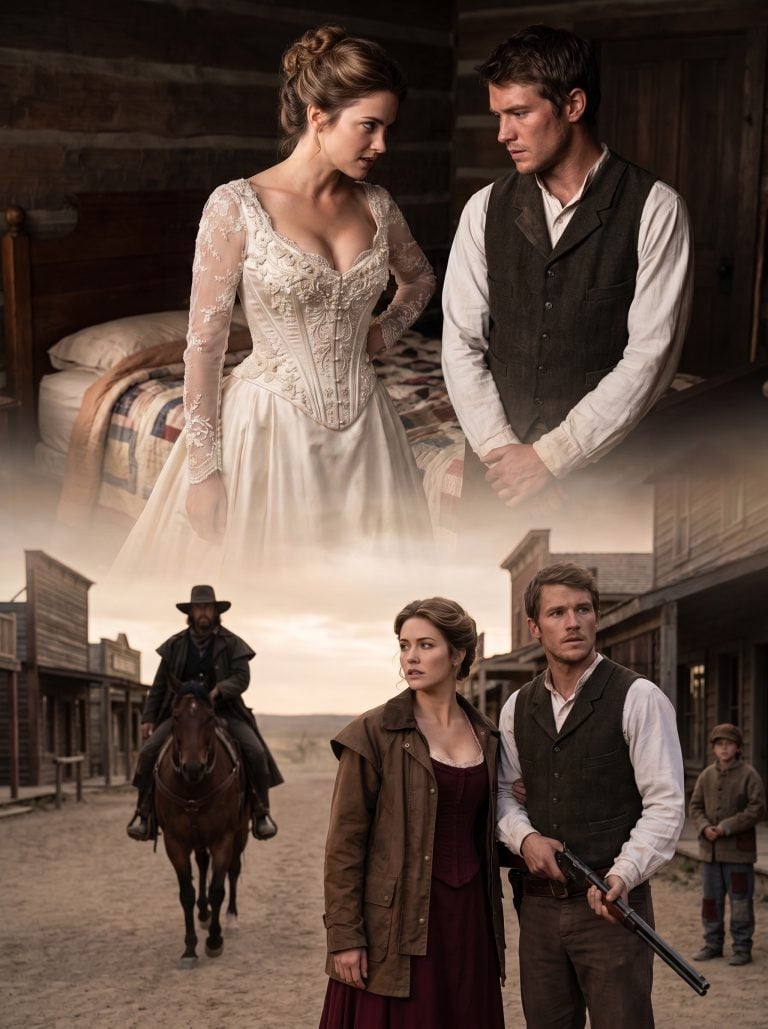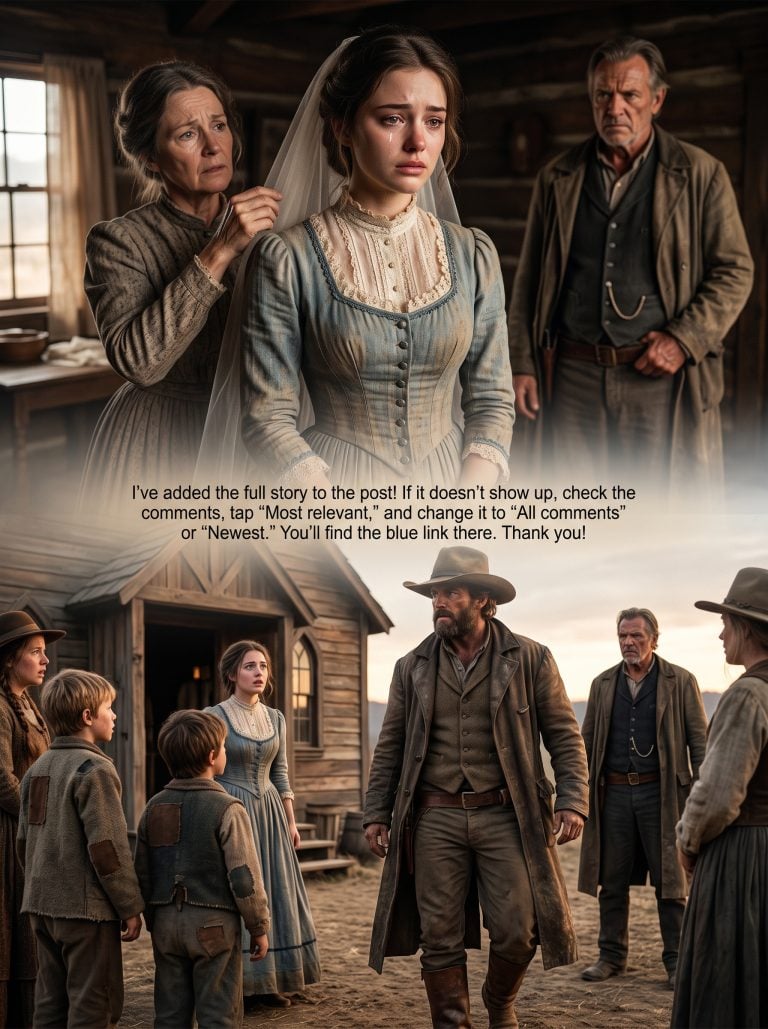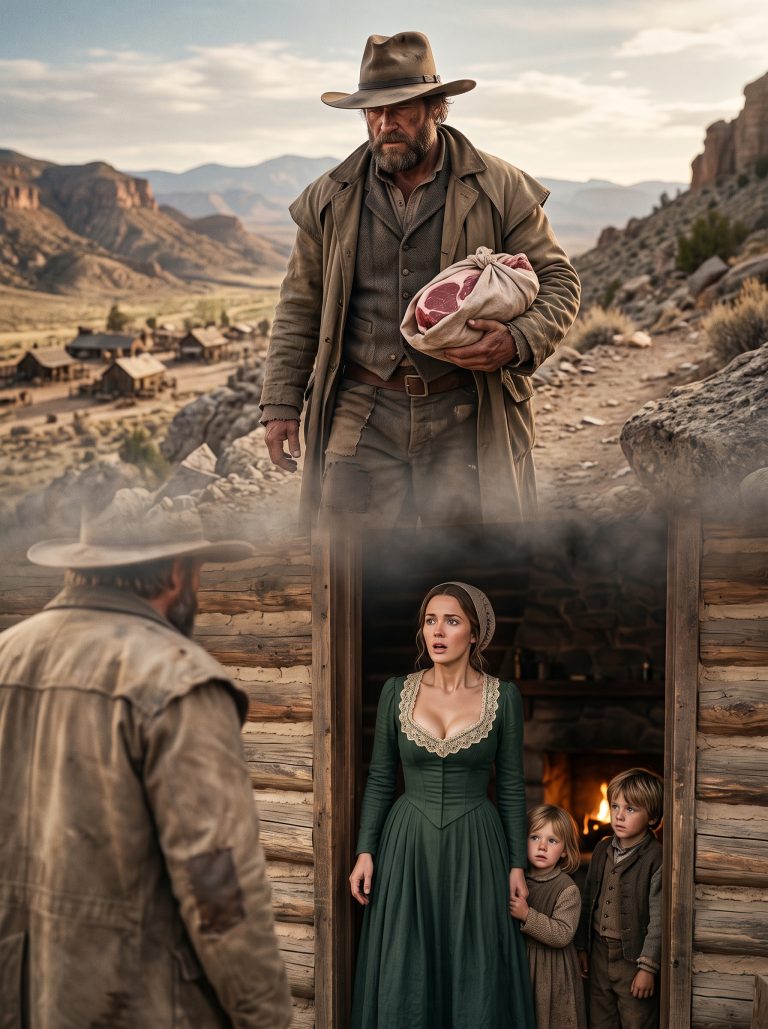
“Mister… If They Come, Please Hide My Mom,” She Cried — The Rancher’s Response Was Unwavering

Part 1
The rifle was already in his hands when the door burst open.
Not knocked. Burst.
A woman fell across the threshold. One arm around a small child. The other pressed to her ribs, where the snow had gone dark and red.
She looked up at him. Not afraid. Just empty. The look of a woman who had already buried everyone who ever promised to help her.
“They murdered my husband,” she said. “They’re coming for me next. Please. Hide my daughter.”
Caleb Horn had not opened that door for anyone in eight years. Not for neighbors. Not for the preacher. He’d built this cabin fifteen miles from town so nobody would ever need anything from him again.
He got her inside. Got the wound cleaned. It was a knife wound, four inches long, two days old. While he worked, his hand caught something hard stitched into the lining of her coat. A shape like a small book.
She flinched and covered it with her arm before he could ask.
Her name was Margaret Cole. Maggie. The silent girl was Eliza, seven years old. Hadn’t spoken since October.
Her husband had been Reverend Thomas Cole — a preacher who spent two years quietly documenting something ugly. Forged land deeds. Stolen homesteads. Families run off their own land in the dead of winter. All of it pointed straight at one man: Governor Harlon Stokes. A man who owned three buildings, a courthouse, and the sheriff’s office in four counties. A man who didn’t lose.
Three days before Thomas meant to send his evidence to the U.S. Marshal’s office, two of Stokes’s men walked into the church and killed him. Eliza was there. She saw it happen.
That was three months ago. Maggie had been running ever since — and the thing stitched into her coat, against the very wound Caleb had just finished dressing, was her husband’s journal. What was written inside it, she hadn’t said yet.
Caleb looked at Eliza. She was already holding out a scrap of paper — a note, worn soft from being folded and unfolded. Written in a child’s careful hand.
If bad men come, please don’t let them take my mama. She didn’t do anything wrong. My papa would want me to ask.
Caleb read it twice.
“You can stay,” he told Maggie. “Don’t thank me yet.”
That was when he heard it. A horse, screaming through the wind. A rider, driving hard through a blizzard that should have stopped anyone from moving that fast.
Somebody already knew where they were.
Part 2
The rider wasn’t one of Stokes’s men. Not yet.
His name was Getty, a neighbor twelve miles east, and he hadn’t ridden through a blizzard to knock politely. He’d come to warn them.
Eight, maybe ten riders were sweeping the county, asking about a widow and a silent girl. A man loyal to Stokes had already spotted their tracks turning north.
“How long?” Caleb asked.
“Three hours. Maybe four.”
He sent Getty back into the storm with three words — you never came — and turned to find Maggie already reaching for her coat, ready to walk out into a blizzard rather than put anyone else in danger.
He stopped her. Not with force. With the plain truth: the horse was spent, the storm hadn’t broken, and Stokes’s men knew this land better than she did. Walking out that door tonight meant dying before sunrise.
“You don’t owe us anything,” she said.
“No,” Caleb agreed. “I don’t.” He looked at Eliza’s note, still sitting on the table between them. “Somebody should have stood up for a man named Aaron Webb. I didn’t. I’m standing now.”
Maggie drew the journal from her coat and set it down between them like she was setting down the last piece of someone she loved. Every name her husband had found. Every date. Every forged signature — the one thing left in the world that could still bring Harlon Stokes down. Which meant it was also the one thing Stokes wanted gone.
They had until dawn. Caleb copied pages by firelight while Maggie read the evidence aloud from memory — forty-three pages, three county sheriffs, two judges, a land attorney who’d filed sixty fraudulent deeds in eighteen months, all of it circling back to one name.
Somewhere past midnight, Maggie found an entry she’d never let herself read before. Four sentences her husband had written four days before he died. She broke, once, quietly. Then she kept going.
An hour before dawn, a sharp crack near the barn pulled Caleb outside with the rifle — and the man he found there wasn’t reporting to Stokes’s men. He was hiding from them, holding a letter written three weeks earlier by a woman named Ruth Abernathy in Dalton Springs, telling every homestead in the county to be ready to help a woman with a journal and a silent child.
Thomas Cole, it turned out, had been building more than a case. He’d been building a network — and it had been waiting for his family for weeks.
But it’s the name Caleb heard next that changed everything. A Deputy U.S. Marshal, three hours south, already riding toward them.
A name Caleb hadn’t spoken out loud in eight years. The brother of a man he’d once helped send to the gallows for a crime he didn’t commit.
Part 3
I. What Was Sewn Into the Coat
The girl crossed the room in four silent steps and held the note up before Caleb had finished folding the copied pages.
If bad men come, please don’t let them take my mama. She didn’t do anything wrong. My papa would want me to ask.
He read it twice. Something in his chest, shut down for eight winters, opened without asking his permission.
He tried to hand it back. Eliza shook her head and went to sit by her mother instead, fingers laced through Maggie’s, eyes on the fire. Settled.
Then the wind outside changed pitch. Hoofbeats — one horse, driving hard through snow that should have stopped anything from moving that fast. Caleb had the rifle up and a shutter cracked before he’d decided to move.
The rider was Getty, a neighbor from twelve miles east. He dragged the scarf down from his face, and what Caleb saw there wasn’t the calm of a man delivering routine news. It was real fear, badly hidden, on a man too solid to scare easy.
“Stokes’s men are riding,” Getty said, low. “Eight, maybe ten. Asking every homestead about a widow and a girl. Saying she murdered a man in Laramie.” A pause. “McAffrey at the relay station saw a bay mare turn north off the main road. Two hours back.”
“How long?”
“Three hours behind. Maybe four.”
Caleb held his eyes. “You tell anyone you were coming here?”
“No.”
“Then you never came.” Final, flat. “You rode out, the storm turned you back.”
Getty studied him. “God be with you,” he said, and rode back into the white.
Caleb closed the shutter and turned to find Maggie already pulling on her coat.
“You’ll die out there,” he said. “The mare’s spent. The storm hasn’t broken. And they know this land better than you do.” He didn’t soften it. “That’s not me keeping you here. That’s just what’s true.”
Her jaw stayed hard, but she stopped moving.
“If we stay,” she said, “they come here.”
“Then they come here.” He heard himself say it and understood, in the same breath, that he meant it. “You knocked. I opened the door. I’m already in this.”
“You don’t owe us anything.”
“No,” he said. “I don’t.”
“Then why?”
He looked at Eliza. At the note still lying on the table. “Somebody should have stood up for Aaron Webb,” he said quietly. “I didn’t. I’m standing now.”
Something shifted in Maggie’s face — not soft, exactly. A guard sliding aside just far enough to show what was underneath. She crossed to the table and drew a small book from inside her coat, unstitching it herself with quick, practiced fingers. Leather-bound, worn soft at the corners, her husband’s name written inside the cover in careful ink.
The thing Caleb had felt earlier through the fabric. Not a weapon. A record.
“It’s all here,” Maggie said. “Every name my husband found. Every date. Every forged signature.” Her voice held. “He died for this book.”
“Then we make sure he didn’t die for nothing.”
II. What the Journal Held
Thomas Cole had been a methodical man — the kind who dated every entry and named every source. Forty-three pages: three county sheriffs on Stokes’s payroll, two circuit judges, a land attorney in Cheyenne who’d filed sixty fraudulent deed transfers in eighteen months. Families run off homesteads that had been theirs for twenty years.
And at the center of it, a man Caleb already knew by reputation. Harlon Stokes didn’t send threats. He sent paperwork — deeds that appeared out of nowhere, signed by people who’d never signed them, filed by attorneys who never had to explain where the signatures came from. Nobody in four counties had ever managed to make a charge against him stick, because by the time anyone noticed what he’d taken, it already belonged to him on paper.
One entry stopped Caleb cold. Thomas had written about meeting Stokes once, in person, at a land office in Cheyenne. Stokes had smiled the entire conversation. Asked after Thomas’s daughter by name. Mentioned, pleasantly, that a preacher’s congregation could turn on him awfully fast if the right rumor started moving through it. Then he’d shaken Thomas’s hand and wished him a good evening.
Thomas had written, underneath it: He never raised his voice. That’s what frightened me most.
Caleb read it twice and understood, for the first time, exactly what kind of man was hunting the woman across the table from him.
“You said you worked for the law once,” Maggie said, somewhere past midnight, not looking up from the page she was reading aloud.
“I did.” He kept copying.
“What happened?”
A log settled in the fire. “I testified against a man. Name was Aaron Webb. Homesteader, over in Nebraska. I was a deputy marshal. I saw a man running from the direction of an attack, and I told myself that was enough.” His jaw tightened. “The court convicted him. Sentenced him to hang.”
Maggie waited.
“Three months after the execution, the real man confessed. Drifter, in a saloon in Kansas.” Caleb set down the pen. “Webb had a wife. Two daughters, six and nine years old.”
Silence took the room.
“It wasn’t your fault,” Maggie said quietly.
“I’ve heard that.” His voice was worn smooth from eight winters of hearing it and never quite believing it. “Doesn’t change what happened.”
“No,” she agreed. “It doesn’t.” Her eyes stayed steady on him. “But hiding in a cabin for eight years doesn’t change it either. I’ve spent three months running, Mr. Horn. I know exactly what it looks like when someone decides the only safe place left is away from everyone. I understand it.” A beat. “I just don’t think it works.”
“No,” Caleb said, slowly, admitting it to himself for the first time. “It doesn’t.”
Something passed between them — not tenderness, too early for that, but recognition. Two people who’d learned the same hard lesson, sitting together in what was left of it.
Past midnight, Maggie stopped mid-sentence on a page she’d never let herself finish. Her voice went careful, held tight, reading her husband’s last entry aloud. Four days before he died, Thomas had written that Maggie was the strongest person he’d ever known, though she didn’t believe it — and that whatever happened to him, she and Eliza would be all right.
Her voice cracked once. She kept reading anyway.
“He was right about one thing,” she said when she finished, eyes wet, face composed. “I don’t believe it. That I’m strong.”
“That’s what strength looks like,” Caleb said. “It doesn’t feel the way people think. It just feels like not quitting.” He nodded at the pages between them. “You’re still here. Eliza’s still here. This is still here. That’s not luck. That’s you.”
She held his gaze, swallowed hard, and picked the pen back up. “We should keep going.”
They worked another hour in silence before Maggie noticed his hand had slowed. Not from tiredness. From care — each letter shaped deliberately, like the writing mattered as much as what it said.
“Where’d you learn to write like that?” she asked. “Careful, I mean. Like it costs you something to get it wrong.”
“Taught myself.” Caleb didn’t look up. “Ordered a primer from a catalog my second winter out here. Copied Scripture until my hand stopped shaking on the letters.” A pause. “Had a lot of winters.”
Something almost like a smile crossed her face — the first one he’d seen. “Thomas used to say the same thing about sermons. Said the ones that mattered were the ones that cost him sleep to write.”
“He sound like he was hard on himself.”
“He was hard on everyone he loved. Himself most of all.” She refilled his cup without asking, set it by his elbow — a small, ordinary kindness that landed harder than it should have, given the night they were having. “You remind me of him a little. God help you.”
Caleb almost laughed. It came out rough, unused, like a door hinge that hadn’t moved in years. “That supposed to be an insult?”
“Depends whether you take the compliment or the warning.” She sat back down across from him, journal open between them again. “He never knew how to stop carrying things either.”
“Maybe that’s not the worst thing a man can be.”
“No,” Maggie said, quiet now, watching the fire instead of him. “Maybe it isn’t.”
Neither of them said anything else for a while. The pen scratched. The fire cracked. And for the first time in eight winters, the silence in that cabin didn’t feel like something Caleb had built to keep people out.
III. The Man at the Barn
An hour before dawn, a sharp crack near the barn brought Caleb to the door with the rifle. He found two men — one on foot, older, heavyset, and one on horseback with a flat, bored voice that carried more threat than anger ever could.
“Two horses came off the north road tonight,” the rider said. “Tracks lead to your fence line. You’ve got one chance before this gets difficult.”
Caleb stepped around the corner. “Don’t.”
The rider’s hand froze halfway into his coat. “Caleb Horn,” he said, the way men say a name they’ve already been given. “You know who I work for.”
“I have a good idea.”
“Then you know how this ends if you point that rifle at me.”
“Might be.” Caleb held steady. “Turn around. Tell whoever sent you there’s nothing on this ridge worth their trouble.”
A long look. The rider turned his horse. “Governor Stokes doesn’t forget,” he said over his shoulder.
“I don’t expect he does.”
The man on foot — Abel Dobbins, a homesteader two miles east — stood there afterward with the look of someone who hadn’t expected anyone to still stand up to Stokes’s men in this county. His own neighbor had lost forty years of family land the spring before and never fought it, because men like Stokes always won.
“Do they?” Caleb asked.
Dobbins pulled a folded letter from his coat. Written three weeks earlier by a woman named Ruth Abernathy in Dalton Springs, sent to every homestead in the county — telling them to be ready to help a woman with a journal and a silent child.
Thomas Cole, even in his last weeks, had been building more than a case file. He’d been building a net.
Caleb asked Dobbins for a fresh horse and his silence. Both came without hesitation.
“You’ve got until midmorning before more men ride up,” Dobbins warned. “I know you’re not afraid.”
Caleb thought about Aaron Webb. About a note pressed into his hand by a child who had already forgiven the world for more than it deserved. “I’m afraid of the right things,” he said, and went in to tell Maggie they were leaving at first light.
IV. The Timber Tract
Three riders on two horses moved south through a world gone white and quiet. Caleb rode ahead, watching the tree line the way a man watches for weather he can’t afford to miss.
Three miles out, Eliza turned and held up four fingers. Pointed east. Made a small, unmistakable motion — horses, moving.
Caleb’s spine went cold. He listened. Three seconds of nothing. Then the muffled crunch of hooves in packed snow, parallel to the road.
“They’re flanking,” he said. “Waiting for us to hit open road.” He turned west instead, toward the timber tract. “Longer, rougher — but it breaks their angle.”
“You know this land in snow?”
“Trust me.”
She held his eyes one beat, then turned the mare west without another word. He knew exactly what that cost her.
What followed was short and vicious — a crow startled out of the trees, a shout of stop in the name of Governor Stokes, a shot that cracked wide and threw up snow a few feet from his boot, and one voice, sharper than the rest: Don’t shoot again — Stokes wants the journal, not a dead woman.
Useful information. They needed Maggie alive. Caleb turned them down a frozen creek bed that ran straight into Dalton Springs, and by the time the first buildings appeared, the pursuit had faded behind them.
V. Ruth Abernathy’s Kitchen
Ruth opened her back door before Caleb’s knuckles finished the second knock, like she’d been standing there waiting. Sixty years old, built solid, gray hair pulled back hard, dark eyes that took the measure of all three of them in about two seconds.
“All of you. Right now.”
Her kitchen was warm and smelled of bread. She had Eliza wrapped in a blanket with something warm to drink before anyone finished sitting down.
“Your daddy told me about you,” Ruth said to the girl. “Said you were the smartest person in the family.” A pause. “He wasn’t wrong.”
Something moved across Eliza’s face. Not quite a smile. Something more complicated.
Ruth had been waiting three weeks. Thomas had written her in September — if anything happened to him, trust whoever brought his family. She’d already reached a Deputy U.S. Marshal out of Cheyenne, a straight man named Aldis Webb.
Caleb went very still.
“You know him?”
“I knew his brother,” Caleb said, and didn’t explain further.
Ruth read the silence and let it sit. But then came the rest of the news. Stokes had already moved. He’d filed formal murder charges against Maggie through his own judge, Perryman — a warrant legal on paper, backdated to arrive before Webb could act. If any officer in the territory took Maggie into custody first, she’d go to a Laramie jail and never come back out.
“Then we move faster than the warrant,” Maggie said.
VI. The Sheriff’s Choice
Sheriff Denton Price came to warn them, not arrest them — a man who’d carried a badge for six years while quietly answering to Stokes, because Stokes had made it plain that Price’s nephew, working in the land office, would pay for any trouble his uncle caused.
“I’m not asking for your sympathy,” Price said. “I’m telling you the shape of the cage.”
“And now?” Caleb asked.
Price looked at the journal a long moment. Unpinned his badge. Looked at it lying on the table. Pinned it back on. “When this is over — when Stokes is finished — I want the boy out clean.”
“If the case holds, everyone who testifies gets consideration,” Caleb said. “That’s how it works.”
“I used to believe in how it works,” Price said quietly. “Maybe it’s time to start again.”
Eliza crossed to him with her slate. He crouched to read it, and his face changed. He told her, quiet, that he’d known her father — that Thomas had come to him two years ago with the first piece of what he’d found, and Price had turned him away. He’d been sorry ever since.
She held the slate up again. Help us now. That’s enough.
Price rode to stall Stokes’s men at the county line. Ruth sent her stable hand south to push Webb’s timeline forward. And Caleb set the second rifle in front of Maggie.
She checked the load in two efficient movements. “My husband was a pacifist,” she said, when he asked if she could shoot. “That’s not an answer.” A beat. “Yes. I shoot. He didn’t know.”
Eliza negotiated her own terms before agreeing to the cellar — she’d go down, but she kept the copied pages, and she came up only when she heard a Deputy U.S. Marshal say his name and rank out loud.
“Promise me,” Caleb said.
She wrote: I promise. Then, underneath: Don’t get shot.
He almost smiled. “I’ll do my best.”
VII. The Man at the Door
Six riders came in slow down the main street, unhurried, the way men move when they think the outcome is already settled. The one in front dismounted and knocked three times. Polite.
Edgar Crane. Lean, still, the kind of stillness that isn’t peace — it’s a man who has trained urgency out of himself because urgency belongs to people who aren’t certain. Maggie had already told them what to expect. He was the one who’d walked into the church in October. The one who did what Stokes needed done, quietly enough that it never touched the governor’s own hands.
Ruth opened the door with a revolver at her side and a perfectly pleasant voice. Crane produced his warrant and asked for cooperation like a man requesting a signature.
“You’ve made this valley hard for three years, Mr. Crane,” Ruth said. “You can survive me being hard back.”
Behind Crane, his five riders had already spread — two peeling toward the alley beside the boarding house, one circling toward the back. Caleb saw it happen and understood, in the space of a breath, that this was never meant to end with a knock. The front door was a courtesy. The back was the plan.
“Denton,” Crane called, without turning his head, “cover the rear.”
“Sheriff’s not here,” Ruth said.
“I noticed.” Crane’s voice didn’t change at all. That was the worst part of it — no heat, no hurry, just a man rearranging pieces on a board he’d already decided he’d win. “Which tells me he’s somewhere he thinks matters more.”
Ruth stepped aside. Crane saw Caleb and the rifle and registered nothing.
“Horn,” he said. “I was told you’d gotten religious about closed doors.”
“Made an exception.”
Crane’s eyes moved past him to Maggie — steady, no fear at all — and something behind his flat expression recalculated. He took a step further into the room. Old Douglas, at the front window with his shotgun across his knees, shifted his weight, and Crane’s gaze flicked to him for exactly one second before dismissing him entirely, which was somehow more unsettling than a threat would have been.
“Mrs. Cole. I think you understand the position you’re in.”
“I understand it very well.”
“Then you understand this ends one of two ways.” Crane’s voice stayed level, almost gentle. “You walk out with me, and Judge Perryman hears your case in a courtroom that already knows the verdict. Or you make this difficult, and I have five men outside who won’t be as patient as I am.” He glanced, deliberately, toward the cellar door. “I understand there’s a child somewhere in this house.”
The room went very still.
Caleb’s hand tightened on the rifle. “She’s not part of this.”
“She’s part of whatever her mother made her part of, Mr. Horn. That’s not my doing.” Crane said it without malice, which was worse than if he’d said it with any. “I’d rather this stayed simple. Simple is better for everyone still breathing at the end of it.”
Maggie’s face didn’t move, but Caleb saw the muscle in her jaw lock down hard. She set the journal on the counter in plain sight, deliberate, a card played face-up.
“A Deputy U.S. Marshal is two hours south,” she said, “with a writ that supersedes your judge’s warrant. Everything my husband found has already been copied and sent to four locations. Including the name of the man who walked into that church in October. And the name of the man who sent him.”
“Copies burn,” Crane said. “Witnesses recant. Deputy U.S. Marshals get delayed on bad roads.” He took another step, close enough now that Caleb could see he hadn’t so much as glanced at the rifle since he’d walked in — a man who’d decided a long time ago that guns pointed at him were somebody else’s problem. “I’d think about that, Mrs. Cole, before you decide two hours is a number you can count on.”
“Whatever you’re being paid,” Caleb said, low, “it’s not enough for what comes next.”
“It never is.” Crane almost smiled. “That’s not an argument against taking it.”
Nobody moved. Ruth’s hand had drifted an inch closer to the shawl at her hip. Douglas’s thumb rested on the shotgun’s hammer. Caleb watched Crane watch all of it, cataloguing, and understood that the only reason this hadn’t already turned violent was that Crane was still doing the math on whether five men against a house full of witnesses was a fight worth winning ugly.
Then the sound arrived from the south — more than one horse, moving fast — and every man in the street heard exactly what it meant.
For the first time, something behind Crane’s stillness shifted.
VIII. Aldis Webb
The Deputy U.S. Marshal rode in flanked by two men and pulled up in the center of the street, already certain of what he was about to do. Younger than Caleb had pictured — and the resemblance hit him like a stone dropped into still water. Same jaw. Same eyes, sweeping the street until they landed on Caleb standing in the doorway.
Three seconds passed between them. Caleb didn’t look away. He’d looked away once, eight years ago, in a courthouse. He wasn’t doing it again.
Webb turned to Crane first. “Federal writ. Supersedes all territorial warrants on Margaret Cole. Stand down.”
Crane’s men made their own calculation — riders who’d worked for Stokes because Stokes paid well and always won, watching that math come out differently for once. One turned his horse. Then another.
“This isn’t finished,” Crane said, to no one.
“No,” Caleb told him. “But it’s starting.”
Crane rode north. Webb dismounted and walked to the door.
“Horn.”
“Webb.” Caleb held his eyes. “I’m sorry about your brother.”
It wasn’t enough. It was never going to be enough. But it was said, out loud, to the right person, after eight years of carrying it alone.
Webb was quiet a moment. “I know you are,” he said finally. Not forgiving. Not condemning. Present. “I need you to tell me everything about the evidence against Stokes so I can build a case that sticks.”
“Come inside,” Caleb said, and for the first time since a woman had fallen across his threshold, the ground under him stopped moving.
IX. What It’s Worth
Four hours at Ruth’s table. Webb thorough and relentless, Maggie answering everything from memory, Price arriving with land records and three signed statements from families brave enough to speak.
By evening, Webb set down his pen. “It’s enough. Enough to bring charges. Enough to remove Stokes pending trial. Enough to void the warrant against you, Mrs. Cole.” He looked at Maggie. “It’ll be a long fight. But the foundation is solid. Thomas built it solid.”
“Will he be charged with Thomas’s murder?” Maggie asked.
“Harder to prove than the fraud,” Webb said honestly. “Crane’s the direct connection. Whether it reaches Stokes depends on how his people hold up under questioning.” He met her eyes. “I won’t promise what I can’t deliver. But I won’t stop until every connection that can be proved is proved.”
“That’s enough,” Maggie said. “That’s all Thomas ever wanted. Not vengeance. The evidence, told in the right place, by the right people.”
Eliza crossed to the table, wrote something, and held it up. Webb’s face changed as he read it.
My papa said the truth was worth dying for. Is it worth living for, too?
“Yes,” Webb said, voice rougher than before. “That’s exactly what it’s worth. Your father understood that better than most men I’ve known.”
She considered him, then wrote one more line and turned the slate around. He would have liked you.
Webb swallowed hard and nodded, and didn’t trust himself to say more.
Caleb turned toward the window. Some moments need a wall to lean on. He was still standing there when Eliza’s slate appeared again beside him.
Thank you for opening your door.
Five words. Everything that mattered had come from that one choice.
“You’ve been brave every day since October,” he told her.
She wiped the slate. Wrote: I was scared.
“I know. That’s what brave is.”
She crossed the two steps between them and held on, and he put his hand on her head, careful, and let her stay there as long as she needed.
X. Home
Three days later, a telegram reached the kitchen table: Harlon Stokes, removed from office, pending federal charges. Maggie read it twice and stood with both hands flat on the wood, breathing — relief and grief arriving in the same breath, the way they always do when a fight this long finally lands.
“It’s not over,” she said. “The trial will take months.”
“It won’t fall apart,” Ruth said, flat and certain. “Thomas made sure of that.”
Eliza wrote on her slate and held it up for her mother. Papa would say: now keep going.
The next morning, Caleb rode back to the ridge for the first time since the blizzard — not away from anything this time, but toward something. He packed what little he owned. In his coat pocket he found a note he hadn’t put there. Maggie’s handwriting, left the morning after they fled.
Thomas always said the measure of a man was what he did for people who couldn’t pay him back. You measured up. Come back to Dalton Springs when you’re ready.
He left the cabin door unbarred. Whoever needed shelter next winter could have it.
Maggie was on Ruth’s porch when he rode back into town.
“I didn’t know if you’d come back.”
“I said I would.”
“People say things.”
“I meant it.”
Eliza appeared in the doorway with her slate — Ruth had already offered him the room next to theirs, until spring — wearing the satisfaction of a child who’d expected exactly this and was only waiting for the adults to catch up.
“I may have mentioned to Ruth the roads are bad through March,” Maggie said, holding his eyes. “And that a man who knows this territory might be useful, while the trial’s pending and Crane’s people are still loose.”
“That’s practical.”
“Yes. It is.”
“Then I’ll stay.”
Inside, the table was set for four. The fire was strong, the smell of coffee filled the room the way it only does in a house with a future in it, and Eliza reached up and took his coat without being asked, hanging it on the peg beside her mother’s.
Two coats, side by side.
He sat down. Eliza sat beside him, wrote one word, and held it up.
Home.
Four letters, solid as ground. He looked at Maggie across the table, at the fire, at the winter light fading outside and the warm light pushing back against it.
“Home,” he said. Not borrowed. Not hoped for. Finally true.
He glanced once at the door — the same kind of door he’d kept shut for eight winters, the same kind that had never once opened for a stranger until a woman fell through his. This one stood unlocked, unbarred, warm light spilling under it into the snow outside. He’d spent eight years believing a closed door was the only thing that kept a man safe. He knew better now. The door that had changed everything was the one he’d opened.
He picked up his fork. The food was good. The people at the table were alive.
Outside, the snow fell quiet and steady, covering the old ground in clean white — the way winter always does, making room for what comes next.
THE END