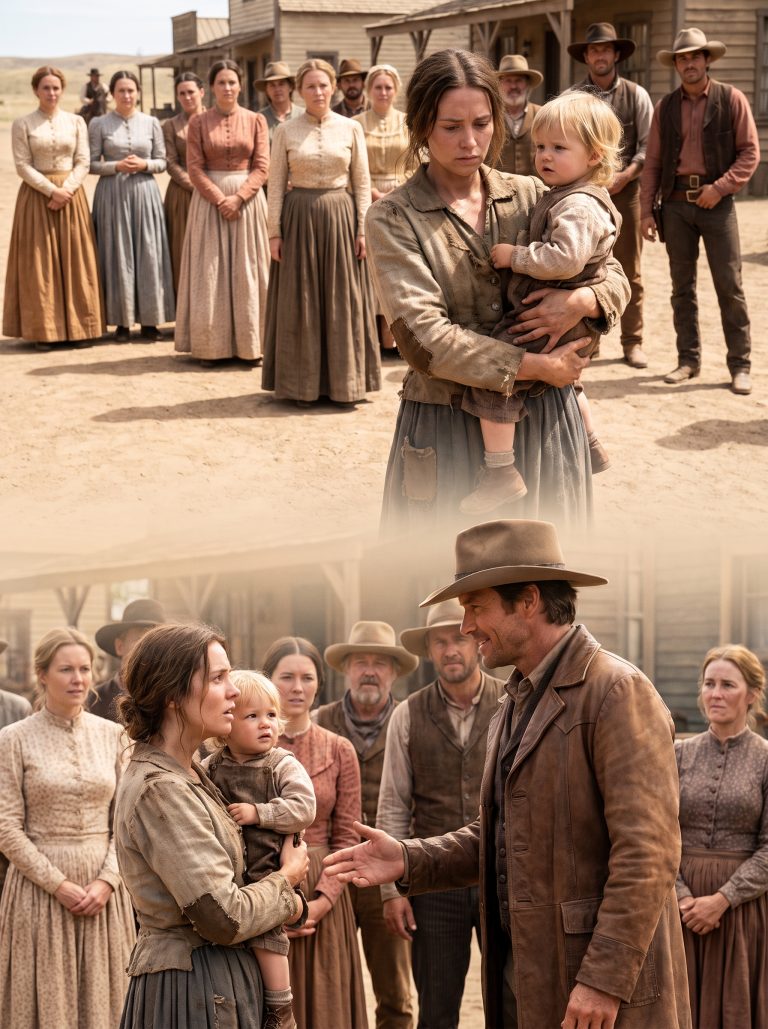
Giant Cowboy Bought The ‘Barren’ Woman For $1—She Gave Him 7 Children In 8 Years

Part 1
The warehouse smelled of tallow smoke and wet wool, and Ezra Calloway wished he’d never let his foreman talk him into coming. It had no windows worth the name — just a row of high transoms so filmed with dust that the evening outside came through as nothing but a grey smear, as if the building had been built on purpose to keep a body from remembering the sky existed at all.
“Last chance to walk out, boss,” Amos Trent murmured beside him, hat pulled low. “Ain’t too late.”
Ezra didn’t answer. He’d built the Calloway Ranch out of eleven thousand acres of stubborn grass and stubborn cattle without flinching from anything — not blizzards, not rustlers, not the bank men who’d once told a Black rancher’s son he’d never hold that much land in this county. He wasn’t about to flinch now, even if what he was watching turned his stomach.
He understood, in the cold way he understood most things, why the exchange existed at all. West of the rail line, men outnumbered women eight and nine to one in some counties, and a man with land but no wife had exactly two choices: travel east for months he couldn’t spare, or pay a broker to bring the introduction to him. Higgins called it a matrimonial exchange, and dressed it in enough ceremony — a modest “consideration fee,” he called the bids, meant to cover a woman’s travel and the broker’s trouble — that respectable towns tolerated it, even if respectable people pretended not to attend. Most of the women on his list were widows with no family left to keep them, or daughters of men too poor to give them a dowry, or women running from towns where their names had already been spoiled. Nobody forced them onto the platform. But Ezra had lived long enough to know that hunger and want-of-any-better-option could do the forcing without anyone laying a hand on you at all.
The matrimonial broker, a reedy man named Higgins, was working the crowd like a cattle auctioneer, which — Ezra thought grimly — was exactly what the theater of it made him.
“Miss Iris Bell, twenty-two, capable seamstress, sound of body and temperament!” Higgins called, and a girl who couldn’t have been older than his youngest ranch hand stood rigid under the lantern light while men called out numbers like they were bidding on heifers.
Ezra had come for one reason only, and it wasn’t romance. He was thirty-eight years old, buried in land and cattle and the echo of two marriages that had ended in a grave and a goodbye letter, and he had no one to leave any of it to. A ranch with no heir was just a very large, very lonely piece of dirt.
He was two steps from the door when Higgins called the next name.
“Mrs. Wren Ashford. Twenty-nine. Widowed. Keeps accounts, reads and writes, and—” Higgins hesitated, and the hesitation was its own kind of cruelty. “The gentlemen should know the lady has been examined and declared unlikely to bear children.”
The room made a sound like a held breath let out all at once — disappointed, dismissive. A woman near the back laughed outright.
Ezra turned to look at the woman standing at the edge of the platform.
She was tall, dark-haired, dressed in mourning grey gone soft with wear, and she was not looking at the crowd the way the other women had — with hope, or fear, or desperation dressed up as both. She was looking at them the way Ezra looked at a herd before a storm: assessing, counting the exits, already three moves ahead.
“Ten dollars,” a man near the front called, out of habit more than interest.
“Not worth it,” someone muttered. “Barren stock’s barren stock.”
Ezra’s jaw tightened at the word stock, and something else tightened with it — a small, unwelcome honesty. He had told himself, all the way into town, that he’d come here for an heir. But he had already married two women who could bear children — one had died, and the other had left — and neither marriage had given him anything he could call a family. Whatever he was actually looking for in that cold warehouse, he suspected now it might not be that at all.
Before he’d quite decided to speak, he’d already said it.
“One dollar.”
The warehouse went quiet enough to hear the lanterns hiss.
Higgins blinked. “Mr. Calloway, sir, that’s — that’s a peculiar figure.”
“It’s the figure I’m offering.” Ezra kept his eyes on the woman, not the broker. “Any man wants to outbid a dollar for a human being is welcome to say so out loud and I’ll remember his name.”
No one said anything.
It was the woman who broke the silence.
“Before this goes further,” she said, and her voice carried clean across the room, “the gentleman should know he isn’t the first bidder tonight. I turned down two other offers this week — quietly, before I ever stood on this platform.”
Higgins looked as though he might faint. “Mrs. Ashford, that is not how this is conducted.”
“I’m not finished.” She didn’t raise her voice, but nobody interrupted her again. “My late husband proved up a homestead claim two years before he died — a hundred and sixty acres over the only reliable spring water in three counties. The final patent on that land was never issued. Until it is, the claim can be reviewed by the land office, and a widow can lose her right to finish proving it if a court finds her unfit to manage it herself. My husband’s brother, Cyrus Ashford, has spent a year telling anyone in the county office who’ll listen that I’m unstable. Childless. Difficult to trust with land. He doesn’t need to prove it. He only needs a judge to have me declared incapable and name him to act over the claim in my place. Once he controls the filings, he can delay my patent, challenge my occupancy, and in time petition to have the land declared his outright.”
She looked directly at Ezra now, and there was nothing pleading in it. It was a negotiation.
“So you should know what you’re buying, Mr. Calloway. Not just a barren widow. A woman with a piece of land a dangerous man wants, and very little time left to protect it. If that changes your dollar, say so now.”
Every eye in the warehouse swung to Ezra. He found, to his own surprise, that it didn’t change his dollar at all. It sharpened it.
“The ten acres surrounding that spring lie less than two miles from my north range,” he said slowly.
“I’m aware,” Wren said. “I looked into your holdings before I let Higgins put my name on his list this week. I don’t do anything by accident, Mr. Calloway. Least of all this.”
A murmur of scandalized amusement ran through the crowd — a woman admitting she’d chosen her own auction. Higgins looked like a man watching his profession get quietly dismantled in front of him.
Ezra almost smiled. Almost.
“Then it seems,” he said, “we’re both here on business.”
“It seems we are.”
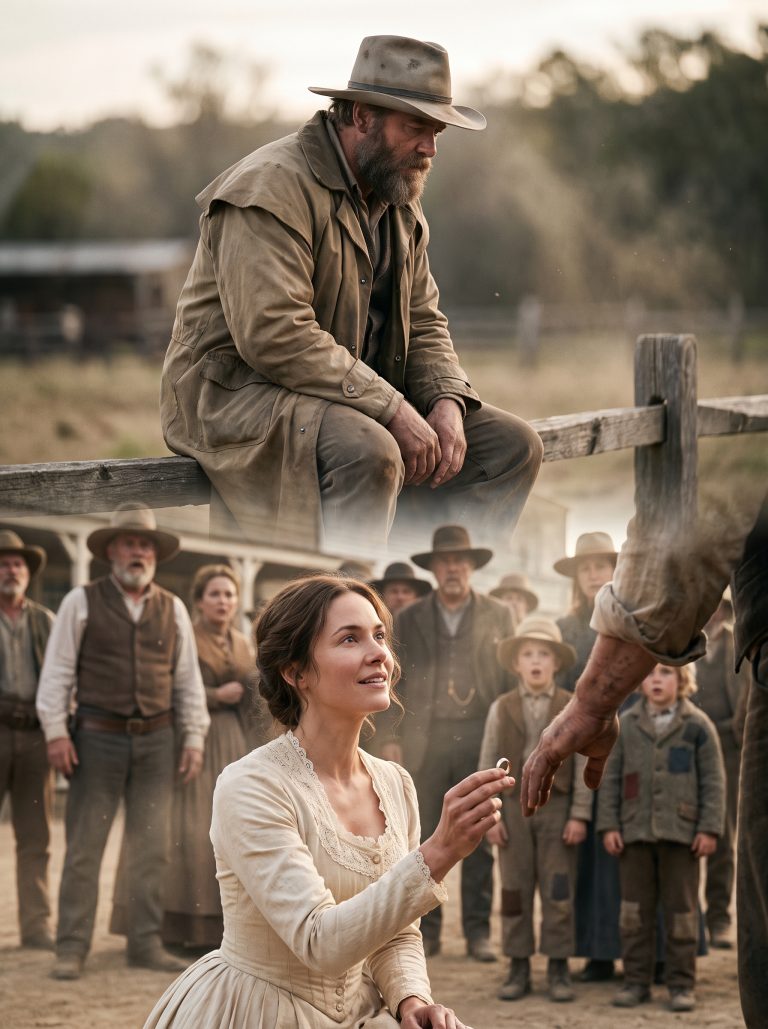
He climbed the two steps to the platform — something no bidder had done all night — and held out his hand, not to claim her, but the way he’d have offered it across a negotiating table.
“One dollar,” he said. “And my word that Cyrus Ashford will never set foot on land that’s under Calloway protection.”
Wren Ashford studied his hand for a long moment before she took it.
“One dollar,” she agreed. “And my word I’ll earn every cent of it back.”
The room erupted into whispers as Higgins fumbled through paperwork nobody in that warehouse had ever seen used quite this way. But Ezra barely heard it. He was still holding the hand of a woman who had, in the space of two minutes, turned herself from an auction lot into a business partner — and he had the distinct, unsettling feeling that he’d gotten the better end of a deal for the first time in years.
Outside, the clouds had broken. Wren stopped on the boardwalk before Ezra could hand her up into the wagon and tipped her face back, the way she hadn’t let herself do in that airless room, to look at the plain dark sky over the wagon yard.
“They priced me at a dollar in there,” she said, not quite to him. “I intend to get considerably more than a dollar’s worth of sky out of it before I’m through.”
Ezra had no answer for that worth giving. He only helped her up and let her keep looking.