Giant Cowboy Bought The ‘Barren’ Woman For $1—She Gave Him 7 Children In 8 Years

Part 3
The child came the following March, three weeks early, in a labor that lasted eleven hours and left Ezra pacing a groove into the hallway floorboards. They named him Caleb. Ezra sat on the edge of the bed afterward and found, to his own bewilderment, that his hands were shaking too hard to hold the boy properly, so Wren guided them, exhausted and laughing under her breath.
“An heir,” he said, wonderingly.
“A son,” she corrected. “Try to remember the difference, Ezra Calloway.”
He remembered. Over the next two years, as a daughter — Iris, sharp-eyed and stubborn as her mother — followed her brother into the world, Ezra became a different kind of man than the one who had bid a dollar out of desperation in a cold warehouse. He came home for supper instead of working past dark. He laughed, on occasion, which alarmed the ranch hands considerably and delighted Wren even more.
Not everyone in the county was as quick to forgive an auction bride her past. The whispers started at church the spring Caleb turned two — women counting months on their fingers behind gloved hands, wondering aloud whether the whole story of the spring and the wicked brother-in-law was simply a clever woman’s excuse for a hasty marriage.
Ezra wanted to answer it the way he answered most threats to what was his — directly, and without patience. Wren stopped him at the door with her hand flat against his chest.
“Threatening the bank and the feed store into silence won’t mend this,” she said. “It will only prove I need a man to fight my battles for me, which is precisely what half of them already believe.”
“Then what do you want to do?”
“Show my face,” she said simply. “Every Sunday. Every social. Let them look until looking bores them.”
It cost her more than she let on. Some nights that spring, Ezra found her out on the porch long after the children were down, saying nothing, just watching the sky go from grey to black. He’d learned by then not to fill that silence with questions.
“That room in the warehouse didn’t have windows,” she told him once, without being asked. “I promised myself I’d never sit anywhere again and let it feel like it did. Some nights it feels like it anyway. I come out here until it stops.”
It very nearly worked, until Beatrice Vance cornered her at the county fair in front of a dozen witnesses. Beatrice was old railroad money, or had been — her father’s line had been quietly losing ground to the newer cattle fortunes for a decade, a fact everyone in the county knew and nobody said aloud, least of all Beatrice, who had come home from two years at a Denver finishing school determined to remind the county who its aristocracy still was, whether or not the bank agreed with her anymore.
“The dollar bride,” Beatrice said, loud enough to carry. “Tell me, was it really only a dollar? I’d have thought even damaged goods were worth more than that.”
“It was exactly a dollar,” Wren said evenly, not lowering her eyes. “And my husband has never once asked for it back.”
“At least I wasn’t sold like livestock because no decent man would have me.”
“You weren’t sold at all,” Wren agreed. “You were simply never tested. There’s a difference between being spared the block and being weighed on it and found worth more than the highest price offered. I know which I’d rather be.” She paused, and something in her voice gentled, just slightly. “I don’t say that to wound you, Miss Vance. I say it because I suspect you already know which one frightens you more.”
Beatrice’s flush this time wasn’t only anger, and for a moment something uncertain moved behind her eyes before she covered it with a sharper retort — but it was Agnes Pruitt, Judge Pruitt’s wife, who stepped in before the argument could sharpen further.
“That’s enough, both of you.” Agnes’s tone carried the particular authority of a woman nobody in the county dared contradict. “Mrs. Calloway has organized this fair and nursed half this county through the influenza outbreak last winter without asking a dime for it. Whatever any of us think of how her marriage began, we’ve all been glad enough of her since.” She turned a cooler eye on Beatrice. “And you’d do better making friends in this county than enemies, Beatrice — a name and a bank balance don’t always arrive in the same envelope forever.”
It wasn’t quite a rescue and it wasn’t quite a scolding of Beatrice alone; other women drifted toward Wren all the same — women whose children she’d tutored, whose sick relatives she’d sat with — until Beatrice found herself standing at the edge of a circle that had simply, wordlessly, closed without her. She left the fairground considerably less triumphant than she’d arrived, though Wren noticed, and did not mention to anyone, that the girl had looked less victorious than merely tired, the way people did when they’d spent a performance they couldn’t afford to keep giving.
Word of the fair spread, and something shifted after that — not everyone’s opinion, but enough of it. A young rancher’s daughter named Rachel Odom rode out one autumn afternoon and asked, plainly, if Mrs. Calloway would consider teaching her the breeding trade.
“I’m your competition, technically,” Rachel pointed out, watching Wren examine a mare’s conformation with an expert eye.
“There’s demand enough in this county for good horses without either of us starving the other for it,” Wren said. “I’d sooner have a colleague nearby than a stranger two counties off who owes me nothing.”
Rachel went on, three years later, to start her own breeding operation two counties over, modest but well-regarded, and the two women referred clients back and forth for the rest of their working lives.
Part Four: The Spring And The Ledger
Cyrus Ashford had not forgotten. He had only been waiting.
Twice in those first years a stranger had ridden through asking after the Ashford homestead’s boundaries, and twice Amos had sent word back to the house before the man got as far as the gate. A county clerk, an old friend of Wren’s late husband, quietly warned her that someone had been requesting copies of the original claim filing — legal, if strange, and worth noting. Wren noted it. She kept a folder of her own in the ranch office, growing slowly, of every odd inquiry, every rumor, every name Cyrus’s had been mentioned alongside.
He came himself only once, the autumn Iris turned one — rode up the Calloway drive in good boots and a borrowed politeness, under a sky already going the flat iron-grey that meant weather by nightfall, and asked to speak with his brother’s widow like a man paying a family call.
“You’ve done well for yourself, Wren,” he said, standing in the ranch house parlor with his hat in his hands, not sitting when Odile offered him a chair. “A house like this. Children. I only came to say there’s no bad blood in it, whatever’s been said. Family ought to settle its business quietly, between family.”
“We have no business, Cyrus,” Wren said. “The claim is mine. The court agreed. There’s nothing left to settle.”
“The final patent hasn’t come through yet.” His politeness didn’t so much as flicker. “Papers take time in this territory. Plenty can happen to a filing while it waits. I’d hate to see a woman with young children spend money fighting something that could be settled friendlier, that’s all I came to say.” He looked, briefly, toward the window, toward the darkening sky over the north pasture. “I’ll see myself out before the weather turns.”
Ezra didn’t come in from the barn until after Cyrus had ridden off, and by then Wren had already written down, word for word as best she could remember it, exactly what had been said and exactly what it meant, and added the page to her folder.
“That wasn’t a family visit,” Ezra said, reading it over her shoulder.
“No,” Wren agreed. “That was a man finding out the front door was locked, and going home to try the back one.”
The trouble finally arrived the following spring, disguised as an ordinary stranger. A horse trader named Silas Bram rode onto Calloway land with a bill of sale in his coat pocket, claiming to have legally purchased three of Wren’s finest breeding mares — the very horses she had spent four years building into the finest bloodline in three counties.
“I signed no such paper,” Ezra said flatly, turning the document over in his hands. The signature at the bottom was close. Too close.
“Then someone’s done a fine job of copying your hand, Mr. Calloway,” Bram said, unbothered, already turning to leave with the mares roped behind him. “Court can sort out the rest, I expect.”
It was Wren who understood, faster than Ezra did, what the forged bill of sale was actually for. Three stolen mares were a loss, but not a fortune. What mattered was the paper trail it would leave behind: a legal claim, however false, that property under Wren’s management had been sold off without her husband’s knowledge — evidence, presented the right way to the right land office clerk, that the Calloway household’s affairs were no better managed than a widow’s alone had once been said to be. It was never truly about the horses. It was the opening move in a fresh petition to have someone else’s hand put back on the deed to the spring.
It went to court, and it was there — cross-examining Bram’s flimsy paperwork with the same cold precision she had once used to negotiate her own worth on an auction platform — that Wren pulled the thread that unraveled the rest.
“Mr. Bram,” she said, standing before the county judge with four years of breeding ledgers stacked at her elbow, “you say you purchased these animals in good faith, from my husband directly. Can you tell the court who introduced you to our operation in the first place?”
Bram hesitated, the first crack in his composure. “Business acquaintance.”
“Was that acquaintance,” Wren pressed, “a man named Cyrus Ashford?”
The courtroom stirred like wind through wheat. Bram said nothing at all, which was answer enough for every man on the jury.
It was, in the end, not her testimony but the folder she had kept almost from the day she arrived that finished the case — inquiries logged by date, a clerk’s testimony about the copied filings, and a trail of payments from Cyrus Ashford to Silas Bram sloppy enough that a week’s honest investigation turned it up whole. Cyrus was charged with forgery and conspiracy to defraud. Within the year, the final patent was issued in Wren’s name, ending Cyrus Ashford’s remaining claim to the spring and the land surrounding it.
Cyrus Ashford served eighteen months and never set foot in the county again.
Part Five: What Held
That should have been the end of the danger to their family. It was not the end of the danger altogether.
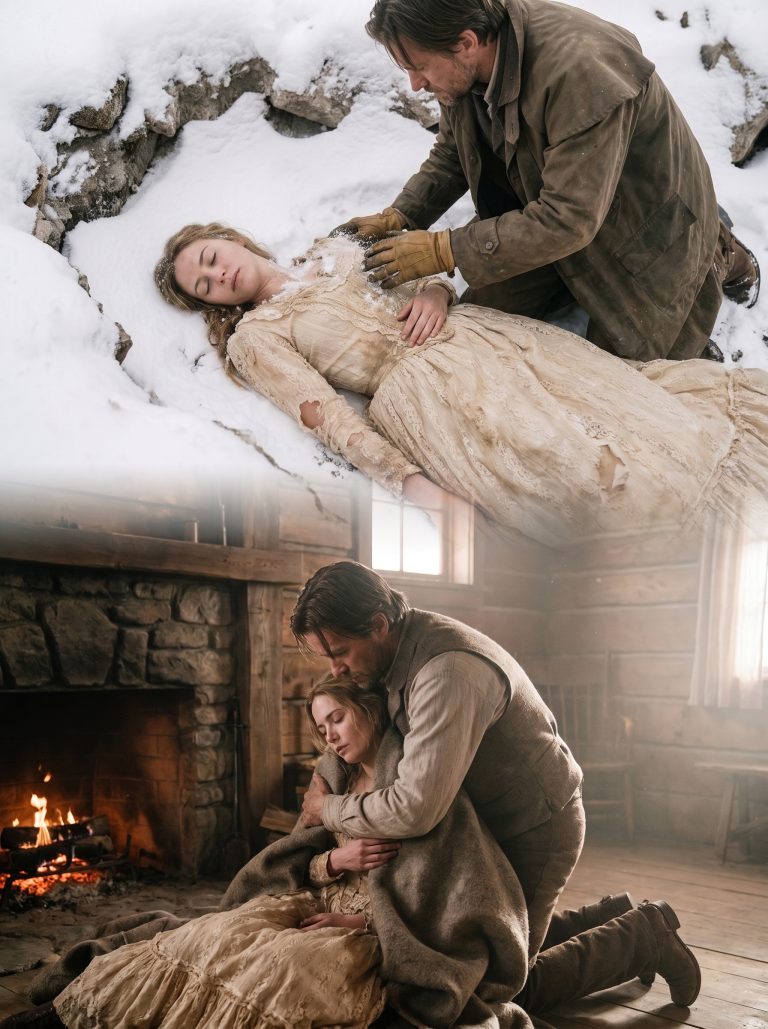
Two years later, pregnant a third time against Dr. Lowell’s cautious advice, Wren went into a labor that turned dangerous within the hour — the baby positioned wrong, the bleeding heavier than anyone in that room wanted to name aloud. Ezra sat beside the bed through the worst of it, gripping her hand hard enough to bruise.
“You don’t get to go,” he said, when her eyes fluttered half-shut with exhaustion. “We had an agreement. We were to see things through together.”
“Bossy,” she managed, barely a whisper.
“Only because you taught me to be.” His voice cracked on it. “Stay, Wren.”
She stayed. Their third child, a boy they named Noah, arrived pale and small but breathing, and Wren spent six slow months recovering her strength. Noah grew into a watchful, careful boy who preferred listening to talking, and who was, from a very young age, the one child among the three who could always be found trailing Wren into whatever dispute or complaint had landed on her desk that week — a tenant’s grievance, a hand’s unpaid wages, a neighbor’s boundary quarrel — absorbing, without anyone quite deciding to teach him, the particular way his mother weighed a claim before she ruled on it.
It was during that slow recovery, with Cyrus finally behind her and a third child asleep in the next room, that Wren told Ezra the last piece of the truth she’d been carrying since the warehouse.
“I didn’t only choose you because your land bordered mine,” she admitted. “Higgins’s list had your name on it three weeks running before I let him put mine beside it, and I made inquiries. I heard you’d buried one wife and lost another to loneliness, and folks said you were hard, and cold, and impossible to please. And I thought — a man that guarded, that careful with what he’d built, is exactly the kind of man who won’t let a woman’s land get taken out from under her once he’s decided to protect it.” She looked at him steadily. “I didn’t fall into your hands by accident, Ezra. I aimed for them.”
He was quiet a long moment. “That should probably insult me.”
“Does it?”
“No,” he admitted. “It’s the most sensible thing anyone’s ever told me about why they chose me.” He kissed her knuckles, roughened now from years of ledgers and breeding charts and a household that had, against every reasonable expectation, become a home. “Best dollar I ever spent.”
“Best dollar either of us spent,” she corrected, and laughed when he groaned at hearing his own line handed back to him.
Years passed the way they do on a working ranch — measured in calving seasons and school terms rather than single dramatic days — until the winter Ezra turned fifty-six and a cough he’d dismissed as nothing settled deep into his chest and refused to leave.
“Pneumonia,” Dr. Lowell said grimly. “At his age, with his history of overwork, I won’t promise you anything, Mrs. Calloway. He needs complete rest, and even that may not be enough.”
Wren had buried a husband once already. She was not inclined to do it twice.
She moved a cot into his sickroom and did not leave it for eleven days. Caleb, seventeen now and already running half the cattle operation, took over what remained without complaint. Iris, home from her studies for the holiday, managed the correspondence and kept her younger brother occupied so the house wouldn’t feel entirely like a deathwatch.
“You are not allowed to do this,” Wren told Ezra, somewhere in the worst of it, her voice rough from days of talking to a man too fevered to properly answer. “We had an agreement. Partners see things through to the end we choose together, not the one a fever picks for us.”
Whether it was her stubbornness or his own, Ezra turned the corner on the twelfth day, and came back to himself thinner, greyer, and considerably less inclined to work sixteen-hour days ever again.
“I can’t run this place the way I used to,” he admitted once he could sit up and hold a cup of coffee without his hands shaking.
“Then don’t,” Wren said simply. “Teach instead. You’ve thirty years of knowledge in your head that’s worth more to Caleb than another decade of you working yourself back into that bed.”
He took her advice, slowly and with considerable grumbling, and spent his remaining years teaching Caleb not just the mechanics of ranching but the philosophy underneath it — that a workforce treated fairly built loyalty no wage could buy, that land cared for paid a family back for generations, that the measure of a life wasn’t the acres a man died owning but the people who’d miss him honestly when he was gone.
“Your mother taught me that last part,” he told Caleb once, watching the boy — nearly a man now — survey the north pasture with the same assessing eye Wren had once turned on a room full of strangers deciding her worth. “I built an empire before I met her. I didn’t understand what it was for until she showed me.”
Epilogue: What The Dollar Bought
Caleb Calloway grew to run the ranch with his mother’s precision and his father’s stubbornness, expanding the breeding program until Calloway horses were requested by name as far off as Wyoming. He married a schoolteacher who insisted every ranch hand’s child learn to read before they learned to rope — a rule Ezra grumbled about for the rest of his own life, and funded anyway, and that Caleb quietly kept funding in his name long after.
Iris went east to study law and came home years later to build a modest but well-regarded practice representing widows and tenant farmers against exactly the kind of guardianship claims that had once nearly cost her mother everything. She never won a case that rewrote the county’s law, but she won enough of them, one at a time, that the local land office grew a great deal more careful about whose word it took on faith. She kept a single worn silver dollar framed above her desk for the rest of her career, and told the story behind it to every frightened woman who came through her office believing she had no options left.
Noah studied law as his sister had, apprenticed for three years under Judge Pruitt’s own successor, and was elected, in his forties, to a district judgeship serving three counties. He was known less for grand rulings than for a stubborn habit of hearing out tenant farmers and cheated laborers who other judges waved through in five minutes. When people asked him why, he only ever said that his mother had taught him fairness wasn’t a feeling — it was a debt you spent a lifetime repaying, one careful judgment at a time.
The spring Cyrus Ashford had spent years scheming to claim went on watering three generations of Calloway cattle without incident, and in time, hardly anyone remembered why it had once been worth fighting over at all — which Wren always said was exactly the point of fighting hard enough, the first time.
Ezra Calloway lived to be seventy-nine, slower in his last years but no less sharp-eyed, and he spent most evenings on the porch with Wren watching whichever grandchildren happened to be underfoot that season. On one of the last of those evenings, watching the sun drop gold and red behind the north pasture, he asked her the question he’d never quite worked up the nerve to ask before.
“Do you ever regret it? The auction. Starting with so little, so publicly, in front of a room full of strangers deciding what you were worth.”
Wren considered it the way she considered everything — carefully, without flinching from the answer.
“Never,” she said. “That room decided I was worth exactly one dollar, and they were fools for it, but I’ve never once been sorry they were fools in your direction instead of some other man’s. You could have looked at a woman the whole town called worthless and believed them. Instead you looked long enough to wonder if they were wrong.”
“Best decision I ever made,” Ezra said.
“Second best,” Wren corrected, smiling. “Marrying me was the second thing you did right. The first was refusing to believe that room knew what I was worth. Everything after was just what happens when two people agree on that and refuse to budge from it.”
People in that county told the story of the auction for years afterward, and it grew taller with every telling, until it barely resembled the plain truth of it anymore. But whenever curious neighbors asked Wren about it directly, she always gave the same answer, steady as the ledgers she’d once used to save her own life:
“He didn’t buy me. He bid on the one thing everyone else in that room had already decided was worthless, and then he kept his word about it, every single day, for the rest of his life. Everything after that we made ourselves. That’s not something you can put a price on. It just happened, once, to start with one.”
Above the porch where they sat, the Nebraska sky ran clear and enormous from one edge of the world to the other, the way it had every evening of their marriage and would go on doing long after neither of them was there to look at it — and Wren, who had once priced it at exactly a dollar’s worth and meant to collect on every cent, never once in fifty years found reason to think she’d undersold herself.
The End