“I’m Your Wife, Can I Sk It?” – The Shy Rancher Trembled, But When The Bride Did, He Forgot Every…

Part 1
The wind over the Ashwood Basin never rested. It scraped the high grass flat, rattled the sage, and carried the smell of dust so far that a man could taste Montana ten miles before he saw it. Caleb Hartwell had grown up under that wind. He’d learned to talk to horses before he learned to talk to people, and at thirty-one, he still preferred it that way.
He rode the north fence line at dawn, checking wire, while a haze of dust on the horizon told him everything he needed to know. Silas Kane was moving the Triple K herd toward Bitter Creek again — the same creek that marked the boundary of the Hartwell claim.
The dispute wasn’t a simple matter of a bachelor being unfit to hold land, as Caleb sometimes told it out of bitterness. His father’s original claim to the creek parcel had been filed under a territorial homestead agreement with a specific, ugly clause: the land had to show a permanent, occupied household by the coming autumn, or the claim would lapse and revert to open filing. Kane’s lawyers had already argued once, quietly, that a rancher who spent half his year alone on the range and slept in a bunk more often than a bed had effectively abandoned the parcel. The land office hadn’t ruled yet — but everyone knew which way Kane’s money would push the decision.
Kane had also bought Caleb’s father’s four-hundred-dollar note from the bank the year before, and held it now like a blade over Caleb’s neck. Between the note and the residency clause, Caleb didn’t need a lawyer to tell him he was running out of road.
So he had done something that still made his ears burn with shame: he’d written to a matrimonial agency in Helena and paid the passage west for a woman willing to marry a stranger. It was no marriage by proxy and no ceremony conducted through letters — only a desperate arrangement between two strangers, made in the deep silence of a bad winter.
Today she was arriving on the noon stage.
By the time Caleb reached Coldwater Flat, the sky had turned the color of a bruise, and the first fat drops of a spring storm were darkening the boardwalk. He waited under the station overhang, hat brim low.
The stage lurched in through curtains of rain. A woman’s boot touched the mud, and she stood a moment, gathering herself, scanning the street the way a hawk studies open ground before it decides whether to land.
“Miss Calloway?” Caleb asked, hating the crack in his own voice.
“Josephine,” she said. Her eyes were a startling green, and they moved over him quickly — his hands, his belt, his mouth. “Josie will do.”
Behind her, two women under the mercantile awning whispered loud enough to carry. That’s her. Come up from Silver Draw. Border trash, most like. Josie’s spine didn’t bend an inch. She turned her back on them and looked at Caleb instead.
“I’m ready,” she said. Her bag was light enough to carry in one hand. Caleb thought about what that meant and said nothing, because every word he tried out in his head sounded wrong before it reached his mouth.
Before they left town, they stood before Justice Bell in the back room of the stage office and spoke the plain legal vows the territory required. There were no flowers, no music, and no witnesses beyond the stationmaster and his wife, pulled in off the boardwalk to sign as such. By the time they stepped back out into the rain, Josephine Calloway had become Josephine Hartwell on paper — a fact that would matter more, in the months ahead, than either of them yet understood.
The ride to the ranch was long, wet, and mostly silent. The house, when they reached it, was small and startlingly bare — a table, two chairs, a stove, no clutter of a man’s bad habits anywhere. “Your room’s through there,” Caleb said. “I sleep in the loft.” He was drawing a line. Josie noticed, and filed it away as one small, useful fact.
She pushed open the door and found a narrow bed, a washstand — and on a shelf, a small wooden horse, whittled clumsily by a child’s hand, and a faded ribbon beside it.
She reached for it.
“Don’t.” Caleb’s voice cracked like a rifle shot. He crossed the room, took both objects, and shoved them into a drawer. “Sorry. Those are old. I should’ve cleared them out.”
“It’s all right,” Josie said. “I didn’t mean to pry.”
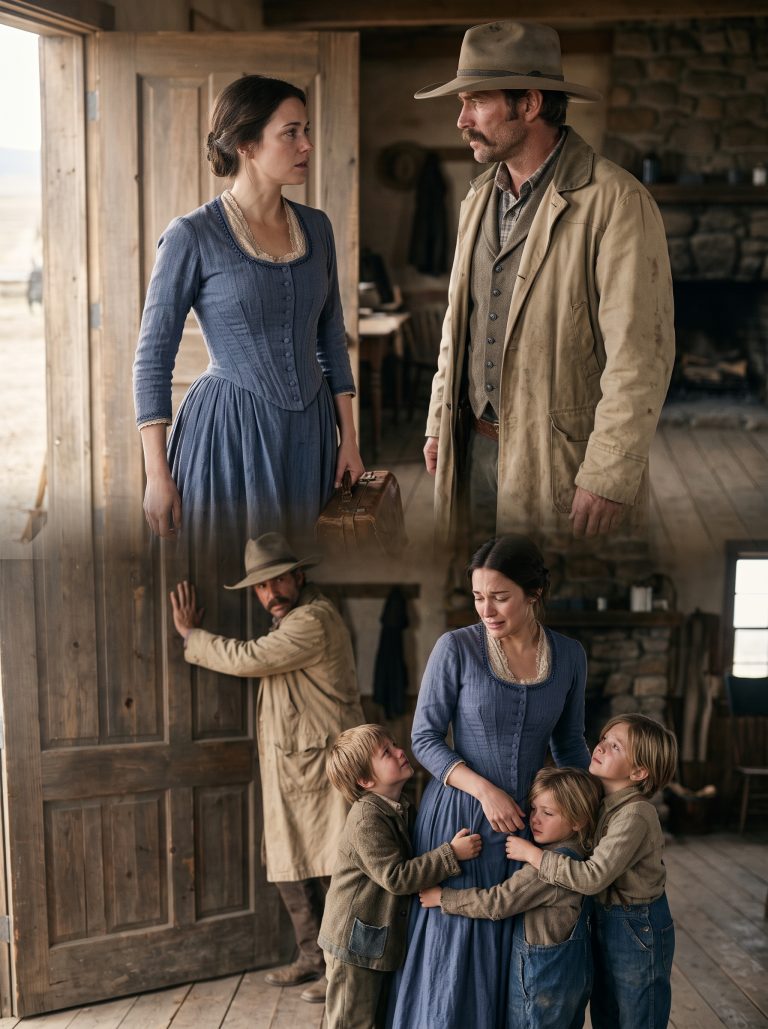
They ate supper in near silence. When the dishes were done and the lamp burned low, Josie stood, walked toward him, and began, with trembling fingers, to undo the top button of her collar. “I know what’s expected,” she said. “I want to be a good wife.”
Caleb went pale. “Josie — what are you doing?”
“I’m your wife now. I can —” The offer died in her throat.
“No.” He backed away until the stove edge caught him, hands raised. “I know where you came from. I know what you had to do to live. But you’re not that here. You’re not a thing I bought.” He dragged a hand through his hair. “My father took what he wanted from the women in his house. I am not him.”
“I don’t know how to be safe,” Josie admitted, the truth falling out before she could stop it.
“Then we’ll learn,” Caleb said. “I won’t touch you until you want it, even if that’s ten years from now.” He stepped forward slowly, telegraphing every motion, and draped a blanket over her shoulders instead of reaching for her at all.
It was not trust yet. But it was the first moment in a long while that Josie hadn’t felt the need to run.
Outside, the storm broke apart against the mountains, and neither of them heard the two riders who paused just past the gate before turning back into the dark.