“I’m Your Wife, Can I Sk It?” – The Shy Rancher Trembled, But When The Bride Did, He Forgot Every…

Part 2
The note was nailed to the fence post by morning: Sell before the land hearing, Hartwell, or accidents will decide it for you. No name — just a crude K scratched at the bottom. Caleb burned it and said nothing.
The weeks that followed reshaped them both. Josie’s hands cracked and calloused from hauling water and splitting kindling. Caleb taught her to read a horse’s temper, to hold a rifle steady, to stand her ground in rooms gone silent with judgment. The trust between them grew the way frost thaws — not all at once, but noticeably, day by day. By the third week she no longer flinched when he passed close behind her at the stove. By the fifth, she was the one who reached for his hand crossing the creek, not the other way around.
One night that same week, mending a torn shirt by the fire, Josie finally worked up the nerve to ask about the wooden horse. Caleb was quiet long enough that she thought he wouldn’t answer.
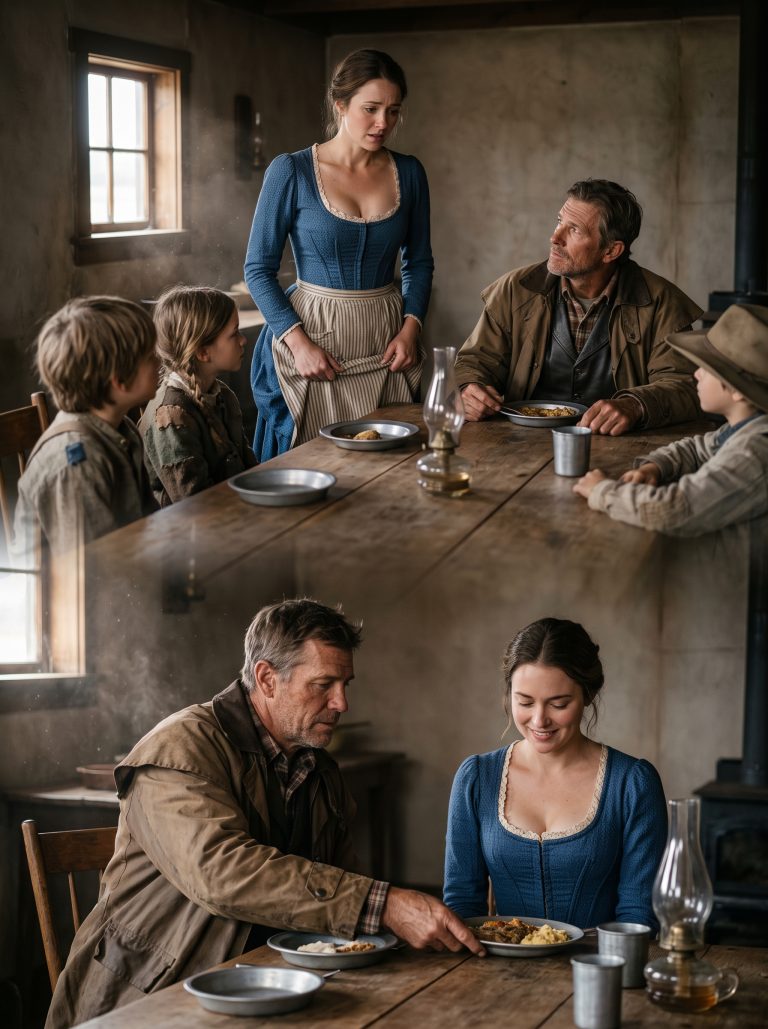
“My sister,” he said at last. “Clara. She carved that thing the winter before she died — six years old, and prouder of that ugly little horse than anything I ever made with my own hands.” He turned his cup slowly on the table. “My father had a temper before whiskey ever touched him, and worse after. My mother ran with Clara the first chance she got — north, I think, though I never found out for certain. The ribbon was Clara’s. It’s the last thing of hers I’ve got. I don’t know why I kept it here instead of burying it. I just couldn’t.”
Josie didn’t reach for his hand. She only sat with him in the quiet a while, and let him have it.
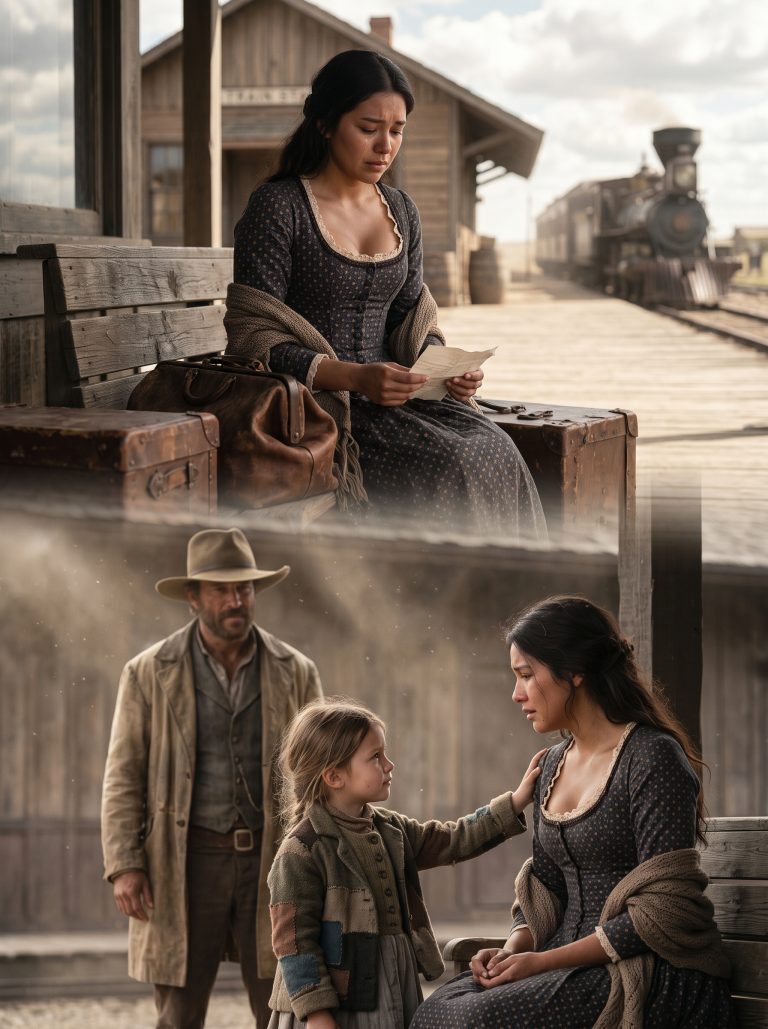
One evening not long after, mending gloves by the fire, she finally told him about Mattie — a girl who’d kept the books at the Silver Draw saloon and found something in the ledgers she wasn’t meant to find: proof that Silas Kane’s outfit was running stolen cattle across the territorial line and rebranding them. Two days after Mattie said she’d take it to a marshal, she was dead — a stray bullet in a bar fight everyone agreed was an accident. Josie still had three letters Mattie had written her in that final week.
“You kept them,” Caleb said. “All this time.”
“I kept more than that,” Josie admitted, but didn’t say what. Not yet. The three ledger pages she’d carried out of Silver Draw stayed sewn in the false bottom of her trunk — the one thing she wasn’t ready to hand to anyone, even him.
At the mercantile the following week, a clerk refused to sell her flour sitting plainly on the shelf. Caleb didn’t shout. He set the sack on the counter and said, “Ring it up,” in a voice like rock grinding underground, and the clerk’s hands shook as he obeyed.
It was there, at the livery next door, that they first met Tobias — a thin, watchful boy of fourteen mucking stalls for his keep, driven out of steadier work in town because his mother was Crow. He said little, but Caleb noticed the boy watching Kane’s foreman, Garrett Boone, loading unusual amounts of kerosene into a wagon that same afternoon — far more than any bunkhouse lamp would need. Tobias mentioned it only once, in passing, to the liveryman, who told him to mind his own business. Caleb remembered it anyway.
The danger sharpened after that. A cowboy grabbed Josie’s wrist outside the stage office, laughing about what he’d heard she was worth an hour. Caleb — his revolver still locked in the wagon, useless — put the man down with his fists alone, then stood over him shaking with a rage that frightened them both.
“I almost killed him,” he said afterward, staring at his own hands.
“But you didn’t,” Josie said. “You stopped.”
Three nights later, a masked rider caught her alone at Bitter Creek, looped a rope around her arms, and pressed a knife shallow but deliberate across her sleeve. Tell your husband to sell, the man hissed. Next time it’s your neck. Josie didn’t recognize the voice, but she recognized the boots — the same scuffed, mismatched pair she’d later notice on one of Boone’s riders in town.
Caleb wanted blood after that. It was Josie who stood in the doorway and stopped him. “If you go there, you die, and I’m alone. I need a living husband, Caleb — not a dead hero.”
He stayed. But five days later, the sky to the south turned orange. By the time they reached the stackyard, the winter’s hay — every bale of it — was already ash, the fire still climbing when they arrived.
Caleb stood watching the flames a long moment before he spoke. “This isn’t going to stop with hay,” he said. “Next time it’s the barn, or the house, or you.”
Josie looked at him, and made a decision she’d been circling for weeks. “There may be one way to stop him for good,” she said. “I have Mattie’s letters. And three pages torn from the ledger she died for — enough to show Kane’s cattle crossing the border under false brands, if a court will look at them properly.”
Caleb stared at her. “You’ve had this the whole time?”
“I didn’t know if I could trust anyone with it,” Josie said. “Not even you. Not until now.”
“Then we ride for Helena,” Caleb said. “Tonight.”