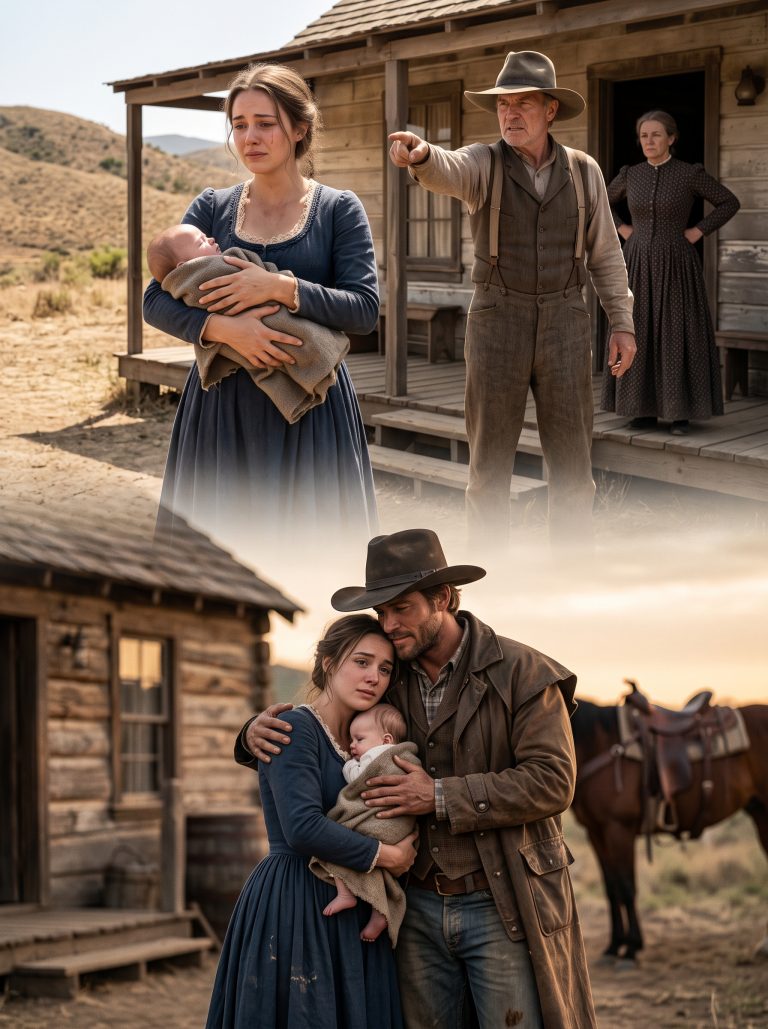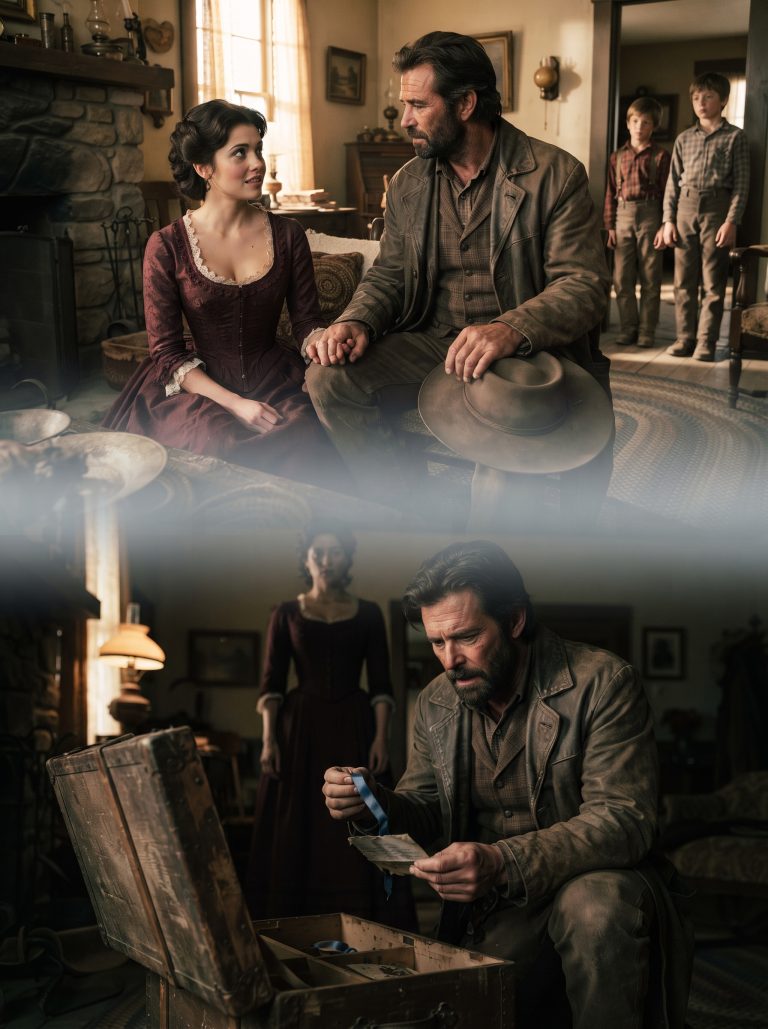
A Widow Offered To Cook For Shelter — The Cowboy Said: Only If You Season With Laughter Too…

Part 3
By November the sight of Nathaniel Cross’s boots in her kitchen doorway no longer startled Eleanor — it settled something in her chest instead, a feeling she distrusted precisely because she recognized it.
The storm came on a Tuesday, a wall of black cloud swallowing the horizon whole. Eight men were still out with the herd when it broke, Nathaniel among them, and for six hours Eleanor turned her kitchen into a lit harbor against the dark — coffee always hot, bread always rising, lanterns burning at every window so any rider caught in that howling rain would have something to steer toward. When Nathaniel finally stumbled through the door past midnight, half-carrying two frozen men he’d refused to leave behind, he found her still standing, exhausted and unshaken, exactly where the ranch needed her to be.
“You did well tonight,” he told her afterward, voice rough with more than cold. “This kitchen — it’s more than food, Eleanor. It’s a safe harbor. I’d forgotten how much that matters.”
Three weeks later it was young Wesley Mercer, the storekeeper’s nephew, carried in gored and bleeding from a bull he’d misjudged. Eleanor cleaned and stitched the wound on her own kitchen table with sewing silk and whiskey and a steadiness she hadn’t known she still possessed — the only surgery frontier life allowed — while Nathaniel held the boy’s shoulders and murmured him toward sleep. The fever that followed broke on the third dawn, and Eleanor wept from relief on the porch, and Nathaniel’s arms came around her, and neither of them pretended anymore that this was only an employer steadying an exhausted cook.
“When this is over,” he said into her hair, “we need to talk about the future. About whether this is just a position to you. Or whether it could be something more.”
It was three days later, in his small office with the morning sun cutting gold across his desk, that he asked her properly — a plain gold band, a small sapphire, no ceremony to it at all beyond the naked honesty in his eyes.
“I’m not Edmund — I mean, I’m not the kind of man who hides debts from a wife,” he said, and Eleanor’s breath caught at how easily her late husband’s name had risen between them, at how thoroughly her old life and this new one had already begun to overlap in her mind. “I can be distant. Moody. But I can promise you partnership. And if you’ll let me — love.”
She told him everything, then — not just the debts Edmund had left her, but the deeper wound: that her husband had lied to her for a decade about money, about other debts, about a version of their life that had never truly existed. That she had come west not merely to survive but to find out who Eleanor Whitfield was when nobody was managing what she was allowed to know.
“I came here to stop being lied to,” she said. “I need to know you’ll never do that to me. Even about hard things. Especially about hard things.”
“Never,” Nathaniel said, and meant it so plainly that she believed him.
She said yes. They set the wedding for Christmas.
The Man From Cheyenne
The trouble arrived on a gray afternoon in early December, in the shape of a narrow man in a city coat who introduced himself as Silas Grant, agent of the Territorial Land & Trust Company of Cheyenne.
He found Nathaniel in the yard and Eleanor at the kitchen window watching, a familiar dread pooling cold in her stomach at the sight of a stranger’s ledger book under his arm.
“Mr. Cross,” Grant said, producing papers with the smooth economy of a man who had done this before, “the Rocking C’s mortgage was purchased by my company eighteen months ago from your original lender. Records show three missed payments and a balance in significant arrears. I’m afraid foreclosure proceedings have already begun. You have thirty days to satisfy the debt in full, or vacate.”
Nathaniel went very still. “I’ve never missed a payment in ten years. I pay every note in person, in this county, to Elias Kepford at the bank.”
“Kepford’s bank sold the paper,” Grant said smoothly, laying a document across the porch rail. “This is all quite in order, Mr. Cross.”
Eleanor, drying her hands on her apron in the doorway, felt something cold and familiar crawl up her spine — not fear exactly, but recognition. She had seen that particular slant of ink before. She had seen those exact phrases — arrears, satisfy in full, proceedings already begun — arranged in that exact order, on a document that had arrived at her own Boston parlor eight months ago, signed by a firm called Pratt & Holloway, in the weeks after Edmund’s death.
“May I see that,” she said, stepping onto the porch before either man could object.
Grant’s eyes flicked to her with faint condescension. “This is a business matter, madam.”
“I kept my late husband’s accounts for the last two years of his life, Mr. Grant, because his own hand had grown too unsteady to trust with a pen — and in the months after he died, I spent three of them disputing forged claims against his estate, poring over every document a lawyer would show me until I understood exactly what I was looking at.” She held out her palm, and something in her voice — flat, unhurried, entirely unafraid — made him hand the papers over before he’d decided to.
She studied the transfer page for several long, silent seconds, turning it once toward the weak December light before she spoke again. “I know a forged assignment of mortgage when I see one. This signature,” she tapped the page, “claims to be Elias Kepford’s. But Mr. Kepford signs his K with a closed loop, always — I’ve watched him countersign supply drafts a dozen times at Mercer’s counter. This K is open at the top. And this seal is stamped, not pressed. A true county notary’s seal leaves an impression in the paper. This one lies flat on top of it. It was applied afterward, with ink, over a document that was never properly notarized at all.”
Silas Grant’s composure cracked for exactly one second — long enough for Eleanor to see it.
“I don’t know what tricks you’re accustomed to in the city, ma’am, but—”
“I’m accustomed to exactly this trick,” Eleanor said, and her voice did not shake. “A firm calling itself agents of a trust company arrives with a purchased note nobody local has ever heard of, threatens foreclosure inside thirty days — too fast for a rancher to travel to Cheyenne and verify anything before the deadline passes — and offers, I expect, to settle quietly for a fraction of the property’s worth if the debt can’t be satisfied in full. It is the very same maneuver that stripped my husband’s estate to nothing after his death, while I was too grief-stricken to examine a single document closely. I did not examine them closely enough then. I have had a great deal of practice since.”
Nathaniel had not said a word through any of this, but Eleanor watched the set of his jaw change from confusion to something considerably more dangerous.
“Mr. Grant,” he said quietly, “I’ll be riding to Cheyenne myself, with the sheriff, to confirm this mortgage transfer with the actual Territorial Land & Trust office. Today, not in thirty days. You’re welcome to ride along and explain the seal to them yourself.”
Grant did not ride along. He rode east instead, at considerable speed, and was never seen again in Sagebrush Hollow. The genuine bank confirmed within the week that no such transfer existed; Elias Kepford still held the Rocking C’s honest note, unbothered and unsold, exactly where it had always been.
What The Forgery Was Worth
That evening, once the ranch had quieted and the last of the crew had gone to the bunkhouse still trading astonished retellings of “the lady who caught the swindler by his own signature,” Nathaniel found Eleanor in the kitchen, staring at nothing over a cup of cooling tea.
“You did that ranch a considerable favor today,” he said, sitting across from her. “Might have lost everything to a fast talker and thirty days, if you hadn’t looked twice.”
“I didn’t look twice for the ranch’s sake, not at first,” Eleanor admitted. “I looked because for one terrible moment I thought it was happening to me again. That I was about to watch a man I trusted lose everything to a stranger with a ledger, and that I would once again be the last person in the room to understand what was actually written on the page.”
“And now?”
She turned her cup slowly in her hands. “Now I understand something I didn’t, back in Boston. It was never that I was foolish, Nathaniel. It was that I had never been given a reason to look closely — no one had ever asked me to. Edmund managed everything and told me nothing, and I let him, because that was the shape love was supposed to take. I have spent six months out here learning that a kitchen runs better when nothing is hidden from the person keeping it. Today I found out the same is true of a ranch. Of a marriage, I expect.”
Nathaniel reached across the table and covered her hand with his. “Then you’ll keep the books from here on. Not because I’m careless with them — because I’d rather you know everything I know, always, even when it’s dull as dishwater. Especially then.”
“That,” Eleanor said, the first real smile in an hour breaking loose, “is a considerably better wedding gift than a mortgage note.”
Christmas At The Rocking C
They married on Christmas Day, in a main room strung with pine boughs, before a crowd of cowhands scrubbed pink and townspeople who’d braved the snow. Danny Shaw, arm long since healed, stood grinning at the back of the room, having reportedly won the crew’s betting pool on the exact date of the proposal. Wesley Mercer, scarred and thoroughly recovered, sat at the front telling anyone who’d listen that he intended to get gored more often if it earned this much sympathy from the ladies of the county.
Nathaniel’s vows were plain and steady, the words of a man who had learned the hard way what silence cost a house. Eleanor’s trembled only once — not from doubt, but from the sheer, disorienting weight of being known, fully and without editing, by another person for the first time in her adult life.
“To my wife,” Nathaniel said at the feast that followed, raising his glass, “who came here answering an advertisement for a cook, and instead brought this whole place back to life. Who reads a mortgage document the way most men read a Bible, and God help anyone who tries to lie to her about either.”
The crowd roared its approval. Somewhere under the noise, Eleanor caught Nathaniel’s eye and understood, with a certainty she’d never once felt in Boston, that whatever came next — hard winters, thin years, the ordinary trouble of an ordinary life — they would meet it having already decided the one thing that mattered: nothing between them would ever again be hidden to spare the other’s feelings.
That, she thought, watching fresh snow drift silver past the kitchen window she had curtained with her own hands, was the true difference between a house and a home. Not the flowers, or the pie, or even the love, though all of it mattered. It was simply this — that a woman could look every document, every stranger, every hard truth full in the face, and never again be the last person in the room to understand what was written on the page.
The advertisement had promised room and board. It had delivered, instead, the one thing Eleanor Whitfield had stopped believing she was owed: a life with nothing kept from her, seasoned, at last, with hope.
— The End —