Abandoned in a snowbound cabin by her husband, she expected death… until a mountain man offered her something she had never been given

PART 1
He dropped his rifle.
Nora tried to speak, but no sound came.
The stranger crossed the cabin in two strides and knelt beside her. His hands were enormous, rough-knuckled, scarred by cold and work. Yet when he pulled the blanket aside to see the child, his touch was gentler than any Nora had known in years.
“Still breathing,” he said, voice low and gravelly. “Both of you.”
He shut the door with his boot, barred it, and moved with swift certainty. He found linen, tore strips, bound her as carefully as haste allowed, then scooped Nora and the baby together into his arms.
She flinched.
His face changed. Not with offense. With understanding.
“I won’t harm you,” he said. “But you stay here, you die.”
She remembered pieces after that. Snow against her cheek. A horse moving beneath them. His arm locked around her and the baby both. Then darkness took her.
When Nora woke, she smelled pine. Not rot, not whiskey. Pine resin, sage, coffee, something simmering in a pot. She lay beneath heavy quilts. The cabin was larger than Silas’s had been, sturdier, clean in the plain way of a man who owned few things but kept them in order.
The baby.
Nora jerked upright, pain catching her low and sharp.
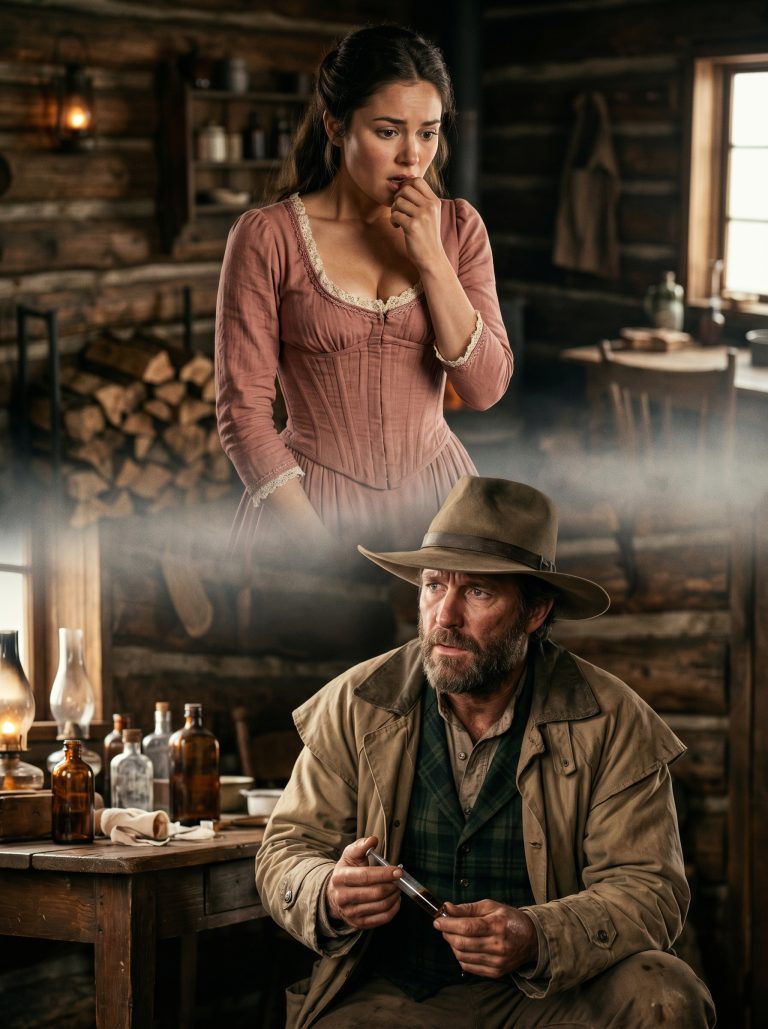
A shadow moved near the hearth. The man from the storm stepped into the firelight, well over six feet, shoulders shaped by ax work. His beard made him look fierce. But in his arms, wrapped in clean white flannel, was her daughter. He was rocking her, not with practiced ease, but his broad hand supported the baby as if he held blown glass. From deep in his chest came the rough thread of a tune.
He stopped humming when he saw her watching. “You’re awake.”
“Give her to me.”
He came at once, bent, and placed the baby in her arms with such care that Nora’s distrust faltered.
“Willow bark tea,” he said, setting a tin cup on the stool. “You’ve had fever four days. It’s near broke.”
“Four days? Where am I?”
“My cabin. Wind River Range. Name’s Garrett Holt.”
She clutched the baby closer. “My husband—”
“Was gone when I found you.”
She searched his face for contempt, pity, calculation. Garrett had none. His gaze was steady, guarded, tired.
“You sent for the midwife?”
“Couldn’t get down the mountain once the storm closed in. Did what I knew. Goat gave milk last month. I keep some dried. Baby took enough.”
Nora looked at the child. “Nellie,” she whispered. “Nellie May.”
He nodded once, solemn. “Nellie May, then.”
She waited for him to ask questions. He only turned toward the fire and stirred the pot.
“Why take us in?” she asked.
“Door was open. You were dying.”
“That is not an answer.”
“It is the only one I’ve got.”
A rifle hung above the mantel. A narrow cot stood against the opposite wall — he had given her his bed and slept elsewhere.
“What do you expect from me?”
“Nothing while you’re weak. Nothing after that except plain speaking. When you can travel, I’ll take you where you ask.”
“And if I have nowhere?”
“Then you’ll have time to decide.”
Over the next week, she learned Garrett Holt spoke little because he meant every word to carry its own weight. He rose before daylight, fed the animals, chopped wood, warmed milk for Nellie with a patience that made her chest ache. He never touched her without asking.
The first time he helped her from the bed to the chair, he stood with one arm offered, eyes averted. “May I?”
It was such a small question. No one had asked her such a thing in years.
“Yes,” she whispered.
He lifted her as though she weighed nothing, but did not hold her one heartbeat longer than needed.
Nellie lay in a cradle Garrett had made from a wooden crate padded with flannel. “I’ll build better when the weather lets me get to the shed,” he said, embarrassed by its roughness.
“You made this?”
“Couldn’t have her rolling near the hearth.”
“Thank you.”
That was how Garrett received gratitude: like a man standing in sleet, unwilling to admit warmth could touch him.
On the tenth morning, Nora wrapped a shawl around her shoulders and took a broom to the floor. Garrett stopped as if he’d found a fox sweeping his cabin.
“You ought to be sitting.”
“I have sat enough to become part of that chair.”
His mouth twitched. Not quite a smile, but it changed his whole face.
By evening, the window over the table had a plain curtain, sewn from a torn flour sack. Garrett stared at it over his coffee. “Just not used to curtains.”
“That window has likely spent years feeling indecent.”
This time, he did smile.
That night Nellie woke hungry while Garrett mended a harness by firelight. “I can take her a spell,” he offered. He set the harness aside and waited. At last she nodded.
Nellie fussed against his chest until he began that low, rumbling hum. The baby quieted.
Nora watched them through the amber firelight. The arrangement, whatever it was, had already become dangerous. Not because Garrett frightened her. Because he did not.
PART 2
By the third week, Nora could stand long enough to knead bread. Garrett said nothing when he found flour on his floor and finished the dough himself when her face paled.
“You’ve done this before.”
“Man gets hungry enough, he learns.”
She laughed. It startled them both.
The cabin changed by degrees. Nora found a place for the Bible she had hidden from Silas. Garrett built another shelf for it. Next trip to town, he returned with a household guide and a children’s primer, though Nellie could not yet hold up her head.
He taught her to read weather. She taught him dried apple and cinnamon could turn plain mush into something edible.
Once, when he came in with a split across his knuckles, Nora took his hand before thinking. “You have a dozen scars,” she said, touching the pale line through his eyebrow.
“Tree limb. Bad storm. I was young enough to think speed mattered more than sense.”
“You are getting bold, Mrs. Ruston,” he said, then froze, the name striking like a dropped pan. “I’m sorry.”
“My name was Wentworth before him. He was charming at first. He said the West would let me breathe. Then I learned some cages are made of distance instead of iron.”
“You thinking of going back east?”
“I do not know.”
That night, Garrett told her about his brother Elias, taken by an avalanche building this cabin. “Cabin’s been quiet since.”
“Nellie is not quiet.”
“No. She is not.”
The next morning, he began teaching her to shoot — a coyote near the pen had turned her face white. “Both eyes open. Don’t fight the weight.” She missed by a yard. They both laughed.
For a while, peace seemed possible.
Then Garrett rode to town and returned with his face carved from stone. “Silas’s in the valley. He’s telling folks I beat him and stole you.”
Nora’s arms tightened around Nellie. “Word came by telegraph,” Garrett said. “Your father passed in Philadelphia. Left you twenty thousand. Silas means to claim husband’s rights.”
She tore at the lining of her travel bag until she found a folded letter — a Pinkerton report her father had commissioned. “Jebediah Cross. His true name. Warrants in Dakota. A first wife dead under circumstances no one proved.”
“You were going to run.”
“I was going to survive. Because you came through the door.”
“I cannot be another thing a man guards because he calls it his.”
“That ain’t what I mean,” he said, pained, removing his hat. “There’s a trapper’s trail behind the ridge. You and Nellie can be at Josiah’s by morning. I’ll stay. Lead them wrong if I can.”
“You would send us away?” “I’d rather put you on that horse and never see you again than make this cabin another cage,” he said, misreading her silence.
She faced him. “Do not pack my life because you fear to ask what I want.”
“What do you want, Nora?”
PART 3
Before she could answer, a distant crack split the storm-dark evening.
A branch breaking. Or a rifle shot.
Garrett took the rifle from the wall.
Garrett did not become frantic.
That frightened Nora more than panic would have.
He moved through the cabin with controlled speed, shuttering windows, dousing the lamp, banking the fire low enough to hide its brightness while keeping warmth alive. He placed flour sacks along the lower crack of the door against drafts, then pulled a trunk in front of the back window.
“Cellar hatch is beneath that rug,” he told her. “If lead starts coming through, you take Nellie down. There’s blankets, dried meat, water.”
He crossed to the chest, took out the Colt he had used for lessons, checked it, and laid it on the table within her reach. “You know the weight. Same as before. Only if there’s no other way.”
Nora looked at the revolver. Her stomach clenched, not from weakness now, but from the terrible knowledge that a life could narrow to one trigger.
“No,” Nora said when he reached for the door. “You said you would not make this cabin a cage. Do not make yourself the wall I am forced to hide behind.”
“I can draw them off.”
“And if you die in the snow? Then you will have made my choice for me as surely as Silas ever did.”
“I can draw them off.”
“And if you die in the snow? Then you will have made my choice for me as surely as Silas ever did.”
He said nothing.
“What do you ask?” he said at last.
“Stand with me. Not in front of me so far I cannot see you. Not behind me as if my courage is too fragile. With me.”
His throat worked.
“All right.”
The first shout came from the trees. “Holt! Send out the woman and child!”
“Deputy,” Garrett called back. “You’re a long way from the law.”
“I got a sworn complaint says you kidnapped another man’s wife.”
“I have a letter says that man is wanted in Dakota under another name.”
Then Silas’s voice cut through the wind. “Nora! You come out now.”
Her knees nearly failed. Garrett turned from the window but did not come to her, did not hush her.
He waited.
“No,” she called.
“You hear that, boys?” Silas laughed, ragged. “That mountain devil has bewitched her.”
Nora stepped closer to the door. “I was never bewitched. I was beaten, starved, lied to, and left. There is a difference.”
“You hear that, boys?” Silas laughed, ragged. “That mountain devil has bewitched her.”
Nora stepped closer to the door. Garrett’s hand moved, then stopped. He let her.
“I was never bewitched,” she called. “I was beaten, starved, lied to, and left. There is a difference.”
The deputy shouted, “Woman, I ain’t freezing for speeches. Come out with the child.”
“My daughter remains with me,” she called.
“His daughter,” Silas snarled.
Nora looked at Nellie’s sleeping face, then at Garrett, steady as earth.
“No. Not his.”
A shot struck the front wall. Nellie woke screaming. Garrett fired once through the shutter — not to kill, Nora knew, because the answering cry came from a horse rearing and a man diving away from the door. Confusion broke outside. Men cursed, trying to control frightened animals in deep snow.
“Cellar,” Garrett said.
This time, Nora obeyed.
She carried Nellie down the ladder into the cramped darkness beneath the cabin. The cellar smelled of earth, apples, and smoke. Above, boots crossed the floorboards. Another shot cracked. Wood splintered. Garrett’s rifle answered.
Nora sat on a crate and rocked Nellie against her breast.
“Hush now,” she whispered, though her own body shook. “You were born in a storm. This one does not get to keep you.”
The gunfire did not last long. The mountain itself fought for them. Wind slammed through the pines, blinding any man foolish enough to leave cover. Snow swallowed sound and sight. Garrett knew every rock, every drift, every angle of his own land. The men below did not.
A crash came from the rear of the cabin. Then a man’s grunt.
Nora froze, the old reflex of fear arriving before thought could catch up, the same paralysis that had once kept her rooted in place while Silas raged through rooms that should have been safe. She forced her body to move anyway, because Nellie’s small weight against her chest demanded a courage that fear alone could not grant.
Then Silas’s voice, inside. “Where is she?”
Nora’s blood turned to ice.
Nellie whimpered. Nora pressed one hand softly over the baby’s back, not her mouth, never that, and reached with the other for the Colt tucked into the blanket beside her.
Floorboards creaked over the cellar hatch.
“You think you can keep her?” Silas sneered. “She’s mine by law and by God.”
Garrett’s voice came low. “No woman belongs to a man who left her to die.”
A scuffle exploded overhead. The table overturned. A chair broke. Nora heard the sickening thud of fist against flesh, then Garrett’s harsh breath. She climbed the ladder with the revolver heavy in one hand and Nellie bound to her chest in the shawl.
She pushed the hatch open.
Silas had come through the back washroom window. Snow blew in behind him. He held a crowbar in one hand, and blood ran from his nose. Garrett stood between him and the hearth, rifle knocked aside, one arm hanging stiffly where the crowbar had caught him.
Silas saw her. His face twisted. “There you are.”
He lunged toward her.
Nora lifted the revolver.
“Stop.”
He stopped, but only because the barrel was pointed at his chest. For the first time in their marriage, Nora saw uncertainty in his eyes.
Then he remembered himself and smiled. “You ain’t going to shoot me.”
Nora’s hands trembled. She did not pretend otherwise.
“No,” she said. “I hope I do not have to.”
“You weak, ungrateful—”
Garrett moved, but Nora spoke first.
“I said stop.”
Nellie began to cry harder, her little fists pushing against the shawl. The sound sharpened everything in Nora — the smoky cabin where she had nearly died, Silas’s boot kicking embers apart, the open door, the snow on her baby’s blanket.
Silas took one more step.
Nora fired.
The bullet struck the crowbar, or his hand, or both; she never knew exactly. Iron clanged to the floor. Silas howled and clutched his bleeding fingers, dropping to one knee.
Garrett crossed the room in two strides, kicked the crowbar away, and pinned Silas facedown to the boards. His injured arm shook, but his knee held.
Outside, Higgins shouted. “Silas?”
Garrett hauled Silas upright and put him between the door and the rifle slit.
“Deputy,” Garrett called, “your complainant is alive and wanted for crimes in Dakota. I have proof. You keep firing on this cabin, and you’ll hang beside him.”
Higgins answered with a shot that struck the door.
Garrett’s face went flat. Nora could see the decision in him. Not rage. Not wildness. A cold readiness born of mountains and graves.
Before he could lift the rifle, another voice rang from outside.
“Cole Higgins! Stand down in the name of the Territorial Marshal!”
Nora nearly dropped the Colt.
Lanterns bobbed below the trees. “I’ve got Martha Gentry here, and Josiah Trent, and two men who say your boss paid them to ride unlawful. Throw down your weapons.”
Garrett went to the window slit. Lanterns bobbed below the trees, more than before. A man’s voice carried again, older and sharper. “I’ve got Martha Gentry here, and Josiah Trent, and two men who say Cross paid them to ride unlawful. Throw down your weapons.”
Silas cursed.
Garrett glanced at Nora. For the first time all night, hope touched his eyes.
“Josiah,” he murmured.
It was not a rescue out of a dime novel. There was no grand charge. No clean ending in a single shot. There was shouting, confusion, men slipping in snow, Higgins trying to run and being brought down by his own frightened horse. There were weapons thrown aside one by one. There was Martha Gentry bursting through the cabin door with a marshal behind her, taking one look at Nora alive with Nellie against her chest and pressing both hands to her mouth.
“You dear girl,” Martha whispered.
Nora began to shake then. Not before. Not when Silas came through the window. Only when the danger passed did her strength go loose.
Garrett reached for her, then stopped himself.
May I?
He did not say it aloud, but she heard the question.
Nora stepped into his arms. He held her carefully, his cheek resting against her hair for only a moment before he released her, because men were watching.
But she had felt his heart pounding.
Garrett reached for her, then stopped himself.
May I?
He did not say it aloud, but she heard the question in the pause.
Nora stepped into his arms.
He held her carefully, one arm around her shoulders, the other sheltering Nellie between them. His cheek rested against her hair for only a moment. Then he released her, because men were watching and because he was Garrett.
But Nora had felt his heart pounding.
—
The marshal took the Pinkerton letter, Jeb’s false name, and Martha’s sworn statement. Josiah added what he knew. Two hired men, cold and frightened and far less loyal once money seemed unlikely, admitted Silas had promised them a share of the inheritance.
By dawn, Silas Ruston — Jebediah Cross — was bound on a horse between two deputies from Lander who had ridden with the marshal. Cole Higgins rode bound as well, cursing every drift in Wyoming.
Before they took him down the mountain, Silas twisted in his saddle and looked at Nora.
“You’ll come to nothing,” he spat.
Nora stood on Garrett’s porch with Nellie warm in her arms.
“I already came through worse than you,” she said.
They rode away.
Spring did not come quickly to the Wind River Range. It arrived by inches, the way most good things in that country did, never trusting itself enough to announce its arrival all at once. Ice softened at the roof edge. Snow shrank from the bases of trees, retreating in slow grudging steps as though it resented losing ground at all. The creek spoke under its frozen lid before it showed its face, a low murmuring promise that warmth was coming even when the air still bit at exposed skin. Nora’s body healed. Garrett’s arm mended. Nellie grew round-cheeked and loud, filling the cabin with the particular noise of a child who had decided, somewhere in her small certain heart, that the world was a safe enough place to be loud in.
Word of the trial reached them in pieces, the way most news traveled in that country, carried by riders who stopped for coffee and stayed to talk longer than their horses appreciated. Nora learned to wait for these fragments without dreading them the way she once had, because each new piece of news only confirmed what she already knew in her bones: Silas Cross would not walk free again, not after Dakota, not after the warrants, not after a Pinkerton agent’s careful documentation of a decade’s worth of cruelty practiced under different names in different territories.
The law moved slower than weather, but it moved. Letters came by way of Josiah: Silas held for trial under his true name; Higgins removed from office; Nora’s claim recognized by her father’s attorney; the marriage to Silas under fraud and coercion set for annulment.
One letter came in a finer hand than the rest, offering Nora passage east, rooms in Philadelphia, management of her inheritance, a nurse for the child, and restoration to proper society.
She read it twice.
Garrett was outside mending a fence rail where snow had split it during the worst of the winter freeze. Nora watched him through the clean curtain she had sewn from cotton he had brought down from Miller’s Fork, the same simple act of homemaking that had once made him stare at the window as though a trespasser had taken up residence in his life. His sleeves were rolled, his head bent to the work with the same patient concentration he gave to everything, whether it was a fence rail or a frightened newborn or a woman he had pulled half-frozen from a dying fire. Nellie slept in the cradle he had built properly at last, with smooth rockers and a carved little moon at the head, a far cry from the padded crate that had first held her.
Nora folded the letter and put it on the shelf beside the primer.
That evening, she found Garrett by the creek.
The sun had gone low behind the peaks, turning the snowfields rose and gold. Meltwater ran black and silver over stone. He stood with his hat in his hands, looking toward the valley as if measuring the distance to every place he had never gone and likely never would, a man who had spent so many years rooted to this single piece of mountain that the rest of the world had become almost theoretical to him, a story other people told rather than a place he might actually visit.
“I received another letter,” she said.
“I know.”
“You did not ask what was in it.”
“Figured you’d tell me if you wanted.”
“It says I may go home.”
His fingers tightened on his hat brim. “That’s good.”
“Is it?”
He looked at her then, and the restraint in him was almost unbearable.
“You’d have help there,” he said. “Doctors. Schools when Nellie’s older. A house that doesn’t lose a fight with every storm.”
“I have seen houses lose fights with silence.”
He swallowed.
Nora stepped beside him. “Do you want me to go?”
“No.”
The answer came rough and immediate.
Then he looked away, as though ashamed of having taken even that much.
“No,” he said again, quieter. “But wanting ain’t claiming. I won’t ask you to trade one lonely place for another just because I can’t bear the thought of this cabin empty again.”
Nora’s eyes stung.
“What if it is not lonely to me?”
He turned.
“What if I do not want Philadelphia?” she said. “What if I want land where Nellie can run? What if I want a school near Miller’s Fork one day, and a pasture for goats, and a garden that will likely fail twice before I learn the soil? What if I want books on that shelf and bread in your stove and my daughter growing up knowing that a man’s strength is measured by how gently he uses it? And what if,” she whispered, “I want you?”
His breath left him.
“Nora.”
“I am not grateful enough to marry a man simply for saving my life,” she said. “I am not frightened enough to stay for shelter. I am not ruined enough to accept whatever kindness is offered. I choose. Do you understand?”
His eyes shone, bright with something that looked almost like relief.
“I understand.”
“Then ask me properly, Garrett Holt. Not because you found me. Not because you protected us. Ask me because you know I may say no.”
A slow, tremulous smile touched his mouth.
He took one step back, then lowered himself to one knee in the thawing snow, hat held against his chest.
“Nora Wentworth,” he said, voice unsteady but clear, “would you do me the honor of building a life with me? Not behind me. Not beneath my name. Beside me. I’ve got a cabin, a stubborn horse, poor conversation, and a heart I thought had froze years ago. It’s yours if you want it. And if you don’t, I’ll still see you safe wherever you choose to go.”
Nora laughed through tears.
“Yes,” she said. “Though your poor conversation will need improving.”
“I feared as much.”
She held out her hand. He rose and took it, not pulling, only holding.
Their first kiss was quiet.
There was no storm in it. No desperation. Only warmth, wonder, and the soft astonishment of two people who had survived winter and found spring waiting beneath it, patient as a seed that had simply needed the right season to finally show itself above the soil. Nora thought, in the brief space of that kiss, of every door that had ever slammed shut on her, and understood with sudden clarity that this man would never be one of them. He was, instead, the door that had been left open in a blizzard by mistake or by mercy, the difference between the two having long since stopped mattering, and through which her whole life had walked.
They married in June at Miller’s Fork, with Martha Gentry crying openly and unashamed, Josiah Trent pretending dust had got in his eyes though the day was clear and windless for once, and Nellie fussing through the vows with the particular outrage of an infant who had decided the whole ceremony was taking entirely too long, until Garrett finally took her in one arm and Nora’s hand in the other and the preacher, wisely, sped through the rest. Nora signed the register as Nora Wentworth, then as Nora Holt, and no one there mistook the second name for surrender.
With part of her inheritance, she bought a broad tract of valley land below the range where the creek widened and grass grew thick in summer, the kind of ground Garrett had spent his whole life believing belonged to other men, men with capital and connections and the easy confidence that comes from never having gone hungry. Garrett argued that it was too much, that they didn’t need so wide a holding, that pride had a way of outrunning sense in men who suddenly found themselves with more than they’d ever expected.
Nora told him he would grow accustomed to prosperity if he practiced.
They built slowly. A barn first. Then a house with two bedrooms, then three, because Nora insisted empty rooms were not sorrowful if they were waiting for guests, books, children, or sunshine. Garrett built shelves in every room. Nora hung curtains in every window before she planted seeds in the garden.
Not all seeds took. The first summer’s tomatoes shriveled before they ripened, and the carrots came up twisted as old rope, more amusing than edible. Nora kept planting anyway, certain that persistence counted for something even when the soil disagreed.
Some did.
By the next winter, smoke rose from a strong chimney at the base of the Wind River peaks. Cattle moved dark against the snow in slow patient lines. Goats complained loudly in their pen, as goats always did. A schoolteacher boarded with them twice a month on her way between settlements, and Nora began teaching letters to any child near enough to come.
On the coldest nights, when the wind came down like the old judgment, Nora would stand in the doorway with Nellie on her hip and watch Garrett cross the yard from the barn, lantern swinging in his hand.
He always looked up before he reached the porch, every single time, in a habit that had become so consistent over the years that Nora sometimes wondered if he did it without conscious thought anymore, the way a man checks a familiar trail for changes even when he has walked it a thousand times before.
As if he still marveled to find light waiting.
Inside, bread cooled beneath a cloth. Books lined the shelves, more of them now than the small primer and the battered Longfellow that had started the collection — Garrett brought something new from nearly every trip to Miller’s Fork, as though he had appointed himself personally responsible for filling every empty space on every shelf he had ever built. A blue curtain stirred near the stove. Nellie’s laughter rang through rooms that had never known her fear, rooms that held no memory of a man’s fist against a washbasin or a door flung open to let the cold claim what it wanted.
Garrett came in stamping snow from his boots, the same boots he had worn the night he found her, though they had been resoled twice since and would likely need it again before this winter ended. Nora took his cold hands between her warm ones, the way she had learned to do without thinking, the gesture as automatic now as breathing.
“Storm’s coming,” he said.
She looked around their bright, noisy, imperfect home — the shelves crowded with books, the curtains she had sewn one stubborn stitch at a time, the cradle that had become a small bed that would soon become something else entirely, the man whose hands had once pulled her from death and now simply waited, warm, inside her own.
“Let it,” she answered.
And when the wind struck the house, it found no open door.
THE END