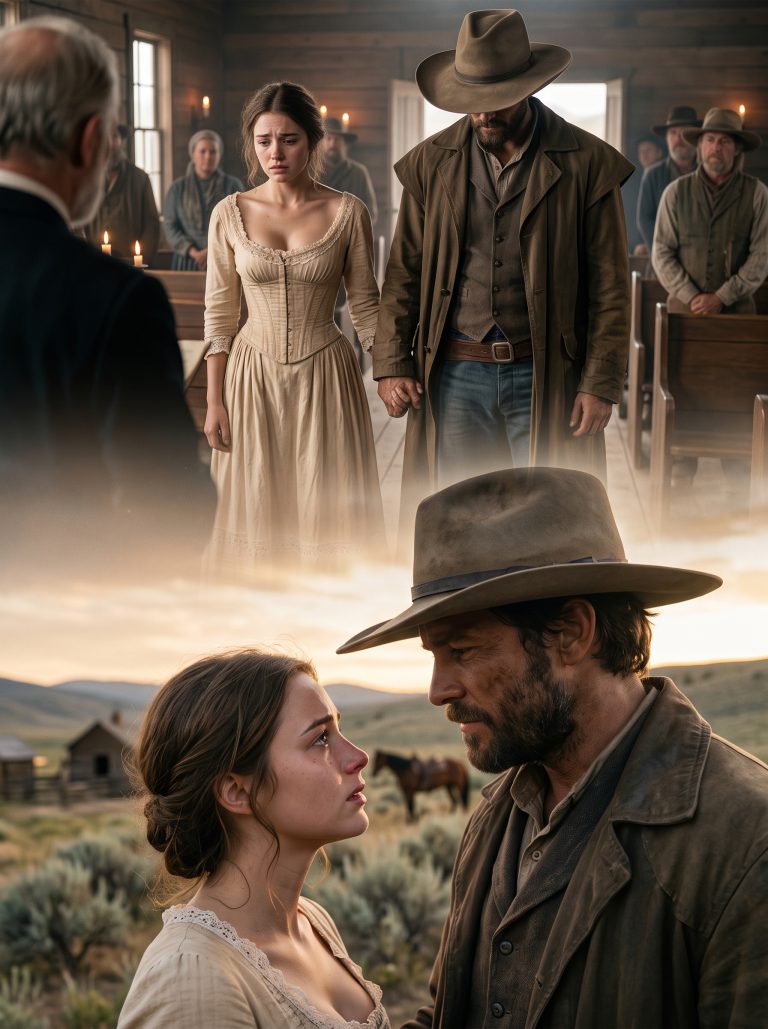
“At 19, She Was Forced to Marry an Apache — But His Wedding Gift Silenced the Whole Town”

Part 3
I. The Summer Of Dust
The summer of 1874 came dry and cruel to the Missouri plains. Dust lay heavy on rows of corn that never reached their ears, and the sky burned white as a furnace, day after day, until it seemed the whole world had forgotten what rain was for.
For Clara Whitmore, that year marked the end of everything she’d known — the house of her childhood, her father’s steady voice in the pulpit, the gentle rhythm of a life she’d once had the luxury of taking for granted.
Her father, Reverend Whitmore, had buried more neighbors than he’d baptized that spring. Cholera and hunger took them quick, and when the reverend himself fell sick in early June, there was no doctor left in the county to summon. He died with his Bible on his chest, leaving Clara nothing but that Bible, a cracked china teacup, and debts to men who had grown as hard as the land itself.
She was nineteen. Too old, suddenly, to be a girl. Too young, still, to be hardened.
Her aunt Miriam arrived from St. Louis a week later, dressed for travel in a way that made clear she didn’t intend to stay. She surveyed the empty house, the unpaid ledger, the daughter standing too straight in the doorway, and called it, with the flat practicality of a woman who had buried a husband of her own, “a practical solution.”
“A girl alone can’t make a life out here,” she said. “There’s a paper in town. The Matrimonial Gazette. Good men in the territory, seeking wives. They’ll pay your fare if you agree to marry.”
Clara read the notice a dozen times before she let herself answer it. Honest man of thirty seeks God-fearing bride to share ranching life in Arizona territory. Faith and fortitude required. Write to Samuel Crowe, San Miguel.
The name sounded steady. Safe.
She wrote back in her best hand, not truly expecting a reply — and a fortnight later, a sealed envelope arrived bearing train tickets, a plain gold ring, and a photograph of a fair-haired man in a wide hat, the ghost of a smile on his face.
On the morning she left, she boarded a train bound for a man she had never met, carrying a grief too large to name and a hope too small to fully trust.
II. The Man Who Was Not In The Photograph
The journey took six days. Each mile stripped something away — green fields, cool rain, the light she’d grown up under — and replaced it with red rock, blistering sun, and a silence so total it had a sound of its own.
When the train hissed to a stop at San Miguel, the land outside the window took her breath. Mesas rose like temples; cacti stood sentinel in the heat-shimmer.
She stepped down in her pale blue dress, clutching the photograph.
No man in a hat came forward.
Instead the sheriff crossed the platform, turning his own hat over in his hands. “Miss Whitmore? There’s a man waiting outside town for you. Calls himself Samuel Crowe.”
“My fiancé,” she said, and the word caught in her throat.
“He ain’t what most around here would call a settler,” the sheriff said, not quite meeting her eyes. “But he’s a decent man, by all I know.”
“What do you mean?”
“You’ll see.”
A wagon waited beyond the station, drawn by two lean mustangs, driven by a boy of perhaps fourteen who said not a word the whole ride. The town fell away behind them, replaced by open desert, the horizon burning toward evening. By the time the sun leaned low and red, smoke was curling up from a cluster of dwellings in the valley below.
“Where are we going?” she finally asked.
“To the man your people call Samuel Crowe.”
III. Seven Days
He came forward out of the firelight — tall, broad-shouldered, a pale scar cutting down one cheek, his dark hair bound with copper beads, his eyes the grey of a storm still deciding whether to break.
“You are Clara Whitmore.” Not a question.
“I came to marry Samuel Crowe.”
“That is the name I am known by in your towns. My own is Nantan Lobo.”
She held up the photograph, her hand not quite steady. “This isn’t your face.”
He didn’t look away from it. “The letters were written and carried by a friend of mine, a man who moves between your world and ours. I did not know a photograph had been sent until the sheriff told me this morning, riding out.” He had not sent it, but he didn’t hide behind that. “It should never have happened.”
“You still let me be brought here on a lie.”
“What I owe you now is the truth, plainly. My people need this marriage to hold a peace that’s thinner than it should be. But I won’t ask you to swear to anything tonight. There’s a lodge set aside for you. Take seven days. Watch how we live. If, at the end of it, you wish to leave, I will see you safely back to San Miguel and onto a train myself.”
“And if I stay?”
“Then what comes after is yours to choose. Not mine. Not the treaty’s.”
He held out a small wooden box, a silver lock set into the lid, no key in sight.
“A token,” he said, “so that even if you stay, you’ll remember that staying once doesn’t take away your right to choose again. You’ll have the key when the time is right.”
She took it without understanding it, and did not yet know that this box, still unopened, would very nearly cost her everything before it gave her the one truth that would set her free.
IV. Learning The Shape Of A Stranger
She spent her first morning in a lodge of her own, waiting for a fear that never fully arrived. Instead there was only the strangeness of new sounds — coyotes at night, drumbeats she felt through the ground before she heard them in the air — and, at dawn, a basin of cool water left outside her door by someone who never stayed to be thanked.
“You will meet my people today,” he said. “Some will not welcome you easily. But if you walk with respect, they’ll see it.”
“I don’t belong here,” she said.
“Neither did my mother, once,” he said. “She was separated from her first home as a girl. She built a second life here instead, though she never spoke lightly of what the first had cost her.”
Clara didn’t know what to say to that.
That day she walked the camp beside him: women grinding maize, children running barefoot between the dwellings, men watching her pass with a wariness that felt more like weather than cruelty. An older woman, her face lined deep, pressed woven bread into Clara’s hands.
“White Dove,” she said, in halting English. “You strong. He choose well.”
Clara looked to Nantan. “What does she mean?”
“She has already chosen the name she hopes the elders will give you,” he said. “It isn’t mine to confirm yet.”
On the second evening, he crouched beside the cookfire and showed her, without a word of instruction first, how to lay the kindling in a small teepee so the smoke wouldn’t choke her. She fumbled it twice. The third time, his hand closed briefly over hers to steady the angle of a stick, then withdrew before she’d fully registered the warmth of it.
“There,” he said. “Now it is yours. You won’t need me for it again.”
“Is that what you want? For people not to need you?”
He didn’t answer right away. He fed a twig into the flame and watched it catch. “It is easier,” he said finally, “to be needed for small things. A fire. A wagon. Water fetched from the stream.” He looked up at her, and something in his face closed as quickly as it had opened. “Ask me about the trade routes instead. I know those better.”
She let it go, that first time. But she noted it — the exact shape of the door as it shut.
It happened again two days later, over the fire, when she asked why he’d taken the name Samuel Crowe at all.
“A teacher gave it to me, when I was a boy,” he said. “He said the crow is clever. It survives what others cannot. I kept it.”
“You had a teacher?”
“A missionary. Before your people burned his mission, he taught me words.” A pause. “Words can build bridges, he told me. I’ve tried to remember that.”
“And did they? Build bridges?”
His jaw tightened, almost too briefly to catch. “Not always. Not for everyone who trusted them.” He rose, brushing dust from his knees, and did not finish the thought. “It grows late. You should rest.”
She caught his sleeve before he could leave the fire. “You do that,” she said. “Every time a question gets close to you instead of your people, or your mother, or your trade routes. You close it like a door.”
For a moment he said nothing, and she thought she’d overstepped. Then, quietly: “You see more than most who’ve been here seven days.”
“I’ve had practice watching for doors that close. My father had a few of his own, after my mother died.”
He almost smiled at that — the closest she’d seen yet. “Then you’ll forgive me if it takes longer than seven days to open mine.”
At night, by the same fire, he taught her a handful of words in his own language — water, sun, heart — and laughed, low and unguarded, when she stumbled over the sounds. It was the first time all week she’d heard him laugh without checking himself afterward, and she found she wanted to hear it again.
V. The Snake And The Fever
On the fourth afternoon, fetching water from the stream that cut through the canyon floor, she heard the sharp rattle of a snake and froze — a coiled diamondback, inches from her skirts.
Before she could move, a blur crossed the space between them. His knife flashed once. The serpent went still.
“You must always look where you step,” he said, breath quick.
That night, the fever came — brought on less by the shock of the snake, she would understand later, than by days of desert heat, too little water, and a body that had been running on fear since Missouri. She woke to find him beside her, cooling her forehead with a wet cloth, saying nothing at all.
By morning the fever broke. He pressed something small and cold into her palm. A key.
“For the box,” he said. “Open it only when your heart knows whether it wishes to stay.”
She held it a long time after he’d gone, and did not open the box. Not yet.
VI. What She Chose
On the seventh evening, the sheriff rode out with a small escort. Nantan stood at the edge of the firelight.
“You have your answer to give,” he said. “Whatever it is, I’ll hold to what I promised.”
She looked past him, at the camp that no longer felt as foreign as it had a week before, and answered before she’d finished thinking it through.
“I’m staying.”
The ceremony that followed that night was simple — elders speaking words she didn’t understand, the sheriff and two settlers standing witness. When it was done, Nantan placed a hand over his own heart.
“From this day you are called White Dove,” he said. “My people will protect you.”
Under a blaze of desert stars, she sat by the fire, turning the box in her lap, the key still unused.
“Why not simply tell me what’s inside?” she asked.
“Because you would believe it only because I said it,” he said. “Not because you’d come to know it was true.”
She didn’t open it that night either. But for the first time, she found she didn’t want to rush toward the answer.
VII. Trust And Its Price
Autumn arrived with a kind of quiet menace — days still fierce with heat, nights turning sharp and cold. Clara rose before dawn now to grind maize with the other women; her blistered hands had calloused fast. The people no longer stared when she passed. Some even nodded.
But peace in the camp remained fragile as glass.
Rumors drifted in from San Miguel — cattle stolen, wagons raided along the river trail. Nantan rode in from the trading post one afternoon, his horse lathered, his eyes grim.
“The settlers say my people took cattle from their ranches.”
“Did they?”
“No. But outlaws ride under our shadow, and white men see hoofprints and think them ours.”
The next morning, she insisted on riding with him to San Miguel — and stood beside him in the street when a rancher spat in the dirt and demanded blood without proof, her voice ringing out clear: “If you harm this man, you’ll answer to me. He is my husband, and I will stand with him.”
The sheriff finally barked for calm. They rode out with an uneasy peace intact, and that night, by the fire, something between them shifted for good.
“Why did you defend me, White Dove?”
“Because I see you,” she said. “Not what they say you are. What you truly are.”
“And what do you see?”
“A man who carries more honor in silence than most carry in words. But who also mistakes silence for strength, sometimes, when it’s really just fear wearing a calmer face.”
He was quiet long enough that she wondered if she’d gone too far again. Then he said, low: “There was a wife before you. Chosen the same way — for the same peace. I told myself duty was enough, that I didn’t need to give her more than that, because giving more had cost my mother everything once. She died in a raid two winters past, and I have wondered since whether she died believing I never let her past the door.” He looked into the fire rather than at Clara. “I built the seven days, and the box, and the key, so that I would never again mistake a woman’s silence for her consent. So that if you stayed, it would be because you had truly seen me — not because I had made it easy to overlook what I withheld.”
“That isn’t a flaw, Nantan. Not the wanting to protect me from your own guilt.”
“It became one,” he said, “the day I realized I was doing to you exactly what I swore I wouldn’t — keeping a door closed and calling it honor.”
“Then open it,” she said simply.
“You are braver than most who ask that. Too brave for this world, maybe.”
VIII. The Night The Camp Burned
The peace held. Barely.
Then, on a moonless night, it broke completely.
Clara woke to the smell of smoke and the sound of screaming. Masked riders stormed the camp with torches raised, horses shrieking, gunshots tearing through the dark. She stumbled out to see Nantan surrounded — three outlaws closing on him, one striking him across the temple with a rifle butt hard enough to drop him.
“Leave him!” she screamed, running forward — but a hand seized her arm. The old woman, her voice fierce.
“No, White Dove. If you die, hope dies with you. Ride west, past the split rock where the wash runs dry. Men without honor camp there. Find the ones who track — they will know.”
Clara looked once more toward Nantan, bound now, being dragged toward the canyon. At the edge of the camp she cut her own mare loose from its post, threw herself into the saddle, and rode until the flames disappeared behind the canyon walls, the box still strapped tight against her satchel, the key still around her neck.
By dawn she collapsed beneath a sandstone arch, weeping.
“Please,” she whispered. “Don’t let that be the end.”
IX. What The Key Was For
She rode for hours on the old woman’s word — west, past the split rock, following hoofprints that cut across the dry wash — and eventually spotted a column of black smoke rising beyond a canyon rim. Cautiously, she climbed a ridge and looked down.
Five riders. Rifles glinting. And tied to a post at the camp’s edge, beaten and bloodied but alive, was Nantan.
She had no weapon. She thought of the box, its weight she’d never been able to explain, and wondered — for the first time letting herself hope for something practical rather than sentimental — whether Nantan had hidden money, a map, or proof inside it. Anything that might buy him time.
With trembling fingers, she fit the key to the lock and lifted the lid.
Inside lay a folded piece of crimson and gold cloth, and beneath it, a letter in both English and Apache.
Clara. If ever you have opened this, it means you chose to stay long enough to earn the truth of it. This cloth is the mark of a wife among my people. Wear it only if you choose me now — not from duty, not from the vow the elders spoke for us, but because your heart has found something here worth keeping. If it hasn’t, show this letter to the sheriff in San Miguel. He has given me his word that he will see you safely home, and I will never come after you. — Nantan Lobo.
Tears blurred the words. The lock she’d feared for weeks had been guarding nothing but a second chance to choose him freely.
“You fool,” she whispered, smiling through tears. “You noble, impossible man.”
She tied the sash across her shoulders and looked down toward the camp.
“I’m coming, Nantan.”
X. The Signal
She didn’t charge the camp. She had never held a rifle longer than it took to hand one back to her father, and she knew it.
Instead she crept along the ridge until she reached the outlaws’ tethered horses. A rifle leaned against a saddle near the picket line; she took it, checked the hammer the way she’d watched her father do years ago, cut the horses loose, and fired one shot into the air. The animals bolted, scattering the camp into chaos — and from the far ridge, an answering cry rose up. Tosa, Nantan’s kinsman, had been tracking the raiders’ trail since the fire, waiting for exactly this kind of opening. His riders poured down the slope, war cries cutting through the dust.
In the confusion, Clara ran to Nantan and sawed through his bindings with a dropped knife.
A stray shot caught his upper arm as they broke for cover, and he grunted but didn’t slow.
“Are you hurt?” she asked, pulling him behind a boulder.
“I’ll live.” His eyes caught the sash at her shoulder, and his breath went still. “You opened it.”
“I chose you, Nantan. I choose you.”
When the fighting ended, Tosa grinned through the blood on his own arm. “You have brave woman, brother. She rides like the storm.”
“Like the storm,” Nantan said, “and the dawn.”
XI. What Peace Actually Cost
Two of the captured outlaws confessed under questioning, hoping cooperation would spare them the gallows — hired, it turned out, by a rancher who’d been rustling his neighbors’ cattle for a year and blaming it on raids that never happened. The sheriff rode out with the confession in hand and the rancher in irons a month later. Not every family in San Miguel accepted it. Some still crossed the street when Nantan rode through. But enough did that, come spring, the sheriff arrived at the camp himself with new trade terms.
“I was wrong to let suspicion stand where proof should’ve been,” he said, turning his hat over once in his hands. “Your people paid for that mistake. I’m sorry for it.”
“And your people will have safe passage here,” Nantan said. “No blood for blood.”
That night, at a fire that lit the whole valley, Nantan took her hand before the gathered crowd.
“Once I took a wife to hold a peace,” he said. “I thought duty was stronger than love. This woman taught me otherwise. Clara Whitmore. Will you stand with me again — not as a bride of treaty, but as a wife of choice?”
“I will,” she said, and meant it more completely than she had the first time.
He pressed something into her palm — a pendant, a small silver bird in flight, its surface uneven where it had been melted and reshaped by hand.
“It was the lock from your box,” he said. “A lock only ever kept your heart closed to me. I thought it deserved to become something that could fly instead.”
XII. Final Image
Later, when the fires burned low, they walked together to the edge of the cliff overlooking the valley, the same rise where she had first begun, seven days into everything, to imagine what staying might look like.
“Do you regret it?” she asked. “The letter that brought me here?”
“Only that it wasn’t sent sooner.”
She leaned into him, the desert stretching out below — no longer a place that had swallowed her old life, but one that had handed her a new one instead.
The wind moved through the canyon, and the silver bird caught the last of the firelight against her collarbone — a lock once meant to keep something closed, remade into the one thing that had finally set her free.
The seasons turned, as seasons do, and the camp in the valley learned to measure time by her the way it measured time by anything else worth watching — the year White Dove taught herself to weave, badly at first and then well; the year the drought broke and the maize grew taller than anyone could remember; the year Nantan finally let Tosa talk him into racing horses along the river flat, and lost, and laughed about it for a week afterward in a way the old woman said she hadn’t heard from him since he was a boy.
He kept a small wooden box on the shelf by their bed, empty now, the lock long since reforged into the bird Clara wore. She asked him once why he hadn’t thrown it out, since it had no lock and nothing left to guard.
“Some things you keep,” he said, “not for what they hold, but to remember what it cost to open them.”
She understood that better than most.
There were harder years too — a winter when fever swept the camp and took two children and nearly took a third, when Nantan sat up three nights running with his hand on a boy’s chest just to feel it still rising, and Clara understood then, watching him, exactly what kind of man closed himself off out of fear of losing what he loved, and exactly how much it cost him now to stay open anyway. He wept once that winter, in the dark, thinking her asleep. She didn’t let on that she’d heard. She simply took his hand and held it until morning, and never once mentioned it after, because some doors, once opened, don’t need to be spoken of to be understood.
By the time their first child was born — a girl, dark-haired and grey-eyed, who the old woman took one look at and declared “strong, like her mother” — the sheriff of San Miguel had become, improbably, a fixture at their table twice a year, and the trade routes Nantan had once guarded so carefully ran both ways without a rifle in sight.
Clara Whitmore, who had once stepped off a train in a pale blue dress holding a stranger’s photograph like a compass, no longer needed a compass at all. She had learned, in the space of one drought-cracked summer and all the seasons after, that the truest homes were rarely the ones a person was born to, and that the doors worth walking through were almost never the ones standing open — only the ones somebody, eventually, found the courage to unlock.
THE END