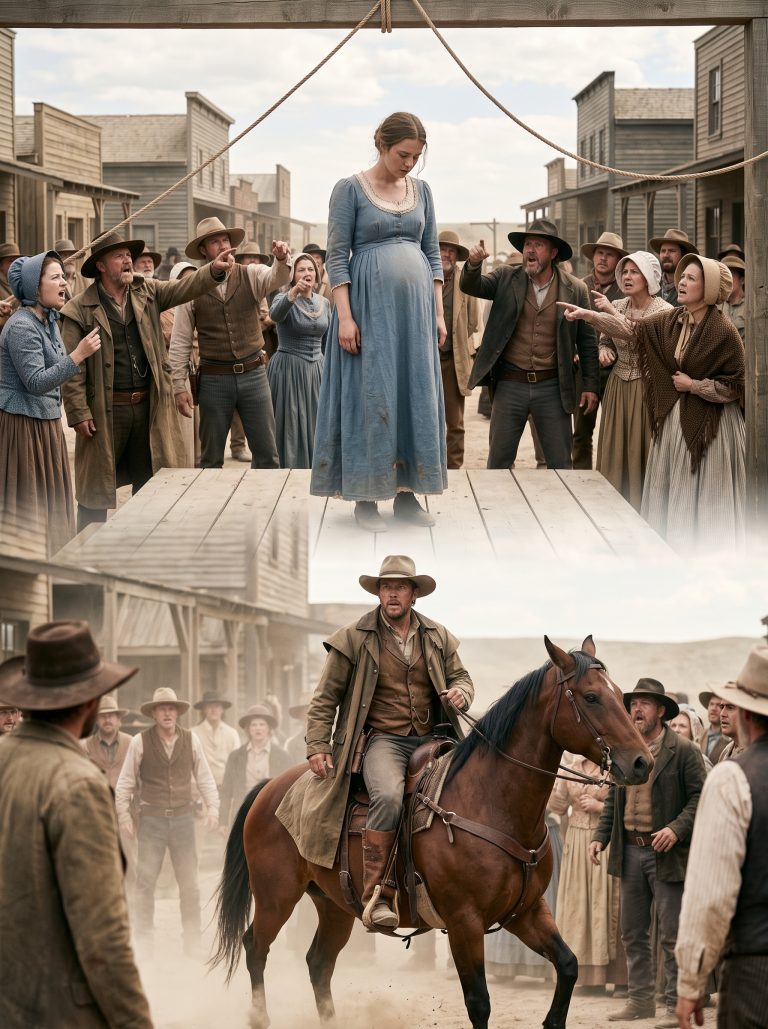
Don’t Hurt Him! I’ll Buy Him, She Said — ‘Call Him ‘Savage’ All You Want… I See A Man Worth Saving

Part 3
The riders came at dawn, six of them, torches guttering in the grey light — Reverend Pruitt at their head, Jim and Pete Cole behind him, men whose tempers ran hot even sober.
“Mrs. Hayes,” Pruitt called out, “we’ve come to talk sense to you. This is sin, and you know it.”
Eleanor stepped onto the porch, shotgun visible but not raised. Kai stood a half-step behind her left shoulder.
“The only sin I see,” she said, “is grown men riding to a widow’s home before sunrise with torches, like a lynch mob dressed up as scripture.” She didn’t lower the gun until the last horse was well down the road, and even then her hands shook for an hour after.
Not everyone rode away convinced. Pruitt kept preaching. The Cole brothers kept spitting when Kai passed. But something had cracked, and cracks, Eleanor was learning, let in light slowly — not all at once.
Sheriff Coyle rode out alone a few days later, hat in hand, and stood a long moment before he managed the words. “I should’ve asked harder questions before I put irons on you,” he told Kai. “Finding the truth of it won’t undo what I did. But it’s where I mean to start.” Kai studied him the way he studied most things — carefully, without haste — and finally nodded once. It wasn’t forgiveness. It was a beginning.
The Fire
Smoke rose black against the sky two weeks later — the Whitfield barn, ablaze, with six-year-old Lily Whitfield trapped in the loft. Kai ran before anyone could stop him, before anyone could shout the word savage one more time, and disappeared into the smoke.
The seconds stretched like hours. Then he emerged, soot-blackened, coughing, a small girl clutched safe against his chest.
“She breathes,” he said simply. “Scared. Not hurt.”
Daniel Whitfield — who had ridden with Pruitt’s torches two weeks earlier — stood frozen, then stepped forward, hand extended. “I was wrong about you,” he said. “I’m sorry. Truly.”
“Neighbors help neighbors,” Kai answered, and shook the offered hand.
It changed some minds. Not all. Mrs. Ashford watched from a careful distance and said nothing that day. Pruitt called it a trick of the devil’s timing from his very next pulpit. But the barn raising that followed drew half the valley, and by its end even Sheriff Coyle was asking Kai’s advice on how the old lodge-pole joints held weight better than nailed lumber.
What Ethan Found
The court register listed only the date of sentencing — the arrest record itself, Ethan discovered, had gone missing from the sheriff’s office entirely, a gap Coyle couldn’t explain and didn’t like. Ethan went looking for another way to fix the timeline, since Kai could describe exactly how he’d been trapped, but not why Grant had gone to such trouble over it. Doc Marsh had treated Kai’s split knuckles the night of his arrest, and his patient ledger was the one independent record left of that date.
But the ledger itself was older than Ethan expected — its binding predated his father’s own practice by a decade. Doc Marsh’s late father had served for years as the contract physician to the Indian agency, before the reservation lines were redrawn, and had treated Strong Elk’s family more than once in that time. It was, Ethan realized, exactly the kind of ledger no living soul had reason to open anymore — which was likely why someone, years before, had chosen it as a place to hide what wasn’t meant to be found. Sewn beneath its leather backing, in a section far too thick for the entries it claimed to hold, Ethan found a folded survey map.
He brought it to the ranch with shaking hands. “This marks an old tribal allotment boundary. It runs under both your land, Mrs. Hayes, and half of Grant’s. By federal treaty, mineral and water rights inside that line pass to a named heir — if the heir can prove the lineage.” He hesitated. “The original allottee is recorded as Strong Elk.”
Kai went very still. He drew out the pale arrowhead and set it beside the map. The mark pressed into its base — a shape he’d never thought to explain because it had simply always been there — matched, stroke for stroke, the personal mark recorded beside Strong Elk’s name on the allotment register.
“My father’s mark,” he said quietly. “I did not know it was also his name on paper.”
It explained, at last, the horse theft — and Kai, for the first time, put the pieces together himself. “Grant’s foreman offered me two days’ work, moving horses between his south pastures. Said he needed a man who knew animals. The moment I crossed onto Grant land with them, Coyle’s deputies were already waiting. The foreman swore I’d taken them without leave.”
“There’s more,” Ethan said. “I checked the county employment rolls. Before Grant ever hired him, that foreman spent two years as a clerk for the Indian agency — the same agency that kept this register. He’d have handled entries like your father’s himself.”
Kai went quiet, turning the thought over. “Then he knew exactly who I was the day he offered me that work. Grant didn’t stumble onto my father’s claim after I came to this valley. He already knew whose son he was hiring to move his horses.”
The map and the mark weren’t proof enough on their own — a carved stone could be traded, stolen, bought secondhand, and Judge Harrison said as much. It took the whole winter to answer him. Ethan traced agency correspondence out of Denver by mail. Sheriff Coyle tracked down an elderly interpreter, once employed by that same agency, who had signed the original allotment register decades before. Shown the arrowhead, the old man did more than confirm the mark. He named the childhood name Kai had been given before the mission school changed it, recalled the line of Kai’s mother’s family by name, and recited, from an agency letter he’d helped translate the year Kai was born, the description of a small burn scar on the boy’s left forearm — the same scar, pale with age, that still marked Kai’s arm. Only then did he weep.
“Strong Elk’s boy,” he said. “I carried the message that his land could not be taken. No one listened.”
The Reckoning
Grant did not go quietly. When word reached him that Judge Harrison had summoned the interpreter’s sworn statement, he rode to Doc Marsh’s office at night, meaning to burn the ledger himself. Ethan caught him with a lamp already lit at the doorway and a pistol drawn on him for his trouble.
Kai arrived before Coyle did. He could have made Grant pay in the oldest way a man knows how. Instead he pried the gun from Ethan’s shaking hand, stepped between them, and looked at Grant with the same stillness he’d once shown a jeering crowd.
“You had chains put on me to keep an old paper quiet,” Kai said. “I will not become what you called me in order to answer for it. The judge will answer for you now.”
Once Grant was in custody, Coyle rode out with a warrant to search his ranch office — and there, in Grant’s own account book, found what he’d been missing all along: a payment entry to the foreman, dated the morning before Kai’s arrest, with a note in Grant’s own hand instructing him to “move the two bays south before noon.” It was enough. Grant was charged before the week was out — for the false charge behind Kai’s sentencing, for the attempted destruction of evidence, and, once the allotment was confirmed that spring, for two land purchases built on a claim he’d never legally held. He sold what remained of his spread and left the valley before the thaw was through, and no one in Miller’s Bend troubled themselves to wish him well.
What Remained
Kai could have taken his rightful land and gone anywhere the treaty now allowed him to go. He didn’t.
“Land is not only a line on paper,” he told Eleanor, standing at the ridge where her failing ranch and his father’s allotment now quietly became one piece of ground. “It belongs to those who tend it, and love it enough to stay.”
They married that autumn under the cottonwood tree, Lily Whitfield scattering wildflowers, Ethan standing witness, and even Mrs. Ashford — arms folded, eyes wet despite herself — in attendance. Reverend Pruitt did not come. Some cracks never fully close, and Eleanor had stopped expecting them to.
Years later, no one in Miller’s Bend could say exactly when the word savage stopped being spoken on the boardwalk. They only remembered that when a fence needed mending, when a child went missing after dark, when an early frost threatened the herds, Kai Windrider was the first man they rode out to find.
— END —