For $1, a Mountain Man Claimed a Forgotten Cabin — But Inside Was a Woman Who Had Been Waiting Years for Him

Part 1
The wind off the Colorado peaks smelled of snow long before the clouds turned gray, and Jonah Crow rode into Silverton with that smell in his collar and a winter’s worth of silence behind his eyes. His bay gelding was more bone than beauty. So was he — lean, watchful, a man who read rooftops and doorways the way other men read newspapers. He did not like towns, but a man could not live on silence alone. He needed flour, cartridges, nails. He needed land he could close a door on and call his own.
He tied his horse outside the courthouse and ignored the men who stepped aside from him as though he carried plague. He was used to it. To Silverton he was a mountain savage, belonging fully to neither the white settlements nor the people his grandmother had come from — a man who had spent his whole life being punished for existing between two worlds.
Inside, a clerk with ink-stained fingers droned through a tax auction. “Item forty-two. A cabin and claim on Black Pine Ridge, seized for default. Twenty acres of vertical rock.” Laughter rippled through the room. A man near Jonah spat into the cuspidor. “Cursed place. Old man died crazy up there. Wind screams like a banshee.”
“One dollar,” Jonah said.
Every head turned. The clerk peered over his spectacles, certain he’d misheard, then shrugged and brought the gavel down. “Sold to the drifter for a dollar. Sign your mark.”
Jonah did not sign with a mark. He wrote his name in sharp, angular letters that startled the clerk, and set a silver coin on the desk hard enough to ring.
“Fool’s errand,” the clerk muttered, stamping the deed. “That roof’s likely caved by now. You’re buying a grave.”
“It’s my grave to buy,” Jonah said, and walked out into the whispers that followed him — savage, blood man, doesn’t belong here — and did not turn around.
He bought his supplies quickly, wanting the trail closed behind him before the storm the shopkeeper warned of arrived, and rode for the ridge with the sun sinking into purple and blood-orange behind the peaks.
The cabin, when he reached it, was worse than he’d hoped — gray logs, a sagging porch, a roof patched with sod and flattened tin. A ruin. But his ruin, and something in him settled at the thought.
Then he saw the smoke.
A thin wisp breathed from the chimney of a place the clerk had sworn was empty. Bootprints, small and recent, marked the snow by the porch steps. Jonah’s hand found his knife but did not draw it. He moved to the door the way he moved through bad country, and lifted the latch without knocking.
He owned this door.
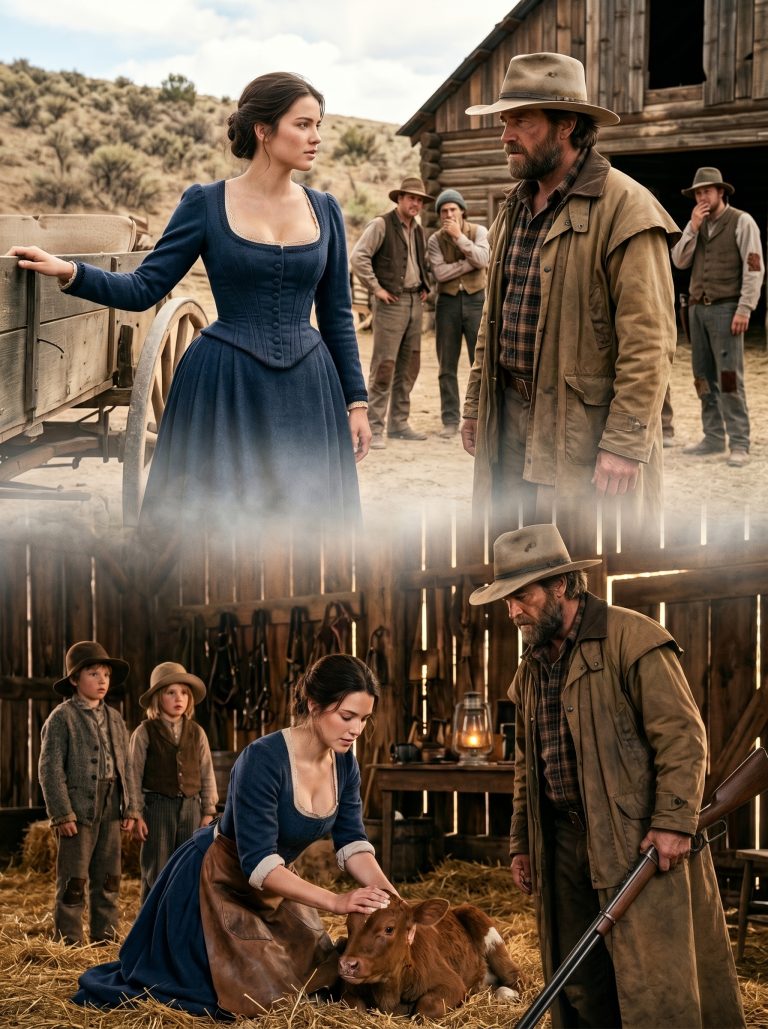
Inside, a woman rose from a chair with a Winchester leveled at his chest, her hands shaking but her aim steady. She was small, gaunt, her wrists ringed with fading bruises she did not try to hide.
“Get out,” she said. “I’ll shoot.”
He believed her — cornered things were the most dangerous kind. “This is my cabin,” he said. “Bought the deed today. Paper’s in my pocket.”
“Nobody buys this place. It’s cursed.”
“Storm’s coming,” he said instead of arguing. “I have food. I won’t put you out in a blizzard, but I won’t leave either.”
She weighed him the way a wounded animal weighs a stranger, measuring one danger against another, and at last lowered the barrel — not away, but enough. “Put your knife on the table.”
He did. It cost him something to do it, and she seemed to see that it did.
“Emilie,” she said finally. “Millie.”
“Jonah Crow.”
Night came down like a hammer, and with it, footsteps in the snow that were not wind. Voices. Millie went white and reached for the rifle with both hands.
“They’re here,” she whispered. “They’ll drag me back.”
Jonah did not ask who they were. He killed the lamp, smothered the stove’s glow under a quilt, and pulled her down behind the table.
“No smoke,” a voice outside said. “Nobody’s here.”
“Cold’ll take her by morning if she’s up here at all,” said another, laughing. “Let’s go.”
The boots faded into the storm. Jonah waited a long while before he moved.
Millie sat on the floor, not crying, only shaking with what fear leaves behind when it passes. Then she looked at him — really looked, for the first time — at the gun he’d drawn for a stranger, at the space he’d put his own body into between her and the door.
“I was told you would come,” she said.
“What?”
“Etienne. The old man who lived here before he died. He said a man would come who was stubborn enough to stay. He said you’d be the only thing standing between me and the town.” She looked at the barred door. “I’ve been waiting for you.”
A chill went through Jonah that had nothing to do with the cold. He had bought this cabin on a whim, for one dollar, because no other soul in the room would have it.
He was beginning to understand that the dollar had not purchased solitude.
It had purchased a war he had not known was already being fought for him.
Part 2
The blizzard did not cover the world. It erased it. For three days the cabin existed in white noise and cold, and survival narrowed to wood, water, and the shrinking distance between two careful strangers.
Jonah fought the woodpile with a hatchet until his hands split at the knuckles. Millie ruled the interior — melting snow, rationing flour, dressing a snared hare with a knife’s precision that surprised him.
“You’ve done this before,” he said.
“My father was a trapper. Before whiskey took his hands.” She didn’t look up. “He taught me to use mine.”
When the chimney backdrafted and choked the room with smoke, they fought it together, bare-handed, and when it was over she wrapped his blistered palms in melted-snow cloth and did not let go right away. That night, exhausted past pride, they finally spoke — her camp north of Leadville, too French for the Cree and too Cree for the French; his years as an army scout, finding camps that held people who looked like his own grandmother, and the blood that never quite washed off.
“We are a pair,” Millie said softly. “A ghost and a mapmaker with no country.”
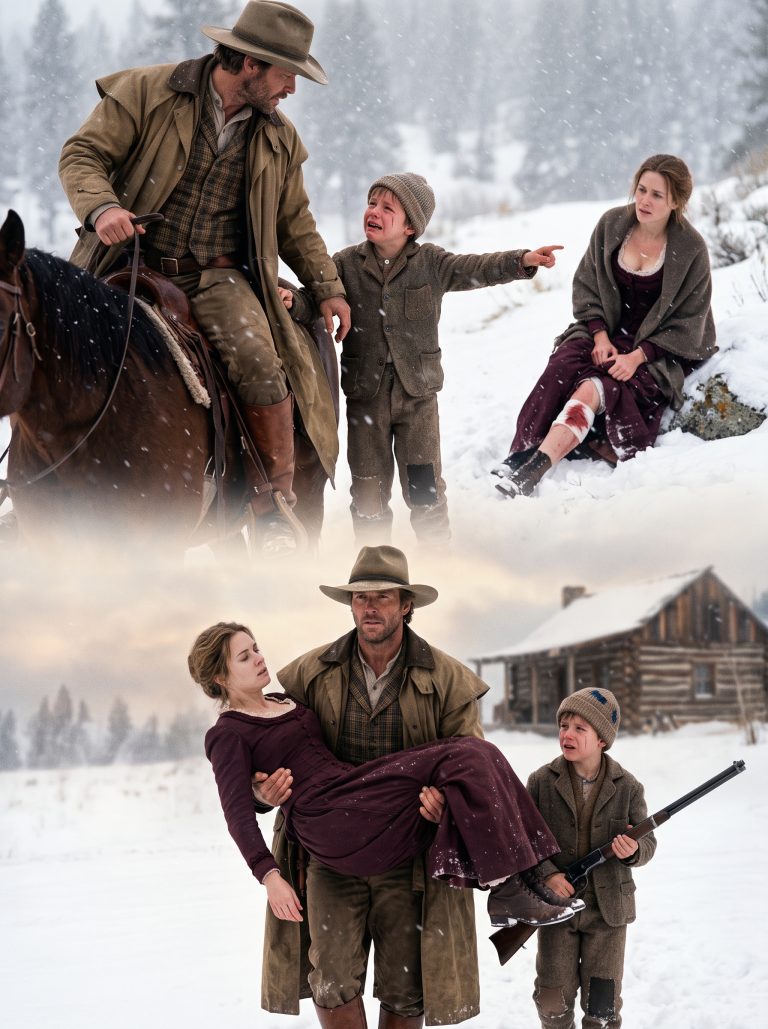
Two nights later the wolves came, drawn by the smell of the hare. Jonah went out into moonlight and gunsmoke and came back with claw marks through his coat and a dead animal dragged onto the porch as warning. Millie stitched his shoulder by firelight, her hands steady even as her voice was not, and told him at last about Silas Pritchard — the sawmill owner who had wanted her, been refused, and set about destroying her name in the mouths of people who believed whatever he paid them to believe.
“No one takes what isn’t given,” Jonah said, and it sounded like a law older than any courthouse.
Days later, prying up an uneven floorboard, he found an oilskin packet: a map that didn’t match any survey he knew, a leather ledger, and a letter sealed in red wax, addressed to him by name in a hand he’d never seen.
Millie went pale. “That’s Etienne’s writing.”
Jonah broke the seal.
If you are reading this, you are the fool I hoped you’d be. The girl is my goddaughter. I am dying and cannot protect her any longer. There are wolves in this town worse than the gray ones on the ridge. Do not trust the sheriff — he is Pritchard’s dog. And do not think this is only a cabin. What is hidden in these walls is the key to everything. Keep her safe, and it is all yours.
— Etienne Laroux
The cabin was no longer merely a shelter.
It was a fuse, and Etienne had lit it the moment Jonah signed his name.
Part 3
Spring did not come easily to Black Pine Ridge, and neither did the truth.
They spent the weeks after the letter in preparation as much as survival. Jonah taught Millie to shoot not as a woman defending a door but as a marksman who intended to win. In the clearing, breath fogging, he stood behind her and corrected her stance until she put a bullet through a pinecone at fifty yards without flinching.
“Better,” he said.
“It needs to be better than better,” she answered. “It needs to be certain.”
She had stopped waiting to be saved.
Dr. Clara Hargrove came up by cutter with medicine and news that hardened Jonah’s jaw: Pritchard had filed papers to seize the ridge by eminent domain, calling Jonah a squatter and Millie a fugitive and thief. It was not hatred alone driving him now. It was hunger. Etienne’s map, laid flat on the table, did not mark a boundary — it marked a vein of ore running straight beneath the cabin floor.
“He’s not only cruel,” Clara said. “He’s desperate.”
“We need proof he knew,” Millie said. “Proof he killed for it.”
Jonah remembered the letter’s promise — what is hidden in these walls — and began tapping the logs behind the bed until one rang hollow. Beneath a carved plug he found a sealed tin: a second ledger, correspondence, payments to Sheriff Cable, records of stolen federal timber, and dates that lined up exactly with the night Etienne died.
But it was the last item in the tin that changed everything.
Not a mining record. A treaty.
A single yellowed copy of an old federal agreement, decades faded, naming a band of families — hunters and trappers who had wintered on this exact ridge before any survey line was ever drawn — and guaranteeing that the ground could not be sold outright without the consent of their living descendants. Pinned to it, in Etienne’s shaking hand, was a note: Ask him about his grandmother. Ask him her mother’s name. This land was never truly for sale — not to Pritchard, not to the county, not to any stranger off the street. Only to blood that belonged to it.
Jonah sat very still.
His grandmother’s name — the one she had murmured to him as a boy, before the world taught him to be ashamed of it — was written three lines beneath the treaty’s seal, among a list of families who had once wintered on this very rock.
“He knew who I was,” Jonah said slowly. “Before I ever rode into Silverton. Etienne knew my grandmother. He didn’t leave this cabin to a stranger who’d be fool enough to buy it.” He looked up at Millie. “He left it to me. He was waiting for me specifically, same as you were.”
The auction had never been luck. The clerk’s contempt, the town’s laughter, the dollar bid no other man in the room would make — all of it had simply been the slow closing of a door that had been left open for one particular hand to walk through.
Millie’s eyes were wet. “Then it was never a fool’s errand at all.”
“No,” Jonah said. “It was a homecoming neither of us knew we were walking into.”
They could not wait for the thaw to finish before the town swallowed the truth or buried it. Judge Thaddeus was in Silverton, delayed by weather at the Grand Imperial, and Clara insisted he was the one honest thing left in a corrupt county.
They rode down in daylight, heads up. On the hotel steps, Sheriff Cable waited with two deputies, cleaning his nails with a small knife.
“Well now,” he called. “Look what the wind blew down. You’re under arrest, Crow. Abduction and theft of county property.”
“She is not abducted,” Jonah said. “She walks where she chooses.”
Millie stepped forward before he could stop her and pushed back her hood in front of the gathering street. “My name is Emilie Laroux. I am not stolen. I am here of my own will, and I have evidence of murder, bribery, and fraud against Silas Pritchard and Sheriff Cable.”
The street went silent. Cable reached for his revolver, but Clara’s shout brought the judge to the doorway — and with him, by pure fortune of timing, a federal marshal passing through on unrelated court business. Federal authority arrived exactly when Pritchard’s local authority could no longer protect him.
What followed was not a clean victory. It was a slow, public unraveling. Pritchard’s lawyer, imported from Denver, called Millie a liar and Jonah a savage and the evidence a forgery — until the tin box was entered whole into the record. The ledger’s ink did not lie. Dates matched. Payments matched. Henry, Pritchard’s own bookkeeper, broke and confessed to years of altered timber counts and hidden bribes.
And then came the treaty.
Sterling, Pritchard’s lawyer, tried to have it struck as irrelevant — a Métis girl’s fugitive claims, an old drifter’s grandmother, ancient paper no one could verify. But Judge Thaddeus read the document himself, turned it over to check the federal seal, and set it down with the particular quiet of a man who has just realized the ground beneath a case has shifted entirely.
“This changes the character of this proceeding,” the judge said. “Mr. Pritchard’s eminent domain filing presumes the land was ever fully his county’s to seize. If this document is authentic, it was never simply Mr. Crow’s claim to defend. It was never for sale to anyone outside the bloodline it names — including, Mr. Pritchard, to you.”
Pritchard’s composure finally broke. He shouted about conspiracy, about a mountain savage and his squaw fabricating parchment, until the judge threatened him with contempt. When Etienne’s letter was read aloud — the dead man’s warning about wolves worse than the gray ones on the ridge — something in the courtroom’s mood turned for good. People who had laughed at Jonah in the auction house sat very still.
Pritchard ran. He shoved his own lawyer aside, vaulted a railing, and made it as far as the swollen creek south of town before his horse threw him in the mud. Jonah caught him there, held him down without striking him, and waited for the marshal’s cuffs with something that was not quite triumph and not quite mercy — the specific, tired satisfaction of a debt finally called due.
“The law will do its work,” Jonah said over him. “Even if it’s late.”
Sheriff Cable was indicted before the week was out. Pritchard was denied bail and shipped to a federal cell to await trial for murder, fraud, and bribery, and the mining district he had built out of stolen timber and threatened widows began, slowly, to come apart in the daylight.
Silverton did not become a kind town overnight. Some still crossed the street when Millie passed, unable to forgive being wrong. But others — shopkeepers cheated for years, families who’d lost sons to unsafe mills — looked at Jonah Crow with something closer to respect than they’d ever managed before.
On Clara’s porch, two days after the trial, Jonah asked Millie if she wanted to leave — California, Oregon, somewhere the name Laroux meant nothing and the name Crow meant nothing either.
She looked up at the ridge, white against a clean blue sky, and shook her head.
“No. Etienne didn’t hide that treaty for us to run from it. He hid it so someone with a right to this ground would finally stand on it without apologizing for being there.” She took his hand. “We paid a dollar for a grave, Jonah. We are not leaving it a grave.”
They rode back up through mud and thaw with their heads high, and found the cabin door hanging from one kicked-in hinge, the windows dark, the whole place looking exactly like the ruin it had always been called.
To them, it looked like the first thing either of them had ever owned outright — not by paper alone, but by blood, by choice, and by the plain fact that they had bled to keep it.
They rebuilt through the spring. Jonah split cedar shakes for the roof. Millie planted a garden in the strip of sun by the cliff wall and sewed curtains for windows that had never had any. The silver vein stayed in the ground, untouched, a fact and not yet a fortune — there was time enough for that later, and neither of them was in a hurry to let money decide who they were.
One afternoon a rider named Crouch, one of Pritchard’s old loud supporters, stopped his horse at the edge of the clearing and eyed the mended porch, the smoke, the garden.
“Some folks don’t like it,” he said. “A man like you living up here with a woman like her. Fences get cut. Barns burn.”
“If a fence is cut, I’ll fix it,” Jonah said. “If you come up here threatening my wife, you won’t make it down the mountain.”
Millie stepped up beside him, not behind him, rifle resting easy in the crook of her arm. “Tell your friends,” she said, “we are home.”
Crouch looked at the two of them — solid, unmoving, exactly where they meant to stay — and turned his horse without another word.
When the sound of hooves had faded, Millie glanced sideways. “Wife?”
Jonah, suddenly and uncharacteristically shy, cleared his throat. “Circuit judge comes through next month. Thought we might make it official. If you wanted.”
“I would like that,” she said, and kissed him, and it tasted of woodsmoke and thaw.
The mountain did not grow gentler. Winter would come again, and with it old aches in a shoulder scarred by wolves and a heart scarred by everything else. Prejudice did not vanish from the valley below simply because one corrupt man had been dragged out of it in handcuffs.
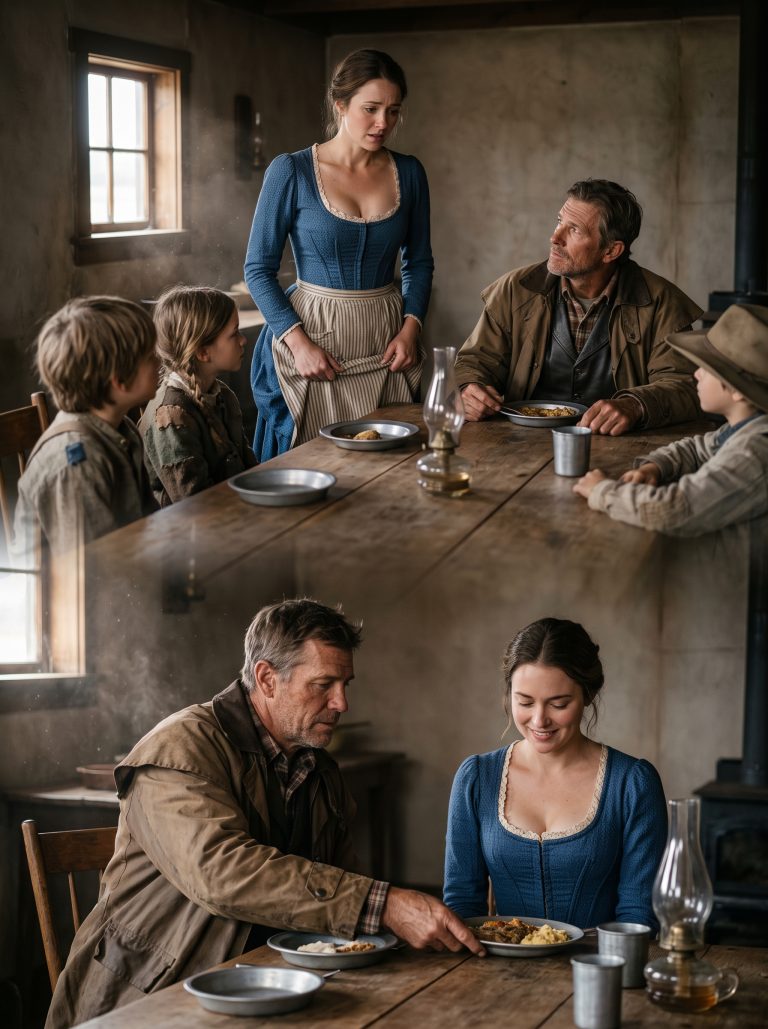
But that evening, as the sun went down gold and violet behind the peaks, smoke rose steady from the chimney of the cabin on Black Pine Ridge — not stolen smoke, not borrowed smoke, but their own. Inside, the stove was warm and the table was set, and two people who had spent their whole lives being told they belonged nowhere sat down to break bread in a home that had, in the end, been waiting for exactly them.
It had cost a dollar to buy the deed.
It had cost everything else to earn the right to keep it.
The End