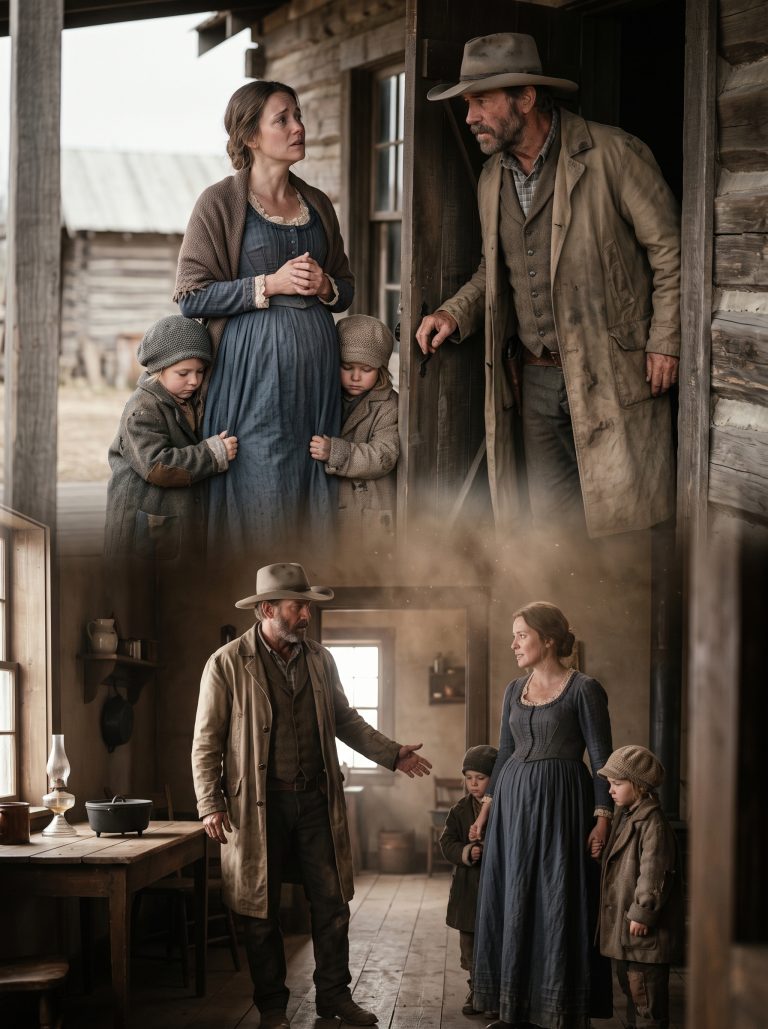
“Government wards don’t get to choose a father,” Agent Crenshaw sneered as he reached for the starving Cherokee children — until I showed him the court order that changed everything.

PART 3
Judge Blackwell did not read fast.
He read the way a man measures the weight of a coin before deciding whether to spend it — slow, deliberate, every syllable landing like a footstep on a floor that might not hold. It was, Elias would think later, the cruelest kind of mercy: giving a room full of frightened people no choice but to sit inside the silence between his words.
Cross stood with his hands folded behind him, the composed posture of a man who believed the law was simply cruelty wearing a collar and tie, and that it would do his work for him without his ever getting his own hands soiled. Crenshaw sat just behind him, arms crossed, waiting to be called.
Elias didn’t watch the judge. He watched the row of children in front of him — twelve faces he’d come to know better that winter than he’d known most of the men he’d worked cattle beside for a decade — and he understood, with a clarity that felt almost peaceful, that whatever came out of Blackwell’s mouth next was going to decide the rest of his life either way.
“This court,” Blackwell said, “has read the transport manifest submitted by the government. It has read the correspondence from the Commonwealth of Pennsylvania confirming no legal guardianship was ever filed for the children in question. It has read—” he paused, and for one terrible second Elias thought the pause was for effect, a hangman testing the rope “—the guardianship documents submitted under the name of Elias Granger, and finds them, on their face, to be false.”
A murmur went through the gallery.
“The court has also,” Blackwell continued, “received a petition this morning from counsel for Mr. Granger, requesting a custody hearing under territorial law, naming twelve minor children by both their given and their chosen names.”
He set both papers down side by side on the bench, as if their proximity to each other was itself a kind of argument.
“Before I rule on either,” he said, “I intend to hear from every person this court considers necessary to understand what has actually happened in that house, and what these children were being transported into. Mr. Cross, you may call your first witness.”
Cross called Agent Crenshaw, who testified plainly to the transport program’s procedure — how children were gathered from scattered families, moved by wagon and rail, and consolidated for the eastbound leg to Pennsylvania. Cross called a records clerk who confirmed, yes, the guardianship papers bore a signature that did not match any notarized document on file in the territory. Every fact landed exactly where Cross wanted it. He didn’t need to lie. The truth, laid out plainly, was already a rope long enough to hang a man.
When it was Thornton’s turn, he didn’t call a single character witness to speak on Elias’s behalf. He didn’t put a neighbor on the stand to say what a fine, upstanding man Elias Granger was. He did something Elias hadn’t expected and, for one cold second, feared.
“I call Caleb Red Feather Granger.”
The courtroom shifted. Cross’s composure held, but Crenshaw’s jaw tightened.
Caleb stood. Fifteen now — his birthday had fallen just weeks earlier, the whole house turning it into an occasion, Alina baking a cake with precisely half the sugar the recipe called for because sugar was still dear that year — and taller than the frightened boy who’d stepped into a barn doorway with his hand near a knife. He walked to the witness chair with his shoulders set the way Elias had seen him sit a horse: like something that had decided, deliberately, not to be afraid.
“Tell the court,” Thornton said, “about the night you left the transport.”
Caleb didn’t look at Cross or Crenshaw. He looked at the judge.
“They loaded us at night so nobody in the towns we passed through would see how many of us there were,” he said. “Tessa was the smallest. She couldn’t keep up when we ran, so Marcus carried her for two miles before his legs gave out and I took her the rest of the way. We didn’t have food for six days. We ate bark once. I’m not proud of that, but it’s true.”
“And when you reached the Granger ranch?”
“He left milk on a stump. He didn’t chase us or call the marshals or anything a man’s got every right to do when he finds strangers on his land. He just left food and walked away like he hadn’t seen us at all.” Caleb’s voice caught, just slightly, on the next part. “Nobody had ever done that for us before. Not once. Not the whole time we were wards.”
Cross stood. “Objection. The witness is testifying to a legal status—”
“The witness,” Blackwell said, without raising his voice, “is testifying to a fact within his own memory, which this court is entirely capable of separating from the legal argument you’re about to make in closing, Mr. Cross. Sit down.”
Something in the room loosened, just slightly, at that. Elias didn’t dare hope it meant anything. But he noticed it.
“Continue,” Blackwell told Caleb.
“He said nobody was going to take food from a child in his house,” Caleb said. “And then he did more than feed us. He taught me accounts. He taught me to read a cattle contract so nobody could ever cheat me the way men cheat boys who can’t read. He learned our songs badly on purpose so we’d laugh at him instead of being scared all the time.” A small, unguarded smile crossed his face, gone as quick as it came. “He never once asked us to stop being who we were. He asked us to teach him.”
“Did Mr. Granger ever, at any time, prevent you or any of the other children from leaving if you wished to?”
“No, sir. He told us that door” — Caleb pointed, and every head in the gallery turned toward it — “was never locked from the inside. Only from men like the ones who put us on that wagon.”
Cross’s cross-examination was short and sharp, built to remind the room that a boy’s gratitude wasn’t a legal defense. It landed some of its blows. But when he asked, almost as an afterthought, whether Caleb understood that Mr. Granger had broken federal law, Caleb answered before Thornton could object.
“If saving children is your crime,” he said, “then your law is wrong.”
The gallery went so still that Blackwell didn’t reach for his gavel. He didn’t need to.
Kai testified next, quieter than her brother but no less exact. She spoke about the herbs she’d been allowed to grow along the south wall of the garden, about the nights Elias sat cross-legged on the parlor floor trying and failing to get his mouth around words that weren’t built for a rancher’s tongue, about how in that house, for the first time since the wagon took them, Cherokee had stopped being something to be punished for and started being something Elias asked to learn. She mentioned, too, that when the children finally trusted him enough, they’d each told him the name a government clerk had struck from their papers — the name their mothers had actually given them — and asked him to use it.
“He didn’t take our names,” she said. “He protected us until we could say them without flinching.”
Then Martha Patterson stood, uninvited, a folded quilt in her arms — and Thornton, catching Blackwell’s eye, asked permission for her to be heard as a character witness for the community rather than the defense proper. Blackwell allowed it with a small nod, the first crack of something like curiosity showing through his judicial calm.
“Your Honor,” Martha said, “I’ve helped stitch a piece of every child’s story into this quilt since the week I first met them, because that’s simply what neighbor women do when there’s sewing to be done and children who’ve never had a quilt of their own. I didn’t ask questions about papers. I asked what their names were. Every child gave me two — the one they were born with, and the one they’d have chosen if the world had let them keep it plain.”
She laid the quilt across the courtroom rail. Every square carried a child’s birth name, with Granger stitched beside it in plainer thread — not a second given name, but the family name each child had chosen to wear alongside the one nobody had the right to take.
Cross made a note on his pad and didn’t look up again for the rest of Martha’s testimony.
Elias hadn’t known it existed until that exact moment. He’d find out later that the children had asked Martha to keep it secret, wanting it to be a surprise for a Christmas that, three weeks earlier, none of them had been certain they’d still be together to celebrate.
Then Thornton did the thing that, even sitting beside him, Elias hadn’t seen coming.
He walked to the defense table, opened Sarah’s cedar box — the one Elias had given him weeks earlier only because Thornton had asked, without explanation, for “anything that belonged to your wife that might matter to this case” — and lifted out a single folded paper.
Elias’s chest went tight. He hadn’t opened that box in three years. He didn’t know, until that second, what Thornton had found inside it.
“Your Honor,” Thornton said, “I’d like to submit this into evidence. It’s a letter written by Sarah Granger to her husband, dated the week before their son was born, found among her personal effects.”
Cross was on his feet. “Relevance, Your Honor, this is—”
“I’ll determine relevance once I’ve heard it,” Blackwell said. “Proceed, counsel.”
Thornton unfolded the letter with the care of a man handling something that had outlived the person who’d written it.
“‘Elias,'” he read, “‘I want this house full one day. Not just with our own, though I pray for that too. If someone hungry ever finds this house before happiness does, feed them. Promise me that. Yours, Sarah.'”
The courtroom did not stay quiet after that. It couldn’t. Thornton let a beat pass before he added, quietly, “Mr. Granger did not know this letter existed until I found it in that box three weeks ago. I raise it only because it speaks to the character this court is being asked to weigh.” Even Blackwell, for the first time in two days of testimony, set down his pen and simply sat with it.
Elias did not cry in front of that room. He had promised himself, walking in that morning, that whatever happened, he would not give Cross the satisfaction of watching him break. But something in his chest came loose all the same, and Tessa, sitting close enough to feel it, reached over and put her small hand flat against his arm the way she had the very first night, and didn’t say anything at all.
When Thornton called Elias himself, there was no theater left to play. He didn’t deny a single thing Cross had proven.
“I forged the papers,” he said. “I coached the children on the story we told in town. I hid them from federal officers and I would do every part of it again tonight if it meant Tessa didn’t go back on that wagon.”
“Do you understand,” Blackwell asked, not unkindly, “that this court is required to weigh the law as it stands, and not merely the mercy of your intentions?”
“I understand it, Your Honor.”
“Are you sorry for what you did?”
Elias looked, for a long moment, at the row of children in front of him. At Caleb, who’d learned to read a contract so no man could ever cheat him again. At Kai, whose herbs had already cured two fevers in that house that might otherwise have gone very badly. At Tessa, whose corn-husk doll still sat on the windowsill of what used to be a guest room and was now, simply, her room.
“I’m sorry the truth had gotten so dangerous,” he said, “that a lie was the only shelter I could build with the tools I had. But I am not sorry, and I will never be sorry, for feeding hungry children and calling them mine.” His voice held steady, though it cost him something to keep it that way. “A child is not paperwork, Your Honor. Whatever this court decides, that much I’ll go to my grave believing.”
Blackwell sat with that for a long time — long enough that even Cross’s confidence seemed to thin at the edges.
In his closing, Cross argued the law plainly and, within the narrow frame he’d chosen to stand inside, correctly: guardianship required process, process had been circumvented, and a rancher’s grief-born affection for twelve children didn’t rewrite federal statute no matter how many quilts got stitched in its honor.
Thornton argued something else entirely. He argued that the law existed to protect children, not to grind them, by force of habit and paperwork, back into a system that had already nearly starved and frozen twelve of them to death once. He argued that this court had both the authority and the obligation to stay a removal order while the fitness of the transport program itself was examined — and that a court asked to choose between the letter of a manifest and the plain, testified, quilted, sworn truth of a family that had built itself out of nothing but milk on a stump and a promise kept, was not actually choosing between law and lawlessness. It was choosing what the law was for.
The neighbors, who had filled every seat and every inch of standing room along the walls for two straight days, didn’t argue anything at all. They simply stayed. Jim Patterson. Old Thomas Weatherbe with his storm-leather face. A dozen others who’d watched twelve frightened children turn, over that one long winter, into twelve children who laughed in church and argued over chore assignments and asked for seconds without flinching. Their silence, shoulder to shoulder in that packed room, said the thing none of them had the legal standing to say out loud: we are watching what you do here, and we will remember it.
Blackwell took the evening to consider his ruling and returned to the bench the following morning with the kind of stillness in his face that told the room, before he’d said a word, that whatever came next had cost him something to decide.
“This court,” he said, “finds as a matter of fact that Elias Granger knowingly falsified guardianship documentation, and that this constitutes a violation of federal transport and custody statute as written. That finding stands, and Mr. Granger will answer for it in a separate proceeding on the falsification charge, which this court is not empowered to dismiss.”
Cross’s shoulders came down half an inch, already tasting the win.
“However,” Blackwell continued, and the word landed like a door opening in a room everyone had believed was sealed, “this court also finds, based on sworn testimony from the children themselves, from community witnesses, and from the government’s own transport supervisor, sufficient and credible doubt as to the welfare conditions of the transport program these children were removed from — doubt this court is unwilling to resolve by simply returning them to it before that question is answered.”
He looked, for the first time in two days, directly at where Crenshaw sat.
“The law is meant to protect children. Not to grind them into obedience for the administrative convenience of a program this court has not yet been shown is safe for them to return to.”
He set down the removal warrant.
“I am staying execution of the federal removal order for a period of ninety days, pending an independent welfare inquiry into the transport program’s conditions, to be conducted jointly by this court and territorial child-welfare officers. For that same ninety days, I am granting Elias Granger emergency guardianship of all twelve children, and directing counsel for Mr. Granger to file a formal custody petition in territorial court under the names each child has chosen to carry, to be heard at the close of that inquiry.”
Cross’s face went from pale to something closer to resignation, the look of a man who understood the stay would, in practice, likely become permanent long before ninety days ran out. Elias, even in the middle of the single best moment of his life since Sarah died, felt no urge to gloat at him for it.
Tessa reached Elias first, moving faster than a six-year-old in a stiff Sunday dress had any business moving. Then all twelve of them were around him at once — crying, laughing, talking over each other, Caleb’s hand gripping his shoulder hard enough to bruise, Kai’s face pressed briefly against his sleeve, the twins nearly knocking over a courtroom bench in their hurry to get close.
For the first time in three years, Elias did not feel haunted by the family he’d lost on that hill.
He felt, entirely and for the first time, surrounded by the one that had found him instead.
The welfare inquiry took eleven weeks. It found what the children had already testified to in plain language: overcrowded wagons, six days without food not an aberration but routine, a program built to move children, not care for them. By the time the inquiry closed, the government had quietly abandoned its removal petition rather than defend the transport program in open court a second time. No child from that transport was ever ordered back. The falsification charge against Elias was resolved separately, months later, with a fine and a suspended sentence — Blackwell’s private opinion, never entered into any record, being that a man who’d already given a home to twelve children had paid a debt no fine could improve on.
The adoption papers, when Thornton finally filed them with the territorial court, kept every birth name and added one more to each: Caleb Red Feather Granger. Kai Riverwind Granger. Alina Morning Star Granger. Down the line, twelve times, each child signing or marking the page with a seriousness that made the courthouse clerks stop their idle whispering and simply watch.
On the day the adoptions became final, Elias gave each of them a small silver medallion — a mountain with twelve stars circling it, and on the back, four words he’d asked the silversmith in Helena to engrave himself, standing over the man’s shoulder until he got the spacing right.
Family forged, not born.
Over the years that followed, the ranch became something larger than a refuge, though it never stopped being one. Caleb became the best horseman in the county and could read a cattle contract better than most of the bankers who tried to write them. Kai studied healing with a single-mindedness that eventually had families riding for miles just for her steady hands and her herbs. Alina turned the old bunkhouse into a school, teaching arithmetic beside Cherokee stories, because no child in her classroom would ever again have to trade one kind of knowing for another just to be allowed an education. Tessa grew up sharp as a whetstone and twice as stubborn, writing letters to newspapers before she was old enough to vote, arguing that children should never be called wards when what the men writing the policies actually meant was captives.
Six years after the hearing, Harrison Blackwell rode back out to the ranch. He was no longer a territorial judge by then — the territorial governor’s office had quietly removed him from the bench within a year of his ruling, the letter citing “inconsistent application of statute,” which everyone involved understood to mean he ruled for the children instead of the manifest.
“Losing that bench,” he told Elias on the porch, watching the children — older now, taller, moving through evening chores with an ease that still caught in Elias’s throat — fill the yard with noise and motion, “is the only thing that ever gave me my conscience back.”
He’d come to ask Caleb, Kai, and Alina to testify before a territorial convention weighing reform to custody law. They went, and spoke plainly — about schooling that didn’t have to steal anything from a child to teach it something, about medicine that listened before it named a diagnosis, about workbooks Alina set down without a word in front of men who’d never had to weigh a policy against a child’s actual handwriting. The reform that followed didn’t fix the world. But it made room, for the first time, for a child’s own testimony to carry legal weight — and here and there, quietly, other ranches began doing what Elias had done on instinct that first November night: asking questions second, and feeding people first.
Ten years to the season after Caleb first stepped into that barn doorway with his hand near a knife, the Granger table — Sarah’s table, the one with eight chairs he’d once kept pushed in because looking at them empty hurt less than putting them away — had two new planks added to either end and enough benches besides to fit everyone who now called it home. Some of the children had children of their own by then. Caleb’s first daughter was named Sarah, and when Elias heard it said aloud for the first time, he had to leave the room, because joy, it turned out, could still ambush a man just as hard as grief ever had.
That night he walked up the hill behind the house, to the two graves that had, for three long years, been the only family he had left. He stood there a while in the cold, the way he did every year around that same season, and told Sarah the house was full. Told her the yellow room upstairs, the one they’d once painted together and never got to use, hadn’t stayed empty after all. Told her the children weren’t the ones they’d imagined lying awake planning for, all those years ago — but that they were his, hers, theirs, in every way that had ever actually mattered.
The wind moved through the frost-stiff grass on the hill, and for once, it didn’t sound lonely at all.
When he came back down to the house, Tessa was waiting by the door — not the starving, silent little girl who’d once whispered three words to him from a barn doorway, but still, in the way that mattered most, holding that same door open for him.
“You all right, Papa?” she asked.
He looked past her, into the warm, noisy, overfull house that had once been a place where a man ate supper alone and left seven chairs empty out of respect for a grief he didn’t know how to put down.
“I am now,” he told her.
And for the first time in a very long time, he meant every word of it.
THE END