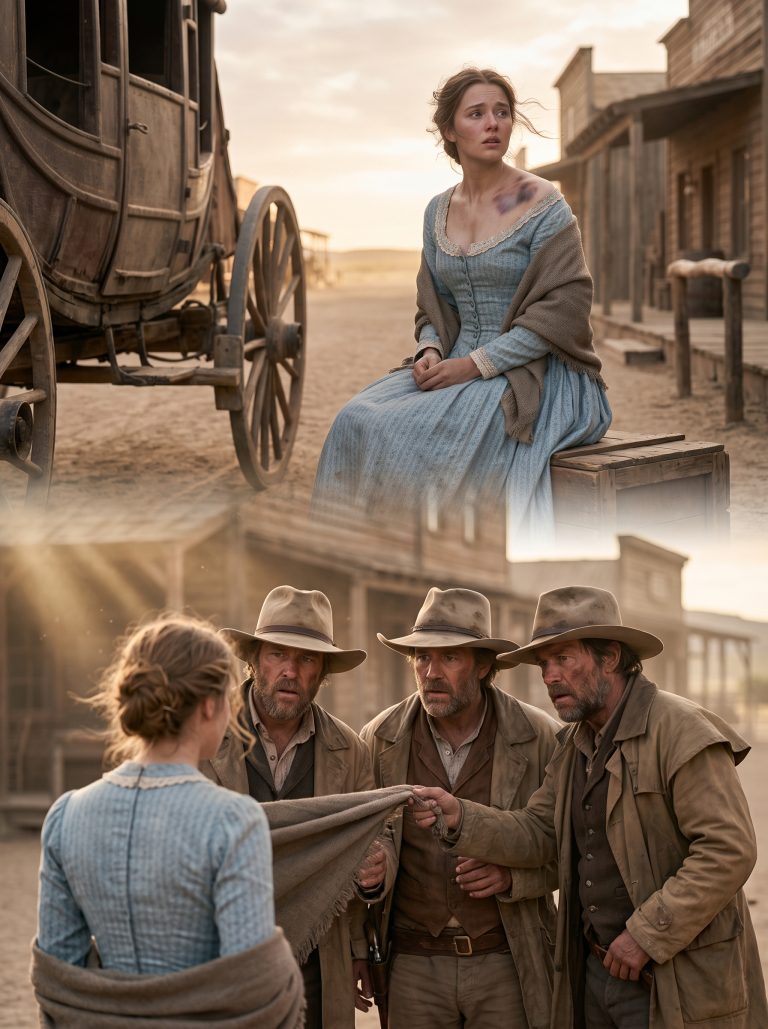
He Saved a Lost Apache Girl From Wolves — By Sunrise, Her Fearless Sister Was at His Ranch With a Secret That Changed Everything

Part 1
By the third week of November, 1881, winter had closed over the New Mexico Territory like a hand tightening around a throat.
Frost cracked the grass along the basin floor. The wind ran down off the mountains and did not stop, finding every gap in a man’s coat and every gap in his thinking, too.
Nathaniel Colston lived nine miles northeast of Tularosa, where the lower slopes of the Sacramento Mountains began to rise out of the basin — far enough from town that the church bells never reached him, far enough that nobody rode out unless they had a reason.
He had built the ranch with his own hands, plank by plank, and his late wife Abigail had filled it with opinions about hymnbooks and hearths and the particular slant of afternoon light through the west window. She had died of fever two winters back, along with the son who came too early to draw more than a week of breath. Nathaniel buried them beneath a stand of cottonwoods on the rise behind the house and had been running the ranch like a machine he no longer cared about ever since.
He had not spoken to another soul in nine days when the crying started.
It came thin and high from the east fence line, cutting through the dark. Nathaniel took his rifle down from the pegs above the door and went out into a night hard with stars.
He found the wolf first — lean, gray, circling a boulder where a child crouched wrapped in a blanket too thin for the cold. She was small, perhaps six years old, her black hair divided into two tight braids. She did not scream when she saw him. She only watched, the way wild animals watch something that may prove even more dangerous than what already threatens them.
He fired once, from where he stood. The wolf dropped. He did not go near the carcass — there was a frightened child to see to — and crouched at a careful distance, the rifle still in his hand.
“Nathaniel,” he said, pointing to his own chest.
The girl said nothing, but she stopped shaking, and when he turned his back and crouched lower, small arms came around his neck.
He carried her home, fed her cornmeal by the fire, and did not sleep.
At dawn, hoofbeats came fast from the east. A young woman rode into the yard, a short hunting bow and a worn quiver lashed behind her saddle, and eyes that read the whole scene — the girl, the man, the rifle by the door — before she said a word.
“You kept her safe,” she said, dismounting.
“She needed keeping.”
“My name is Sakari,” she said. “This is Kimi. My sister. We are Mescalero — what remains of our family group, since our parents died.”
Kimi ran to her, and Sakari held the child’s face in both hands, counting fingers and breaths, before she trusted the girl was whole.
Their parents, Sakari explained, had died two years before — not in ordinary fighting between bands, as she had once let people assume, but in a raid on their camp near the foothills, carried out by armed men who called murder enforcement and carried orders stamped with the government’s seal to prove it. Since then she had raised Kimi alone at the ragged edge of what was left of their people, moving carefully, camping light, staying clear of soldiers and of men worse than soldiers.
Kimi had wandered off the evening before while Sakari gathered wood. Sakari had searched until dark, then through the dark.
Then she straightened, and something in her spine changed.
“There is a debt,” she said. “For a life saved. I will work it. Keep your house. Tend your animals. Until it is answered.”
“I don’t want a debt paid,” Nathaniel said. “I shot a wolf.”
“I know what you did,” she said. “That does not change what I owe. And there is another matter besides the debt — a reason of my own to want ground that is watched less closely than open range.”
He didn’t understand that last part yet. He only knew the sky behind her had gone the color of an old bruise, and snow was coming before noon, and the thought of a woman and child out in it sat wrong in him.
“Stay till the weather breaks,” he said. “We’ll talk after.”
Before Sakari could answer, Kimi tugged her sleeve and pointed east, toward the fence, and said one sharp word in their own language.
Sakari’s face went cold in a way that had nothing to do with the wind.
Nathaniel didn’t know the word. But he knew fear when it walked back into a woman’s eyes.
Part 2
“What did she say?” Nathaniel asked.
Sakari’s hand tightened on her sister’s shoulder. “She says there were two wolves last night. Not one.”
He found the second set of tracks before the snow buried them — not paw prints, but shod horses. Two riders had come close to the boulder, then turned away without dismounting.
“Army?” he asked.
“No,” Sakari said. “Men who watch. Men who sell what they see to the agency for a few dollars a name.” She studied the tracks a long moment. “My mother’s people scattered from the old camp when men like these began riding near it. Those who remain sent word that I should keep Kimi apart, keep us both unplaced, until the watching stopped. That is the other reason I need ground no one is looking at.”
Nathaniel understood then that she wasn’t only weighing a debt. She was weighing where her sister would be safest, and had decided, for now, it wasn’t with her own people at all. That decision cost her something. He could see it in the set of her jaw.
The snow arrived before noon and did not let up for three days. Sakari cooked with dried corn and salt pork and herbs from her own pack, stretching what little the larder held, and the food was better than anything Nathaniel had made in two years, though he didn’t say so. He only ate every bite.
By the second morning, Kimi was following him to the barn. By the third, he was laughing — a rough, unused sound, like a door opening in a wall he’d forgotten was there.
The house changed by degrees that week and the weeks after. A cup left near the stove where he’d reach for it. Kimi’s blanket folded by the hearth each morning. A strip of red-and-white beadwork drying in the afternoon light. Some evenings, while cleaning a rabbit she’d taken with the bow behind the barn, Sakari hummed a few notes that circled back on themselves, unaware she was doing it.
One night, with Kimi asleep, Nathaniel told her about Abigail and the boy — the first time he’d said it aloud in two years. It came out rough, dragged over stone.
“I am sorry,” Sakari said. Just that, and because she meant it, nothing more was needed. Then, after a silence, she added something of her own: that she had watched her mother die of the same fever two winters after the raid took her father, and that she had been Kimi’s age when she first understood grief did not ask permission before it arrived.
In December, during a thaw, she asked him to ride with her to the ridge above the canyon. She stood facing the peaks and told him the names her father had taught her before other men renamed what already had names. Nathaniel butchered the words twice trying to repeat them. On the third try she said nothing at all, which he understood to be its own kind of tenderness.
He had lived on the land four years and knew how to survive it. She knew how to belong to it. He was starting to understand those weren’t the same skill, and that he wanted the second one.
In January, Sakari came back from the east fence with her jaw set and her eyes flat.
“Two men,” she said. “Watching from the fence line a long while before they turned their horses.” She described them — one stocky, red-cheeked, in a brown coat; the other lean, on a bay, a faded bandana at his throat. “I have seen the stocky one before. Near our old camp, two years gone. I did not forget his coat.”
Nathaniel felt something go cold in his chest. He knew the pair by reputation from Tularosa talk: Dalton Reese and his partner, Otis Kell, bounty men who collected agency scrip for reporting where Apache families camped, and who weren’t particular about how rough that reporting got.
For three days he carried the rifle everywhere and told Sakari exactly where he was watching and why, because she deserved to know the shape of the danger, not just be kept from it.
“I have been watching also,” she said. “Since before you noticed the tracks.”
Of course she had.
Part 3
On a hard-blue Tuesday in February, two riders came through the east gate. Reese rode first, easy in the saddle, hands loose on the horn like a man paying a neighborly call. Kell followed a length behind, the red bandana bright at his throat.
“Heard you’ve been keeping some Apache on your land,” Reese said. “We’ve come to clarify the situation.”
“The situation’s clear to me.”
Reese’s smile thinned. “Last chance to be sensible.”
The first arrow took Kell’s hat clean off. Nathaniel didn’t see where Sakari had come from — only that she was suddenly there, stepping out from behind the tool shed with a second arrow already nocked, placing herself where he couldn’t be flanked, bow drawn steady on Reese’s chest.
“Go,” she said. One word. The yard held its breath around it.
Reese looked for the thing that would break — Nathaniel’s rifle, Sakari’s arms, which did not shake, his own horse sidestepping under him. Kell, startled by the second arrow, jerked his revolver free and fired once before Reese could stop him. The shot went wide, but not by much — Nathaniel felt the heat of it pass close enough to nick his forearm through his coat sleeve.
Reese made his calculation and didn’t like the rest of it either.
“This isn’t finished,” he said.
“I know,” Nathaniel answered. “Ride.”
They rode. Nathaniel let out a breath he hadn’t known he was holding, and only then noticed the sting in his arm.
That night, cleaning the shallow graze — he’d barely felt it happen, in the moment — it was Sakari who sat him down at the table, boiled water, and stitched the wound closed with the same small, careful hand she used on beadwork.
“You should have told me you were hit,” she said, not looking up from the needle.
“Didn’t seem worth mentioning.”
“It is worth mentioning.” Her voice was steady, but her hands, for once, were not quite. “I have already buried people I did not get to help in time. I would rather you tell me.”
He watched her work, and understood that whatever this was between them, it had stopped being only about a debt some time ago, on both sides. Somewhere along the way, they had simply stopped speaking of debts.
Nathaniel wrote to a circuit judge named Everett Voss, laying out plainly what he knew of Reese and Kell’s methods. Sakari added her own account — the coat, the camp, the year — because she was the one with the clearest memory of what had happened, and she wasn’t willing to let a man tell her story for her.
Voss’s reply came in April. Most of it was formal, but the final paragraph changed the shape of things.
Dalton Reese was named two years past in an inquiry into a raid on a small off-reservation camp near the Sacramento foothills, in which two adults were killed under disputed circumstances. The inquiry stalled for want of witnesses. You wrote that the woman in your care lost her parents in fighting between bands. My records suggest otherwise — that the deaths she describes and the raid under inquiry are the same event, and that Reese was among the men who rode that day.
Nathaniel read it twice before he understood what it meant: the man who’d ridden into his yard threatening to collect Sakari and Kimi like unpaid debts was, in all likelihood, the same man who had orphaned them in the first place.
He told her plainly, the way she’d taught him to say the things that mattered.
Sakari sat a long time with the letter. “I always believed it was chance,” she said finally. “That the man who threatened my sister and the man who killed my mother were only alike. Cut from the same cloth, not the same hand.”
“Better or worse, knowing?”
“Both.” She folded the letter carefully, though it was only paper. Reese had been the same man all along, she said — only now she no longer had to wonder if memory had lied to her.
She sent her own statement to Voss’s office — the first testimony the stalled case had ever had from someone who’d lived through it. A federal warrant followed within the month, with copies sent to marshals across New Mexico, Arizona, and Colorado Territory.
Reese and Kell tried once more before they ran. In late April, they rode as far as the Tularosa livery, where a deputy Voss had sent ahead was waiting on a tip Sakari herself had passed along through Reverend Amos Pruitt. Kell threw up his hands the moment he saw the badge. Reese went for his gun instead, and the deputy put a bullet through his shoulder before he cleared the holster — the kind of ending that satisfied no one fully, but left both men alive to stand trial, which was more than their own methods had ever offered anyone.
It wasn’t a clean ending. Reese would face a court that hadn’t always been kind to testimony like Sakari’s, and there was no guarantee what a jury would do with it. But the fear she’d carried for two years finally had a name, a warrant, and a wound to answer for — not just a shape she had to keep watching for in the dark.
Spring came slowly that year, the way territory springs do after a hard winter. One warm afternoon, then cold again, then three warm days, the worst finally gone from the air.
One morning a mare foaled in the barn, and Kimi pressed herself so still against the stall boards that Nathaniel understood the sight had gone all the way down into her.
That evening, Sakari set her beadwork down and said, without looking up, “I think the debt is answered.”
“You’re not being useful when you patch the fence,” Nathaniel said slowly. “Or braid Kimi’s hair, or stitch a man’s arm at midnight. That’s not a debt. That’s just a life.”
“What is it, then?”
“I don’t have the right word for all of it. But this house has been a house again since you two got here.”
Sakari looked toward the window. “There are people who would say I give something away by staying on a white man’s land.”
“And?”
“I have decided I am living my own life. Not the life other people say it should be.” She reached over and took his hand first this time, before he could reach for hers. “Kimi belongs here now. So, I have found, do I.”
“Do you want to stay?” Nathaniel asked — the plainest question he knew.
“Yes,” she said. “It stopped feeling like a debt months ago.”
In May, Nathaniel rode to Tularosa and asked Reverend Pruitt to come out and do it properly, because if Sakari was staying, he didn’t want any man in that town pretending he had the right to name what she was in his house.
“You ask now?” she said, when he stood in the yard with the reverend and a folded paper.
“I asked before,” Nathaniel said. “I’m asking again. Sakari — will you marry me?”
Kimi stood between them at the small ceremony, holding both their hands, which hadn’t been part of any plan and turned out better than the plan. Sakari said her vows in English, then again in her own language, and Nathaniel understood without translation that the second version reached places the first hadn’t quite gotten to.
“Good,” Kimi announced afterward, with the pure confidence of a six-year-old who considered the matter settled.
The ranch grew — slowly, honestly, fence by fence, calf by calf. Not every door in Tularosa opened easily for them, and Nathaniel stopped expecting that it would; what mattered was what they built between the hard days, not the absence of hard days.
Kimi grew up knowing the mountains by two sets of names and the weather by the shape of the light before it changed. She could bead a diamond pattern with her head bent at the same careful angle as her sister’s, and shoot a bow nearly as well, and ride any horse Nathaniel trusted beneath her — and a few he didn’t.
Years later, standing at the east fence at dusk, she asked him if he remembered the wolf.
“I remember,” Nathaniel said.
“You didn’t grab me. You waited.”
“Seemed wrong to scare a child worse than she already was.”
Kimi was quiet a moment. “Sakari says that was when our life changed.”
Nathaniel looked toward the porch, where his wife stood with one hand raised to shade her eyes, silver threading now through her dark hair, still the same woman who had once stepped into an open yard with a bow drawn and no fear in her arms — and who, more than once since, had been the one to save him instead of the other way around.
“No,” he said. “That was when mine changed.”
The wind moved through the cottonwoods on the rise, over the ground that held Abigail and the boy, and Nathaniel had stopped needing that sound to mean only grief. It could hold more than one thing now.
Time hadn’t healed anything. It had only moved. What they’d chosen to build inside that time — and who had chosen to stay and build it with him — was what made the difference.
— END —