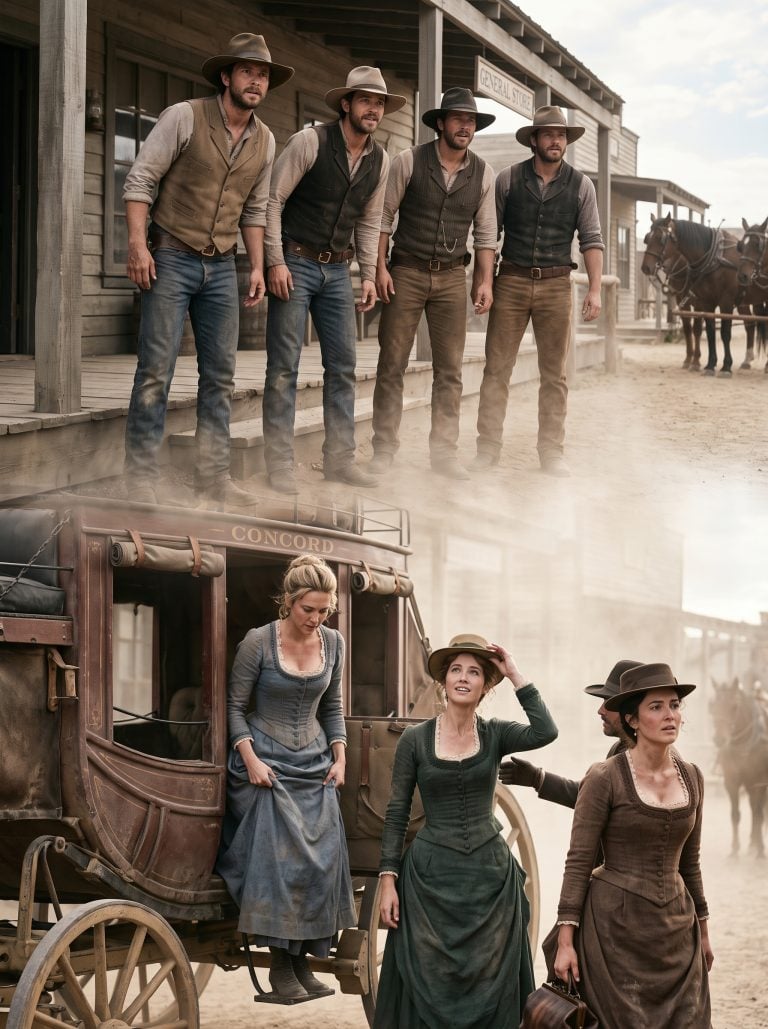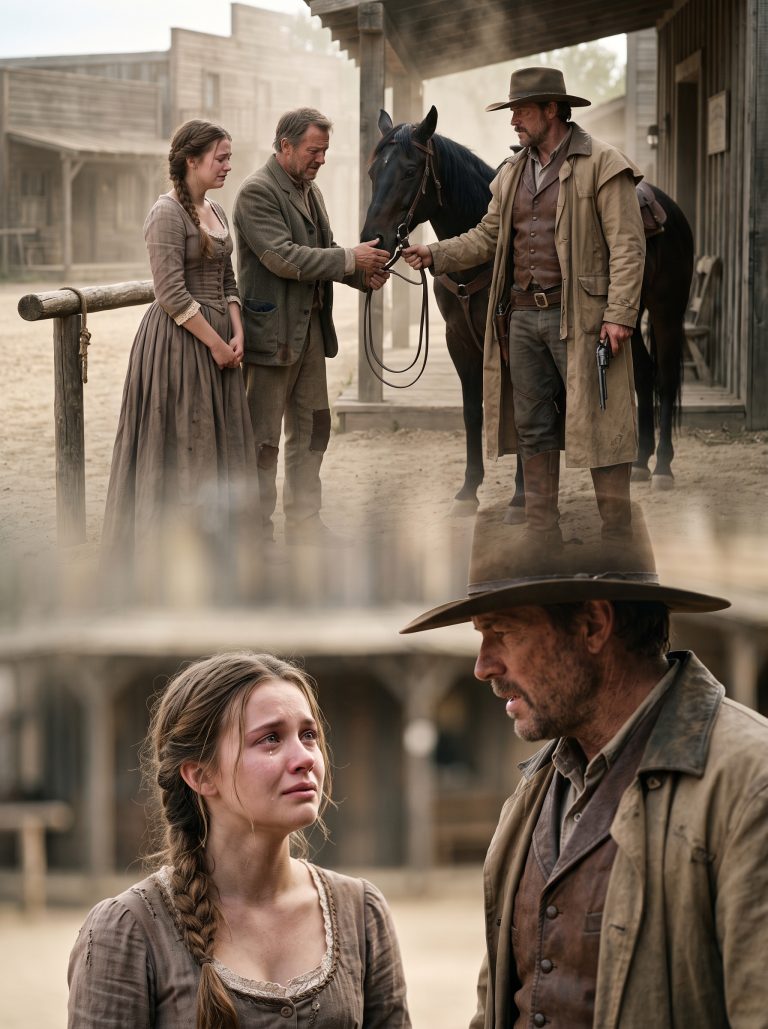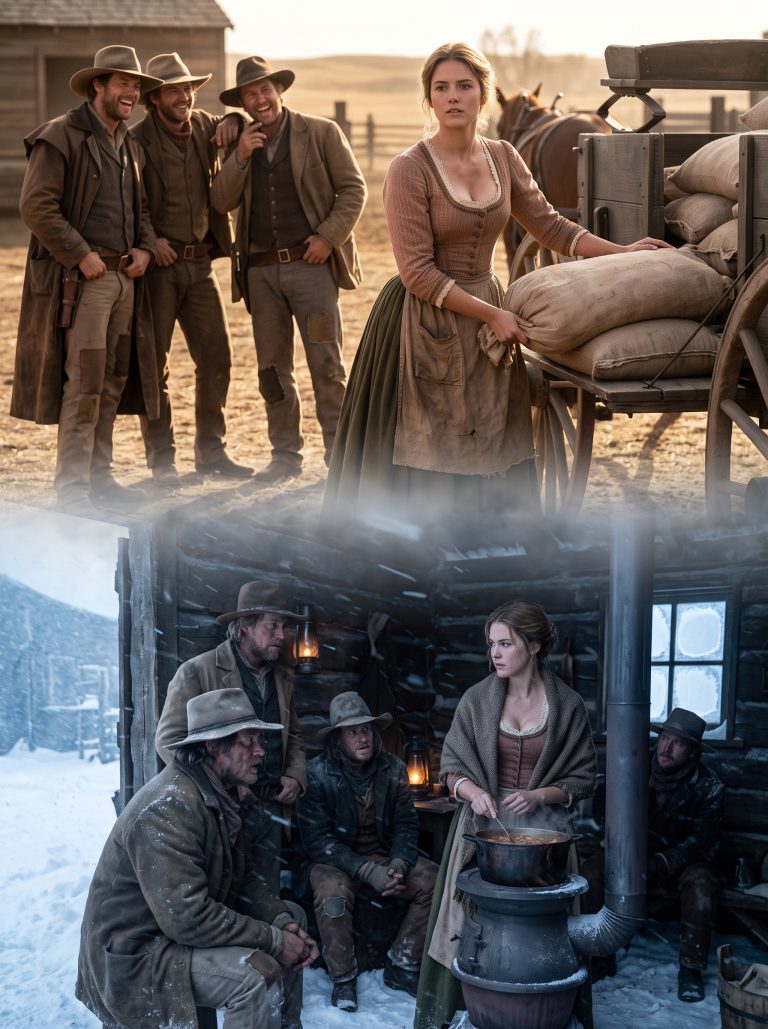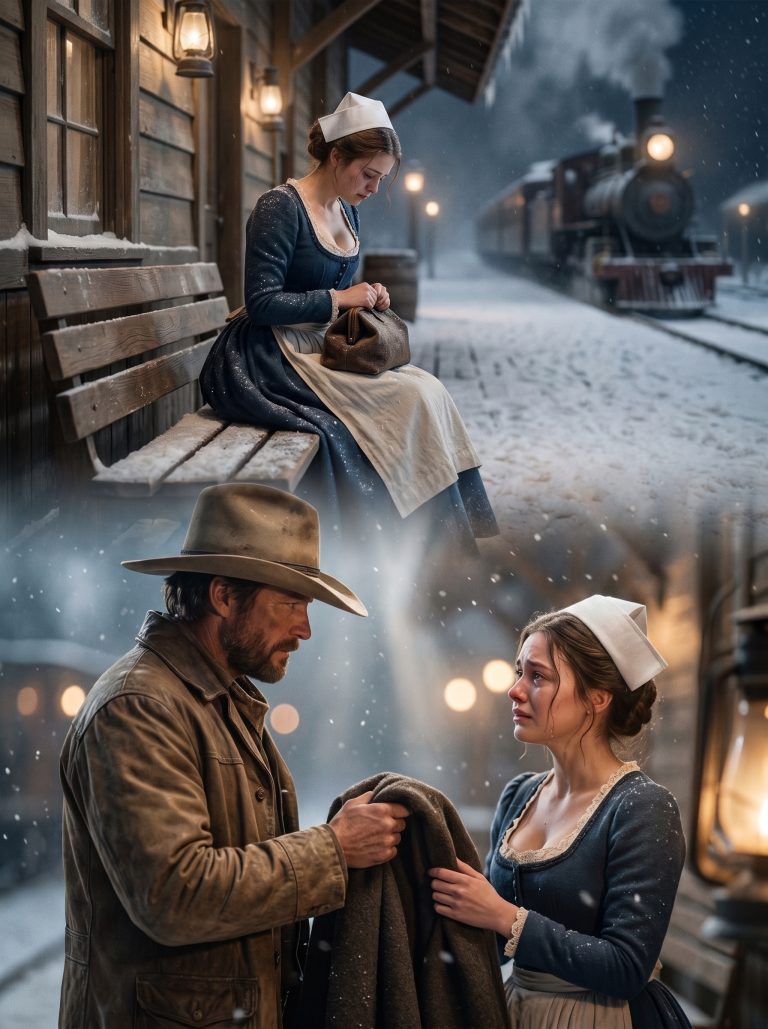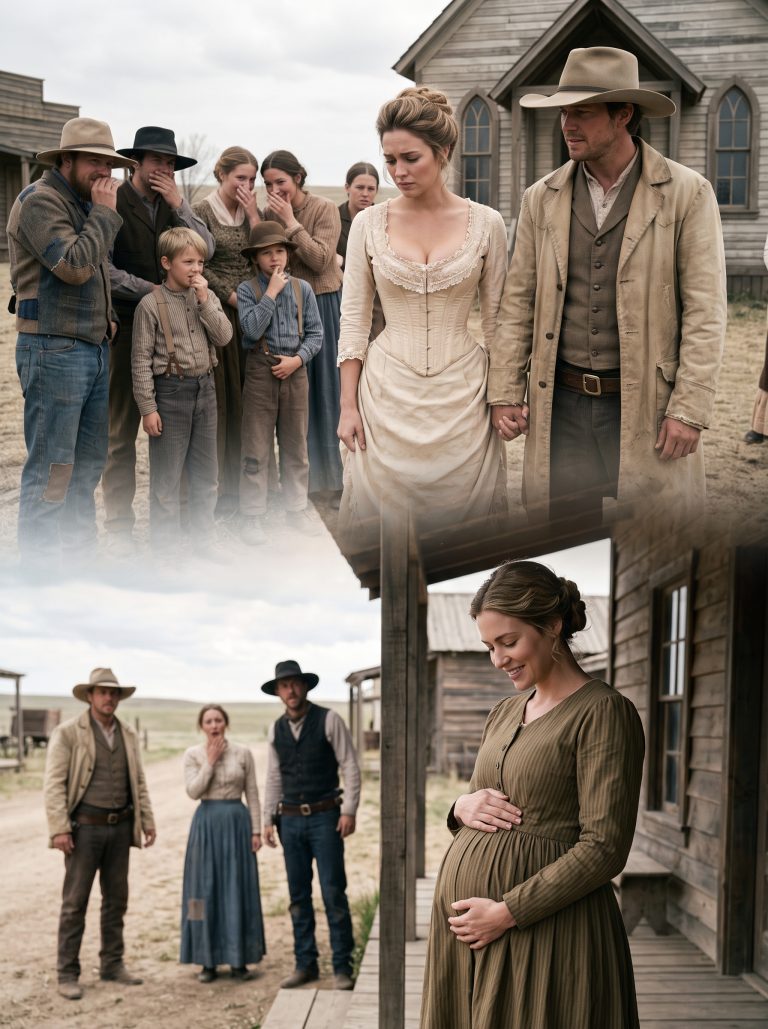
Mail Order Bride Arrived a Day Too Late — The Cowboy Said ‘You’re Right on Time for Me’

PART 1
Hannah Campbell stepped off the train with $17 in her pocket and a promise she’d crossed nearly two thousand miles to keep.
The promise was already six feet under.
“James Blackwell shot dead two days ago, ma’am.”
The station master said it plainly, the way a man reports the weather, not knowing he’d just detonated the only future Hannah had left.
She didn’t cry. Not yet. Her body simply forgot how to hold itself up, and her satchel — everything she owned in the world — slipped from her fingers and hit the platform with a sound she would remember for the rest of her life.
Three days earlier, she’d been folding the last of her clothes into that satchel in a cramped Boston boarding room, reading James’s final letter for the hundredth time. I am not a man of poetry, but I’m a man of my word. He’d promised her a ranch, a house, a life. He’d promised to be waiting at the station at 2:00 sharp.
She was one day late. A stalled train in Kansas City, an engine problem nobody could have predicted. One day — and in that one day, a stranger in a saloon had put a bullet through the only soul in the entire Colorado territory who’d been waiting for her.
Now she stood on a platform in a town called Silvage, population unknown, future unknown, with a dead man’s promise in her pocket and nowhere on earth to go.
“You got folks meeting you here?” the conductor had asked her, back on the train.
Yes, she’d told him. Yes, I do.
She’d lied without knowing it.
There was nothing waiting for her in Boston either. Her parents were five years dead of typhoid. Her brother Thomas was somewhere at the bottom of the Atlantic. The mill she’d worked in for two years had taken her hands, her health, and very nearly her dignity — a foreman with wandering fingers had made sure of that. She’d answered James Blackwell’s advertisement, tucked among a dozen others like it in the back pages of a matrimonial paper, because the alternative was staying in Boston and disappearing one exhausted day at a time.
She had gambled everything on a stranger’s letter.
And the stranger was already in the ground.
The station master — an old man with a silver mustache and a kindness he didn’t quite know how to deliver — steadied her elbow before her knees gave out completely. He brought her cornbread wrapped in cloth. He didn’t ask her to explain herself. He simply said, I’m powerful sorry, miss, and let the silence do the rest.
That’s when the door opened.
A tall man walked in — dust on his boots, several days of stubble on his jaw, eyes the color of a mountain lake in a face that looked like it had survived things it never talked about. He looked at her the way you look at someone you already know is carrying something heavy.
“You’re James’s mail order bride, aren’t you?”
It wasn’t a question that needed an answer. Hannah gave him one anyway — quiet, broken, honest.
His name was Colton Sullivan. He’d been the one who found James’s body on the saloon floor.
And what he said next — a simple, almost accidental offer of shelter for one night — was the sentence that would quietly, irreversibly rewrite the rest of Hannah Campbell’s life.
She didn’t know it yet. Neither did he.
But something had already started the moment she stepped off that train one day too late.
PART 2
She almost said no.
Standing in that station office with the name of the man she’d never gotten to meet still hanging in the air, Hannah Campbell had every reason in the world to refuse a stranger’s wagon ride into the dark. Back in Boston, she’d learned exactly what kind of man offers help to a woman alone.
But Colton Sullivan’s eyes didn’t ask for anything.
“My sister runs a boarding house here. Clean. Respectable.” He turned his hat over in his hands like he needed something to do with them. “You shouldn’t face this town alone tonight.”
What Hannah didn’t know — what nobody at that station told her — was that Colton Sullivan hadn’t spoken more than a few words to a stranger in three years. Not since the fever that took his wife and his two-year-old daughter in the same terrible week. Not since he’d nailed the door of a nursery shut and let his ranch, and the rest of his life, quietly go to seed.
James Blackwell had been the only man who kept showing up at his door during those months. Every day, for a month, making sure Colton was still eating, still breathing, still standing.
Now James was dead. And the woman James had been waiting for was sitting in front of him, shattered, with nowhere to go.
Colton didn’t tell Hannah any of that on the ride to town. He just drove, steady and quiet, past a saloon with light spilling out of its doors — the same saloon, though Hannah didn’t know it yet, where James had died two nights before.
What she also didn’t know: the offer of a bed at his sister’s boarding house wasn’t the last thing Colton Sullivan would offer her.
Within two weeks, he would stand in his own kitchen — the one that hadn’t been properly cleaned in three years — and ask her something that had nothing to do with charity.
Within two months, half the town would be whispering her name.
And within a year, a woman named Katherine Thornton would arrive from Philadelphia, buy the very ranch James Blackwell had built with his own hands, and try — deliberately, publicly — to take apart everything Hannah had started to build.
Nobody at that station platform could have guessed any of it. Least of all Hannah, who was simply grateful, in that moment, not to be sleeping outside in October cold.
She didn’t know that arriving one day too late for James Blackwell meant arriving exactly on time for something else entirely.
She was about to find out.
PART 3
Chapter One: The Wrong Kind Of Late
The wind found every gap in Hannah’s coat on the ride into Silvage, and she was grateful for it. The cold gave her something to feel besides the hollow drumbeat of James Blackwell shot dead two days ago looping behind her ribs.
Colton Sullivan didn’t fill the silence with talk. He drove his wagon with the unhurried competence of a man who’d done it ten thousand times, reins loose in his scarred hands, and let the town of Silvage introduce itself at its own pace — false-fronted buildings leaning into the wind, a general store gone dark for the night, a bank, a livery, and the Silver Star Saloon, spilling piano music and lamplight into the street.
Hannah’s stomach turned when she understood what that building was.
“That’s where—” she started.
“Yes.” Colton’s jaw tightened, just slightly, the only place his grief was allowed to show in public. “That’s where I found him.”
She didn’t ask anything else. She didn’t need to. The men standing in doorways along the street were already turning to watch the wagon pass, and she understood, with a hot flush of humiliation, exactly what story they were writing about her without ever having spoken to her. The mail order bride who arrived too late.
“Don’t mind them,” Colton said, reading her face without looking at it directly. “Small town. Not much happens. You’re a novelty. They’ll find something else to gossip about.”
She wasn’t sure whether that was meant to comfort her. It didn’t, not really. But there was something steadying in the rough gentleness of his voice — the voice of a man who had clearly learned, the hard way, exactly how loud silence could be.
Sarah Sullivan was on the porch before the wagon had fully stopped, backlit by lamp light, already talking before she saw Hannah’s face.
“Colton Sullivan, is that you finally? I was starting to—” She stopped mid-sentence. Her eyes went soft with instant, unguarded sympathy. “Oh. Oh, you poor dear.”
Nobody had to explain who Hannah was. Sarah simply opened her door, her kitchen, and her stew pot, and refused every attempt Hannah made to apologize for existing in her house uninvited.
“You’re not imposing,” Sarah told her, ladling stew into a bowl with the finality of a woman who had made up her mind. “You’re accepting help. That’s what sensible people do.”
That night, in a narrow bed under a wedding-ring quilt, Hannah lay awake long after the house had gone quiet, running the arithmetic of her situation over and over. Seventeen dollars and thirty-two cents. No ticket home. No home to buy a ticket toward. She had come nearly two thousand miles for a future that had died two days before she could reach it.
But I’m still here, she thought, somewhere in the small hours. I’m still standing.
It wasn’t hope. Not yet. But it was a foundation. And foundations, she would learn, were exactly what this land demanded before it gave you anything back.
Chapter Two: The House He Built For A Stranger
Colton came back the next morning with an offer that had nothing to do with pity, or at least that’s what he told himself.
“Wanted to see if you’d ride out to James’s place today. See what he was offering you.” He turned his hat in his hands — Hannah was beginning to recognize this as the thing he did instead of admitting he was nervous. “Might help. To know.”
She almost refused. What good could come from touring the ruins of a future that had never actually existed?
But something stubborn in her — the same stubbornness that had gotten her onto a westbound train in the first place — made her say yes.
The ranch sat three miles outside town, plain and solid, built by a man’s own hands over five years of hard, patient work. Colton walked her through the rooms in near silence, the house smelling of dust and a life interrupted mid-sentence. A room prepared for a bride who never arrived — curtains hung with care, a vase set out and waiting, empty, for flowers that were never picked.
It was the bench beneath the oak tree that broke her.
“Built it last month,” Colton said, standing beside it, not quite looking at her. “Told me he wanted a place where his wife could watch the sunset. Said every woman deserved a peaceful spot of her own.”
Hannah pressed her hand to her mouth and let herself cry, finally, for a man she had never met but had somehow, through months of careful letters and hope, come to know. Colton didn’t try to stop her tears or fill them with empty comfort. He simply stood near her, solid as the bench itself, and let her grieve without being alone in it.
“What’ll happen to it?” she asked, once the tears had passed.
“Go up for sale, probably. James’s cousin back east has no interest in ranching.” Colton looked out over the pastures where cattle still grazed, unaware their owner was gone. “Someone else will make a life here. That’s how it goes.”
Neither of them could have known, standing there, that within the year someone would — and that her name would be Katherine Thornton, and that her arrival would test everything Hannah was about to build somewhere else entirely.
On the ride back, Colton said something simple that Hannah would carry with her for a long time.
“You’ve got friends here, even if you didn’t know it yesterday.”
Chapter Three: A Business Arrangement
The offer came a week later, delivered with the awkward formality of a man unused to asking for anything.
“A housekeeper,” Colton clarified, before Hannah’s imagination could run somewhere he hadn’t intended. “Real employment. Fair wages. My father started the place — Sullivan’s Reach, I call it now — and I’ve kept the land in good order. It’s the house that’s a disaster.”
Fifteen dollars a month. Room and board. A thirty-day trial, with train fare home guaranteed if it didn’t suit her.
It was more money than Hannah had ever been offered for honest work in her life. It was also, she understood clearly, a door into an isolated ranch with a man she’d known for exactly eight days.
“Why me?” she asked. “You could hire anyone in town.”
Colton was quiet for a moment, guiding the horses around a rut in the trail.
“Because James trusted you enough to ask you to share his life,” he said finally. “That tells me something.”
The house, when she saw it properly for the first time, was worse than he’d admitted. Three years of a grieving man’s neglect had buried a good home under dust, clutter, and a kitchen that hadn’t been properly used since his wife died. Hannah stood in the wreckage of it and felt, for the first time since stepping off that train, something that wasn’t grief.
It was purpose.
“This is chaos,” she said, staring at his office, where two years of receipts and unpaid debts sat tangled together in indistinguishable piles.
“I know.”
“No — I mean this is actual chaos. How do you function?”
“Not well,” Colton admitted, with the closest thing to a smile she’d seen from him yet.
She said yes to the month. She told herself it was purely business.
She would spend the next several weeks discovering exactly how untrue that was.
Chapter Four: What The House Remembers
Hannah attacked the ranch house the way she’d once attacked mill machinery — with a discipline that left no room for the grief still sitting quietly underneath it. Kitchen first, because a home without a working kitchen isn’t a home at all. Then the parlor, excavated layer by layer like an archaeological dig, revealing good furniture and a handsome rug beneath years of neglect.
She found, in the office, three hundred dollars a neighbor had owed Colton for six months and forgotten to pay — money he hadn’t even known was missing.
“You’ve just found me money I didn’t know I had,” he said, staring at her freshly organized ledger with something close to wonder.
“That’s what a properly kept ledger does,” she told him, and felt an unfamiliar warmth bloom in her chest at his amazement. It had been a long time since anyone had looked at her work and seen anything but a body doing a job.
But it was the closed door at the end of the upstairs hallway that told Hannah everything she needed to know about the man she was working for.
“Grace’s room,” Colton said, his voice catching on the name. “My daughter. She was two.” He opened the door anyway, because he’d said he would show her the whole house, and a small, sunlit room revealed itself — a child’s bed, a rocking horse his own father had carved, dust motes turning slowly in clean windows someone had never stopped caring for, even while letting the rest of the house fall apart.
“She loved that horse,” he said. “Used to ride it for hours, singing to herself.”
“She must have been precious.”
“She was everything.”
Hannah looked away to give him privacy for a grief too large for words, and understood, in that moment, that she was standing in the presence of a man who had been quietly drowning for three years — and that something in her, without her permission, wanted very badly to help him breathe again.
Chapter Five: The Question Neither Of Them Meant To Ask
The weeks folded into each other. Hannah rose before dawn, made coffee that made Colton close his eyes in something close to reverence, and worked until her back ached and her hands cracked despite the lard Sarah insisted she rub into them each night.
Sarah, visiting one afternoon with laundry pins between her teeth, was not subtle about what she’d noticed.
“Colton’s been asking about you.”
“Has he?” Hannah kept her voice level and failed completely.
“He stops by every few days on some pretext or other. My brother has never once in his life needed to borrow sugar this badly.” Sarah’s smile was knowing. “Colton Sullivan doesn’t do anything out of duty. If he’s checking on you, it’s because he wants to.”
It wasn’t any single moment that changed things between them. It was the accumulation of small ones.
It was Hannah teaching him to make something better than bacon and beans, standing close behind him at the stove, guiding his hand over the pan while he pretended not to notice how near she was. It was Colton, without being asked, mending the hinge on her bedroom door because it had been sticking, and saying nothing about it afterward, letting her find the fix on her own. It was the two of them falling into the habit of sitting on the porch after supper — him whittling, her mending — talking about nothing important until the stars came out, because neither one wanted to be the first to say goodnight.
It was the evening she found him standing at Grace’s door, not opening it, just standing there, and she didn’t ask him to explain himself. She only stayed close until he was ready to walk away from it.
By the fourth week, Hannah had stopped counting the days until her trial month ended. She noticed this about herself with something like alarm.
It came to a head on an ordinary evening over roasted chicken and fresh bread, in the kitchen Hannah had scrubbed back to life with her own hands.
“You’ve brought this place back to life, Miss Campbell,” Colton said, setting down his fork. “Brought me back to life, in a way.”
Hannah’s breath caught.
“It’s just housework,” she said. Her voice betrayed her.
“It’s more than that, and you know it.” He leaned forward. “May I call you Hannah?”
Yes.
“I’ve come to think a great deal of you, Hannah. More than I have any right to, given how short a time—”
A sharp knock at the door cut him off.
It was Henderson, a neighboring rancher, hat in hand and clearly uncomfortable, bringing news that would change the shape of everything that came next.
The Blackwell ranch had a new owner. A young widow from Philadelphia. Money, ambition, and — according to the whispers already moving through Silvage — a very particular interest in Colton Sullivan.
Her name was Katherine Thornton — a name Hannah wouldn’t fully understand until much later, when Sarah finally told her the rest of it: a husband dead in the war before their first anniversary, a mother-in-law who’d spent two years writing letters insisting the only respectable path left for a young widow was to remarry well, and remarry fast. Katherine hadn’t come west chasing romance so much as running from a Philadelphia parlor where she was reminded, every day, of exactly how little a widow without a fortune of her own was worth. Buying the Blackwell ranch had been her one act of defiance. Wanting Colton Sullivan, Hannah would come to understand, wasn’t cruelty so much as fear dressed up as ambition — the same fear that had once put Hannah herself on a westbound train.
It didn’t excuse what came next. It only explained it.
Chapter Six: The Woman From Philadelphia
Katherine arrived at Sullivan’s Reach a week later in an elegant buggy entirely wrong for a working ranch, wearing a dress entirely wrong for a casual visit, and asking questions entirely wrong for a woman who claimed no interest beyond neighborly advice.
“You must be the housekeeper,” she said to Hannah, her smile precise and cold. “I’ve heard so much. What a terrible tragedy, arriving too late. How fortunate Mr. Sullivan was kind enough to give you employment.”
The sympathy in her voice had all the warmth of a knife.
It got sharper from there. On a second visit, cornering Hannah in the kitchen while Colton was out of earshot: “A young unmarried woman living alone with an unmarried man. People do talk.” An offer of “alternative employment” at her own ranch, delivered with the precision of a woman removing an obstacle rather than extending a kindness.
Hannah said nothing she’d regret. But that night, alone with Colton, the fear she’d been holding back finally broke the surface.
“She’s beautiful. Wealthy. Established. Everything a rancher’s wife should be. And I’m just—”
“Don’t,” Colton said, cutting her off before she could finish talking herself down. “Katherine Thornton hasn’t brought this house back to life. She hasn’t made me glad to see morning come. You have.”
He took a breath, the kind a man takes before jumping from something high.
“I’m falling in love with you, Hannah. Have been for weeks.”
“I feel exactly the same way.”
“Then marry me.”
It was too fast by every rational measure. They’d known each other barely two months. But Hannah had already tried the rational path once, with a stranger’s careful letters and a practical arrangement built on paper — and it had ended with her standing alone on a train platform, holding nothing but grief.
This — wild, immediate, terrifying in its intensity — felt, for the first time in her life, entirely real.
“Yes,” she said. “Yes, I’ll marry you.”
Chapter Seven: What Gossip Cannot Touch
Katherine Thornton did not take the engagement quietly.
She arrived at the ranch days later with her mother-in-law’s poison dressed up as concern, calling the marriage “opportunistic” to Hannah’s face, questioning Colton’s judgment to his.
“She’s a mill worker from Boston who came west looking for any man desperate enough to take her.”
Colton’s voice, when he answered, went cold as winter wind.
“That’s enough. You don’t know anything about Hannah — about what she’s survived, or what she’s capable of. She’s made me remember what it feels like to hope. I’ll be damned if I let anyone, including you, speak about her with such disrespect.”
Katherine left in fury — though beneath the fury, if Hannah had looked closer, she might have recognized something more familiar than she expected: a woman who had also gambled everything on a stranger’s promise of security, and lost.
The wedding, two weeks later, was small and unapologetic. Sarah sewed a dove-gray dress with her own hands and refused every protest about the cost. Half the town came, curious more than kind, but Hannah walked the aisle alone and unashamed, because this marriage wasn’t about being handed from one man to another — it was about two people who had found each other at the exact moment they both needed to be found.
“I love you,” Colton whispered against her hair on their wedding night, in the house she had scrubbed back into something worth calling home.
“I love you too,” she said. “Like home.”
Chapter Eight: The Room They Opened Together
Winter came hard and early, burying Sullivan’s Reach under a blizzard that sealed them into their own small world for three days — days Hannah would later remember as some of the most honest of her life. Snowed in together, they talked long into the night about parents lost to typhoid, a brother lost at sea, a wife and daughter lost to fever. Grief laid next to grief, neither one trying to outweigh the other.
It was Hannah who finally raised the question that had been sitting, unspoken, at the top of the stairs for months.
“I think it might be time to let some light back into Grace’s room. Not to forget. Never to forget. Just — to stop keeping it like a sealed tomb.”
Colton’s hands stilled.
“I don’t know if I can.”
“You don’t have to do it today,” she said gently. “But when you’re ready — we could sort through her things together. Keep what’s precious. Let the rest serve a new purpose.”
It took a week. But on a quiet afternoon, Colton’s hand found the doorknob, and Hannah’s hand covered his, and together they opened a door that had been closed for three years — not to erase what was inside, but to let it breathe again.
They kept the rocking horse. They kept the quilt.
They let the room become, simply, a room again — waiting, without grief attached to the waiting, for whatever came next.
Chapter Nine: What Came Next
What came next was Katherine Thornton’s quiet, humiliating departure back to Philadelphia. Ranch life, it turned out, had never been the reality she’d imagined, only the story she’d told herself — and rather than keep fighting land she didn’t understand and couldn’t manage, she put the Blackwell place back up for sale within the year, letting it go for far less than she’d paid, eager only to be rid of it.
What came next was Hannah and Colton buying that same neglected ranch, now run down worse than when James had left it, for a fraction of its worth — building something larger from the wreckage Katherine had left behind. It felt, to both of them, less like a business decision than a kind of restitution: honoring James Blackwell rather than replacing him, giving his land back the life he’d meant it to have.
What came next was a March morning when Hannah woke feeling strange, and a doctor’s confirmation a week later that made Colton weep openly at his own kitchen table.
What came next was Clara Grace Sullivan, born on an October evening as the sun set gold over the prairie — a name that held both the past and the future in the same two words, and made Colton cry harder than Hannah had ever seen him cry, for entirely different reasons than grief.
What came next was years — a son named Thomas James, a school built for a growing community of ranches, a quiet reputation Hannah and Colton earned without ever seeking it: the couple who helped other mail order brides whose arrangements had fallen through, the way strangers had once helped Hannah when she had nothing.
“You’re building something bigger than a ranch,” Sarah told her once, watching another young woman settle into a new life nearby. “You’re building a community.”
“I’m just doing what people did for me,” Hannah answered.
Final Image
Five years after Clara’s first cry split open the evening light, Hannah sat beside Colton on the bench beneath the oak tree — the one James Blackwell had built with his own hands, for a bride he never met, so that some woman, someday, would have a peaceful place to watch the sun go down.
Clara chased fireflies through the dusk. Thomas toddled after her on unsteady legs. Sarah’s laughter drifted out from the house behind them.
“Do you ever think about it?” Hannah asked, leaning into her husband’s shoulder. “How different everything would be if I’d arrived on time?”
“Sometimes.” Colton’s arm tightened around her. “But then I remember what you said on our wedding day. That you arrived exactly when you were meant to.”
The sun sank lower, painting the land they had built together in shades of amber and gold — the same colors, Hannah realized, that had lit the platform the night she thought her life was over.
She had come west one day too late for one man’s promise. She had built, instead, an entire life she’d never dared to plan for.
And as the first stars broke open over the Colorado sky, and her children’s laughter rose to meet them, Hannah Sullivan felt no need to name what she was feeling. She simply leaned into her husband’s shoulder, and let the evening hold her.
THE END