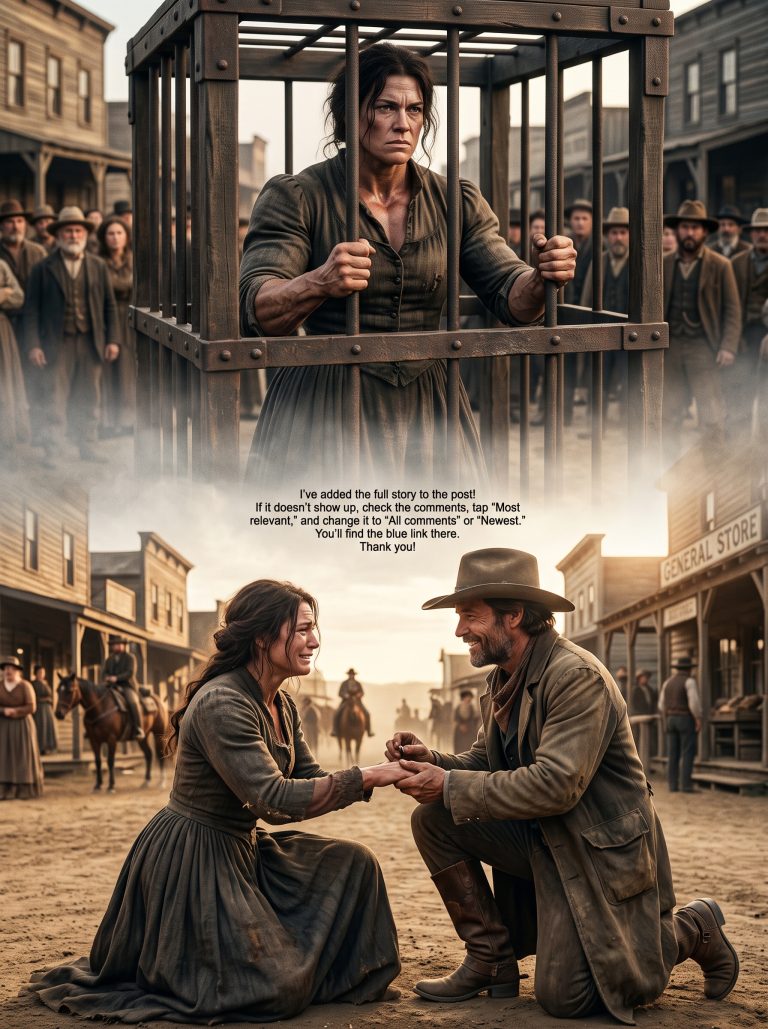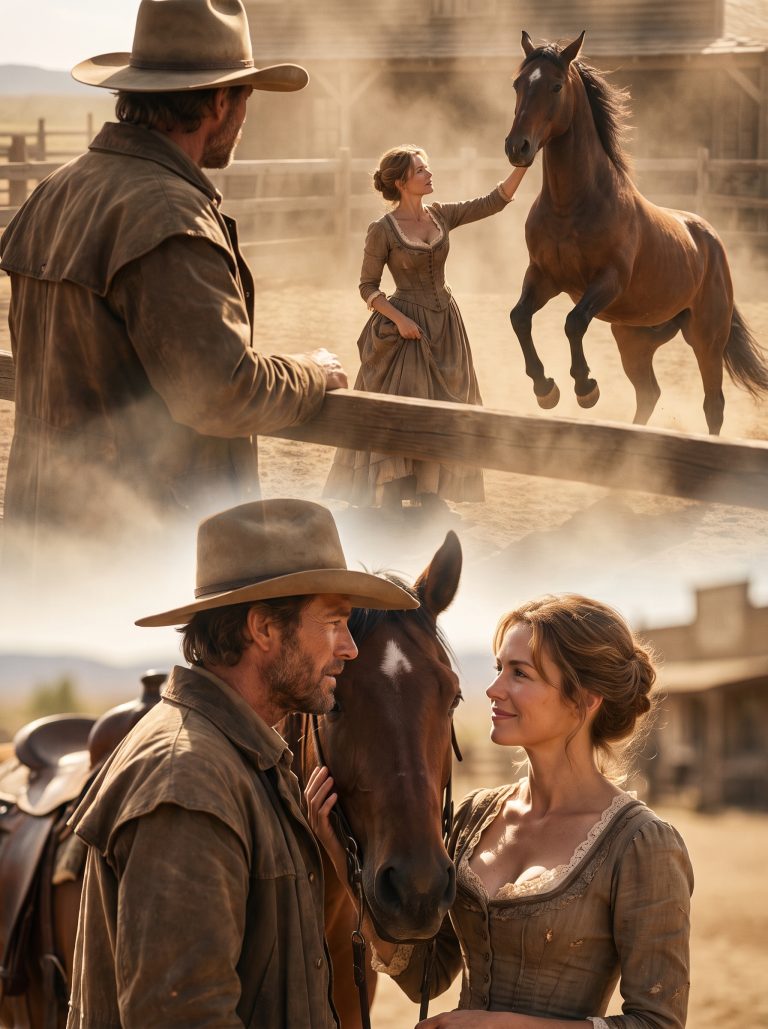
Her own brother got rid of her like she meant nothing, sending her to marry a complete stranger three hundred miles away. She braced herself for another man who would reject her… but what happened instead changed everything.

PART 1
The suitcase was tied shut with rope because the latch had broken years ago, and nobody in that house had ever thought Abigail Whitmore worth the price of a new one.
She stood on the porch holding it now, knuckles white around the handle, while her brother laughed at her like she was the punchline to a joke the whole family had been telling behind her back for twenty-seven years.
“Say it again,” she said. “Say it to my face, Silas.”
He didn’t even straighten off the post. Just grinned, thumbs hooked in his belt, wearing their father’s old stance like a borrowed coat.
“Already said it. Ain’t my fault the truth stings.”
His wife Kora stood in the doorway, arms crossed, sighing the way a person sighs at a chore they’ve put off too long.
“It’s for the best, Abby. A woman your age, with no husband and no prospects. It ain’t natural.”
“I do plenty,” Abigail said, voice cracking despite everything she did to hold it. “I tend the garden. I salt the meat. I raised Jonah’s boy half his life.”
“That ain’t the same as having a husband,” Silas said plainly. “Look at you, Abby.”
As if her face were a debt the family had been carrying, and someone had finally decided to collect. She’d heard some version of those words since she was twelve, since a barn dance where a boy named Llewellyn Briggs called her a heifer dressed for slaughter and every boy in earshot laughed along because it was easier than defending her.
Jonah came around the side of the house with a folded letter.
“A rancher,” he said. “Montana Territory. Man named Thornton. No wife. Desperate enough he don’t much care what he’s getting.”
The words landed on her like stones. Desperate enough he don’t much care what he’s getting.
“You already wrote to him.”
“Three weeks ago. Preacher Coleman knows him through his cousin. He agreed to receive you. Sight unseen.”
Something in her chest, held together by nothing but stubbornness for a very long time, finally gave way.
“You’re sending me to a stranger so you don’t have to look at me anymore.”
“Nobody’s selling you,” Kora snapped. “Don’t be dramatic.”
“Then what do you call it?”
Nobody answered. That was answer enough.
“Stage leaves at dawn,” Silas said, already turning away, already finished with her. “And if you refuse — you can walk off this property tonight and see how far twenty-seven years of being nobody’s favorite gets you alone. Your choice, Abby. Always has been.”
It wasn’t a choice. It never had been.
That night she packed her mother’s old suitcase — two dresses, a shawl, a small wooden box of hairpins, the only inheritance anyone had thought to leave her — and let herself cry the quiet, controlled way a woman cries when she’s learned that loud grief only invites more laughter.
“You’re not nothing,” she whispered to the dark, not quite believing it, needing to say it anyway.
Only Jonah’s six-year-old boy came out to see her off, arms around her waist, asking if she was coming back.
“Not for a while, sweet pea,” she told him, and did not let herself look back at the house as the stage pulled away.
The stage carried her to the rail junction by midday, and from there she spent six long, jolting days changing trains westward, until the country outside the window turned to nothing but sky and rock and distance.
The train finally let her off at a small depot in a town called Amber Creek. She stood on the platform with her suitcase and her mother’s box, entirely, completely alone.
Until a voice behind her said her name.
She turned — bracing herself, the way she’d braced herself for six straight days, for the look she knew was coming. The squint. The measuring glance that traveled her face and settled into disappointment before a single word left his mouth. She had rehearsed how to stand under that look without flinching. She had told herself she would survive it, because she had survived worse.
The man standing a few paces off did not look like the man her brothers had described.
Tall. Broad through the shoulders. A weathered face, eyes the gray-blue of storm light over snow. A scar near the corner of his mouth that made his expression hard to read.
But there was nothing careless in the way he looked at her.
Nothing cruel.
Nothing amused.
He looked at her like a person who had simply arrived after a long journey — and that alone was enough to make her throat close.
“Miss Whitmore?”
“I’m Abigail Whitmore.”
He took off his hat.
“Caleb Thornton.”
His gaze dropped — not to her face, not to her figure, the way every man’s gaze always did first. It dropped to the suitcase tied with rope.
“May I take that?”
Her fingers tightened on the handle before her mind could stop them. She hated it instantly — hated that the reflex was still there, after everything, after finally arriving somewhere new.
Caleb didn’t reach for it again.
He simply waited. Hat in one hand. Not offended. Not impatient.
Waiting.
The choice, she realized with a small shock, was hers.
And for the first time in fifteen years, someone was leaving it there.
What happens when a woman who has never once been asked what she wants finally meets a man who won’t stop asking?
PART 2
She let go of the suitcase.
Caleb lifted it like it deserved care simply because it belonged to her, glanced at the frayed rope, then at the small wooden box tucked under her arm.
“I can carry that too.”
“No.” Too quick. She heard it herself.
He didn’t press. “All right.”
They hadn’t gone ten steps before he stopped and turned to her, like a man setting down a weight he didn’t want to carry any further than he had to.
“Your brothers wrote that you’d agreed to consider marriage,” he said. “I won’t hold you to words they wrote on your behalf. You can stay on as my guest, paid for your work same as any hand, until you decide for yourself what you want. No one’s owed anything here but honesty.”
He said it stiffly, like a man reciting something he’d rehearsed the whole ride to the depot and still hadn’t smoothed the edges off of, and when she didn’t answer right away, he seemed to take her silence for offense and looked away first, jaw working, unsure what to do with his own hands.
She didn’t know what to do with a sentence like that either. She only nodded, because her voice wasn’t steady enough to answer it properly, and it took him a moment too long to notice the nod was answer enough.
At a café across the street, he pushed the fuller bowl of stew toward her instead of taking it for himself.
“This one’s got more beef.”
“I don’t need—”
“You traveled farther.”
Small corrections. The world rearranging itself in ways she didn’t have language for yet.
On the wagon ride up into the mountains, he told her the town’s small truths — who cheated, who didn’t, when the church bell rang — the way another man might read scripture.
“Why me?”
“Because you’re new.” As if that explained everything.
Then, quieter: “Your brothers said you were willing to work.”
“My brothers said many things.”
“I expect some were true and some weren’t.”
She told him what she could do — cook, sew, tend a garden, nurse a fever. He said it was a strong list.
Then, before she could stop herself: “Did they tell you I was ugly?”
The horses plodded on. He didn’t laugh — the thing she’d braced for, the thing she almost wished for because at least it was familiar.
“No,” he said. “Not in that word.”
“In enough words.”
“Yes.” Then, firmer: “Don’t mistake their words for my eyes. I’d rather judge a person myself than take another man’s word for her.”
She had no answer for that.
The ranch appeared at sunset — log and stone, cattle in fading light, a creek cutting silver through the pasture. A shaggy cattle dog came bounding off the porch, barking once, then leaned his whole head against her skirt as if he’d made a decision she hadn’t asked him to make.
“That’s Gideon,” Caleb said. “Thinks he owns the place.”
Inside, the house was clean but lonely in a way that struck her at once — no curtains, no jar of wildflowers, no marks of a woman’s hand, and none of a man’s neglect either.
He set her suitcase down in a small room off the back hall.
“This is yours.”
Yours. Not ours. Not the spare room.
That night, dust still on her boots, she found something behind the coffee tins while putting away the kitchen shelves — a folded bank letter, tucked twice beneath a ledger like something meant to be forgotten.
She didn’t read it.
She carried it out to the barn, where Caleb stood in lamplight with a rag and a bridle, and held it out to him.
“You may wish to put this somewhere safer.”
His face went very still.
What she didn’t yet know was that the letter in her hand wasn’t the only thing someone in Amber Creek had been quietly trying to bury.
PART 3
Caleb looked at the paper in her hand the way a man looks at a wound he thought he’d hidden well enough.
“I did not read it,” Abigail said quickly.
“I know.”
“You do not have to tell me.”
“I know that too.” He took the letter but didn’t put it away. Just leaned against the stall door and dragged a hand across the back of his neck, and for a moment the careful, steady man from the train platform looked like something much younger — a boy caught holding a debt too big for his hands.
“Bank wants payment by end of season.”
“How much?”
He hesitated.
“Too much.”
“That is not a number.”
The corner of his mouth twitched. He told her.
It was bad. Not impossible, perhaps, but close enough to cast a long shadow over everything she’d seen so far — the cattle, the creek, the mended fences. A hard winter had killed calves. A broken axle had cost him a sale. And a neighboring rancher had offered to buy a strip of land with water access on it, and Caleb had said no.
“They’ll come again,” he said. “Offer less next time, likely.”
“Who?”
“Brandt Hollis.”
She’d heard the name already — Mrs. Pike at the café had described him once, in passing, as a man who smiled like a closed knife.
“He wants your water,” Abigail said.
Caleb’s eyes cut to her, sharp. “How’d you land on that so fast?”
“If he wanted land, he’d buy elsewhere. If he keeps coming back for that particular strip, the strip is the thing he wants.”
Something shifted behind his eyes. Recognition, not surprise.
“You notice plenty.”
“I was unwanted, Mr. Thornton. Unwanted people learn to notice what wanted people overlook.”
He flinched at that. Not from insult. From how plainly she’d said something that should have cost her more.
“Caleb,” he said.
“What?”
“My name’s Caleb.”
“Caleb,” she repeated, and the name felt dangerous in her mouth.
He folded the bank letter with care, the way a man folds something he intends to fight for.
“I’ll find a way.”
She looked around the barn — the hay stacked too low for comfort, the tack mended instead of replaced, the tired line of his shoulders under his coat.
“Perhaps we should find one,” she said.
“We?”
Heat crawled into her face. “I live here for now. I eat your food. Seems prudent not to let the roof vanish over us both.”
“For now?”
“I meant only—”
“I know what you meant.” But he didn’t look away.
That evening he brought the account ledgers to the kitchen table and set them down between them — not as a test, but with a trust so quiet it frightened her more than any cruelty ever had.
“If you can see something I don’t,” he said, “I’d be obliged.”
She opened the ledger. And began.
By midnight she had covered six pages in figures, the lamp burning low and gold between them. Caleb watched her work with something close to wonder — at the woman her brothers had shipped west like freight, sitting at his table with a force in her that had clearly spent years with nowhere safe to stand, and now that someone had finally given it a lamp and a ledger and permission, it had simply gone to work.
“These entries are wrong,” she said.
“Which?”
“Feed costs climb in March. The herd count doesn’t. Then again in May. Then July.”
“That’d be Voss, at the mercantile.”
“Or someone placing orders through Voss.”
“And here — you paid for repairs to the south fence three times.”
“Kept going down.”
“Or someone kept billing you for work that was never done.”
“Hollis wants the water strip,” Abigail said finally. “Your note tightens with every inflated bill. If you can’t pay, you sell. If you sell, he gets the creek. If he gets the creek, the land below the ridge weakens on its own. Within two years he won’t need to buy your ranch at all.”
Caleb stared at the ledger. “That’s a serious accusation to hang on a man’s name.”
“It’s a serious set of numbers.”
“Numbers can be coincidence.”
“Three coincidences, all bending toward the same man’s water rights, in the same season he’s twice offered to buy them?” She turned the ledger to face him fully. “I’d need more than figures before I accused anyone outright, Caleb. I’m not asking you to accuse him. I’m asking you to look.”
He looked. It took him longer than it had taken her, tracing the same columns with his finger, checking her arithmetic against his own memory of the year. When he finally sat back, something in his face had settled.
“You think he’s been pushing me under.”
“I think someone has.”
“What do we do?”
“We prove the false charges. We delay the bank. We refuse to sell the water. And we find money before winter.”
“That all?”
She smiled — small, but real. He went very still at the sight of it.
The weeks that followed sharpened them both, and they were not as easy as she’d hoped.
The first man she questioned — a young clerk at the mercantile — went pale and denied everything, insisting the orders had always been written that way, that he remembered no changes at all. Abigail walked back to the wagon that afternoon feeling the old shame rise in her throat, certain she’d made a fool of herself in front of half the street.
“He’s lying,” Caleb said, watching the boy through the window.
“I know that. Knowing it and proving it aren’t kin.”
It took her three more visits, and a quiet word from Mrs. Pike about the boy’s mother’s medical bills at the very bank in question, before he finally admitted what he’d seen — that the orders had been changed after Caleb’s signature was already dry on the page.
“Who?” she asked, and her voice, to her own irritation, came out thinner than she wanted it to.
The boy’s eyes slid to the window, where one of Hollis’s riders was tying up a horse across the street.
“I don’t want trouble.”
“Trouble’s already crossed your doorstep,” she managed, steadier the second time. “The only question left is whether it owns you.”
He gave them a name: Ephraim Cole, the bank clerk.
That should have been the end of it. It wasn’t.
Two days later, the freight driver who’d first mentioned Hollis’s wire deliveries suddenly recalled nothing of the sort, and the ledger page Abigail had copied the delivery dates from went missing from Caleb’s desk — not lost, she was certain, but taken, sometime between supper and the following dawn, by someone who knew exactly where to look.
She stood in the study with the empty drawer in her hands and felt the whole case go thin as paper.
“Maybe I was wrong,” she said. “Maybe I built a scheme out of coincidence because I wanted somewhere to put my anger.”
It was the first time Caleb had heard her doubt herself, and for one unsteady moment, watching her hands, he doubted too.
“Abigail—”
“Don’t,” she said. “Don’t be kind about it if you’re not certain.”
He didn’t answer right away. He crossed the room instead, took the ledger from where she’d left it, and set it back open in front of her.
“Read the numbers again.”
“They haven’t changed, Caleb.”
“That’s my point. Read them again and tell me they’re not still true, missing page or no missing page.”
She read them again. They were still true.
He was certain, too, once he’d thought it through — the numbers didn’t lie even if the paper carrying them could be stolen. “The bank still holds the originals,” he said slowly. “Cole altered copies. If we go through Vale, official request, the sheriff can demand the bank’s own ledger before anyone thinks to touch it.”
It meant a second source. Independent of anything sitting in that house. Abigail exhaled, and some of the color came back into her voice.
“Then that’s where we start again.”
She saw Hollis himself only once before the bank, outside the mercantile, silver-templed and unhurried, watching her cross the street with the particular patience of a man who has never once had to raise his voice to get what he wants.
“Miss Whitmore.” He tipped his hat, all courtesy and no warmth. “I hear you’ve taken an interest in Thornton’s books.”
“I have.”
“Women who count other men’s money,” he said, “usually end up counting their own regrets.” He smiled the way Mrs. Pike had described — like a closed knife — and walked on before she could answer, unhurried, certain she wouldn’t follow.
A rider came by the ranch not long after — one of Hollis’s men, polite as a drawn knife, delivering nothing but an offer to buy the water strip “before things got difficult for anyone.” He didn’t look at Caleb when he said it. He looked at Abigail, letting the threat land exactly where he meant it to.
Her hands were not steady that night. She sat by the window long after the house had gone dark, listening to the wind, and it was Caleb’s voice from the doorway — not touching her, just there — that finally let her sleep.
“I’m not asking you to be brave every hour of every day,” he said. “Just the hours that matter. I’ll stand the rest of them with you.”
The confrontation came ten days later, in the bank office — Caleb, Abigail, Sheriff Vale, Mrs. Pike, the mercantile clerk, and the bank’s own original ledgers, subpoenaed by Vale himself, spread across the desk while Ephraim Cole sweated through his collar and Brandt Hollis smiled like the room existed purely for his entertainment.
“Thornton,” Hollis said. “You brought a sewing woman to a banking matter?”
Caleb’s fists tightened. Abigail stepped forward before he could speak, and this time her hands did not shake.
“No. He brought the person who can count.”
She laid the bank’s own originals beside the ranch’s copies and let the discrepancies speak for themselves — dates that didn’t match, a payment Caleb made in June that Cole had held back until July, just long enough to trigger a penalty, and finally the note in Cole’s own hand, recovered from the bank’s files rather than Caleb’s desk this time, reading: pressure him before the fall sale.
“This was no misunderstanding, Mr. Hollis,” Abigail said. “These records were altered deliberately, and now there are two ledgers instead of one to prove it.”
“I never touched a page of it,” Cole said, too fast, his eyes darting to Hollis for something that didn’t come. “The dates could be a clerical error. Anyone could—”
Vale set the bank’s own original beside Cole’s copy, the same entry, two different figures, in the same hand.
“Explain that,” Vale said, “and I’ll believe you.”
Cole opened his mouth. Nothing came out. He sat down without being told to.
Sheriff Vale confiscated both sets of books and detained Cole for questioning once the clerk, cornered by his own bank’s paperwork, admitted to altering the records. Hollis was harder — men like him always were — but Vale warned him plainly not to leave the county while the territorial prosecutor reviewed the evidence.
On his way out, Hollis leaned close enough that Caleb moved.
“Women who meddle in men’s affairs often regret it,” he murmured.
“I have regretted silence more,” Abigail said.
Caleb stepped beside her. Not in front of her. Beside her.
“Keep walking,” he said.
Hollis did.
The story spread through Amber Creek faster than a prairie fire. By week’s end, everyone knew that Abigail Whitmore had uncovered a scheme that nearly stole the Thornton ranch out from under its owner. Men who’d never met her tipped their hats. Women stopped her outside the mercantile to ask if she might help with their own household accounts.
Removing the false penalties cut nearly a third from what Caleb owed. The bank granted him until the following cattle sale to make up the rest, and Abigail spent the winter reorganizing his feed contracts and sitting in on his negotiations with buyers from the rail depot — work that put real money against a real number, not a debt simply wished away.
The ranch would survive. But survival didn’t bring Abigail the peace she’d expected. Instead, it brought a letter.
It arrived in late autumn, in handwriting she recognized before Caleb ever set it on the table. Silas had heard she was doing well. Jonah’s boy missed her. Kora had taken ill and the household had grown hard to manage. If Abigail wished to return, Silas supposed they might discuss terms. He added, almost as an afterthought, that perhaps things had been said in haste before she left.
No apology. No love. No shame. Just a door cracked open because her usefulness had, at last, been remembered.
“What do you want to do?” Caleb asked.
The old Abigail would have asked what he wanted. This Abigail looked out the window instead — Gideon asleep in a patch of sun, cattle moving like dark stitches across gold grass — and took paper from the drawer.
Silas — I will not be returning. You called me a joke nobody wanted to keep. That was the last useful thing you ever said to me, because it sent me somewhere I learned you were wrong. Tell Jonah’s boy I love him. Tell Kora I hope she recovers. As for terms, I have none to discuss. — Abigail
Her hand did not shake.
The first snow came a week later. Abigail stood on the porch wrapped in a shawl, watching flakes fall in the blue hour before dawn. Caleb came out behind her with two cups of coffee. Their fingers brushed. Neither of them moved away quickly.
“Abigail.” He set his cup down on the rail. “I got something to ask. You can say no. You can say no and stay here anyway, if that’s what you want — the ranch don’t need a wife to keep you safe in it.”
He drew a small ring from his coat pocket — narrow gold, a small blue stone worn smooth with age.
“My mother’s,” he said. “I reckon she’d have liked you. I don’t want a wife because I need the house kept. I want you because this house started breathing the day you walked into it. Because every day I look at you and wonder how any fool back east ever mistook you for something unwanted.”
“I am not beautiful,” she whispered — the old wound speaking before she could stop it.
His face changed. Not with pity. With grief that she still believed it.
“Abigail, I have seen sunrise on fresh snow. Lupines blooming after rain. Horses running loose under a storm sky. I know beauty when God sets it down in front of me.”
“May I?” he asked, holding the ring, waiting until she nodded before he reached for her hand.
It fit like it had been waiting there all along.
“Yes,” she said. “Yes, I’ll marry you.”
By the following spring, Cole had testified against Hollis in exchange for a lighter sentence of his own. Hollis lost his interest in the county bank entirely, was ordered to repay the fraudulent penalties he’d engineered, and left Amber Creek ahead of his trial rather than face the people he’d nearly ruined.
The wedding took place that same spring. Amber Creek came in force. Sheriff Vale stood by the church door turning his hat in both hands. The mercantile clerk brought a set of new ledgers as a wedding gift. Gideon escaped the porch twice and had to be dragged bodily away from the cake.
She wore a cream dress she’d sewn herself, her mother’s pins in her hair. When she reached Caleb at the front of the little church, he looked at her the way he had that first day on the platform.
Late that evening, away from the music, she stood alone at the pasture fence. Caleb’s coat settled over her shoulders before she heard him come up behind her.
“I thought I was being sent away because no one wanted me,” she said.
“You were being sent where you were needed.”
“And wanted?”
“More than I know how to say.”
Years later, people in Amber Creek would still tell the story — the ledger, the bank, the letter she never answered the way anyone expected. But Abigail always knew the real beginning was smaller than any of that.
It was a stranger on a train platform, looking at a suitcase tied with rope, and asking, “May I take that?” — and then simply waiting for her answer.
And from that one small mercy, an entire life opened.
THE END