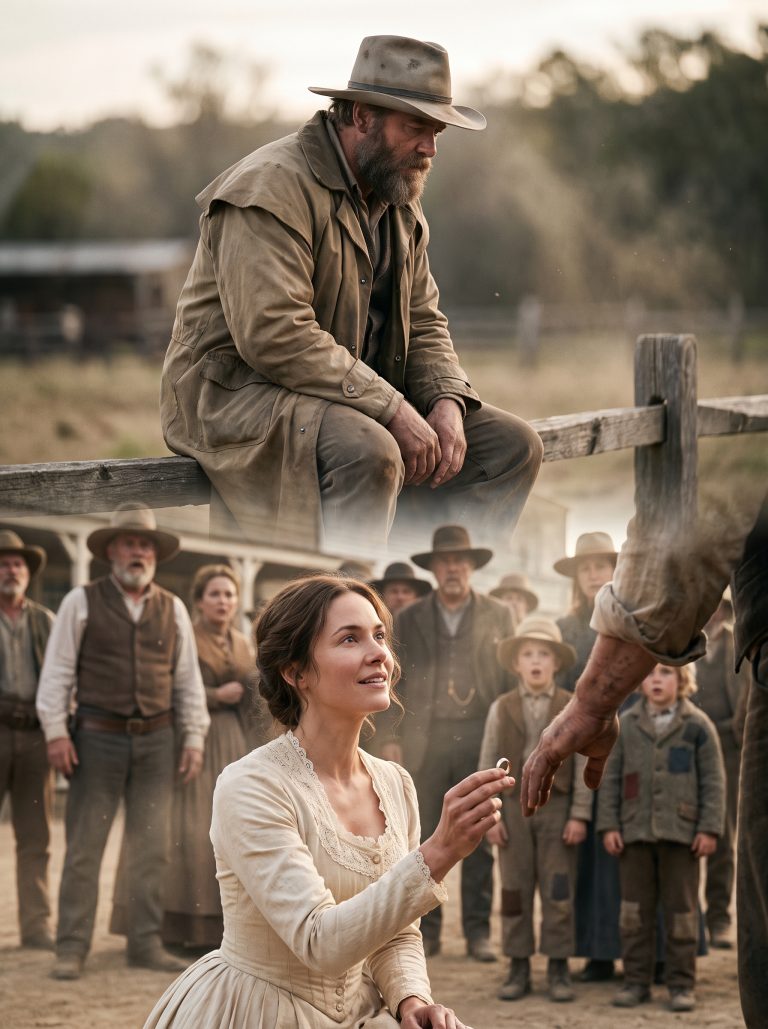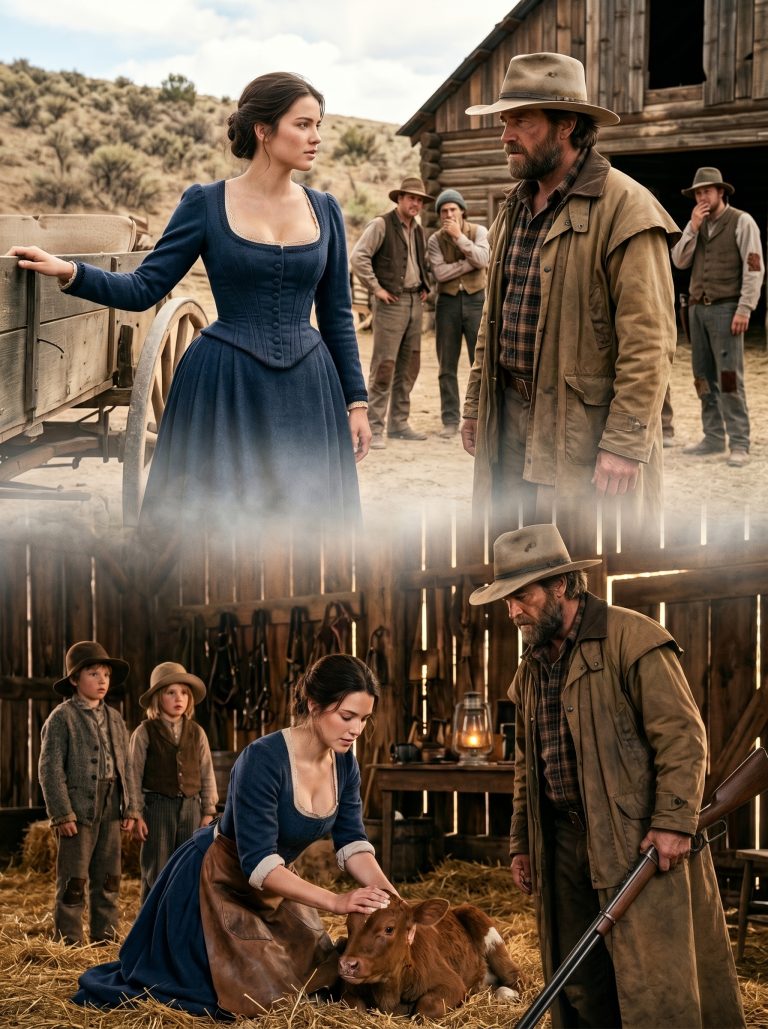
She plunged into a raging river to save two helpless babies—never knowing she was about to rewrite a Duke’s destiny.

Part 1
Rain had punished Yorkshire for six days straight, and on the sixth night the River Aldwyn finally broke its banks. Eleanor Winslow stood on the porch of her stone cottage, a sack of flour forgotten in her arms, watching black water crawl across the pasture like something alive.
Nine months a widow, and she had learned to decide fast. There was no husband left to decide for her.
Then wood cracked somewhere out in the dark — a sound too large to be a fence.
She dropped the flour and ran. A carriage lay on its side in the flood, dragged sideways by the current, one wheel still spinning uselessly in the air. Eleanor waded in without a second thought, the cold closing over her knees, then her waist. Over the roar of water she heard crying.
Inside the wreck, wrapped in soaked blankets, were two infants, red-faced and screaming. Beside them, slumped against the door, a man bled from a gash above his eye.
She took the babies first. She always would tell herself that later — that she had no choice, that the living came before the merely breathing — but some nights she still felt the shame of leaving him there while she fought the current back toward the bank, a boy under each arm, her skirts a dead weight trying to pull her under.
She set them down in the wet grass, out of the water’s reach, and went back for the man.
He was heavier than any sack of grain she’d ever hauled, and twice she went under trying to drag him free of the carriage door before the river tore it away entirely. When she finally got him onto solid ground, she collapsed beside him, chest heaving, and only then saw it — a dark stain spreading through the shoulder of his coat that owed nothing to the river. She tore the fabric back and found the wound beneath, ragged and still weeping, high in the meat of his shoulder — a bullet had gone clean through him, missing the bone by a hand’s width, but a bullet all the same. Below it, bruising already purpled across his ribs — old enough that she couldn’t say for certain whether the crash had put it there, or something crueler, done to him before the water ever took the carriage.
This had not been an accident.
She half-carried, half-dragged him up to the cottage, laid the twins in a blanket-lined box by the fire, and set to work on the stranger with the same hands that had once stitched her husband after a scythe took his arm open to the bone. Needle. Thread. Brandy poured raw over the wound. He did not wake for it.
Two boys, perhaps six months old, so alike they might have been carved from the same wood, slept at last once she’d coaxed goat’s milk into them drop by drop from a honey spoon. She sat on the floor between them and the unconscious man and allowed herself, for one held breath, to be afraid.
The bridge was gone. The road to it, gone. No one would reach this farm for days, maybe weeks — and she was alone in it with two babies who were not hers and a man whose hands, she noticed even now, were not a gentleman’s hands. Calloused in the wrong places. A man who had held a blade before.
He woke near midnight, disoriented, reaching instantly and instinctively for the boys before he even asked where he was.
“They’re safe,” Eleanor said. “You’re the one who isn’t, if you keep thrashing like that. I only just finished sewing you shut.”
He stared at her — really looked, the way a hunted man looks at anyone new — and she watched him decide, in real time, what to tell her.
“Edmund,” he said finally. “Edmund Colt.”
She heard the lie the moment it left his mouth. His vowels were too careful, his stillness too disciplined, like a man who had trained himself out of flinching. But she had buried a husband who’d lied to her about smaller things than this, and she had learned that some lies were not hers to unravel by force.
“The boys are yours?” she asked instead.
Something in his face broke open, briefly, painfully. “Their mother is dead.”
“What happened to you on that road?”
He closed his eyes. Fragments came back to him even as he spoke them — a hedgerow bursting open, four men, a shot, the driver falling before he could cry out, the horses screaming, the bridge arriving too fast beneath failing wheels.
“Someone tried to kill you,” she said. Not a question.
“Someone is still trying,” he answered, and then the fever took him again, dragging his eyes shut, his breath turning ragged and uneven.
Eleanor sat back on her heels and looked at the sleeping twins, then at the stranger sweating through her late husband’s shirt, and understood, with a coldness that had nothing to do with the storm outside, that she had pulled far more out of that river than three lives.
She rose, locked the door, and took her husband’s old shotgun down from the wall.
Then she sat down by the fire to wait for whatever the dawn brought.
Part 2
The fever held him for two days. He raved about carriages and orders given in a voice used to being obeyed, and once, gripping her wrist so hard it bruised, he begged someone unseen not to let them near the boys.
On the second night, when the shaking grew violent enough to rattle his teeth, Eleanor did the only thing she knew to warm a body the fire couldn’t reach — she lay down beside him and let him burn against her until dawn broke the fever at last.
He woke ashamed, apologizing before he’d even opened his eyes fully. She only handed him broth and told him to drink.
“Their names?” she asked, nodding at the box by the hearth.
“Simon and Peter,” he said. “Simon has the birthmark, behind his ear.”
“I’d been calling him James.”
The ghost of a smile crossed his face — the first she’d seen. It did not last.
“You still haven’t told me who you are,” she said.
He was quiet a long moment, turning the empty bowl in his hands like a man deciding how much rope to give away.
“I am the Duke of Ashcombe,” he said finally. “I inherited the title a year ago. Along with it, I inherited an enemy — my cousin, Lord Reginald, who stands to gain everything if my sons and I are dead.”
The word duke sat strangely in that small kitchen, too large for the space, too large for the man who’d wept in his sleep and let her hold him through a fever like any frightened animal.
“And if he finds you here?”
“He believes we drowned with the carriage,” he said. “He has no reason to search a widow’s farm in the middle of nowhere.”
Eleanor studied him — the scar over his brow, the calluses that didn’t belong to men who only sat at desks signing papers, the unshakable watchfulness in a man supposedly safe for the first time in weeks.
She said nothing about the parts of his story that didn’t fit together. Not yet.
“You may stay,” she said instead. “Until the water goes down. Until it’s safe.”
“It’s imprudent.”
“It’s done,” she said, and turned back to the fire, unaware that she had just tied her fate to a lie neither of them yet understood the size of.
Part 3
The weeks folded into a rhythm neither of them named aloud. Eleanor milked the goat at dawn; Edmund minded the boys until she returned. They traded the night’s vigil back and forth, one sleeping while the other listened for any small, ragged cry. Simon began to reach for fistfuls of Eleanor’s hair. Peter learned to laugh at nothing at all, delighted simply by the sound of Edmund’s low, rough voice.
It was, Eleanor thought more than once, dangerously close to a family.
On the ninth day, Edmund walked to the village under cover of a market crowd and paid a passing courier — with one of his last two gold cufflinks — to carry a letter south and wait for a reply. When Eleanor found out afterward, her fear came out as anger.
“If they trace that letter—”
“They won’t,” he said. “The courier doesn’t know who I am. He only knows where to bring the answer.”
She wanted to believe him. She noticed, and hated noticing, that she wanted very much to believe everything he told her now.
The reply came eleven days later, delivered by the same soaked courier in the dead of night. Edmund broke the seal with shaking hands and read it twice before he could speak.
“He has proof,” he said finally. “Payments. Names. Three witnesses who’ll swear my cousin ordered the ambush.” He set the letter down as if it burned him. “It wasn’t robbery. It was murder, planned and paid for.”
“Then you can end this,” Eleanor said. “Expose him.”
“Not alone. He has friends among the judges, the peers. If I accuse him without protection, he’ll destroy the accusation, and me with it.” He looked up at her, and for the first time since the fever, she saw real fear in him — not for himself. “I need to reach someone he cannot buy. The Duke of Wexford commanded my father’s regiment once. If I can put this in his hands directly, my cousin has nowhere left to hide.”
“And the boys?”
“I’ll take them.”
“You’ll do no such thing,” Eleanor said, sharper than she meant to. “The road, the cold, men who might know your face — leave them with me. Finish this. Come back for them when it’s done.”
He crossed the room and took her face in both hands, careful of the sleeping boys, searching her eyes as though memorizing them.
“You are the most extraordinary person I have ever known,” he said.
“Go,” she whispered, “before I change my mind.”
He left at first light, promising three weeks at most. Eleanor stood on the porch with a son on each hip and watched him disappear around the bend in the road, and told herself, sternly, that this ache in her chest was only worry.
It was not only worry.
The weeks that followed were the hardest of her life since the fever that took her husband. The boys cried for their father at night. Eleanor sang the same wordless songs he used to hum, if only to give them something familiar. Slowly, they settled. Slowly, without her permission, she began calling them my boys when no one was listening.
Three weeks passed. Then four. On her rare trips to her father’s farm for news, she heard only rumor — talk in the city of some dispute among noblemen, nothing confirmed. Once, riding back, she saw two strangers stop to speak with a neighbor by the road, and one of them looked at her a moment too long. She kept walking, shawl tight, heart hammering, and did not breathe easy until her door was locked behind her.
By the fifth week, she had stopped counting days and started grieving instead — for a man she had convinced herself was already dead or imprisoned, and for the family she’d let herself believe in for exactly as long as it lasted.
He came back on the thirty-eighth morning, on foot, his horse lost somewhere along the road, his coat torn, a fresh cut healing above one eyebrow. Eleanor didn’t wait for propriety. She ran to him barefoot through the mud and he caught her hard against his chest.
“You’re here,” she said into his shoulder, and hated how much her voice broke on it.
“I’m here. I’m sorry. It was worse than I expected.” He held her at arm’s length, and something in his face had changed — not relief exactly. Dread, carefully controlled. “Eleanor. There’s something I have to tell you. Something I should have told you the first night.”
Her stomach dropped. “Tell me.”
He looked toward the house, where the boys were surely stirring, and then back at her, and for the first time since she’d pulled him from the river, Edmund Colt looked genuinely afraid of a single word.
“I am not the Duke of Ashcombe.”
The pasture seemed to go very quiet.
“My name is Gabriel Renshaw,” he said. “I was the duke’s secretary. His friend, since we were boys. Julian — the real duke — sat across from me in that carriage.” His jaw tightened. “We’d swapped coats an hour before the ambush. It was his idea, a precaution, nothing more — if there were trouble on the road, better the attackers hesitate over which of us was worth the bullet. When the shooting started, it worked exactly as he feared it might. They went for the man in the duke’s coat first.”
“You,” Eleanor said slowly.
“Me. The bullet meant for Julian took me in the shoulder instead — I was wearing his coat, so I was the one they aimed for. It threw me back against the carriage door hard enough to crack my skull on the frame, and everything after that comes to me in pieces.” Gabriel’s voice roughened. “The horses bolted for the bridge half-blind with fear. Julian was thrown clear when the carriage first struck the rail — he could have run for the bank and saved himself. Instead he went into the water after it, trying to cut the traces before the current dragged the boys under with it. I was already senseless inside, tangled with Simon and Peter, when the carriage broke free and went over. Julian never let go of the harness. The river did. I didn’t see him go under — I wasn’t conscious for that part — but the men who searched the banks downstream for two days after found no trace of him at all. Only the coat I’d given him, caught on a snag a mile down, empty.”
“So when I found the carriage,” Eleanor said slowly, “he was already gone. It was only ever you in there. With the boys.”
“Only me,” Gabriel said. “His last words to me were said an hour before any of it happened, not after — over supper the night before, when he asked me to swap coats if the road ever turned dangerous. He never got the chance to ask for anything else. Everything I did after that, I did guessing at what he would have wanted, not because he told me to. I let people believe otherwise because the truth made me sound like a man playing dead duke for his own convenience, and I couldn’t bear that, not with his sons in the room.”
“So you became him.”
“I became a shield with his name on it. Every day I wore it, I told myself it was temporary. That once the boys were safe, I’d set it down.” He looked at her, stripped now of every performance. “I never once told Wexford I was the duke. I told him the truth, the whole of it, the moment I reached him — because I could not put a lie that large in front of the Crown and still call myself Julian’s friend. Wexford believed me. He has the letter, the courier, three witnesses to the ambush, and now my own confession, all pointing the same direction. Reginald ordered his cousin’s murder. He will hang for it, or as near to hanging as a title allows.”
“And the boys?”
“Are the rightful sons of Julian Ashcombe, whatever name the man raising them wears. Wexford has already begun the process to confirm them as heirs in their own right, under guardianship until they come of age.” He drew a breath. “I am not a duke, Eleanor. I never was. I’m a steward’s son who kept two babies alive because I loved their father, and I had already failed to keep him alive — I could not fail his sons too.”
Eleanor stood very still in the mud, turning the truth over the way she once turned over her husband’s smaller, meaner lies, and found, to her own surprise, that this one did not diminish him at all.
“You lied to me for five weeks,” she said.
“I did.”
“And you came back anyway to unmake it, when the easier lie would have kept you a duke and made me a duchess.”
“I couldn’t build a marriage on the one lie I hadn’t yet told you,” Gabriel said. “You deserved to choose the man, not the coat he was wearing when you pulled him out of that river.”
She was quiet a long moment, watching him brace for the answer he clearly expected — that she’d send him and his borrowed name back down the hill.
“I didn’t fall in love with a duke,” she said finally. “I fell in love with a man who gave away his last cufflinks to save two babies that weren’t strictly his to save, and who came back across half of England to tell a farm widow an uncomfortable truth instead of a comfortable lie. That man can call himself whatever he likes.”
The Crown, in the end, was more generous than either of them expected. For loyalty that had cost him his name for two months and nearly his life more than once, Gabriel Renshaw was granted a new title outright — Earl of Renshaw, land and income enough to raise the boys in comfort without ever touching a shilling of the Ashcombe estate that wasn’t rightfully theirs. Simon, born mere minutes before his brother and marked by that small birthmark behind his ear, was confirmed as Julian’s true heir and would inherit Somerville and the dukedom when he came of age, held in careful trust until then. Peter, as a duke’s younger son, would be styled Lord Peter Ashcombe for the whole of his life — courtesy enough for a good and comfortable one, without a crown of thorns attached to it. Gabriel served as guardian to them both, not impostor to either.
Lord Reginald Ashcombe was arrested within the month, undone by the same courier’s testimony and the same gold cufflink, traced back through a pawnbroker’s ledger, that had once seemed such a reckless risk to send. Tried before the House of Lords, he was stripped of his title and his estates before sentence was passed — a peer’s privilege spared him the rope a commoner would have faced for the same crime, but it spared him nothing else. He was transported in chains to New South Wales and died there some years later, a convict with no title left to bury him under.
Gabriel and Eleanor married the second spring after the flood — a match unconventional enough to set the county talking for a season, though the ceremony itself was too small and too plain to give the gossips much to hold onto: a widowed farmer’s daughter and a steward’s son who’d been handed a title neither of them had asked for. Eleanor wore plain cream linen instead of silk. Simon and Peter, just past two years old by then, wept through most of the vows on principle, deeply offended that anyone dared speak for so long without offering to hold them.
At the first formal dinner Eleanor ever attended as a countess, a sharp-tongued baroness studied her work-roughened hands over the soup course and remarked, with a thin smile, how unusual it was to find a countess who still smelled of milk and woodsmoke rather than rosewater.
Eleanor set down her spoon.
“I prefer to smell of a living home,” she said. “So do my sons.”
The silence that followed was not embarrassment. It was the room quietly rearranging itself around her.
Years later, when the boys were old enough to ask how their parents had met, Gabriel would tell them the truth, all of it — the flood, the false name, the lie he’d carried out of love and set down out of it — and he’d end the story the same way every time.
“Titles can be given and taken by men who never once earned them,” he’d tell his sons. “But nobody can hand you the kind of love your mother pulled out of that river with her own two hands. That, you have to earn every single day, same as I still do.”
Eleanor, listening from the doorway, never tired of hearing it — not because the story flattered either of them, but because it was, at last, entirely true.