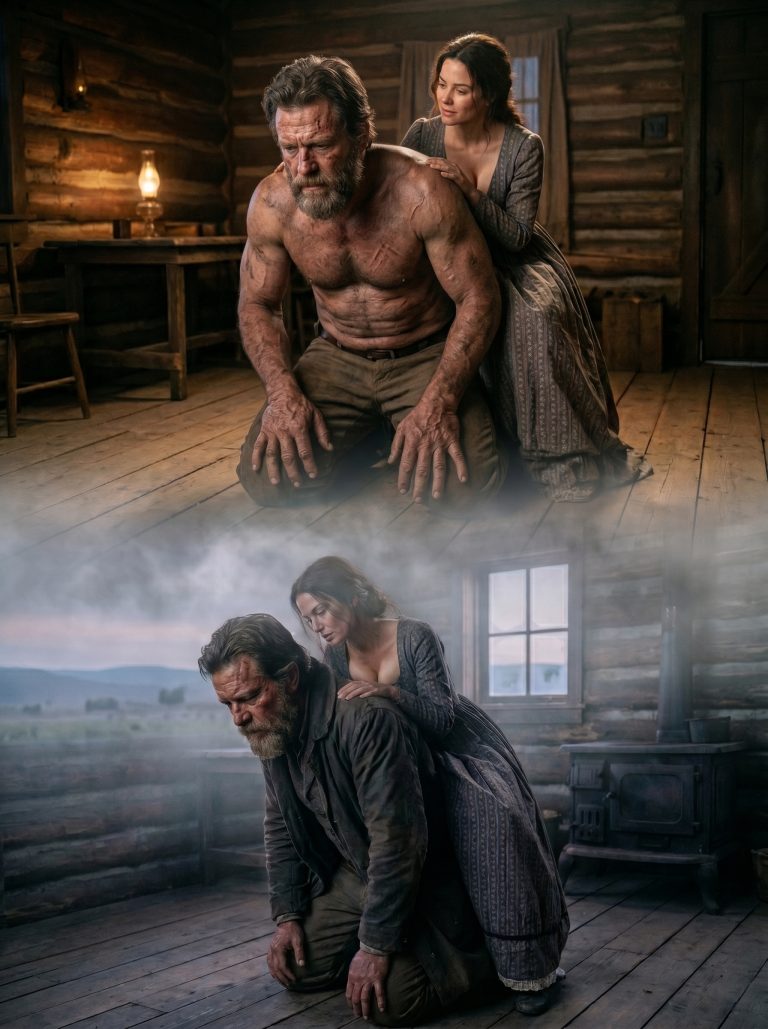
After walking thirty-one miles on bleeding feet, she begged a stranger rancher for work, never knowing the man who had hunted her for four years was riding through the gate behind her.

PART 1
The summer of 1881 sat on the Colorado high country like a punishment. Heat pressed down until it felt like something alive, something that wanted a man to quit.
Ethan Blackwood did not quit. He hadn’t quit in fifteen years — not through the winter that buried the fence posts, not through the winter when three of his men lost toes to frostbite, not even after Rebecca.
He was thirty-eight years old. Twelve hundred acres. Three hundred head of cattle. Eleven men on payroll and more money sitting in a Denver bank than he’d ever spend in his life. The county called him a model citizen.
Blackwood Ranch sat on the far side of the county line — thirty-one hard miles from Mill Haven, and just outside the reach of Judge Hargrove’s official authority. It was, without either of them knowing it yet, exactly the kind of distance that might let a hunted woman be found honestly instead of dragged back quietly.
None of them knew what it felt like to sit alone in his kitchen at six in the morning and feel nothing at all.
Thomas Hail found him there that Tuesday. Nine years running this ranch, and Thomas had never once knocked on that door before. Something in his face made Ethan set his coffee down.
“There’s a woman at the gate,” Thomas said. “Walked here. Best I can tell, a long way. Her feet are in bad shape.”
“What does she want?”
“Work. I told her we’re not hiring.”
“I know.” Thomas turned his hat over in his hands. “I watched her from the fence before I came to find you. She didn’t knock twice. Didn’t sit down. Just stood there like she’d stand all day if that’s what it took.”
Ethan picked up his own hat.
She heard his boots before she saw him — steady, unhurried, the walk of a man used to arriving somewhere and having it mean something. Clara kept her chin up, the way her mother had taught her long before either of them knew how much it would be tested.
For four years, Clara had kept moving — new towns, borrowed names, work found and then lost the moment someone connected her to the Hargrove name. Mill Haven had been her last attempt to stop hiding and use her own name again. Two days after she arrived, someone recognized her from an old Hargrove circular, and every door in town closed within an afternoon.
She had not folded there, either. Not when the Hargroves told every shopkeeper in town she was a thief. Not when the boarding house turned her out with an apology that cost the landlady nothing. Not across thirty-one miles of road on two days without a real meal.
But her hands were shaking under the strap of her bag, and she gripped tighter to make it stop.
He stopped eight feet from her. Studied her the way a man studies something he’s trying to understand.
“You walked here,” he said. Not a question.
“Yes, sir.”
“From where?”
“Mill Haven.”
Thirty miles as the crow flew. More by road. She watched the arithmetic move behind his eyes.
“Family somewhere?”
“No, sir.”
“References?”
The question dropped into her chest like a stone down a well. She had three letters. Years of honest work behind her. None of it would survive the Hargrove name in this part of the state.
“Not the kind that would help me,” she said.
He didn’t ask why. Not yet. “What’s your name?”
“Clara Whitmore.”
“Ethan Blackwood.” No handshake. Neither of them offered one. “What kind of work are you looking for, Miss Whitmore?”
“Whatever kind you need done. Cooking, cleaning, mending, a kitchen garden if you have one. I’ve managed a household of eleven. I know livestock. I keep accounts.” A pause. “I work hard. I don’t complain. And I won’t cause you trouble.”
“What kind of trouble,” he said, “would I be taking on if I said yes?”
She had promised herself she wouldn’t hide it — because a man like this would learn the truth eventually, and she was done letting other people’s lies get there first.
“There are people in Mill Haven who’ll tell you I stole from a family I worked for,” she said. “It isn’t true. But they have more money than I do, and they made sure their version got told first. If anyone from that town writes you about me, that’s the story you’ll hear.”
“Did you steal from them?”
“No.”
“Why’d they say you did?”
She held his gaze. “Because the youngest son wanted something I wouldn’t give him. When I refused, he needed a reason for why I had to go.”
A long silence stretched between them. Somewhere on the road, a bird called twice and went quiet.
“You can stay,” Ethan Blackwood said.
She blinked. She had braced herself for negotiation, for the slow, humiliating work of making herself small enough to seem safe. Not this.
“Just like that?” she said, before she could stop herself.
“Just like that.” He adjusted his hat against the sun. “I know what a lie looks like on a person’s face, Miss Whitmore. And I know what the truth looks like. You told me the truth.”
He turned toward the gate. “Come on, then. Thomas will show you where things are.”
She stood there one more second, feeling something loosen in her chest like a knot worked at for a long time. Then she followed him through the gate.
By the ninth day, the men who’d eyed her with suspicion were fighting over her cornbread. By the eleventh, she found Ethan sitting alone in the barn at dusk, holding a piece of tack he wasn’t fixing — just holding — and something in the careful way he looked up told her this ranch carried a grief nobody spoke of out loud.
Three weeks in, a rider came from town with a letter addressed to Blackwood Ranch.
Ethan read it at the kitchen table. Folded it once. Set it down between them without a word.
It was from the Mill Haven sheriff’s office.
Asking about a woman named Clara Whitmore.
She looked at the letter. She looked at him.
“What did you tell them?” she asked.
Ethan met her eyes — and said something that made her hands go still in her lap.
Something that told her this wasn’t the end of the danger.
It was only the beginning.
PART 2
“I told them Blackwood Ranch doesn’t turn away hardworking women on the strength of gossip,” Ethan said.
Clara’s breath caught. “That’s all?”
“No.”
“What else?”
“I told them if they wanted to ask questions about my household, they could send a man with a warrant, a badge, and better manners than whoever wrote that letter.”
For one dangerous second, Clara wanted to laugh. Not because it was funny. Because relief had come too sharp, and if she didn’t laugh she might break apart right there at his table.
“You shouldn’t have done that,” she whispered.
“I don’t much care what I should have done.”
“You don’t understand who they are.”
“I understand enough.”
“No.” The force in her own voice surprised her. “The Hargroves don’t send letters because they want answers. They send letters because they want to know who’s standing close enough to punish.”
Ethan’s hand tightened over the folded paper. “Then they’ll learn my name soon enough.”
Clara pushed back from the table. Her feet still hadn’t healed; pain climbed her legs when she moved too fast. She gripped the chair until the room steadied.
“I should leave.”
“No.” Quiet. It hit the room like a door barring shut.
“You hired me because you believed I was telling the truth. That was kind. More than kind. But kindness won’t protect you from men like Silas Hargrove.”
“So it’s Silas.”
The name had slipped before she could stop it. Ethan noticed. He noticed everything — the way a horse favored a leg before anyone saw the limp, the way Clara went quiet whenever certain men laughed too loud.
“Yes,” she said, turning to the stove, pretending to check the beans.
“The youngest son?”
She nodded.
“And the father?”
“Judge Hargrove owns half the town and frightens the other half. His eldest son runs the bank. His brother sits on the county board. Silas does whatever he wants because men like that are born already forgiven.”
Ethan said nothing. Outside, thunderheads gathered beyond the ridge.
“He tried once,” Clara said. “At the house. I was in the linen room. He came in drunk and smiling. I told him no. He laughed — said girls like me should be grateful when men like him noticed.” Her fingers curled around the spoon until her knuckles whitened. “I hit him with a brass candlestick and ran. The next morning they said I’d stolen a pearl brooch from Mrs. Hargrove’s dressing table. I had never touched it. But who would believe me? I ran that same week, and I’ve been running ever since — new towns, new names, until Mill Haven.”
“I would.”
She looked at him. The simplicity of it hurt.
“I know,” she said softly. “That’s why I’m afraid for you.”
Thomas appeared in the doorway before Ethan could answer.
“Rider coming hard from the south,” he said. “Two men.”
Ethan turned toward the window. Clara didn’t need to look. She already knew.
The past had found the gate.
By the time they stepped onto the porch, every man in sight had stopped working. Not dramatically — a hammer paused, a rope hung loose, a young wrangler drifted closer to the barn where the rifles were kept.
Two riders came through the yard. One wore a badge. The other wore a gray suit too fine for dust, and a smile too smooth for honesty.
Silas Hargrove.
Four years had changed him only enough to make him worse — broader now, better dressed, a trimmed mustache, polished boots that had no business near cattle dirt. His eyes swept the ranch, assessing value, then men, then the porch.
Then they found Clara.
His smile widened.
“Well,” he called out. “There she is.”
What happened at that gate in the next sixty seconds would decide whether Blackwood Ranch survived what came next — and whether Clara Whitmore would finally get to tell her side of the story in a room that had to listen.
PART 3
Clara’s hand went cold against the porch rail.
Ethan stepped down without hurrying, placing himself between her and the riders in a way that didn’t look like protection — it looked like ownership of the ground he stood on.
“State your business,” he said.
The man with the badge cleared his throat. “Sheriff Caleb Ward, Mill Haven. We’re looking for Clara Whitmore.”
“You found her.”
Silas chuckled. “That’s a tidy answer.”
Ethan didn’t spare him a second glance. “Sheriff?”
Ward shifted in his saddle, uncomfortable in a way that told Clara something — either he wasn’t fully bought, or he didn’t enjoy the taste of being bought at all.
“There’s a complaint on file against Miss Whitmore,” Ward said. “Theft from the Hargrove residence, four years back. We’ve come to question her about it.”
“Question her, or take her?”
“We came to bring in a woman wanted for questioning,” Silas cut in. “Not trade paperwork with a cattleman.”
“She ran before she ever answered for it,” Ward added. “That’s within my authority to look into.”
“Running from a lie isn’t a crime,” Ethan said. “Do you have a warrant?”
Ward hesitated a beat too long. “No formal warrant’s been sworn. Not yet.”
“Then you have no authority to take anyone off my land.”
“She ran before she could face the charges,” Silas said, low and pleased with himself. “That makes her guilty enough for me.”
“Your opinion isn’t a warrant either,” Ethan said.
For a moment nobody moved. The hands in the yard watched in the particular silence of men deciding whether trouble was about to become their trouble too.
“Clara.” Silas’s voice dropped, aimed past Ethan like a thrown knife. “You’ve caused enough trouble. Come down.”
Her throat closed.
Ethan turned his head just slightly. “You don’t have to answer him.”
“She knows me.”
“She looks like she wishes she didn’t.”
Somewhere behind them, a ranch hand coughed to cover something that might have become a laugh. Silas’s eyes flashed.
“You’re making a mistake.”
“I’ve made plenty,” Ethan said. “This doesn’t feel like one.”
Ward wiped his forehead with his hat brim. “Mr. Blackwood, I’d rather not make this ugly.”
“Then don’t.”
“We can come back with a warrant.”
“Do that.”
Silas’s horse tossed its head, feeling the tension travel down the reins. “You think your acres make you untouchable?”
“No,” Ethan said. “But they do mean you’re standing on my land. And I don’t recall inviting you to threaten anyone on it.”
Silas’s gaze slid back to Clara. This time the smile was gone. “You always did know how to hide behind stronger men.”
The words found their mark exactly where he’d aimed them. Clara stepped forward before Ethan could stop her.
“No,” she said, her voice shaking but clear. “I learned to survive men who mistook fear for permission.”
The yard went dead quiet. Something flickered across Silas’s face — the first real surprise she’d ever managed to put there. Then he laughed, soft and ugly.
“There she is. Still dramatic.”
“Leave,” Ethan said.
“This isn’t over.”
“It rarely is with cowards.”
The insult landed clean. Silas’s hand twitched toward his coat, but Ward had already turned his horse.
“We’ll be back,” the sheriff said.
“I’ll be here,” Ethan answered.
They watched the riders disappear past the bend. Only then did Clara realize she’d been holding her breath the entire time. Her knees buckled slightly; Ethan turned toward her.
“You all right?”
“No,” she said honestly.
“Good. I’d worry if you were.”
A Ranch Learns Whose Side It’s On
Rain came hard that night, turning the yard to mud and setting lightning walking along the ridgelines. The bunkhouse carried low voices — Hargrove. Sheriff. Theft. Woman at the gate. Clara braced for the suspicion to return, the way it always had in every town before this one.
Instead, Jonah, the youngest hand, left a pair of dry wool socks outside the pantry door. Old Ben set a tin cup of coffee at her elbow without a word. Thomas told the men that anyone with doubts about Miss Whitmore could take them up with him before taking them anywhere near Ethan.
Nobody did.
Near midnight, Clara found Ethan in the barn, one hand resting on the neck of a bay mare, lantern light softening the hard lines of his face.
“You should sleep,” he said without turning.
“So should you.”
“Never been good at it.”
She stepped closer. “Thomas said Rebecca was your wife.”
The mare shifted under his stilled hand. “He talks too much.”
“He said almost nothing.”
“That’s his version of too much.”
The rain filled the silence between them.
“She died three years ago,” he said finally. “Fever. Took six days. Doctor came from town, did what he could, then stood in my kitchen and apologized like that could hold the world together.”
“I’m sorry.”
“She wanted children. I kept saying there’d be time. Always more fencing to mend. More cattle to move. More money to save.” He looked down at his hands. “Then there wasn’t.”
Clara felt the ache in those words — not because it mirrored hers, but because grief has a way of recognizing grief even across very different wounds.
“Is that why you helped me?” she asked.
“No.”
“Then why?”
“Because you stood at my gate half-starved and still told the truth.” His voice dropped lower. “Because I know what it is to have people think they understand your loss when they don’t. Because when a person has nowhere left to go and still refuses to lie, that ought to count for something.”
Clara looked away before he could see what those words did to her face.
The First Fence Line
The next morning, the first fence line was cut. Not broken by weather — cut, clean and deliberate. Three hundred head broke through the opening and scattered beyond the north pasture. Two calves went missing. A water trough had been fouled with kerosene. And on the gatepost, someone had pinned a scrap of cloth.
Clara recognized it before anyone else did.
A strip from the hem of the blue dress she’d worn the night she fled the Hargrove house, four years before. She had left that dress behind. Silas had kept it.
Ethan pulled the cloth off the nail and folded it once. Thomas swore under his breath. “This is no longer just talk.”
“No,” Ethan said. “It isn’t.”
By noon he’d sent two riders to Denver — one to his attorney, one to a retired federal marshal he’d once helped through a range dispute.
“What are you doing?” Clara asked, watching the dust rise behind them.
“What I should have done before they came back.”
“You’re making yourself his enemy.”
Ethan looked toward the cut fence, then back at her. “Miss Whitmore, he made that choice when he rode through my gate smiling.”
Three days later, Silas struck again. Fire this time. The hay barn went up near dawn, flames climbing orange into a paling sky, horses screaming, men shouting with buckets that felt useless against a wall of heat. Clara ran until smoke clawed her throat raw. Ethan dragged a half-mad gelding clear of the blaze and came out with one sleeve smoking.
They saved the main barn. They lost half the hay.
And in the ashes, Thomas found a silver match case, half-melted but whole enough to matter — not dropped by accident, but placed where it would be found. It bore no name, no initials, nothing a stranger could point to in a courtroom. But Thomas had seen a case just like it pulled from Silas Hargrove’s coat pocket outside the mercantile more times than he could count, and he handed it to Ethan without needing to say why it mattered.
“He Wants You Angry Enough to Move Foolishly”
It took the better part of two weeks for Pritchard to make the ride up from Denver, county business holding him longer than he liked, and the ranch settled into a wary, watchful quiet in the meantime — mended fences, doubled night watches, nobody quite saying out loud that they were waiting for whatever came next.
Clara stared at the match case on Ethan’s desk while Pritchard, a careful man with spectacles and a slow way of turning things over, examined it at last.
“Too obvious,” Pritchard said.
“Meaning?”
“Meaning he wants you angry enough to move foolishly.”
“He burned my barn.”
“Yes. And if you ride into Mill Haven and put a bullet in him, he wins cleanly.”
Ethan’s jaw worked, but he said nothing.
The retired marshal, Amos Creed, arrived that evening — built like old leather, moving with the quiet economy of a man who’d survived more gunfights by avoiding them than by winning them. He listened to Clara’s account start to finish without interrupting once. When she finished, he asked a single question.
“Who else saw Silas go into that linen room?”
“No one.”
“Who found the brooch in your trunk?”
“Mrs. Hargrove.”
“Who searched it?”
“Mrs. Hargrove and the housekeeper. Nora Bell.”
Creed’s eyes sharpened. “Nora Bell still in Mill Haven?”
“I don’t know.”
“She will be.” He rubbed a thumb along his jaw. “Women like that know where the bones are buried. Question is whether she’s scared enough to stay quiet, or tired enough to finally speak.”
He was quiet a moment, turning the match case over in his fingers. “I’m retired, but I’m not friendless. There’s a deputy marshal, name of Foster, two counties over. He’s been quietly gathering complaints against Judge Hargrove for the better part of a year — bribery, seized land, nothing anyone’s been able to make stick yet. If we find something worth his time, I can get word to him. He’ll want to see it firsthand, not take my word for it.”
“So we go carefully,” Ethan said.
“We go carefully,” Creed agreed, “and we let a man with an actual badge be the one who does the arresting.”
By the time Creed had word back from his contact and a plan worth acting on, the first frost had already silvered the pasture grass. Nearly two months had passed since the fire — long enough for the ranch’s wounds to close over, and long enough for Clara’s patience with waiting to run out entirely.
One morning, over coffee gone cold, Clara made a decision that frightened her more than hunger, more than the long walk, more than Silas standing at the gate.
“I’m going back to Mill Haven.”
Ethan looked up sharply. “No.”
“You need proof. I know where to look.”
“Creed can go.”
“Creed doesn’t know the house. Doesn’t know Nora. He doesn’t know where Mrs. Hargrove kept her account books, or which servants knew which secrets, or what kind of lies Silas tells when he’s frightened.”
“It’s too dangerous.”
“Yes,” Clara said. “It is. But I spent four years being hunted by a man who counted on me staying afraid. I’m tired of helping him.”
Something shifted in Ethan’s face. Not approval. Respect.
“Then you don’t go alone.”
She almost smiled. “I didn’t think you’d let me.”
“I’m not letting you do anything,” he said. “I’m asking to ride with you.”
Mill Haven
At dawn they left for Mill Haven — Clara in a plain brown dress and a borrowed hat, a pistol at her hip that Ethan had insisted she learn to load before they crossed the property line. Creed rode twenty yards behind, and a rider had already gone ahead to send word to Marshal Foster. Thomas stayed to guard the ranch with orders to fire warning shots first and ask questions never, should any Hargrove man cross the fence.
By sunset the rooftops of Mill Haven rose below them. Clara had dreamed of this town for years — in nightmares it always grew larger. In truth, it looked smaller. Dusty streets. A white church. The mercantile, the bank, the sheriff’s office. The Hargrove house on the hill, standing over the town like a judge above the condemned.
Her hands shook on the reins.
“We can turn back,” Ethan said.
“No. We can’t.”
Nora Bell worked the laundry now. She had aged badly — bent shoulders, a tight mouth, eyes that kept darting toward the window. For a moment she didn’t recognize the woman standing in her doorway. Then the blood drained from her face.
“Clara.”
“Nora.”
“You shouldn’t be here.”
“I know.”
Nora’s gaze slid past her to Ethan and Creed. “Are they yours?”
Clara nearly said no. Then she thought of the gate, the kitchen, the barn, the cut fence, the way Ethan had stood between her and Silas without ever asking for gratitude.
“They’re with me,” she said.
Nora’s eyes filled. “I’m sorry.”
The words were so unexpected Clara couldn’t answer right away.
“I should’ve spoken,” Nora whispered. “I knew you didn’t take that brooch. Mrs. Hargrove gave it to me that morning and told me to put it in your trunk. Said if I didn’t, my boy would lose his apprenticeship at the bank.”
Creed stepped forward. “Will you swear to that? Not to us — to a federal marshal, on the record.”
Nora trembled. “If I do, they’ll ruin me.”
“They already did,” Clara said softly. “They just left you breathing.”
Something in Nora broke loose. She sank into a chair. “There’s a ledger,” she said. “Mrs. Hargrove kept it hidden. Names. Payments. Girls sent away. Men paid off. The judge thought she only kept the household accounts — but she wrote everything down in her own shorthand. Said someday she might need insurance.”
“Where?” Creed asked.
Nora’s eyes dropped. “It used to be in the old sewing room — behind the blue wallpaper panel. That much I know for certain, because I helped her hide it there myself, years ago.” She twisted her apron in her hands. “But Mrs. Hargrove stopped trusting me the week you disappeared, Clara. She had the locks changed on half the house. I haven’t set foot in that room in three years. I can’t tell you if it’s still there, or if she moved it somewhere I’ve never seen.”
Creed’s face didn’t change, but something behind his eyes did. “Then we don’t have a location,” he said quietly. “We have a location three years old.”
Clara’s pulse pounded. The Hargrove house. The place where her life had first been taken from her. The place Silas still believed he owned every version of the truth inside.
Ethan saw it in her face. “No.”
“Yes,” she said.
Creed held up a hand. “We don’t take that book. Not yet. A three-year-old memory of where something sat isn’t enough to put in front of a judge — and it’s certainly not enough to put in front of Foster.”
“And if they’ve moved it?” Ethan asked.
“Then we’ve lost nothing by asking first,” Creed said.
Marshal Foster met them on the road an hour outside town — a lean, unhurried man with tired eyes and a federal badge that had clearly seen more paperwork than gunplay. He heard Creed out, then Nora’s account, in full.
“I’ve got affidavits from two other families already,” Foster said. “This could be the piece I’ve been missing.” He shook his head slowly. “But I won’t ask a judge to sign a search order on a housekeeper’s memory of a room she hasn’t stood in for three years. And I won’t have civilians going into that house at night under color of my badge, looking for something that might not even be there anymore.”
“Then what,” Clara said, “do you suggest we do? Wait while Silas has time to find the book himself, or burn the room down around it?”
“I’ll find another way to confirm it’s there,” Foster said. “A hired hand, a records clerk, something that doesn’t put any of you inside that house in the dark. Give me a week.”
“A week is a week he can use to burn something else down,” Ethan said.
“That may be true. It’s still my answer.” Foster touched his hat and turned his horse back toward town, taking his authority — and his protection — with him.
Clara said nothing for a long while after he’d gone. Then, well past midnight, she rose quietly from where they’d made camp off the road and started walking.
Ethan woke to the sound of gravel under her boots and found her already halfway toward the turn for the Hargrove house. “Clara.”
“I’m not asking you to come this time,” she said, not stopping. “Foster told his own men no. He didn’t tell me anything.”
“That’s not the same as permission.”
“It isn’t permission I came here for.”
Creed, who’d been dozing by the low fire, was on his feet before either of them realized he’d woken. “If you’re going, you’re not going without me knowing exactly where that side door sticks.” He didn’t look pleased about it. “And I’ll wake one of Foster’s deputies on the way past and tell him where to look if we’re not back by first light. That’s the best you’re getting out of me.”
So it was that Ethan, Clara, and Creed rode for the Hargrove house with no marshal’s knowledge or blessing. The best Creed managed was rousing a young deputy named Hale from his cot at the edge of town and posting him on the road below the Hargrove property, on the pretense of watching for anyone moving suspiciously in either direction — close enough to hear real trouble if it came, far enough to claim later he’d merely been walking his usual round.
Behind the Blue Wallpaper
The Hargrove house looked exactly as she remembered — that was the cruelest part. White columns still stood proud at the front. Rose bushes still climbed the trellis by the west window. The porch swing still moved slightly on its chains, as though the house itself were breathing in its sleep.
Four years had passed. The place hadn’t aged in her mind at all. It had simply waited.
“You’re sure about the side door?” Ethan whispered, crouched beside her near the hedges.
“Kitchen staff used it. The lock sticks in summer.”
Creed waited near the carriage house, one hand resting inside his coat. There was no federal man watching this house tonight — only a sleeping deputy back in town who wouldn’t stir until sunrise found this camp empty. Creed had said what he thought of the plan, going in with no authority behind them at all — most of it involved calling them both fools — but he’d come anyway, and he’d made Ethan swear that if anything went wrong, getting Clara out mattered more than the ledger.
Clara crossed the yard first. Every step carried her closer to the girl she used to be — the one who knew which floorboards creaked, which bells meant Mrs. Hargrove wanted tea, the one who had believed hard work and decency were enough to protect her from powerful men.
The side door stuck exactly as she remembered. Ethan pushed once with his shoulder. It gave.
Inside, the kitchen smelled of old ash and lemon soap. Memory hit her too fast — Mrs. Hargrove’s voice down the hall, Nora’s warnings, Silas laughing near the wine cabinet, the linen room door swinging shut behind her.
“Clara.” Ethan’s hand found her elbow, light as a question.
“I’m all right.”
“You don’t have to be.”
That nearly undid her more than anything else that night. She moved before it could.
They climbed the back stairs into the sewing room. Moonlight fell across covered furniture and abandoned baskets of thread. The blue wallpaper had faded, peeling slightly at one corner. Clara found the panel by touch. For a terrible moment, nothing happened. Then Ethan slid his knife under the seam and lifted.
A narrow hollow space. Inside it, a leather ledger wrapped in oilcloth.
Four years of hunger, shame, running, locked doors, and bleeding feet — all of it led here, to this small dark book hidden behind a wall.
She reached toward it, meaning only to confirm it, the way Creed had asked.
A lamp flared behind them.
“Well,” Silas said from the doorway. “I wondered when you’d come home.”
The Confrontation
Ethan stepped in front of her. Silas held a revolver, loose but ready. Mrs. Hargrove stood behind him in a dressing gown, pale but composed. Judge Hargrove appeared a beat later, tying his robe with shaking hands, trying to look furious instead of frightened.
“Step away from the wall,” Silas said.
Clara didn’t touch the ledger. “We’re leaving.”
His smile sharpened. “I truly did miss that stubbornness.”
“Point that gun somewhere else,” Ethan said, low.
“Or what? You’ll glare me to death, cattleman?”
The judge stepped forward. “This is burglary. Armed trespass. I can have every one of you hanged.”
“No,” Clara said, and her own voice startled her. “No more of that. No more saying something in this house and making the whole town believe it, just because your name is Hargrove.”
Mrs. Hargrove’s eyes flicked to the wall panel. That was enough — the book mattered, and everyone in the room now knew it.
“Whatever you think you found, girl, it means nothing without me to explain it,” Silas said.
“You planted the brooch.”
“You were always clever enough to know, and too poor to prove it.”
Ethan shifted, but Clara touched his sleeve. For once, she didn’t want anyone standing between her and this. She stepped up beside him instead.
“Why did you chase me for four years?” she asked.
Silas’s jaw tightened. “I gave you chances most girls never get. You threw every one back in my face.”
“That’s not an answer.”
“It’s the only one you’re getting.”
But Clara had watched him long enough, across four years and one lamplit room, to hear what he wouldn’t say outright — that whatever he told himself to make it bearable, the truth underneath was smaller and uglier than any of his words: a man who could not stand having been refused, and who had spent four years making her pay for it rather than simply living with it.
“Give me the book,” Silas said, “and we can still end this quietly.”
“No.” Clara’s hand closed around the ledger at last.
He crossed the room fast for a man who’d spent four years growing soft on other people’s money. He wrenched at her wrist; the ledger fell; Ethan drove into him before he could reach it again, and the two men went down hard against the sewing table. Wood cracked. Thread scattered everywhere. The lamp toppled and guttered, throwing wild shadows up the walls.
The revolver went off once in the scramble — a bright, deafening crack that sent Mrs. Hargrove screaming into the hallway and put a hole clean through the wallpaper a foot from Clara’s head. She dropped flat, scrabbling for the ledger in the dark, fingers closing on leather and oilcloth just as Silas kicked free of Ethan and lunged for her.
Creed came through the doorway then, having heard the shot from the yard below, and put himself bodily between Silas and the ledger. It cost him a solid blow to the jaw before he got Silas’s gun arm twisted up behind his back and pinned him, cursing, against the wall.
“Ethan,” Creed grunted, “there a length of curtain cord in this room, or do we do this the hard way?”
By the time they had Silas bound to a chair with a torn drapery cord and the judge cowering by the door in his robe, only a few minutes had passed — but they were enough. Deputy Hale, posted on the road below just as Creed had arranged, heard the shot plainly and was already moving before the echo died, taking the rise toward the house at a dead run, lantern swinging, pistol drawn, shouting for whoever had fired to stand down.
He found the fight already over. Silas bound and furious. Ethan bleeding from a split lip. Clara on her knees on the floor with the ledger held against her chest like something that might still be taken from her.
The deputy took in the room in one long look and lowered his pistol slowly. “Marshal Foster’s going to want every word of this,” he said. “All of it. In order.” He held out his hand toward Clara, not unkindly. “That book goes to me now, ma’am. Not to any of you, not back in that wall — to me, straight into a marshal’s custody, so nobody can stand up in a courtroom and say it passed through the wrong hands overnight.”
Clara hesitated only a moment before she let it go. The deputy wrapped it back in its oilcloth without opening it, wrote the time and his own name across a strip of paper, and tied it shut with the same cord Creed had used on Silas’s wrists — the only length left in the room.
Silas, still tied to the chair, spat blood onto the floorboards. “You don’t know what you’ve done.”
“I know what I walked into,” the deputy said. “A man tied to a chair after firing on unarmed people in his own house. That’s more than enough for tonight. The rest gets done properly, in the morning, with paper.”
What the Ledger Held
Marshal Foster arrived himself before sunrise and took the ledger directly from Hale’s hands, still sealed, the two of them and a Larkspur notary the only ones to touch it from that point on. He was unhappy with all three of them and unwilling to hide it, but he couldn’t argue with what he found: an armed man bound to a chair after firing on unarmed people in his own home, and a ledger recovered in the course of it and secured within minutes — not planned, not tidy, but clean enough to hold up. He entered it into evidence there in the hallway, logged in his own hand, witnessed by the notary and by Hale, and made sure everyone present understood that the manner of its recovery, however irregular, would be scrutinized in court as hard as anything written inside it.
“This gets us a warrant for the rest of the house and the bank,” Foster told them, “not a conviction. That still has to be built.”
Within three days, federal officers arrived with additional warrants, built on Foster’s year of quiet complaints and what the ledger suggested. By the end of the week, Judge Hargrove, his wife, and Silas were all in custody, though it would be the trial — not the ledger alone — that decided what happened to them.
The ledger did not solve the case by itself. Mrs. Hargrove had kept her own private shorthand — payments, names, and dates recorded in phrases that meant nothing to a stranger and everything to the people who’d lived through them. Alone, it was suggestive. It took every other piece — Nora’s testimony, the bank’s own records, Ward’s admission, and the women who came forward — to turn suggestion into proof.
One entry, dated four years back, read simply: Pearl matter arranged. N.B. paid through household account. S. satisfied.
It took Nora Bell’s testimony to explain what those words meant — the brooch, the trunk, the threat against her son’s apprenticeship, and the small monthly payment that had bought her silence ever since. Once she said it aloud, the rest of the ledger read itself: payments to sheriffs, judges, bankers, newspapermen. Names of women driven out of town. Debts manufactured. Land seized through forged agreements. Bribes disguised as household expenses.
Nora testified. Then three former servants. Then five women from other towns, who had read the newspapers and finally found the nerve to come forward.
It wasn’t a clean march to the verdict. Two weeks before the trial, Nora Bell disappeared from the boarding house where Foster had placed her for her own protection — gone for four terrifying days before a farmer found her half a county away, having fled on her own out of pure fright, certain the Hargroves would reach her even under federal guard. She came back shaking and nearly refused to testify at all, until Clara sat with her for an entire night and reminded her that silence had already cost her four years too.
A page had also been cut from the ledger — carefully, with a blade, and long healed over at the edges, so that whoever had done it had done so well before that night. Judge Hargrove’s attorney still tried to make something of it, arguing that a book capable of losing one page could have lost others, or gained different words entirely, once it passed through the hands of people who’d broken into the house to get it in the first place.
Sheriff Ward, called to testify, hesitated on the stand and at first swore he’d never been pressured by the Hargroves at all. It was only under a second round of questioning, after Foster produced a note in Judge Hargrove’s own hand instructing Ward to “handle the Whitmore matter quietly,” that Ward broke and admitted he’d been leaned on for years.
To answer the tampering charge, Foster’s office subpoenaed the Hargrove bank’s private ledgers and matched a dozen of the coded entries — dates, initials, amounts — against real withdrawals and deposits that could not have been invented after the fact. The missing page, it turned out, no one ever fully explained; but the surviving entries, corroborated line by line against the bank’s own records, were enough.
Silas fought the longest. Men like him always do — they mistake delay for innocence, and arrogance for strength.
But the ledger, once explained and confirmed against outside records, was stronger. Nora’s testimony was stronger. And when Clara finally took the stand, her voice was stronger than all of them combined.
She told the court about the linen room. The refusal. The brooch. The trunk. The boarding house that turned her out. The shopkeepers who wouldn’t meet her eyes. The thirty-one miles. The hunger. The gate at Blackwood Ranch.
Silas stared at her the entire time. She never looked away once.
When the verdict came — guilty, on multiple counts — Clara didn’t feel triumph. She felt tired, the way a person feels after finally setting down a bucket of water they’ve carried for four years.
As he was led away in chains, Silas leaned close enough to whisper, “You’ll still be nothing.”
Ethan moved. Clara stopped him with a hand on his arm.
She looked at Silas and smiled. It wasn’t a kind smile. It was free.
“No,” she said. “I was nothing only when I believed you.”
He was taken away before he could answer.
Spring
Spring returned to Blackwood Ranch like a cautious blessing. The fence was repaired. The hay barn rebuilt. New calves stumbled through the pasture on legs still finding their balance. Clara’s kitchen garden took root behind the house, stubborn green pushing up through soil that had looked dead only a month before.
She stayed. Not because she had nowhere else to go anymore — because she wanted to. That made all the difference.
The men stopped calling her Miss Whitmore except when they were teasing her. Jonah swore her cornbread had healing properties. Old Ben claimed her coffee could wake the dead and then insult them back into living. Thomas pretended not to smile every time she reorganized the supply records better than he ever had.
And Ethan changed too — not quickly, not obviously, but the ranch noticed. He came to breakfast more often. He stopped eating alone in the dark before dawn. One Sunday, Clara found him in the barn mending a bridle, and this time he was actually mending it.
“You’re staring,” he said.
“You’re working.”
“I usually do.”
“No,” she said. “You usually hold things and pretend.”
His mouth twitched. “That so?”
“Yes.”
He looked down at the leather in his hands. “Rebecca used to say something like that.”
Clara stepped closer. “Does it hurt when I say her name?”
“Not the way it used to.”
They stood together in the golden dust of the barn, surrounded by the quiet breath of horses.
“I thought if I let grief go,” Ethan said, “it meant I loved her less.”
Clara understood that completely. “I thought if I stopped running, Silas would still own some part of me.”
“And does he?”
She looked toward the open barn doors, where the mountains rose blue beyond the pasture.
“No.”
Ethan nodded. “Good.”
He reached for her hand slowly, giving her every chance to refuse. She didn’t. His hand was warm, calloused, careful — a man used to reins and rope, learning the weight of trust.
Months later, three letters found their way to her. One from a woman in Kansas, who wrote that Clara’s testimony had given her the courage to finally leave a man who’d held debt over her family for years. One from Nora Bell, who had moved west and found steady work in a school kitchen. And one from Mill Haven, unsigned, holding a single line:
You were telling the truth all along.
Clara folded that one and fed it to the stove. She no longer needed Mill Haven to believe her.
The Iron Gate
That winter, snow came early. The ranch turned white and quiet beneath it. Clara stood at the kitchen window one morning, watching Ethan cross the yard, his collar turned up against the wind. He stopped near the gate — the same gate where he’d first found her, half-starved and bleeding.
For a moment she saw herself there again. Cracked hands. Empty stomach. Feet raw from the road. A woman with nothing left but the truth.
Then Ethan turned and looked back at the house. At her.
This time, she wasn’t standing outside the gate.
She was home.
He came in stamping snow from his boots. “Cold out there.”
“It’s winter.”
“Sharp observation.”
“I’m known for those.”
He hung his coat by the door and crossed the kitchen. For a moment, neither of them spoke.
“I’ve been thinking,” he said finally.
“That sounds dangerous.”
“It can be.”
She smiled. He reached into his vest pocket and drew out a small velvet box.
Clara’s breath caught.
“I don’t want to replace anything you lost,” he said. “And I won’t ask you to forget what it took to get here. But if you want this ranch, this life, and a stubborn cattleman who still forgets to sleep when storms come in — I’d be honored to spend whatever years I have left proving you chose right.”
Clara looked at the box. Then at him.
For so long, men had taken choices from her. Silas had tried to take her dignity. The town had taken her name. Hunger had taken her strength. Fear had taken her sleep.
But Ethan stood before her offering something without force, without ownership, without demand.
A choice. Her choice.
She touched his face.
“Yes,” she said.
His eyes closed briefly, as though the word had undone him completely.
Outside, snow kept falling over the Colorado high country, covering old tracks, softening old scars, gathering white along the iron gate where a desperate woman had once asked a stranger for work just to survive.
People would later say Clara Whitmore was lucky that Ethan Blackwood opened that gate.
They were wrong.
Luck had nothing to do with it.
She had walked thirty-one miles on bleeding feet, carrying nothing but her name and the truth.
And when the gate finally opened, she had not been rescued.
She had arrived.
THE END