The Loner Rancher Waited for His Mail Order Bride — And a Woman Twice His Size Stepped Off the Wagon

Part 3
“This isn’t what either of us expected, is it?”
Willa said it to the horizon, not to him — to the last orange line of light going purple over the ridge, where the first stars were starting to prick through. Her profile in that light was strong, angular, nothing like the soft face he’d spent three months imagining onto a stranger’s letters.
Emmett shifted in his chair. The wood creaked under him, too light a sound for the weight of what he was about to say.
“I should’ve been more specific. In the letters.”
“About what?”
She turned to look at him, and the directness of it caught him somewhere under the ribs.
“About being shorter than most men in this county. About having neighbors who measure a man by how much weight he can throw over his shoulder.” He made himself keep going, because stopping now would be its own kind of lie. “About feeling like I’m not enough. Not strong enough. Not big enough. Not — man enough — for the kind of life I’m trying to build out here.”
He’d never said it out loud before. Not to his father, not to the mirror, not to God on the nights he still bothered to pray. Saying it to a woman he’d known less than two days should have felt like handing her a weapon. Instead it felt like setting something down he’d been carrying since he was twelve years old.
Willa didn’t laugh. Didn’t soften it into something smaller than it was, either.
“You know what I saw today?” she said. “When Dakota got loose. I saw a man who cared more about my safety than his own embarrassment. Most men would’ve ordered me back to the house. Would’ve gotten themselves gored trying to prove they didn’t need help.” She let that sit a moment. “And what I should have written in my letters — what I didn’t have the nerve to write — is that I’m tired of being looked at like a curiosity. Or a challenge. I’ve spent my whole life having people assume I must be hunting for someone to prove their strength against mine.”
The revelation moved something in Emmett’s chest, some furniture he hadn’t known was bolted down wrong. All day he’d measured the two of them against each other — her strength against his lack of it, her ease against his fumbling — and it had never once occurred to him that she might be carrying her own version of the same weight.
“So what do we do now?” he asked, and for the first time since the wagon pulled in, the question came out curious instead of afraid.
Willa reached into her dress pocket and drew out a folded square of paper, soft at the creases from being opened too many times to count.
“Do you remember what you wrote in your third letter?” She unfolded it carefully in the dim porch light. “You said real partnership was two people making each other stronger. Not one person making the other feel small.”
He remembered writing it. He remembered thinking, even as he wrote it, that it sounded foolish — too tender a thing to put in an advertisement meant to attract a wife. He’d almost struck the line out. He was glad, now, that he hadn’t.
“I meant it when I wrote it,” he said slowly. “I’m not sure I understood what it would look like. In practice.” He nodded toward the fence line they’d repaired together that afternoon, where her competence had stood so plainly next to his fumbling. “Today showed me how much I don’t know. About my own land. My own animals.”
Willa folded the letter away, but not before he caught sight of others tucked in beside it — a whole small stack of his handwriting, kept, and read enough times to go soft at the corners.
Something in his chest turned over.
“You know what I noticed today?” Willa asked, angling toward him. “When Dakota got loose, you didn’t run for Morrison. Or any of the other men. You came and found me.” Her eyes held his. “That tells me something about who you are when the pretending falls away.”
He hadn’t thought about it in those terms. But she was right. When the crisis hit, his feet had carried him to her — not because he expected her to fix it for him, but because some instinct he didn’t examine had known she’d understand what needed doing.
“In my last letter,” Willa went on, quieter now, “I wrote that I was tired of being alone. I didn’t just mean alone in a house. I meant alone with my thoughts. My doubts. My own idea of what a life could look like, if I ever found someone worth sharing it with.” She studied his face in the fading light. “I think maybe we both advertised for someone to rescue us from being lonely. But what we actually need might be someone to be lonely with, sometimes. And strong with, other times.”
Emmett let that settle into him. In town, the roles were simple, worn smooth by generations of repeating them: the man provided, the woman kept house, and nobody asked whether either one of them was happy inside those lines. What Willa was describing had no worn path to follow at all.
“So we try,” he said. Not a question.
Willa nodded, serious, but with a warmth underneath it that hadn’t been there an hour before. Then she stood, brushing the dust from her skirt.
“First,” she said, “you’re going to show me how you plan to propose. Because technically, we’re still just two strangers sharing a porch.”
Her tone was light. But something in her eyes said the formality mattered to her more than she wanted to admit.
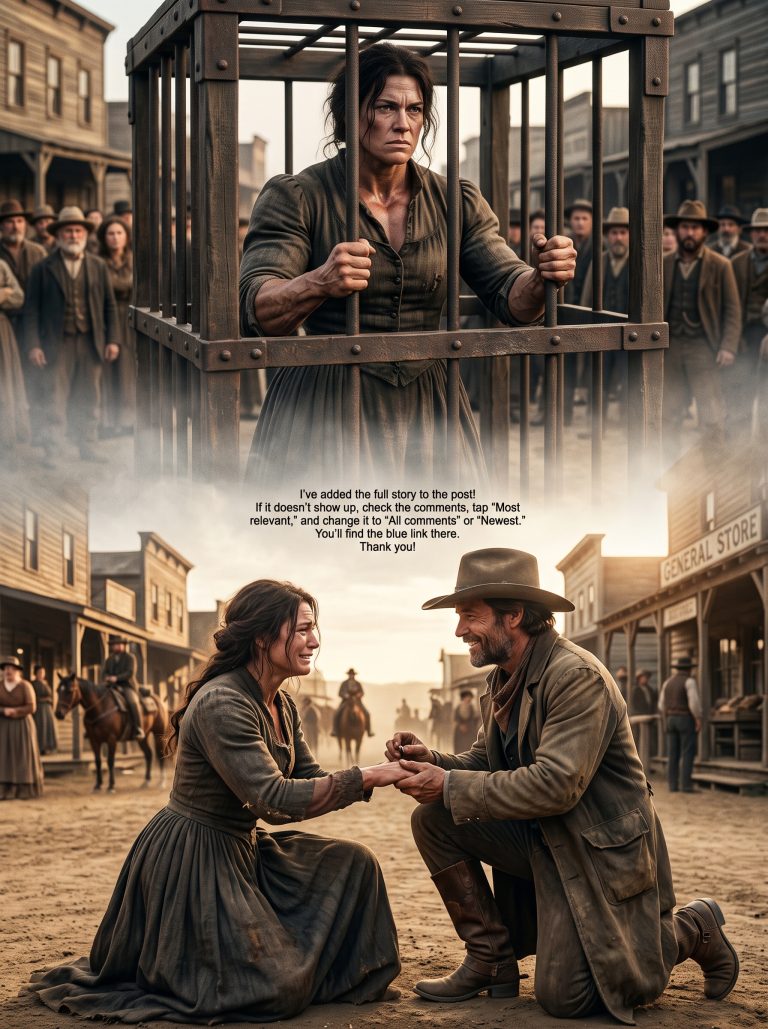
Emmett’s pulse jumped. In all the chaos of the wagon and the bull and the whispering neighbors, neither of them had actually said the thing out loud. He reached into his vest and drew out the small wooden box he’d been carrying, unopened, since before dawn.
Inside sat a ring carved from a fallen oak branch, sanded smooth over three months of quiet evenings. No gold, no jeweler’s polish — just hours of a man’s hands working something plain into something he hoped would be enough.
“I’d planned to do this properly,” he admitted, voice dropping low. “Wait until we’d talked. Until I was sure you weren’t disappointed by—” he gestured at himself, at the modest cabin behind them, at everything that hadn’t matched whatever picture she’d carried on the ride out. “By all of this.”
Willa stepped closer. Close enough that he caught the honest smell of hard work still on her sleeves, and saw real curiosity in her eyes as she looked down at the box.
“May I?”
He nodded. She lifted the ring into the moonlight, turning it to catch the grain of the wood.
“You made this yourself.” Not a question. “How long?”
“Three months. I started the day after your first letter came.”
She slid it onto her finger. It stopped at the second knuckle — too small, exactly the way he’d feared, because he’d carved it for hands that existed only in his imagination. The failure of something so small felt, for one aching second, like a verdict on everything else between them.
Then Willa smiled. A real one. It changed her whole face.
“Three months,” she repeated, soft. “You spent three months making something for a woman you’d never met. Based on nothing but letters and hope.” She looked at the ring, still perched too high on her finger. “Do you know what that tells me about you?”
He shook his head, not trusting his own voice.
“It tells me you’re someone who takes care with the things that matter. Who puts real effort into making something beautiful even when nobody’s watching to judge it.” She slipped the ring free and held it up between them. “And it tells me you’re practical enough to know a ring can be resized. Character can’t.”
The words landed harder than he expected. All day he’d measured himself against inches and pounds — the only currency Morrison and men like him traded in. Willa was handing him a different scale entirely, and for the first time all day, he thought he might actually meet it.
“So is that a yes?” he asked, and it came out more uncertain than he intended.
Her answer wasn’t a word. She took his hands in her own broader ones, pressed the wooden ring into his palm, and closed his fingers around it.
“Ask me properly,” she said, gentle but unmovable. “Not because you think you should. Not because of an arrangement made through letters. Because you want to.”
Emmett looked up — really looked, the way he hadn’t let himself since she’d stepped off that wagon. Yes, she stood taller than him, stronger than him, carried a confidence that still made the whole town whisper behind their hands. But there was kindness in her eyes the letters had never quite captured. Intelligence. Humor. Something that looked, unmistakably, like the beginning of affection, for a man she’d known barely two days.
“Willa Blaine.” His voice found its footing with each word. “Will you marry me? Not because of letters, or arrangements, or what the neighbors expect. Because I think we might build something good out here — something worth the two of us.”
“Yes.”
The word sat in the night air between them like something solid enough to hold onto.
“But I have conditions.”
His stomach tightened for half a second — until he saw she was still smiling.
“I want us to resize this ring together. I want to learn to work wood, and I want you to teach me. And I want to teach you everything I know about cattle and horses that might actually be useful out here.”
Relief went through him so fast it nearly buckled his knees. Her conditions weren’t demands that he become someone else. They were an invitation to build something neither of them had the pieces for alone.
“I’d like that,” he said. “All of it.”
Six months on, autumn laid the valley in gold and rust, and Emmett Sloan stood before the whole settlement in the little community church, waiting for Willa Blaine to become Willa Sloan. The oak ring — properly sized now, resting beside a matching band she’d carved for him with her own two hands — caught the light through the window glass.
Their partnership had never stopped being unconventional. It had also, against every early doubt, proven itself. The ranch thrived under the two of them together — Emmett’s patient, careful planning paired with Willa’s strength and her instinct for animals nobody else could handle. Dakota, contained now behind fencing that actually held, had sired calves that promised to be just as formidable as their father and considerably easier to live with.
More than the ranch, though, Emmett had learned something about strength that no measuring stick in town could account for. He would never out-lift Willa or split a fence post in a single swing the way she could. But his patience, his habit of thinking a problem through before charging at it, had taught her something too — the value of planning instead of muscling straight through. Between the two of them, there wasn’t a problem left on that land they couldn’t solve.
The whispering had faded into something closer to respect, and — in more than one house along the valley — something close to envy. Other couples had started to notice the way Emmett and Willa consulted each other before deciding anything. The way they seemed to actually enjoy the dull, ordinary hours of a life together, not just the good ones.
Morrison had stopped smirking back in September, after the flood took out the lower pasture fence and Willa waded into the rising water to drag two of his cattle out by hand, while Emmett’s drainage trench — dug weeks earlier on nothing but a hunch — kept the whole lower field from washing out entirely. He hadn’t said much about it at the time. Men like Morrison rarely did. But as Emmett caught sight of him in the pews that crisp October morning, there was no trace of the old smirk left, only a slow nod as the couple promised to stand behind each other through whatever came.
The arrangement that had begun with an advertisement built on hope and half-told truths, and a ring carved for the wrong-sized hand, was gone now, replaced by something neither of them had known to ask for in their letters — a partnership built on two people who had learned to see each other exactly as they were, and stayed anyway.
Outside the church, as the last of the wedding guests scattered toward the tables set up under the cottonwoods, Emmett slid the oak ring — properly fitted now — onto Willa’s finger, and she closed her hand around his, easily, the way she always would.
THE END