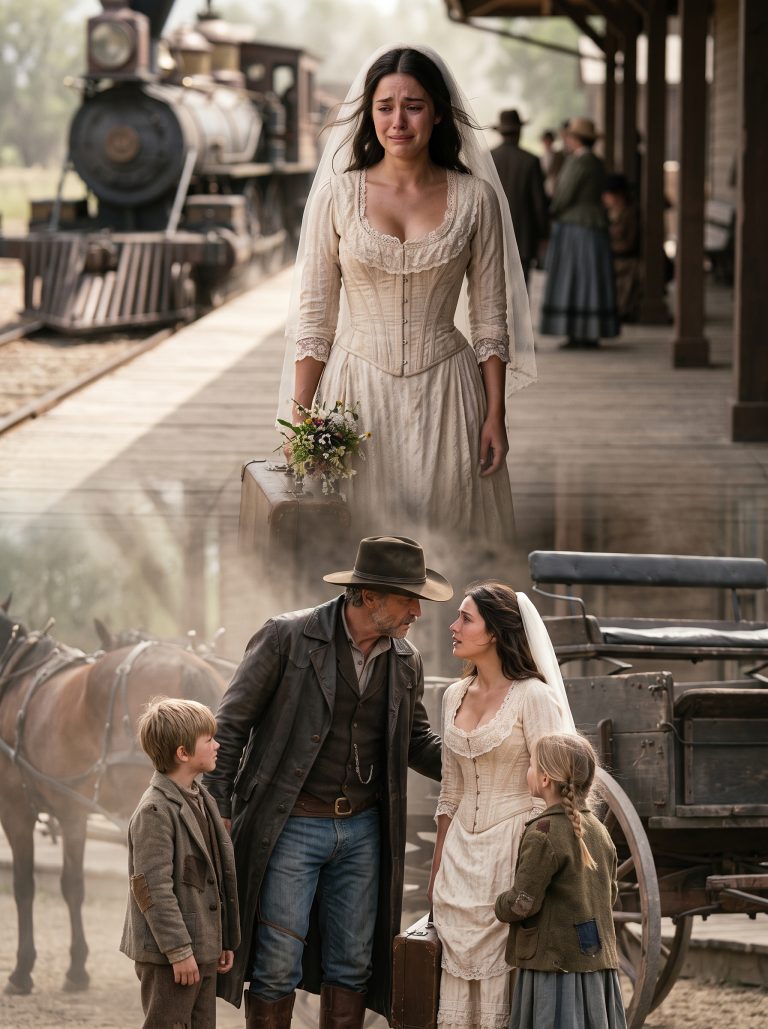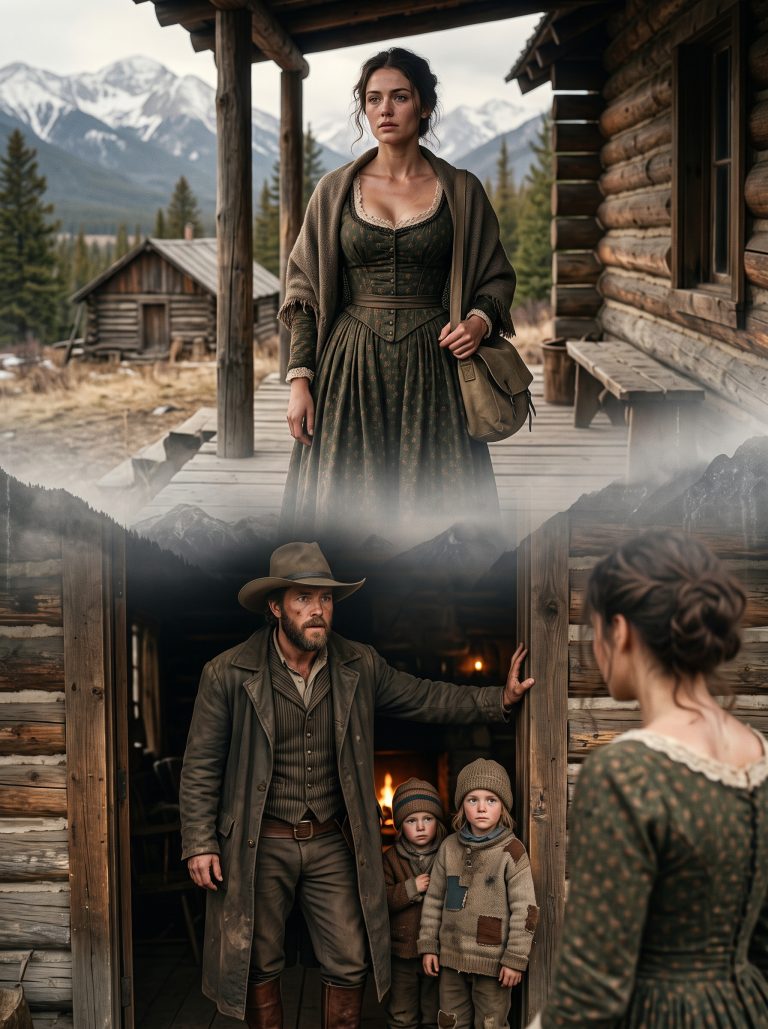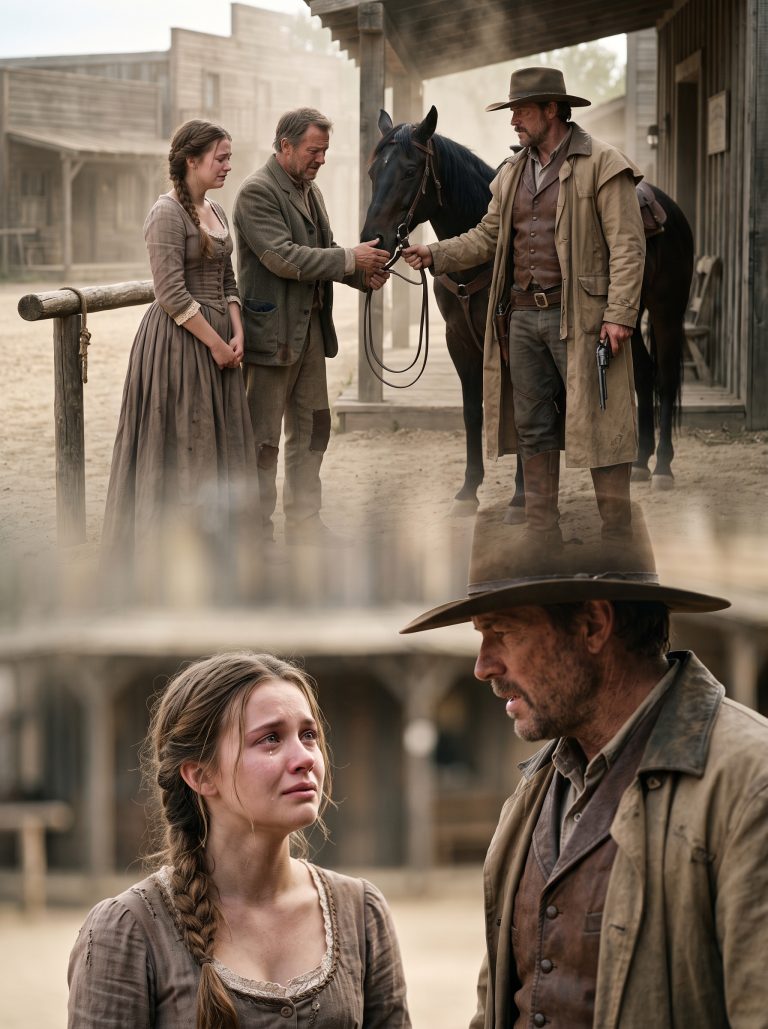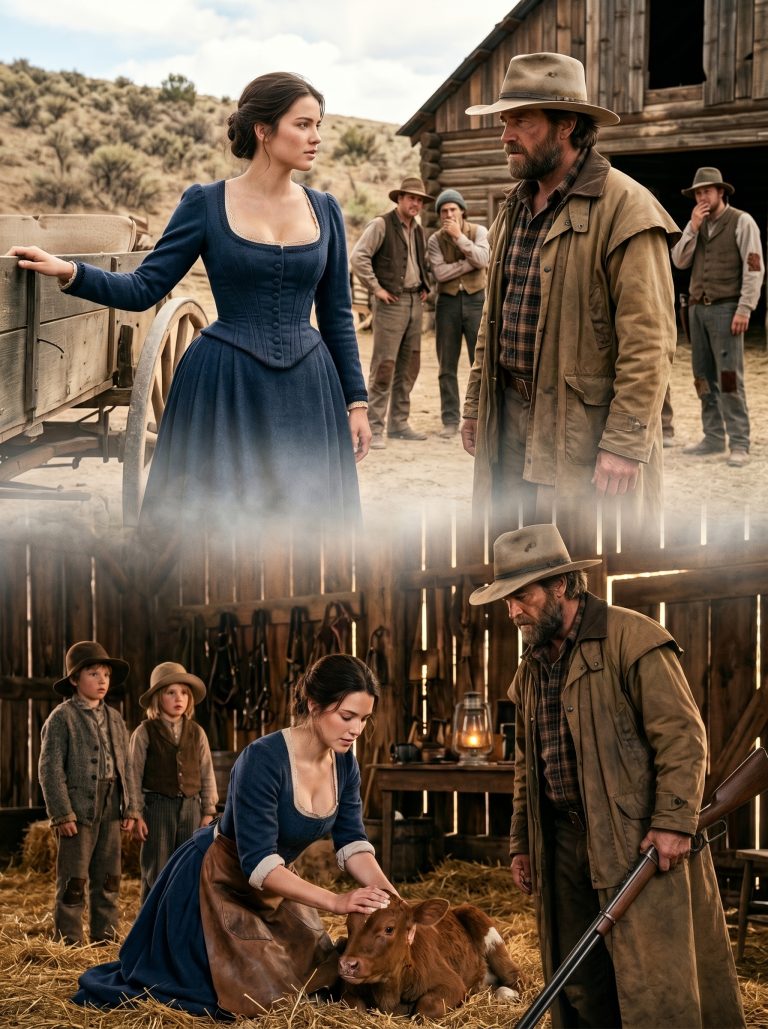
They laughed at the widow’s cabin covered in wild ivy—until the -50°F blizzard hit and the entire town realized she had been hiding something no one understood.

PART 1
Freya Solberg had buried her husband without a single tear, and it was that dry-eyed silence, more than anything Julius Kade ever said to her face, that convinced Frostwell Basin she’d already given up.
Every morning before dawn she proved them wrong the only way she knew how — walking down to the river with a knife in her hand, cutting grape cane and willow switches and dry reeds until her fingers stiffened around the handle, then dragging the whole tangled load home across the frozen grass.
Her older daughter, Signe, twelve and narrow as a fence rail, walked behind her with a coil of salvaged wire over one shoulder. Signe had stopped asking when her father was coming home before the funeral wagon had even finished pulling away from the house.
Ingrid, nine, stayed inside near the stove most mornings. Her cough had gotten worse with the cold — a deep, caught sound that broke loose in sharp little bursts and left her gray-faced afterward. Every time Freya heard it through the cabin wall, she tied the next willow switch a little tighter than the last.
By July, the strange barrier ran the full length of the cabin’s north side — except it didn’t touch the cabin at all. Freya had driven the stakes twelve feet out, angled toward the northwest, and woven cane between them until the whole thing stood taller than a horse.
Halvor Nystrom rode out one afternoon, dismounted, and stood beside it with both hands on his hips.
“You built it away from the house.”
“It was never meant to cover the house.”
“That’s not what folks in town are saying you’re doing.”
“Folks have eyes. They don’t always come with understanding attached.”
He walked the length of it, studying the gaps in the weave. “What’s it for?”
“Catching snow.”
Halvor stared at her like she’d confessed to something.
“You built a wall to bring more snow toward your own cabin?”
“To stop it before it reaches the cabin. My father built walls like this for sheep, back home in Norway — heather and birch and fishnet, anything that slows the wind without stopping it dead. A solid wall just makes the wind angry. It picks the snow back up and drops it wherever it pleases. This one lets enough through to take the fight out of it. The drift builds behind the barrier instead, long and low, and the cabin sits safe on the far side of it.”
Halvor looked at the woven cane for a long moment, then at the gaps between her cabin’s logs where daylight still showed clean through.
“That wall needs more than snow behind it.”
“I know.”
She didn’t tell him she had fourteen cents left in the house. He didn’t ask. He rolled up his sleeves instead and started scraping rotten moss out of the worst gap in her sill, and came back the next morning with a wagonload of clay, straw, roof shakes, and a door too wide for her frame that he swore he could cut down to fit.
“Why?” she finally asked him, arms folded.
He looked past her, through the open doorway, to where Ingrid lay sleeping under her father’s old coat and Signe sat mending a stocking beside her.
“Because a child shouldn’t have to cough through daylight.”
Freya’s jaw tightened. She had survived the funeral without breaking. She had survived the railroad’s contractor counting nine dollars and forty cents into her palm like her husband’s whole life had been worth no more than a broken shovel. But kindness, offered plainly like that, still threatened to undo her completely.
“I’ll repay you.”
“When the cabin stands.”
“It stands now.”
Halvor pushed one finger between two logs. Daylight showed clean around his knuckle.
“It pauses,” he said. “That’s not the same thing.”
By August the north wall no longer leaked daylight. By September it had shutters and a door that finally fit its frame, and the vine barrier beyond it had turned red and brown with the season, leaves fluttering, birds nesting deep in the thicker sections — looking, to anyone riding past on the road, even more foolish than it had in July.
Children rode out from town that autumn just to see what the neighbors had started calling the widow’s garden. Signe was outside splitting kindling when they arrived.
“Your mother growing grapes for winter?” one boy called.
“Maybe she thinks leaves are blankets,” said another, pointing at the woven wall.
Signe kept chopping until the first boy rode closer and told her, plain as weather, that his own father said Julius Kade would own the place before Christmas. The axe stopped. She told him her father had bought the claim outright. The boy told her, just as plainly, that her father was dead — and Signe lifted the axe, not at him, but high enough that every horse in the yard stepped backward on its own.
“My father being dead does not make your father brave,” she said, and the boys rode off without another word.
That was exactly when Julius Kade rode out to remind Freya precisely how much of her stubborn, foolish life still legally belonged to him.
PART 2
Kade arrived two weeks before the note came due, dismounting beside the barrier in a black wool coat too fine for a homestead road, and ran one gloved hand along a willow stake like he was already pricing the wood for salvage.
“Considerable labor,” he said. “Should’ve spent it improving the claim instead.”
“I did.”
“I mean something with value.”
“The value comes when the snow does.”
He smiled thin and told her the note — twenty-eight dollars her husband Anders had signed two months before the blasting accident that killed him — now carried an extra dollar twelve in what he called an administration fee, added, he claimed, the moment a purchaser died. He showed her the paper. Anders’s signature sat at the bottom in faded ink; above it, one sentence sat in ink that hadn’t faded at all.
“That line wasn’t there,” Freya said.
“You were present when he signed?”
“I knew my husband.”
“That isn’t the same as knowing his papers.”
He offered her a way out — surrender the claim, take the girls to a laundry in Bismarck, Signe old enough to work. Freya told him her daughter wasn’t for hire, and that he could return on the first with the original note, not the one he’d just tried to hand her, and watched something cold and startled move behind his eyes before he rode off into the gathering frost — because she had seen exactly what he’d hoped a grieving woman would be too tired to notice.
That night she opened her husband’s tool chest, still smelling faintly of pine pitch and the soap he wore to church, and found, beneath a coil of rope, the ledger he kept on everything — nails, hours, meals owed, money advanced. Near the back, in his own careful hand: Paid J. Kade: $31 deposit. Balance $28 due December 1. No added charge upon death or injury. Kade retains duplicate. Halvor Nystrom witness.
Halvor read the entry standing beside a half-finished coffin in his own shop the next morning, and told her plainly that Kade owned the grain warehouse, the freight yard, half the notes in Frostwell Basin — and the mortgage on the very shop they were standing in.
“Then why testify?” she asked.
“Because a witness who stays quiet is just another kind of forgery,” he said. “Your husband could barely write English legal words. He made me read every line before he signed it. There was no death fee. I’ll say what I saw, whatever it costs me.”
PART 3
The payment fell due beneath a pale, snow-threatening sky.
Freya had scraped together twenty dollars — seven earned washing railroad bedding, five more from Halvor quietly overpaying for a repaired harness she knew was worth half that, three pressed on her by Agnes Kirby under a flour tin for herbs Freya had never actually given her and refused twice before finally accepting. She was still eight dollars and change short when Kade arrived at noon with Sheriff Warrick Dunn and two men from his freight yard, snow already sliding sideways through the air.
“You’re short,” Kade said, not bothering to dismount.
“I owe eight more.”
“Nine, twelve, with interest.”
“The note said twenty-eight dollars total.”
Freya opened Anders’s ledger and held it up where the sheriff could see it plainly. Halvor, standing near the cabin with a hammer through his belt, said flatly that there had been no death fee, not one word of it added to what he’d witnessed, and when Kade turned his cold gaze on him and reminded him whose mortgage he still owed, Halvor didn’t so much as blink.
“Your memory seems remarkably convenient,” Kade said.
“My memory is exact. Your paper isn’t.”
Sheriff Dunn cleared his throat and allowed, reluctantly, glancing between them both, that county rule gave a debtor thirty days before physical removal, whatever the note itself claimed. Kade’s calm cracked half a degree, jaw tightening under his trimmed beard. He dismounted, crossed to the vine wall, and seized a willow stake in one gloved fist, testing its give.
“This structure may damage the claim’s value before transfer.”
“You own nothing here yet,” Freya said, stepping between him and the barrier. Behind her, Signe lifted the wood axe without being asked. Ingrid appeared in the doorway holding a whittled willow whistle that made almost no sound at all. Kade let go of the stake.
“Thirty days,” he said, and rode off into the first real snow of the season, his two hired men falling in behind him without a backward glance.
The barrier did exactly what Freya had promised it would. Within three days a drift rose waist-high against the vines and tapered gently toward the cabin, leaving the north wall nearly bare, the wind sliding up and over the packed bank instead of striking the logs directly. Inside, the lamp flame stopped leaning south. The stove ate less wood. Ingrid slept without her coat on for the first time in weeks.
Then, ten nights before the deadline, a rider stopped near the northern corner of the claim after dark. Freya saw the match flare of his cigarette, then nothing. By morning three of the vine supports had been cut clean through with an axe, and a slumped, frozen wound had opened in the barrier’s line.
“Kade,” Signe said.
“We don’t know that.”
“We know.”
They repaired it with green willow before noon. Halvor arrived, studied the axe marks, and announced he’d be staying the night with his rifle. Nobody came back. The following afternoon a railroad rider brought word down from the western station: an arctic mass was dropping out of Montana, temperatures already down sixty degrees in a day, every household told to gather fuel and stay indoors. Kade’s warehouse auctioned off its remaining firewood before sunset and doubled the price doing it. Freya counted four cords in her own woodpile — enough for an ordinary month, perhaps two weeks of the cold that was coming.
She refused Halvor’s offer of the church cellar, refused his shop with its exposed north wall, and told him the truth instead: they couldn’t outrun what was coming, only prepare for it. He took off his coat.
“I’m staying,” he said, and told her, in the same breath, that Kade had called his shop’s mortgage due that very morning, the moment he’d finished testifying against him. He had nowhere left to go, and hadn’t told her because she’d had enough winter of her own to carry already.
The blizzard hit after dark, wind striking from the northwest with a force that made the whole cabin groan against its foundation, snow hissing across the roof like something alive trying to get in. They rationed the stove by Anders’s old clock — one split log every forty minutes, because fear burned fuel faster than cold ever did — and near midnight felt the shaking stop while the roaring outside went strangely muffled. Snow had climbed halfway up the outer shutter. The vine wall, buried now, was still doing exactly what Freya had built it to do, drawing the drift up around the cabin’s lower logs like insulation instead of letting the wind strike them bare.
“It’s warmer,” Halvor said, one hand flat against the north logs.
“The wind can’t touch it directly anymore.”
By dawn the thermometer read thirty-eight below, and falling, the wind driving it lower still. At noon, three weak knocks sounded at the door. Freya tied a rope around Halvor’s waist before letting him open it, and out of the white poured Agnes Kirby, her son Peter, and Agnes’s small daughter with no feeling left in her feet — their own chimney collapsed, their fire smothered by wind. Freya warmed the girl’s feet slowly in cool cloth first rather than risk the stove’s direct heat, the way her own mother had once shown her.
By evening nine more arrived: the Peterson family, whose wagon horses collapsed near the vine wall and had to be pulled free by rope; an elderly bachelor named Doyle who’d followed the line in on foot after his own stove cracked clean through; two boys carrying their mother between them on a barn door, her leg twisted wrong beneath her skirts. Every story was the same. Wood gone. Chimney broken. Fire dead in the wind before it could catch properly.
By midnight, twenty-three people filled one small room and a loft built for four. Children lay shoulder to shoulder along the southern wall. Wet clothing steamed on every peg in the cabin. Agnes organized the food without being asked, ladling broth into whatever cup or bowl came to hand, and Signe kept the upper vent clear all through the night with a broom handle so no one would wake gasping.
They changed everything to survive it — one fire for cooking at dawn, one at dusk, the stove kept low between, warm blankets pushed beneath the children instead of over them to block the cold rising through the floor, coats shared, everyone eating from one pot. On the second night the temperature hit forty-six below and the roof began creaking under three feet of packed snow on its southern slope; a vine support cracked outside, and a wave of shifted drift struck the north logs hard enough to split a chinking seam and send powder snow screaming through the gap. People screamed inside the cabin, children clutching at the nearest adult. Freya broke a chunk of frozen clay loose with Anders’s hammer, warmed it against her own body until it softened, and packed it into the wound herself while Halvor and three men braced the wall with their shoulders, straining against a pressure none of them could see but all of them could feel building.
“If another section falls,” Halvor said, breathing hard, “the drift could crush the sill entirely.”
“Then we release it before it can.”
“You can’t go outside in this.”
“We use the loft.”
Freya climbed to the loft, tied a rope around her waist and a shovel to her wrist, and crawled out onto the roof through the small western hatch into cold that hit like a physical blow, stealing her first breath entirely and barely allowing her second. She stayed low, crawling toward the north edge where the buried vine wall had vanished beneath the snow except for its tallest willow tips, and cut a channel down the drift’s steep side with the shovel, bleeding off the pressure one shovelful at a time before it could bury the wall for good.
That was when she saw the horse — riderless, reins frozen stiff, dragging behind it across the white. A half-buried sleigh stood fifty yards out, tipped where a hidden wash had swallowed one runner, and a shape lay in the snow beside it, unmoving except for the faint rise and fall of its shoulders.
She tied a second rope to the roof anchor and lowered herself down into the drift toward it.
It was Julius Kade. His fine black coat had torn at the shoulder, one hand bare and already going the waxy white of frostbite. Beneath the sleigh’s overturned canvas lay Sheriff Dunn, one leg pinned hard under the runner, and beside him, unconscious, Kade’s clerk, a thin young man named Simon Ashford who hadn’t moved since the sleigh went over.
Kade lifted his head and saw her. For one long moment neither of them spoke, snow driving sideways between them hard enough to sting.
“What are you doing out here?” Freya finally asked.
“Coming for the property,” Kade managed through lips gone blue and stiff. “Thirty days ended.”
He had ridden out through a killing blizzard to claim a widow’s cabin the instant his own deadline ran out, and nearly died doing it. Freya stared at him long enough that he must have wondered, later, exactly what she’d decided in that silence — because for one long breath, with Ingrid’s cough carrying faint through the storm behind her, she considered simply letting him feel the full weight of the snow he’d have let her feel gladly enough.
Then she tightened her grip on the rope and shouted for help.
Halvor and two of the men emerged from the buried snow tunnel with more rope, and together they lifted the sleigh’s runner just enough to free the sheriff’s crushed leg, carried Ashford in first, then Kade, then Dunn on a makeshift sled of canvas and boards. Kade woke beside the stove an hour later to find twenty-seven people now crowded into the cabin he had once called worthless, his gaze moving slowly over the packed floor, the steaming pot, the children sleeping along the warmest wall, before finally settling on Freya.
“You should have let me freeze,” he said.
“Yes,” she agreed plainly, and handed him a cup of broth. “But I didn’t.”
She warmed his frostbitten hand slowly against her own body afterward, ignoring his attempts to pull it back.
“If you heat it too fast, the damage gets worse.”
“I know what frostbite is.”
“Then stop fighting me.”
“You’re enjoying this.”
“No,” she said, meeting his eyes directly. “That’s the difference between us.”
By the third day the last split log was gone, and they broke apart the table, then the stools, then the storage chest, before Kade finally admitted, ashamed into his blanket, that his freight shed two miles east held twenty sacks of coal he’d been holding back to sell once wood prices climbed higher still.
“You knew families were out of wood,” Freya said.
“I couldn’t distribute stock without payment. It would have ruined the business.”
“It would have saved lives.”
Agnes Kirby looked ready to strike him with the soup ladle in her hand. Nobody argued the point further; there wasn’t time to.
The buried vine wall’s line, even snowed under, gave them a straight, sheltered path most of the way there — the lee side of the barrier held calmer air even now, exactly as it had all along. Halvor and two railroad workers made ready to go, tying every spare rope together into one long line, and Signe stepped forward before anyone could stop her.
“I know where the drainage ditch crosses the road. Without someone who’s walked it, you’ll fall straight through.”
“No,” Freya said immediately.
“I’ve walked it every single day of my life. The tall cottonwood stands right beside it. I can find that even in this.”
“You remain here.”
“I have walked it every day,” Signe said again, steady. “Before the snow, and I’ll know the shape of it under the snow too.”
Halvor looked at Freya. “She may save us real time out there.”
“She’s twelve.”
“So was I when my own father sent me onto a roof in a January storm worse than this one.”
“That’s not an argument.”
“It’s not meant to be. It’s just true.”
Freya wanted, more than she had wanted almost anything in her life, to forbid it outright — to place both her daughters under every blanket in the house and hold them there until spring finally broke. But she remembered her own father trusting an eleven-year-old girl to read winter wind while grown men stood by and laughed at the idea of it, and she understood, standing in her own doorway with her daughter’s coat already half-buttoned, that fear could protect a child for exactly as long as it also taught her never once to trust her own judgment again.
She tied the rope around Signe herself, checking each knot twice.
“You stay between Halvor and the others the whole way.”
“I will.”
“If the rope jerks twice?”
“Stop where I am.”
“Three times?”
“Turn back.”
“And if you see the cottonwood?”
“I don’t leave the line, not for anything.”
Halvor leaned close to Freya before they left. “I’ll bring her home.”
“You’ll bring all of you home,” Freya said, and meant it as both a blessing and an order.
They vanished into the white along the line of the buried wall, the rope paying out steadily through Freya’s own hands — twenty feet, forty, eighty — until even the shapes of them were gone completely.
For three unbearable hours the cabin waited. The temperature inside kept dropping. Breath hung visible in the lamplight. Freya fed the stove pieces of the last remaining chair, one at a time, and Ingrid sat by the door with her willow whistle, blowing it uselessly again and again.
“It doesn’t make a sound anyone could hear,” Freya reminded her gently.
“I know.”
“Then why do you keep blowing it?”
“So Signe can find us.”
Freya didn’t have the heart to tell her that no whistle, however loud, could carry through a storm like this one. Ingrid blew into it again anyway, and this time a thin, real note actually emerged — faint, but unmistakably there, some blocked airway finally cleared loose by Halvor’s careful repair weeks before. Everyone in the crowded room went still at the sound of it.
Three knocks came at the door soon after. Halvor collapsed through it first, carrying a coal sack on his back. Then Peter Kirby, another sack behind him. Then Signe, roped to the last man, dragging a third sack of her own, her eyebrows crusted white with ice and her whole face lit up despite it.
“The cottonwood was still there,” she said, breathless. “Right where I said it would be.”
The coal burned hotter and longer than wood ever had, and carried them through to the fourth morning, when the wind finally stopped and the whole prairie went unbearably silent. Outside, barns had vanished, a windmill lay twisted across the road, entire walls had been torn off houses in town — but Freya’s cabin stood, buried gently in a hollow of its own making, the vine wall gone but its long white shoulder still standing guard along the north side exactly where she’d asked it to.
Newspapers came from as far as Fargo to write about the widow’s living snow fence, one reporter asking outright whether she’d invented it herself. “No,” Freya told him. “Wind and snow existed long before me. I only watched where they wanted to go.” Kade, once his hand was properly bandaged, asked to speak with her alone and offered to forgive the cabin debt outright, standing near the north wall and avoiding the eyes of the families he’d nearly left to freeze over twenty sacks of coal.
“In exchange for silence about the coal,” Freya said. It wasn’t a question.
“No one knew how severe the storm would turn.”
“You knew families were already out of wood before it ever hit.”
She refused the gift entirely. Made him mark the twenty dollars paid, strike the false balance from the paper with his own hand, extend the final eight for the thirty-six days the storm had cost the county road, and return Halvor’s shop to its original terms — reminding him, quietly, that Sheriff Dunn had watched him carry a forged note into her yard with his own two eyes, and that county prosecutors and newspapers alike might find that particular detail more interesting than any story about vines.
“You negotiate boldly,” Kade said, “for a woman who just burned her own furniture to stay alive.”
“I have more now than I did before the storm began,” Freya said, glancing out at the people already rebuilding the vine wall together in the yard — Agnes carrying stakes, Sheriff Dunn directing repairs while balanced on a crutch, Signe and Peter weaving fresh cane into the gaps side by side.
Kade buttoned his coat and left without another word.
She paid the last eight dollars by March, earned sewing tarps and selling willow snow barriers to three neighboring farms who’d stopped laughing the moment their own north walls stopped groaning in the wind. Spring showed her something she hadn’t expected — half the cut willow stakes had taken root in the damp soil, sending up green shoots of their own, the fence slowly becoming a living thing rather than a built one. Agnes Kirby stood beside it one afternoon, running a hand along a new green shoot in disbelief.
“You told me there were no roots.”
“There weren’t. Not when I built it.”
“There are now.”
“Yes.”
By summer half of Frostwell Basin had copied it in one form or another — willow, reeds, corn stalks, slatted boards, whatever a family had on hand — and the railroad hired her outright to design snow barriers along two exposed track cuts where locomotives had buried themselves twice already that winter. She used the first payment to replace the cabin table, the second for proper medicine for Ingrid, the third for glass in a south-facing window that finally let real morning light into the room. Ingrid’s cough eased with the warmer months and, by the following winter, was simply gone.
Halvor rebuilt his shop that same summer and kept finding reasons to still be on her roof come evening, mending shakes that scarcely needed mending. On an autumn night, nail turning idle between his fingers, he told her plainly that he wasn’t Anders, didn’t want to replace him, only wanted to remain after the work was finished.
“The work here is never finished,” she said.
“I had hoped you’d say that.”
“You have no house of your own.”
“I own a shop.”
“You sleep above coffins.”
“They’re quiet neighbors. Never once complained.”
“I have two daughters.”
“I know both their names.”
“One of them dislikes you.”
“Bishop is a hen,” he said, and Freya laughed despite herself, a sound that startled them both. “I’m willing to negotiate with her too, if it comes to that.”
They married the following spring beside the living willow fence, Signe standing up with her mother, Ingrid scattering wild grape flowers from a tin cup, Sheriff Dunn performing the ceremony because the traveling minister had broken a wagon wheel twelve miles off and couldn’t make it in time. Agnes cried louder than anyone in the small crowd. Bishop attacked Halvor mid-vow and nobody considered the marriage any less official for it.
Years afterward, Signe became a railroad engineer, laying snow fences across hundreds of miles of northern track and showing skeptical older men photographs of buried locomotives until they finally chose sense over pride and let a young woman tell them where to build. Ingrid became a doctor who never once refused a family that couldn’t pay her, a small silent willow whistle hung above her office door for the rest of her working life, a reminder she never had to explain to anyone who’d lived through that winter with her.
Kade lost his hold over the valley slowly, the way frost loses its grip on a windowpane — not all at once, just a little more each season, until people finally stopped mistaking his wealth for authority entirely. He came back once, years later, gray-bearded, one hand still stiff from that terrible night in the snow, to stand beneath the fence grown thick with grape leaves and nesting birds and tell Freya she’d been right about the vines all along.
“They weren’t ever the important part,” she said, tying new growth into the weave without looking up even once.
“The snow, then?”
“No. The important part was knowing the storm could be useful without ever believing it was harmless.”
He asked if she regretted saving him that night in the snow.
“Some mornings,” she said, and meant it, and he laughed for what she was fairly sure was the first honest sound she’d ever heard out of him.
When Freya died many years later, quietly in her own bed with her whole family gathered close around her, the town planted willow the entire length of the road out to her grave, and every winter since, snow has settled gently behind it in one smooth white line, exactly where she once taught it to lay itself down. Her daughters chose the words for the stone themselves:
SHE TAUGHT THE WIND WHERE TO LAY DOWN ITS BURDEN.
People still tell the story of the widow who planted a strange, useless-looking wall of vines beside a half-built cabin. The details drift a little further every year — the cold gets colder, the wall gets taller, the storm gets crueler in the retelling. But the people who actually lived through that night remember it plainly enough. Freya Solberg owned no miracle. She had thirty-one dollars, two daughters, three hens, and a house that could barely hold back the wind on its own.
What saved twenty-seven people wasn’t decoration.
It was attention — noticing where the snow already wanted to lie down, and simply teaching it to lie down somewhere that wouldn’t cost anyone their life.