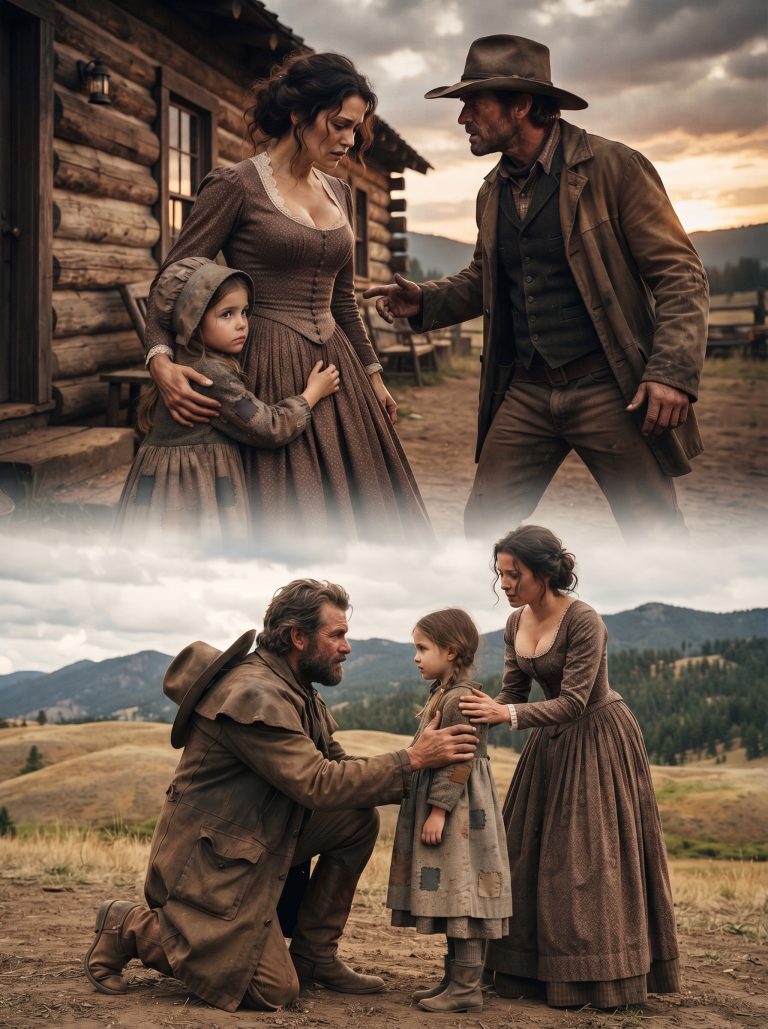
The Mafia Boss Mocked the Chubby Waitress as a “Poor Cow” in Italian—Then Her Reply Brought Up His Dead Mother

PART 1
Dominic Castellano spoke Italian to the waitress because he assumed she was too tired and ordinary to understand him.
The restaurant was his. Trattoria Castellano. The kind of place that existed on both sides of Chicago—elegant enough for legitimate business, protected enough for less legitimate ones. The lunch rush was chaos. A toddler screaming. Customers complaining. Emily struggling through it all.
Dominic watched from his corner booth and felt bored.
“Look at this exhausted creature,” he murmured in Italian to the men beside him. “Probably eats more than she serves.”
Every fork in the room paused.
Emily Callahan, twenty-nine years old, already insulted once that afternoon by a customer who thought her body was the problem with his meal, stopped walking.
Then she turned around.
She looked at Dominic with brown eyes that contained no shame, no anger, only a calm so complete it unsettled him before it frightened him.
And she answered him in Italian.
Not classroom Italian. Kitchen Italian. Real Italian. The kind that carried rhythm in the bones.
“Maybe,” she said quietly. “But at least I know how to treat people. It seems you never learned.”
Marco, Dominic’s right hand, froze mid-swallow.
The second man stared at the wall like he was praying to become part of it.
Dominic did not move.
Emily tucked her order pad under her arm. Then, in English, as if he had not just insulted her in front of criminals, she said, “You look hungry. The tagliatelle is fine. But ask the kitchen for the pasta with the slow butter sauce. It’s not on the menu.”
Dominic’s jaw tightened.
Emily continued, “Tell them to add a pinch of dried calendula to the cream. Most people skip it. It changes everything.”
She walked away.
And Dominic Castellano, who had once watched men beg for their lives without blinking, went cold from the inside out.
A pinch of dried calendula.
He was nine years old again.
Sunday morning. Chicago winter. His mother, Rosa Castellano, standing over the stove in a blue sweater, stirring cream and butter as if the world outside their house could not touch her there.
“Don’t write this one down, Dominic,” she had whispered, smiling at him. “Some things should live in hands, not paper. A pinch of dried calendula. It changes everything.”
It was the only recipe she never wrote down.
The recipe she took with her when she vanished in the spring of 1999.
The recipe no living person was supposed to know.
Rosa Castellano had disappeared when Dominic was eleven. His father, Giuseppe, told him she ran away. Others whispered she was dead. Some said she betrayed the family.
Dominic had spent twenty-five years becoming the kind of man who did not ask questions that hurt.
Now a waitress he had mocked knew his mother’s secret.
He stood abruptly.
“Marco. Find out everything about her. Name. Address. How long she’s worked here. Everything.”
By evening, Dominic knew Emily had worked at Trattoria Castellano for nine months. Before that, a diner. Before that, hospital cafeteria. She lived in a walk-up apartment. She took care of an elderly grandfather named William. She paid rent on time and had no criminal record.
He followed her himself.
Emily walked home with groceries, no earbuds, no phone. She stopped to help an old man pick up a dropped glove. She waited for a mother with a stroller. She moved through the city like someone unprotected but refusing to hate it.
At her apartment, she opened the door to find him standing there.
“You came about the recipe,” she said.
Emily stepped aside. “Come in before Mrs. Doyle calls the cops just for fun.”
Inside, an elderly man sat eating soup with the careful dignity of someone who had survived enough to stop being impressed by trouble.
“My grandfather, William,” Emily said.
William looked Dominic up and down. “You the restaurant man?”
“Yes.”
“You insult my granddaughter today?”
Emily closed her eyes. “Grandpa.”
Dominic said, “Yes.”
William nodded. “Then sit. You can be useful by being quiet.”
Emily went into the bedroom and returned with an old cookbook. Stained cover. Taped spine. Pages swollen from steam and use.
“A woman named Maggie gave me this,” Emily said. “She raised me after my parents died when I was four. She taught me Italian. She taught me to cook. She said memory is sometimes the only inheritance poor people get.”
Dominic stared at the book.
Emily continued, “She taught me the butter sauce. She said someone she loved gave it to her.”
Dominic opened the cookbook.
Margins filled with handwriting. Notes about grief. A life hidden between recipes.
Then a photograph slipped from the back pages.
Two women stood outside a small restaurant with warm light in the windows. One was older, kind-faced. The other was Rosa.
Younger. Alive. Smiling.
Dominic’s hand flattened over the wood.
Emily watched him carefully.
“You know her,” she said.
Dominic turned the photo over.
On the back: New Orleans. Come find us.
For the first time in years, the past breathed against his neck.
“Pack a bag,” he said.
Emily stared at him. “I have work tomorrow.”
“I own the restaurant.”
“And I own my life.”
He almost smiled.
William pushed his soup bowl away. “Go, Em. It’s time you found out why you carry that book.”
Emily looked at Dominic. “If this gets dangerous, I leave.”
Luca thought of the photo. His mother’s smile. The recipe. The words.
“It was dangerous before I knocked,” he said.
New Orleans swallowed them whole.
Heat. Music. River air. Streets that remembered every sin ever committed.
Marco drove while Dominic and Emily followed leads like breadcrumbs from a story someone had left half-finished.
The restaurant from the photograph was gone, replaced by a shop selling masks and tourist trinkets. But the bones of the building were the same.
They found an old Creole man named Auguste Duplessis. He studied the photo on his porch, shaded by banana trees and secrets.
“Rose and Marie,” he said. “Quiet woman. Paid rent three months ahead. Sat with her back to walls.”
“Which was she?” Emily asked. “Military or hunted?”
“Hunted.”
He gave them another name.
Celestine Theriot. Former chef. Seventy years old. Garden District.
Celestine opened her door in a flour-dusted apron.
“Rose and Marie,” she said. “Come in. I’ll make coffee. People tell the truth better when their hands are busy.”
Her kitchen smelled like chicory, butter, onions.
“She came in 1999,” Celestine said. “Bruise on her jaw. No luggage. She needed work and didn’t ask questions back.” She paused. “She talked about a son. Said she hoped he was becoming a better man than the world wanted him to be.”
Emily looked at Dominic, but he did not look back.
Celestine rose and returned with an old folder.
On a yellowed form from February 2000 was a signature.
Marie Fontaine.
His mother’s handwriting.
“What happened?” Dominic asked.
“One morning she didn’t come in. Rose came alone to get their things.”
Celestine’s face grew grave.
“Rose said they found her again.”
But Rose had left trails.
A name. Gerald Wright. Now retired in Memphis.
They drove north the next morning.
Louisiana faded into Mississippi, then Tennessee hills.
In the back seat, Emily read through Rose’s cookbook again and again, finding tiny notes she had ignored for years.
Dominic stared out the window and thought about his father.
Giuseppe had been powerful, feared, respected.
Now Dominic wondered what kind of husband he had been.
And worse, what kind of son Dominic had become in his shadow.
PART 2
Gerald Wright opened his door wearing a veteran’s cap. When he saw Dominic, his face lost color.
“You’re Giuseppe’s boy.”
“Tell me why that scares you.”
Emily stepped forward before Dominic could press harder.
“Mr. Wright, we’re trying to find out what happened to Rosa Castellano.”
The old man looked at her.
Something in her face persuaded him.
He let them in.
“I was a courier,” Gerald said. “Between the Castellanos and Sal Moretti’s operation. In 1999, I saw financial records. Money moving from Castellano accounts to Moretti’s operation. Years of it.”
“Someone inside was selling you out,” Dominic said.
Gerald nodded. “Your mother knew. She came to me. Asked if what she found was real. I told her yes.”
“And then?”
“Three days later, she disappeared.”
Emily’s voice was barely above a whisper. “Did she know who?”
Gerald closed his eyes.
“She said Carlo.”
The room turned silent.
Carlo Feretti.
Dominic’s uncle.
His father’s brother.
The man who sat at every family table. The man who stood closest to Giuseppe’s coffin. The man who kissed Dominic on both cheeks every Christmas.
“She was going to expose him,” Dominic said.
Gerald nodded. “And men like Carlo don’t wait to be ruined.”
That night, at a roadside motel, Dominic woke to a sound that did not belong.
Metal against old paint.
He grabbed Emily and dragged her into the bathroom as the window exploded.
Marco came through the connecting door with his gun drawn.
Forty seconds of chaos. Footsteps. Shouts. Tires screaming away.
Then silence.
Emily stood barefoot in broken glass.
“They know,” she said.
“Yes.”
She looked at him.
Most people would have begged to go home.
Emily wiped dust from her cheek. “Then we’re asking the right questions.”
The clue came from Rose’s cookbook margin.
St. Michael’s, Arkansas. He’ll keep them safe.
Father James, eighty if he was a day, opened the door with bright eyes and a sad smile.
“I wondered which one of you would come first,” he said.
He made tea before giving them the letters.
Four envelopes tied with kitchen string.
Rosa’s handwriting.
Dominic read in silence.
Vincent’s betrayal. The stolen money. The threats. Her escape. Her years of running.
Then the letter turned.
There had been another family. Innocent people close enough to danger to be destroyed by it. Rosa had tried to warn them. She was one day too late.
They were killed in spring 1999.
They left behind a four-year-old daughter.
Rosa found the child before Carlo’s men could erase the last witness.
She gave the girl to Rose.
She told Rose to hide her, raise her, love her, and never let the Castellano name touch her.
Emily set the letter down.
“My parents,” she whispered.
Dominic’s voice came rough. “My mother tried to save them.”
Emily looked at him, devastated.
“She was too late,” Dominic said. “So she saved you.”
They drove across Nevada.
Maria reached over and put her hand on Dominic’s. He turned his palm upward and held it.
That was the apology.
That was the forgiveness.
The last clue was in Rosa’s fourth letter.
Box 114. Ridgeway Post Office. Colorado.
Inside was a hand-drawn map.
A dirt road. A river crossing. A tree line. A cabin.
At the bottom: Come alone.
The cabin sat high in the mountains, hidden among pine trees and cold air. Inside were fourteen journals.
The last entry was dated four months earlier.
Dominic’s hands began to shake.
“She’s alive,” he whispered.
Emily looked up. “Where?”
“Tide Harbor, Oregon.”
PART 3
The Pacific Ocean looked too large to trust.
Dominic stood at the edge of Tide Harbor’s small harbor, watching fishing boats rock on gray water while gulls screamed overhead.
The town was small enough that a stranger’s arrival mattered. A bakery. A hardware store. A library.
Emily found the answer at the bakery.
“Anchor Lane,” the young woman said. “Number seven. Miss Marie buys sourdough on Tuesdays.”
Number seven was pale blue with white trim.
There were herbs in the window box.
Rosemary. Thyme. And at the edge, dried calendula, orange and fragile in the sea air.
Dominic walked up the path and knocked.
The woman who opened the door was old.
Not weak. Not ruined.
Old like a tree is old. Weathered. Rooted. Still standing after storms.
Her white hair was cut short. Her hands were bent slightly at the knuckles. Her face had once been beautiful and had become something better than beauty.
Her eyes were Dominic’s eyes.
She looked at him.
Twenty-five years moved through the doorway.
“Dominic,” Rosa said.
Just his name.
The way she had said it when he was nine years old and dinner was ready.
Dominic could not speak.
Rosa reached for his face, then stopped, as if afraid he might vanish if touched.
He stepped forward first.
When she held him, he felt eleven years old and forty years old at the same time. Rage, grief, shame, relief, and a love so old it had survived underneath everything he had built to cover it.
Then Rosa saw Emily.
Her hand went to her mouth.
“Oh,” she whispered.
Emily stood very still.
Rosa crossed the porch and pulled her into her arms.
No explanation. No hesitation.
Emily broke then.
She sobbed like the four-year-old girl Rosa had saved.
Inside, Rosa made tea.
“I watched from a distance for years,” she told Dominic. “I needed to know what kind of man you became.”
Dominic looked away.
“I became my father’s son.”
“For a while,” Rosa said. “Then you walked into my life with a waitress instead of an army. That told me there was still hope.”
They stayed in Tide Harbor for two days.
Dominic and Rosa walked along the harbor. Sometimes they spoke. Sometimes they did not.
He asked whether Giuseppe had hurt her.
Rosa answered honestly. “Not with his hands. But he loved power more than truth. That can hurt just as deeply.”
He asked whether she hated him for becoming like them.
Rosa touched his cheek.
“I hated the world that taught you to survive that way.”
On the third morning, Rosa packed one suitcase.
“I’m tired of running,” she said.
They drove back to Chicago.
In the back seat, Rosa reached over and put her hand on Dominic’s. He turned his palm upward and held it.
That was the apology.
That was the forgiveness.
That was the funeral for the years they could not recover.
Carlo Feretti arrived at the private club expecting politics.
He wore a charcoal suit, silver tie, and the calm expression of a man who had survived decades by preparing for betrayal except the one buried in his own past.
The room was full.
Seven senior men sat around the long table. Men who had known Giuseppe. Men who had profited from Carlo. Men who respected Dominic because fear had taught them to.
Carlo smiled when he entered.
Then he saw Rosa.
Alive.
Seated at the far end of the table.
His smile died so completely it was almost peaceful.
Dominic laid documents on the table one by one.
Gerald Wright’s statement. Raymond Harper’s testimony. Financial records. Rosa’s letters. Copies of transfers. A federal protection agreement. A formal reopening of the old cases.
Paper can be more lethal than bullets when the truth is sharp enough.
Carlo tried three different defenses.
Confusion. Insult. Rage.
Luca let each one collapse under the weight of evidence.
Finally, Carlo looked at Rosa.
“You should have stayed dead,” he said.
The room changed.
Even men who had done terrible things understood that sentence had crossed a line.
Rosa looked at him without flinching.
“I was never dead,” she said. “You just built your life on the hope that I was.”
Dominic slid the final folder across the table.
“I’m not going to kill you,” he said.
Carlo’s eyes narrowed.
Dominic leaned back.
“I’m going to let the truth do it.”
Within a week, Carlo Feretti was arrested.
Not in violence. Not in drama. Two federal agents came for him on a Tuesday morning while he was drinking espresso in a silk robe.
Old loyalties disappeared with astonishing speed. Accounts froze. Doors closed. Phones stopped answering.
Dominic watched it happen and felt no triumph.
Only exhaustion.
Justice did not always feel like victory.
Sometimes it felt like a room finally going quiet after years of screaming.
Emily quit Trattoria Castellano the following Monday.
She walked into Dominic’s office wearing jeans, a green sweater, and the expression of a woman who had decided she was done being underestimated for minimum wage.
“I’m resigning,” she said.
Dominic looked up. “I was going to promote you.”
“I don’t want to manage your restaurant.”
“What do you want?”
Emily hesitated.
“I want to open a place that feeds people who are tired. Not just hungry. Tired.”
Dominic sat back.
“A kitchen,” she said. “Community dinners. Cooking classes. A small café. Rose always said food is the closest thing poor people have to ceremony.”
Dominic nodded slowly.
“I’ll fund it.”
“No.”
His eyebrows rose.
Emily smiled. “I knew that would bother you.”
“You need capital.”
“I need respect more.”
He studied her.
Finally, he said, “Then let me invest. Minority share. Silent partner. No control.”
Emily narrowed her eyes. “You know how to be silent?”
“No.”
“Then practice.”
Rosa, when told, approved immediately.
“She’s right,” Rosa said. “You have spent enough years owning things. Try helping something grow without putting your name on the door.”
So Emily opened Rose’s Table six months later in a renovated corner space on the South Side.
No velvet ropes. No private booths. No men whispering over blood money.
Just a warm room with mismatched chairs, long wooden tables, framed recipes on the walls, and a kitchen that smelled like butter, garlic, bread, and second chances.
On opening night, William sat near the window with the gray cat carrier at his feet.
Marco wore a suit and looked deeply uncomfortable until neighborhood kids asked if he was security. He said yes, then spent the rest of the night carrying trays.
Rosa stood in the kitchen beside Emily, rolling pasta dough with hands that had hidden, worked, fought, and survived.
Dominic stood in the doorway, watching them.
Emily glanced over.
“You planning to stand there like a haunted statue all night?”
“I’m observing.”
“You’re blocking the busboy.”
He moved.
Later, after the guests had eaten and the room had softened into laughter, Emily brought out one final dish.
Pasta with slow butter sauce. Cream. Patience.
And a pinch of dried calendula.
Most people skip it.
It changes everything.
They sat at the back table: Rosa, Dominic, Emily, William, and Marco, who pretended not to be moved until William handed him a napkin and said, “Big men are allowed to cry, son. Just don’t drip in the pasta.”
Marco coughed violently.
Emily laughed.
Rosa watched her with shining eyes.
Dominic took a bite and closed his eyes.
For a moment, he was nine years old again.
But this time, when he opened his eyes, his mother was still there.
The city outside continued being Chicago. Hard. Loud. Hungry. Beautiful in ways it never admitted.
Inside Rose’s Table, people ate under warm lights.
A former waitress stood tall in the kitchen she had earned.
A woman who had run for twenty-five years finally sat with her back to the room instead of the wall.
A man raised by fear learned, slowly and imperfectly, how to live without worshiping it.
And the recipe that had begun as a secret became what it had always been meant to be.
Not a weapon.
Not a clue.
Not a ghost.
A meal.
A memory.
A way home.
THE END