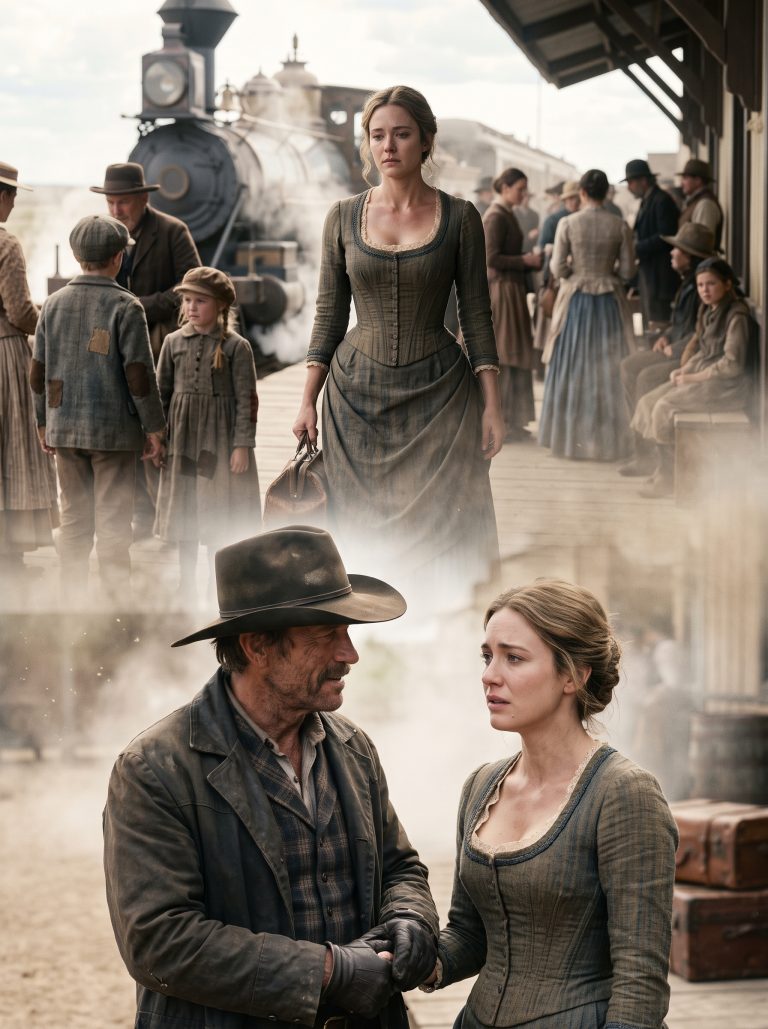
The Mail-Order Bride Came to Bury a Stranger—But the Eight Children Hidden Beneath His Burned Ranch Whispered, “He Said You’d Find the Truth Before the Cattle King Returned…”

PART 1
By the time Nora Calloway reached Redstone Creek Ranch, the house had burned to its bones, the man she’d crossed four states to marry was missing, and the first living voice she found in the ruins begged her not to light another fire.
It came from under the ground.
Thin. Cracked. Too old for the chest carrying it.
“Please.” A boy’s whisper from beneath a cellar hatch. “Please don’t burn us too.”
Nora went still with one hand on the charred doorframe of what had been James Hartley’s kitchen. Ash lifted off the ruined floorboards and settled across her skirt like gray snow. Behind her, the buckboard creaked. Sheriff Walt Calder’s wife, Mae, made a sound between a sob and a prayer.
“Lord above. There are children down there.”
Nora should have stepped back. Any sensible woman would have let the sheriff handle it. But Nora hadn’t come all the way from Ohio for sense. She’d come because she’d run out of rooms where grief could fit.
She was twenty-eight, wide-hipped, round-faced, built in the way that made respectable women say healthy in the tone reserved for old cattle. After her parents died two winters back in a mill fire, she’d learned loneliness had a volume. So when James Hartley’s advertisement appeared in the Western Matrimonial Gazette, she answered.
His letters had been careful, respectful. He wrote of cottonwoods and creek water and a rocking chair he’d started for her because he imagined she might like the porch at evening when the heat finally let go. He wrote as though he wanted someone to stand beside him, not below him.
James’s last letter had said: Come before first frost. I have more to explain face to face.
Now there was no face. No husband at the gate. No house.
Sheriff Calder lifted the cellar hatch. Damp earth and children who had been too long without air.
“Come out,” Calder said. “Nobody’s going to hurt you.”
Silence. Then shuffling.
Nora crouched in the ash. “My name is Nora Calloway. I came to marry James Hartley.”
A small gasp below. A whisper passed child to child.
Then the boy answered: “That’s what they said you’d say.”
One by one, eight children climbed out of the earth.
The oldest came first — a boy of perhaps fourteen, split lip, soot-streaked, eyes hard enough to scratch glass. He moved like someone practicing being a wall. Behind him: a girl with a half-burned braid, twin boys with matching bruises, a freckled boy clutching a flour sack, two girls with locked hands, and last, a tiny girl of about three, hugging a corn-husk doll.
The littlest one looked straight at Nora and began crying without making a sound.
The oldest boy planted himself in front of the others.
“We didn’t steal nothing.” His voice shook. His chin didn’t.
Nora recognized that chin. She’d held her own the same way the morning after the Columbus fire, when neighbors asked what she would do and she’d had no answer that didn’t taste like ashes.
“What’s your name?”
“Levi.”
Each name came slowly, given like something that might be weaponized. The braided girl was Clara. The twins, Sam and Will. The freckled boy Toby, who had carried the flour sack out. The tall girl, Patience. The red-haired one, Ada. The quiet one, Grace. The tiny girl, Lily.
“How long were you down there?”
Levi swallowed. “Three nights. Maybe four.”
Calder crouched near a burned post. “Tools gone. Stock gone. Feed gone. Whoever did this took what they could sell and burned what they couldn’t haul.”
“What happened?” Nora asked.
Levi’s mouth closed. Clara made a warning sound.
“Trouble,” Calder said.
“That’s not an answer.”
“It’s the kind that keeps some folks breathing.”
“Where is James?”
The question lay over the ruin and stayed there. Calder removed his hat. Mae looked away. Levi’s face changed.
“We buried them,” he said quietly. “Me and Clara. Behind the cottonwood by the dry wash.”
Clara was crying now — not seeking comfort. The way a body cries when it’s used up its strength holding a wound closed.
Nora looked past the ash to the cottonwood, green against all that black.
She had arrived expecting to become a wife. Instead she had stepped into a graveyard, a crime scene, and the center of a secret somebody had killed to keep.
Calder said: “We take the children to town.”
Levi stiffened. “No. You didn’t stop them the first time.”
The words hit harder than a slap. Calder only looked older.
Clara watched Nora with the stillness of someone waiting to see whether one more grown person would divide their future into manageable pieces. Nora understood: in town, they’d be separated. Levi for labor. Lily given to a widow with room for one.
“No,” Nora said.
Mae’s eyes filled. “Nora, honey, you have one suitcase.”
“Yes.”
“You don’t own this land.”
“Not yet.”
Calder stared. “Not yet?”
“I came here to marry James Hartley. If he’s alive, I intend to find him. If he’s dead, I intend to find who made him so. And until I know which is true, I will not abandon eight children who were told I was the only person left who might help them.”
Levi’s hard expression faltered.
Then Lily pressed her corn-husk doll against Nora’s arm.
“Her name is Bess,” she said. “She wants to know if we get biscuits.”
Mae Calder was crying before the child finished.
They left Redstone Creek before dark. As the buckboard rattled away, Nora looked back once. The ranch lay black against the red mesa. Smoke climbed in thin ribbons.
On a fence post near the road, something red fluttered.
A neckerchief, knotted around the post like a flag.
Levi saw it. His face went empty.
“Who wears those?” Nora asked.
He stared straight ahead.
“The men who came at night,” he said. “The men who laughed while Papa burned.”
PART 2
Copper Ridge did not look like a town that had watched families burn. Curtains shifted when Calder’s buckboard rolled in with eight smoke-stained children and a woman who’d arrived too late for a wedding. By supper, everyone knew. By morning, everyone had an opinion.
Nora heard enough to understand that Copper Ridge had refined the art of looking away.
At dawn, Calder took her to the land office.
The clerk, Phelps, laughed too small to be honest. “A protective claim on Redstone Creek?”
“As temporary guardian of the Marsh children and surviving fiancée of James Hartley.”
“A promise is not a deed.”
“A letter of intent is a legal instrument.”
He tapped the letters. Nora hated seeing his hands on them.
“There are debts. A note held by Mr. Grant Lassiter.”
Calder went still.
“Cattleman,” he said before Phelps could answer. “Owns the north range, water rights, half the freight this town runs on. Some call him a businessman.”
“And you?”
“Careful.” The word meant two things.
“James Hartley owed three hundred dollars,” Phelps said, “secured against Redstone Creek.”
“James refused a bad bargain. He told me so.”
“Refusal can become debt—”
“Or when another man lies.”
Phelps went still.
The door opened.
“I have always admired direct speech,” said a voice like polished wood.
He entered in a black coat, polished boots, red neckerchief at his throat. Fifty, handsome the way hard men are when money preserves them better than kindness. His eyes moved over Nora — the inventory she recognized. Too soft. Too plain. Too large.
Two men behind him. Both wore red neckerchiefs.
The men who laughed while Papa burned.
“Miss Calloway. I am Grant Lassiter. Sorry for your disappointment.”
“Disappointment?”
“You expected a wedding. Found a tragedy. The West is unkind to romantic women.”
“I haven’t found much romance yet.”
“Put the children in county care. Return east. I’ll cover your fare.”
Through the window: Levi with Lily on his hip, Clara watching the door.
Nora turned back.
“No.”
“No?”
“No to the fare. No to separating those children. No to leaving. And no — James Hartley never owed you anything.”
“You speak like him. He was fond of refusing good advice.”
“Where is he?”
Something moved in Lassiter’s face — quick, involuntary, gone.
“There it is,” Nora said. “The first honest expression you’ve shown.”
At the threshold: “File whatever paper you like. Paper burns.” His eyes found Nora. “So do houses.”
Phelps stared at the blank form.
“Write,” Nora said. He looked at Calder. She said it once more without raising her voice. Whatever survived in Phelps, he dipped his pen and wrote her name as temporary claimant.
On the street, Levi read her face.
“Thirty days before anyone can remove us,” she said.
“That’s nothing.”
“Yesterday we had nothing. Tonight we go back.”
“Why?”
Nora looked at Lily, who had reclaimed her sleeve.
“Because,” she said, “if a wolf wants a house empty, the house is worth filling.”
PART 3
They returned to Redstone Creek that afternoon with borrowed shovels, three sacks of flour, salt pork, beans, bandages, two hens Mae Calder swore were too mean to miss, and a wagonload of Copper Ridge gossip pursuing them like dust.
Calder drove them halfway and left them with a warning.
“If riders come after dark, get the children underground and send Levi to the ridge with a mirror. My deputy watches for flashes at dawn.”
“You expect riders?”
“I expect Lassiter to dislike no.”
“Will you arrest him?”
“Not without proof that sticks.”
“And if proof exists?”
He met her eyes. “Then I’ll need someone braver than this town has been.”
After he left, the ranch seemed to grow larger. The burned walls stood like witnesses waiting to speak. The children moved through the ruins with the tense efficiency of those who had converted fear into chores.
Levi inspected the cellar. Clara sorted food. A girl named Patience found a cracked pot that could still hold water. Toby gathered kindling from the wash edge. The twins dragged stones for a fire ring. Grace, silent as a shadow, collected bent nails from the ashes and dropped them into Nora’s apron without a word. Ada stayed close to Clara. Lily followed Nora everywhere.
Near evening, Nora walked alone to the cottonwood.
Two graves lay beneath it, marked with stones. She knelt in the dust.
“I did not know you,” she said to the ground. “But your children are alive. I’ll try to keep them that way.”
She had meant to rise. Instead grief took hold of her skirt.
She thought of her own parents in Columbus. She thought of James’s letters stacked under her pillow in the hotel, now smelling of smoke because everything she owned smelled of smoke. She thought of the chair he had started and not finished.
For the first time since arriving, she wept.
Not prettily. Not quietly. She wept with both hands over her mouth, her round shoulders shaking, her body folding around sorrow too large to make small.
Levi appeared a few yards away.
Nora wiped her face. “I thought you were gathering wood.”
“I was.”
“Then why are you here?”
He looked embarrassed. “Lily said you were leaking.”
Despite everything, Nora laughed.
It surprised them both.
“You cry loud,” Levi said.
“I will try to be more elegant next time.”
His mouth twitched. “Ma cried like that when the mule died.”
“I’m sorry to be compared to a mule funeral.”
“She loved that mule.”
They stood in the strange quiet. The sun was going red over the mesa.
After a while, Levi said: “What if we find him dead?”
“Then we find who killed him.”
“What if that gets us dead too?”
Nora looked toward the burned house, where Clara was teaching Lily to stir beans with an overlarge stick.
“Then we’ll have to be clever before we’re brave.”
He studied her. “You don’t look clever.”
She raised an eyebrow. “And you look like a fence post with hair, but I’ve been polite enough not to mention it.”
The boy stared.
Then he laughed — once, sharp, surprised, as if the sound had been knocked out of him.
By nightfall, beans simmered over the fire and blankets were arranged in the cellar. The shelter was not a home. It was barely a camp. But when the children ate, the silence changed. Hunger stepped back. Fear loosened its grip by one finger.
After supper, Lily climbed into Nora’s lap without asking. She pressed the corn-husk doll against Nora’s bodice.
“Her name is Bess.”
“She’s lovely.”
“She had yellow hair before the bad men made smoke.” She touched the small locket at Nora’s throat. “Did your mama give you that?”
“Yes.”
“Is she dead too?”
“Yes.”
Pearl nodded with the gravity of children who have made peace with mortality. “Then she knows my ma.”
Nora swallowed. “I hope so.”
Lily leaned closer. “Before the bad men came, Mr. Hartley came. He had a box in a flour sack. Papa said, ‘If we keep this, Lassiter will skin us.’ Mr. Hartley said, ‘If we don’t, he’ll skin every widow from here to Santa Fe.'”
Levi shot to his feet.
“Lily, stop.”
Nora’s pulse quickened. “Where did your father hide it?”
“I don’t know,” Lily said.
“There ain’t no box,” Levi said.
Clara, sitting across the fire, closed her eyes.
“Clara,” Nora said quietly.
The girl whispered, “There was a box.”
Levi rounded on her. “You promised.”
“I promised not to tell strangers.”
“She is a stranger.”
Clara looked at Nora with a tiredness no child should have earned. “She came back.”
That silenced him.
Patience spoke, the first time since the cellar. “Mr. Hartley said Pa’s words could be more dangerous than knives if the right names were written down.” She looked toward the dark. “They came for the box. Men with red cloths. Cole Draden was there — Lassiter’s foreman. He has a scar under one eye and laughs when people beg.”
Levi continued, voice flat: “They asked where the box was. Pa said he didn’t know. Draden beat him. Ma hit one with a stove iron. Clara got the little ones and shoved us into the cellar. I tried to go back. Pa shut the hatch and put a barrel over it from outside.”
He stopped.
Clara reached for his hand.
After a long while, Patience spoke again.
“Mr. Hartley said the woman from the letters should be trusted. He said she’d lost fire too.”
Nora caught her breath.
She had told James about her parents only once, in a letter written past midnight when loneliness had made her honest. He had written back: Then you know ashes are not the end. They are only the place where people decide whether to rebuild.
Those words hurt now.
“What else did he say?” she asked.
Clara looked toward the dark beyond the fire. “That Lassiter had been stealing land with false debt papers. Burning ranches. Scaring widows. Paying men in the land office, maybe the law.”
“Not Calder,” Levi said quickly.
“You trust him?”
“Pa did.”
Nora looked at the children around the fire. Their parents had died protecting whatever James had gathered. James was gone because he’d tried to do something with it. And Lassiter wanted this ranch because something here could destroy him.
“Tomorrow,” Nora said, “we search.”
“We already searched.”
“You searched as children hiding from murderers. I’ll search as a woman who read every letter James Hartley wrote about this ranch.”
That night, Nora lay in the cellar and remembered James’s letters in the dark.
The springhouse is east of the kitchen, he had written. The cottonwood marks the old wash. The dry well I keep covered because a fool can fall into history as easy as water.
She sat up so sharply Lily grumbled.
“The well,” she said.
“What?” Levi opened one eye.
“James mentioned a dry well. He said he kept it covered. Yesterday the cover was gone.”
The boy was fully awake.
The well stood behind the ruined workshop, half-hidden by brush. Stone lip blackened on one side, fire not having reached the bottom. The cover lay several feet away. Levi peered into the dark. “Twenty feet dry.”
Nora looked at the base of the well. One stone sat differently from the others. The mortar around it had been scraped clean.
“Help me,” she said.
Levi wedged a crowbar in. Clara joined. Then Patience. The stone ground and shifted.
Behind it: a hollow wrapped in oilcloth.
Everyone stopped breathing.
Nora reached in and pulled out a metal box.
Small. Heavy. Unburned.
Toby whispered, “Is that the truth?”
Nora looked at the children, the burned ranch, the cottonwood, the thin red line of sunrise over the mesa.
“I believe,” she said, “it’s awake now.”
Inside: papers tied with twine, a ledger, three land deeds, promissory notes marked paid while Lassiter’s copies claimed otherwise, and a cloth pouch of cattle brands cut from hides. Names. Dates. Payments. Careful notes in James’s hand. And at the bottom, a letter addressed to Nora Calloway.
Her hands shook when she opened it.
Dear Nora,
If you are reading this, I have failed to meet you honestly. I ask forgiveness I may not deserve.
I wanted to tell you everything when you arrived. Bart Lassiter has stolen land from widows, orphans, and men too poor to hire lawyers. He creates debt where none exists, burns records that oppose him, and uses fear to make decent people act like cowards.
The Marsh family agreed to hide this box because they are better people than this territory deserves.
You owe me nothing. You do not owe this ranch your future. But if some part of you believes ashes are not the end, take these papers to Judge Elias Crane in Flagstaff. Trust Walt Calder only if he acts in daylight. Trust Mae Calder without question. Trust these children with your life, because their parents risked theirs for this truth.
I built your rocking chair too early. I imagined you resting before I’d made the world safe enough for rest.
Your letters made me braver. You spoke of surviving fire without calling yourself brave. I recognized what you were before you did.
James Hartley
Clara folded the letter for her when Nora’s hands could no longer hold it steady.
“What now?” Levi asked.
“We take it to Copper Ridge,” Nora said. “And we do it where people can’t look away.”
The plan was simple because necessity had no room for elegance. Lassiter expected her to hide or run. He expected fear to scatter them. So instead, they would walk into the light where he had already planted himself.
A prayer meeting, Calder had mentioned — Lassiter sponsored it weekly, his version of public respectability.
Clara wrapped the papers beneath Nora’s petticoat, sewed the ledger into a flour sack, and tucked James’s letter inside Bess, Lily’s corn-husk doll.
Levi objected until Nora pointed out that no one searches a toddler’s toy before a woman’s trunk.
They walked to Copper Ridge because the wagon had left. Hours in the sun. Lily rode on Levi’s back, then Nora’s hip, then Patience’s shoulders. Twice, riders appeared on distant ridges. Levi saw them and moved closer.
The church was full. Lassiter stood near the front beside the reverend, hat in hand, red neckerchief bright. Cole Draden leaned against the back wall. Calder stood near the side door. His face changed when Nora and the eight children walked in.
Mae Calder stood immediately from the second pew.
Nora walked down the aisle with eight children behind her.
“Miss Calloway,” the reverend said. “This is—”
“Murder usually is,” Nora said. “An interruption.”
The church went silent.
Lassiter smiled with sad patience, as if disappointed by a child’s poor manners. “You are overwrought.”
“I was overwrought yesterday. Today I am informed.”
She pulled the ledger from the flour sack.
Lassiter’s eyes moved to it — quickly, involuntarily. Just a flicker. But Levi stood taller.
Nora opened to the first page.
“April ninth, eighteen months ago. Harriet Bloom, widow, Sycamore Draw. Claimed debt: one hundred ten dollars. Actual debt paid in full, receipt signed by Judge Elias Crane. House burned April twelfth. Land transferred to Lassiter Range Company April fifteenth.”
A woman in the third pew made a sound like a wound being touched.
Nora continued.
“August third. Thomas and Ruth Garner. Barn burned, cattle taken, son beaten on the north road. Claimed debt. No debt found. Garner land now leased by Lassiter under a proxy name.”
A man near the aisle rose slowly.
“My brother,” he said. “They told us Tom drank the ranch away.”
Lassiter’s smile was gone.
Nora turned a page.
“March nineteenth. Aaron and Beth Marsh. Refused to disclose location of Hartley evidence. Threatened by Cole Draden. House burned. Two adults killed. Eight children hiding in the root cellar.”
“We weren’t hiding for fun,” Levi said, his voice carrying the whole church. “We were in the ground listening to my mother scream.”
The congregation moved.
Not loudly. Not all at once. But people shifted away from Lassiter in small degrees — a pew creaked, a woman’s hand went to her mouth, the Price man stepped into the aisle.
Lassiter raised both hands. “A boy traumatized by fire can be made to say anything.”
“You’re right that grief speaks,” Nora said. “So do receipts.”
She lifted the paid promissory notes.
“James Hartley paid the only note he ever owed you eleven months ago. The signature is witnessed by Judge Crane.”
That name fell like a stone.
The reverend looked at Lassiter. “Grant?”
Lassiter’s voice went cold. “Forgeries.”
“Then you won’t mind if Sheriff Calder sends the originals to Flagstaff.”
“I mind slander.”
“I know you do.”
Draden lunged.
It happened fast. He reached for the ledger. Levi threw himself at the man’s knees. Clara screamed. Calder struck Draden from behind, and they crashed into a pew. Papers flew. Lily began shrieking. Lassiter’s two men moved forward, but the Garner man blocked one, and Mae Calder — to Nora’s permanent astonishment — struck the other across the jaw with her hymnal with the composure of someone who had been waiting years for the opportunity.
The church erupted.
Not into chaos. Into choice.
Mrs. Bloom stepped into the aisle and picked up a fallen deed. “That is my husband’s mark. He never sold.”
Another man: “My cattle wore that brand!”
A woman from the back: “Red neckerchiefs came to our place too!”
Lassiter backed toward the side door.
Calder caught him with his voice alone: “Grant Lassiter — you are under arrest pending territorial inquiry for fraud, theft, arson, and suspicion of murder.”
Lassiter turned the full weight of his contempt on the room. “You think Santa Fe can protect this town from hunger? My freight wagons feed you. My wells water your stock.”
Calder drew himself up. “Maybe. But your fear has cost more.”
Lassiter’s eyes settled on Nora with the particular hatred of a man whose calculation has failed him.
“You think this makes you safe?” he said softly.
“No,” Nora said. “I think it makes me finished being useful to your lies.”
The church door opened. A deputy and two men Nora didn’t know stood outside, one wearing a territorial marshal’s badge.
Calder looked at Mae. Surprised.
She lifted one shoulder. “You said proof needed daylight. I figured daylight needed reinforcement.”
The marshal took one look at the papers, another at Lassiter, and said, “Mr. Lassiter, I believe we should talk somewhere with iron on the windows.”
Draden cursed until Calder quieted him.
Lassiter did not fight. Men like him don’t believe consequences are real until they arrive formally dressed.
As they led him out, he paused beside Nora.
“This finishes nothing,” he said.
“It finishes you,” she said.
The arrests did not solve everything by sunset. Evil with money leaves roots. Lassiter had partners, hidden accounts, loyal riders, and frightened clerks who had signed what they were told. Cole Draden was jailed and spent a week claiming he’d only followed orders before deciding cooperation with the marshal might improve his situation. Phelps confessed before the hour was out and then fainted. Mae Calder made copies of every page by hand and sent them with riders in three directions.
Copper Ridge did not become brave in one afternoon.
No town does.
But it became unable to pretend.
People came to Redstone Creek without being asked. Mrs. Bloom brought a quilt. The Garner man brought a team of mules and said nothing, because shame had narrowed his throat. The reverend brought nails and lumber and an apology so long Nora told him work was a better prayer. The reverend worked in silence and seemed to find that useful.
The marshal sent word that Lassiter’s freight office had yielded more stolen deeds. Judge Crane confirmed James’s receipt and ordered protection for disputed homesteads. Stories emerged from ranches Nora had never heard of — each one another thread in the net James had tried to weave.
But James himself did not come home.
For two weeks, Nora lived in the cruel space between hope and knowledge. Every rider on the road made her stand. Every distant shout stopped her breath. She imagined James injured in a canyon, or resting in a line shack, walking slowly back with one hand pressed to a wound.
Then Calder found him.
Not alone. Levi had insisted on joining the search once Draden was jailed. They found James near the dry bend of Arroyo Salado, beneath a ledge where floodwater had buried him in brush. He had been wrapped in a blanket. Around his neck was a small pine charm, the same one he had mentioned in a letter as his mother’s.
Calder brought the news at sundown.
Nora was kneading biscuit dough. She knew before he removed his hat.
“No,” she said.
He didn’t answer.
She said it once more, softly, because some words need a second chance to be heard.
“No.”
Mae stepped in and took the dough from Nora’s hands before it could fall.
Levi appeared in the doorway. Dust and tears on his face, neither wiped away.
“He had this,” the boy said.
He held out the pine charm.
Nora closed her fist around it.
Grief made no sound for a long while.
Then Lily walked in, saw Nora’s face, and began crying because children know endings before adults admit them.
They buried James beneath the cottonwood beside Aaron and Beth Marsh.
The whole town came, though Nora hadn’t asked. Some out of respect. Some out of guilt. Some because the West has always understood burial better than apology.
When her turn came, Nora stood at the grave with James’s letters in her hands and the unfinished rocking chair nearby — found beneath a collapsed workshop wall, one arm burned away, a small flower carved into the backrest, awkward and tender.
“You promised me a simple life,” she said. A ripple of sad laughter moved through the crowd. “You lied terribly.”
She waited for the laughter to settle.
“You also promised me partnership. I thought that meant a house waiting, a table set, a man at the gate in a clean shirt. But perhaps partnership can begin even when one person is gone. Perhaps it means carrying forward what the other could not finish.”
Her voice shook.
She steadied it.
“You told me ashes are not the end of a thing. I did not want to learn how right you were. There are eight children alive because you trusted their parents. There are families in this town standing straighter because you wrote down what powerful men wanted buried. There is a chair I never sat in, a home I never entered, a future I didn’t get to choose. I am angry with you for that.” She pressed his pine charm into the soil. “But I thank you too. Because somehow, without ever meeting me, you saw someone I had forgotten how to be.”
Afterward, Nora walked to the dry wash before anyone could soften her with comfort.
Levi found her there.
“You leaving?” he asked.
“Do you want me to?”
He kicked a stone. “That ain’t what I asked.”
“It’s what you meant.”
His jaw tightened. “I don’t care either way.”
Nora sat on a flat rock. “Liar.”
He glared. Then, after a moment, he sat beside her — one careful foot of space.
They watched the mesa go red. The color no longer looked beautiful to Nora without also looking like warning.
“I don’t know how to raise eight children,” she said.
He looked startled.
“Or how to run a ranch. I know accounts, cooking, sewing, garden soil, and how to bargain with merchants who think women can’t count change. But cattle, territorial courts, night riders? No.”
“Then why stay?”
Nora looked at him.
“Because knowing everything is not required for love.”
The word sat between them like something wild.
Levi looked away.
“I’m not your mother,” Nora said. “I won’t pretend. Your mother earned that name and nobody should steal it. But I can be the person who stays until you believe staying is possible.”
He stared at his hands.
“What if we’re too much?”
She almost laughed — those words had followed her for years. Too much cloth. Too much woman. Too much need.
“Then it’s fortunate,” she said, “that I’ve spent my whole life being called too much. I may have finally found a proper use for it.”
When he spoke again, his voice was barely there.
“Lily asked if she can call you Aunt Nora.”
“What did you tell her?”
“Told her to ask you.”
“What do you think?”
He shrugged, though his eyes were wet. “Aunt’s not mother.”
“No.”
“But it ain’t stranger either.”
Nora looked toward the cottonwood where three graves rested in new earth.
“No,” she said. “It isn’t.”
The rebuilding did not come like a miracle. Miracles, Nora decided, were what people called hard work when they hadn’t watched every blister form.
The first shelter had walls the twins named The Drunk Barn. Rain came through the roof in three places. The stove smoked. Mrs. Bloom’s donated hens proved vicious and chased the reverend into a water barrel. The beans burned twice. Ranch mud climbed Nora’s skirts with more determination than any living creature she had known.
But the children lived.
Then they laughed.
Clara hummed while she cooked. Patience learned Nora’s accounts and took fierce pleasure in catching errors. Grace understood animals in ways she couldn’t explain — a skittish mare would let Grace near if she simply stood still and breathed. Ada tied colored scraps to fence posts “so the ranch won’t look sad.” Toby planted beans from the sack he had carried out of the cellar as if they were worth more than gold. The twins built rabbit traps and caught the deputy by the boot. Lily placed Bess in the repaired rocking chair each morning “so she can watch the house grow.”
Levi trusted happiness the least of all. He patched fences, rode into town with Calder, and kept a knife under his blanket. Nora did not take it. Safety, like trust, could not be ripped away and called healing.
One evening, she found him trying to carve a new arm for the burned rocking chair. The shape was rough. He cursed when the knife slipped.
“That chair may never hold weight,” Nora said.
“I know.”
“Then why mend it?”
He kept carving. “Because Mr. Hartley started it.”
She sat on an overturned bucket. “May I help?”
“You know carving?”
“No. But I’m excellent at opinions.”
He snorted.
They worked until dark. He carved; she sanded. Neither spoke much. Then he said, “I hated you when you came.”
“I suspected.”
“I thought you’d take the ranch and send us to county.”
“That would have been a great deal of work for a burned ranch.”
He almost smiled. Then: “I’m still mad at Pa.”
Nora set the sandpaper down.
“I thought if he said to trust you,” Levi said, “then he knew he was going to die. And if he knew, why didn’t he run?”
Clara heard the question beneath the anger.
Why do the dead choose courage when the living wanted them safe?
“I don’t know,” Nora said.
He looked at her, surprised.
“I think your father hoped that doing the right thing would protect more people than running would. Maybe he was right. Maybe he was wrong. Adults like to make noble choices sound clean, but they leave a mess for the living.”
His eyes shone in the dusk.
“I miss Ma,” he whispered.
Nora opened her arms.
For a moment, he stayed stiff as a fence post.
Then he folded into her — all elbows, stubborn bones, and grief held too long alone. She held him while he shook. She did not tell him it would be all right. Some lies are only pretty because they’re cruel.
“I know,” she said. “I’m here. You don’t have to stand guard every minute.”
Clara appeared in the doorway and did not speak. When Nora opened one arm wider, she came too.
By winter, Redstone Creek had become something Copper Ridge couldn’t quite name.
Still a ranch, though small. Also a stopping place for travelers crossing between settlements. Judge Crane arranged a territorial stipend after the Lassiter inquiry uncovered enough stolen property to fund restitution. Nora called it an accounting correction and enjoyed the phrase more than was dignified.
Lassiter went to Flagstaff for trial. Draden testified against him in exchange for a lighter sentence, which Lassiter found more insulting than the charges. Phelps spent months copying land records under supervision as punishment, which the town considered too mild until Nora pointed out that a coward forced to write truth all day might suffer more than he showed.
Families reclaimed land. Not all. Burned houses didn’t rise from paper. Dead parents didn’t return because a judge stamped documents. But parcels changed hands. Debts vanished. Red neckerchiefs became evidence instead of warnings.
Clara changed too, though she didn’t notice at first.
Her body didn’t become smaller. Her hips didn’t narrow, her face stayed round enough for Lily to press both palms to her cheeks and call them good pillows. But somewhere between hauling water, arguing with lumber merchants, bandaging scraped knees, facing Lassiter’s lawyers, and feeding travelers who arrived half-frozen from the high road, she stopped apologizing for the space she occupied.
A peddler passing through told her she was “a sturdy woman.”
The children went quiet.
Nora looked at him over a pot of stew. “Yes,” she said. “That’s why the roof is still on.”
The peddler complimented the biscuits and said nothing else.
Spring came cautious and green.
The bean patch Toby planted sprouted. Clara made curtains from flour sacks and embroidered small yellow flowers in the corners. Patience kept accounts so neatly Judge Crane asked if she might consider legal work someday, and Patience spent a week pretending not to be pleased. Grace nursed a calf through fever. Ada painted stones with berry juice. Lily turned four and announced that Bess needed a birthday too.
On the first anniversary of Nora’s arrival, the ranch held a supper.
No one planned it. Mae simply showed up with pie. Calder came with coffee. Mrs. Bloom brought linens. The Garner man brought a fiddle. The reverend brought nails instead of speeches because Nora had asked him to. By sunset, half of Copper Ridge had gathered at Redstone Creek.
The house stood where ashes had been. Not grand — the walls were uneven, the porch dipped at one corner, the kitchen door stuck when rain was coming. But lamplight glowed through the windows, beans simmered on the stove, bread cooled under cloth, and children ran in and out as if they had never believed the world wanted them dead.
Nora stood on the porch in a green dress Clara had altered — enough room at the waist, no apology in the seams. James’s letters rested in a box under her bed. They no longer smelled of smoke.
Calder climbed the porch steps and handed her coffee.
“Fine place,” he said.
“It leaks.”
“All fine places do.”
Across the yard, Levi lifted Lily into the repaired rocking chair. One original arm, one new arm, a cracked seat reinforced from below, a flower on the backrest darkened by fire but still visible. The Garner man had declared it unsafe for adults. Lily considered this proof it belonged to her.
Levi gave the chair a careful push. Lily laughed — bright and full — and Bess bounced in her lap.
Mae came to stand beside Nora. “You did this.”
Nora shook her head. “We did.”
“Take the compliment.”
“I’m trying.”
Mae bumped her shoulder. “Try harder.”
Lily’s voice rang across the yard: “Aunt Nora! Tell the story!”
Nora groaned. “Not again.”
“Yes!” from the twins.
“The scary part!” called Toby.
“No,” Clara said firmly. “The good part.”
Patience folded her arms. “It is all the same story.”
That quieted everyone, because she was right.
Nora walked down from the porch. She stood near the fire ring built from stones pulled out of the ruin. She saw the place as it had been: smoke, ash, empty corrals, children rising from underground with terror in their eyes.
Then she saw it as it was.
A table too long for the porch because James had wanted a larger one. A chair burned and mended. A town that had learned to be ashamed of itself. Eight children alive.
A woman who had arrived for one life and been claimed by another.
Lily ran to her with both arms up. Nora lifted her, though the child was getting heavy.
“How does it start?” Lily asked.
Levi answered for her, his voice steady now in the way of someone who has finally put something down.
“It starts with a woman who came too late for a wedding.”
Clara added, “And just in time for the truth.”
Nora held Lily close.
“Yes,” she said. “That is exactly how it starts.”
She told it without cleaning the heroes. She told how James had been brave and reckless, how Aaron and Beth Marsh had been terrified and brave too, how a whole town had looked away until it couldn’t stand its own reflection. She told how fear rules a place only so long as everyone agrees to keep bowing.
When she finished, the fire had burned low.
Lily was asleep against her shoulder.
Levi stood near the cottonwood, one hand resting on the fence around the graves. The others gathered around him. Nora carried Lily over and stood with the children beneath the cottonwood’s green.
The wind moved through the leaves — not like warning anymore. Like rest.
Levi looked at the graves and said: “This is home.”
Not Mr. Hartley’s ranch.
Not the burned place.
Not where the bad men came.
Home.
Nora closed her eyes.
She had traveled west to marry a stranger and borrow his future because her own had become too small to live inside. Instead she had found his death, eight children, a box of dangerous truth, and a town that needed one more person to refuse fear out loud.
She had not become James Hartley’s wife.
She had become the keeper of what he could not finish.
Lily stirred and murmured, “Our house.”
Nora kissed her hair.
“Yes,” she whispered. “Our house.”
Above them, the cottonwood shivered under a sky full of stars. And if the dead could hear the living, then James Hartley and Aaron and Beth Marsh heard children laughing where smoke had risen. They heard boards creak under dancing feet. They heard Nora Calloway — broad and strong and no longer ashamed of either — call everyone in for supper.
The wind crossed Redstone Creek Ranch and moved on without fear.
The End