Rancher Bought a Ghost Town for $100 — And Found a Family Still Living There

PART 3
DAY ONE — THE LINE IN THE DUST
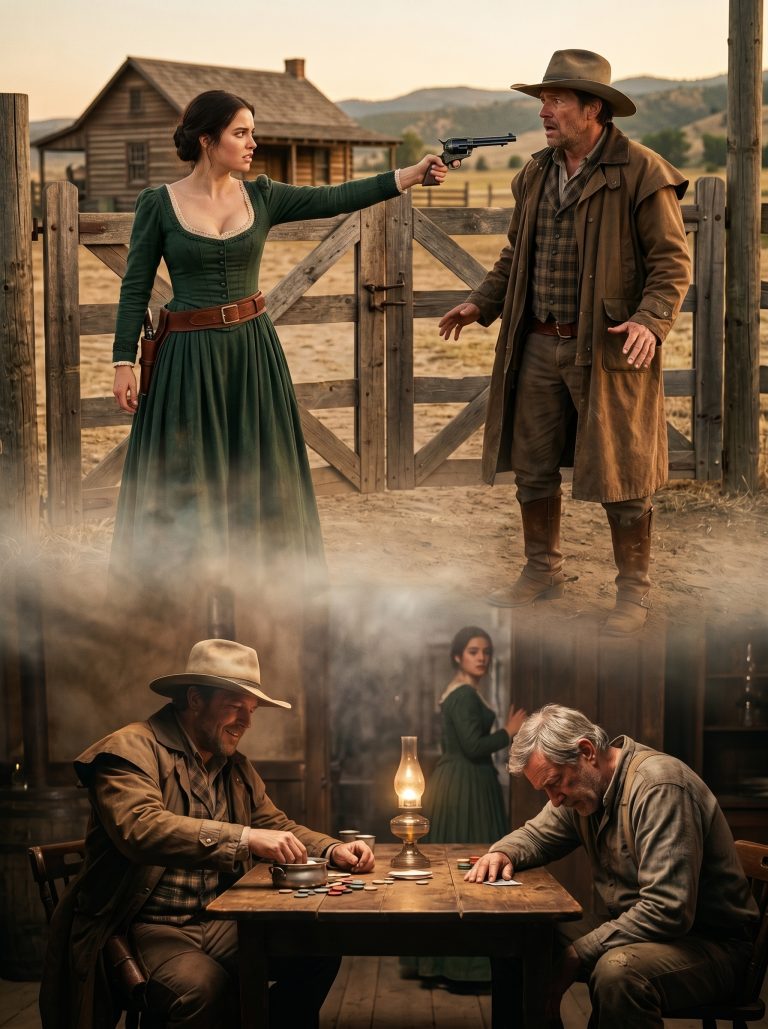
“Eight hundred dollars,” Crow said, resting a hand near his belt, casual, the way a man rests a hand near a gun to remind you it’s there without saying so. “That’s what the loan comes to now, with interest. His signature’s on file at the bank.”
“She doesn’t have eight hundred dollars,” Boon said.
“No,” Crow agreed easily. “Which is why she’s coming with us. Bank has other ways of settling debts.”
From inside the store, Zara’s coughing tore through the quiet, wet and desperate. Dorothy’s whole body flinched toward the sound before she caught herself, plastered herself back into the doorway like she could physically block a sickness from being heard.
“My granddaughter is sick,” she said. “She can’t travel.”
“Then you should’ve thought of that before you ran out on your obligations.” Crow’s voice didn’t change at all. “The child comes too.”
Something in Boon’s chest went dark and cold and very still.
“What kind of work are we talking about?” he asked, though he suspected he already knew the shape of the answer.
Crow’s mouth twitched — not quite a smile, something closer to distaste for the words before he even said them. “The kind that pays off debts real efficient.” A flicker of something crossed his face, gone almost as fast as it came. It wasn’t pride.
Dorothy’s composure, held together by will alone for months now, finally gave. “Please. She’s just a child. She’s sick. Can’t you see that she’s sick?”
Crow was already waving his deputies forward — but Boon caught the way his eyes went, for half a second, to the doorway where the coughing hadn’t stopped. It wasn’t nothing. Boon filed it away and didn’t know yet that it would matter.
He stepped between the deputies and the doorway before he’d fully decided to. “The lady said no.”
The silence that followed had weight to it, the kind that made even the horses go still.
Crow studied him — the worn leather of his gun belt, the way he held his ground without a flicker of doubt in it — and something shifted behind the sheriff’s eyes. Recalculation.
“You don’t want to get involved in this, friend,” Crow said, his voice gone quieter.
“Too late for that. She’s on land I own. That makes it my business.”
The younger deputy — Collins — shifted in his saddle. “Sheriff. Maybe we come back another time.”
“Shut up, Collins.” Crow’s attention didn’t move. “You got any idea what you’re interfering with?”
“Enlighten me.”
“Mrs. Whitmore’s husband borrowed money from Milfield Bank. Signed the papers. Then had the poor judgment to die before paying it back.”
“Convenient,” Boon said. “Dead men can’t dispute signatures.”
“That’s a serious accusation.”
“It’s a serious situation. Show me the papers.”
“I don’t have to prove anything to you.”
“Then you don’t get to take her.”
For a long, ugly pause, Crow seemed to weigh shooting his way through it against something else — patience, maybe, or a plan that suited him better. “Fine,” he said finally. “I ride to Milfield, bring back the bank’s documentation, and a federal marshal besides. That means waiting till tomorrow.” A pause, deliberate. “When he finds you interfering with a lawful debt collection, you’re the one who ends up in chains.”
Zara coughed again inside — raw, tearing, endless.
“Bring your marshal,” Boon said. “Bring your papers.”
Crow’s mouth curved into something that wasn’t quite a smile at all. “You have no idea what you’ve just started.”
When the dust of his departure settled, Dorothy sagged against the doorframe like something holding her up from the inside had given out.
“They’ll be back with enough men to take us all,” she said. Then, quieter: “Why would you risk everything for strangers?”
“Tell me about the loan,” he said instead of answering.
“My husband Thomas never borrowed a dime from anyone. Too proud for it.” Her gaze drifted toward the horizon. “After he died, there were suddenly papers. His signature on loans for equipment we never bought. I handled all our paperwork — Thomas couldn’t read well. Convenient, wasn’t it, that a widow doesn’t get to argue with her husband’s legal obligations.”
A weak voice called from inside. Grandma.
While Dorothy sat with her, Boon found the well out back and drew water, turning eight hundred dollars over in his mind. He had that much and more folded into his saddlebags. He could pay it clean and be done with the whole business.
Except paying meant admitting the debt was real. It meant the next family Crow came for would face the exact same trap, with one less person willing to stand in a doorway.
When he brought the water back in, Dorothy was stroking Zara’s hair with a gentleness that hit him harder than any rifle barrel had.
“There might be another way,” Boon said. “But it means trusting me completely.”
Before she could answer, hoofbeats rolled in again — from the east this time, and many more of them.
NIGHT ONE — RUTH’S RIDERS
They weren’t lawmen. A column of dust rose from the east, and when the riders came close, Boon made out farmers, ranchers, working people — armed, and wearing the same look he’d seen on Dorothy’s face, burned past fear into something steadier.
Their leader was a woman near Dorothy’s own age. “Dorothy Whitmore,” she called, swinging down. “We’ve been looking for you.”
“Ruth Henley. What are you doing here?”
“Same thing you are. Trying to stay alive.” Ruth gestured at the dozen riders behind her. “Every family here got hit by Crow’s little collection scheme. Every one of us had a husband who mysteriously signed papers he never touched.”
Among the riders, a man in a plain gray coat dismounted without fuss, a leather satchel over one shoulder. “Elias Williams,” Ruth said, by way of introduction. “Federal investigator, assigned to the territory. I wrote to him six weeks ago, when the pattern got too big to be one bank acting alone.”
“I’ve been building a case against Milfield for the better part of a year,” Williams said. “What I’ve been missing is a witness who’ll testify to the forgeries in person. Ruth tells me you may have found one.”
“Samuel Chen,” Ruth said. “Bank clerk. Did the forging himself, and got a conscience about it a week back. He’s hiding at the old mining camp, twenty miles north, with Marshal Davidson escorting him in — assuming Crow’s men haven’t found them first.”
“How many families total?” Boon asked.
“Fifteen, at least,” Ruth said. “Maybe more who just disappeared instead of staying to fight.”
“Even with Chen’s testimony,” Boon said, “what stops them burning this place down and calling it resisting arrest?”
“Nothing,” Williams admitted. “Which is why I sent word to three newspapers before I ever left the capital. Witnesses. Enough of them that even Crow’s friends can’t make this disappear quietly.” He looked toward the darkening tree line. “Davidson and Chen were due to reach us by tomorrow midday. If they’re late, it likely means trouble found them first.”
Inside, Zara’s cough turned violent. When Dorothy rushed to her side, Boon followed and saw what made his stomach drop — a dark stain spreading across the blanket at her chest, her breathing gone shallow and fast in a way that hadn’t been true an hour before.
“This is different,” Dorothy said. “Worse.”
They banked the fire low, posted watches at the edges of town, and settled into a night that felt too short and too long at once — short because morning would bring Crow back with whatever he found in Milfield, long because none of them knew if Chen and the marshal would make it to New Haven’s ruins before he did.
DAY TWO, MORNING — WHAT CROW FOUND ON THE ROAD
Crow came back alone, and fast, his horse foam-lathered and blowing hard under him — pushed well past a sensible pace by whatever he’d seen on the road to Milfield.
“This has gone too far,” he said, swinging down on legs that didn’t quite hold steady. “Way too far.”
Ruth stepped forward, hand resting near her gun. “What happened to your federal marshal, Sheriff?”
Crow held up a badge, dark with dried blood. “Found this in a pool of blood on the north road. Enough of it to make any man think Davidson wasn’t walking away from it. A note nearby, signed with Chen’s name — said he’d rather die fighting than hang for forgery.”
The words landed hard across the gathered crowd. If Chen had truly killed a federal marshal, their only witness was now a fugitive, his testimony worth nothing to anyone.
“You’re lying,” Ruth said, though doubt had crept into her voice.
“I’m telling you what I found,” Crow said. “I never said I found a body. I found blood and a badge and enough of both to put fear into the wrong men.” He looked, for the first time, less certain than Boon had yet seen him. “Where’s Chen now, I couldn’t say. Vanished into the mountains, near as anyone can track.”
Williams’s jaw tightened. He said nothing, but Boon saw him glance toward the northern ridge, toward the road Davidson and Chen were supposed to be riding down by now.
Inside the store, the coughing stopped.
Not eased. Stopped.
Dorothy’s scream brought every person in town running.
Zara lay motionless, skin gone the gray of old ash, breathing so shallow it barely stirred the blanket over her chest. Boon dropped to his knees and pressed his ear to her ribs — her heartbeat fluttered fast and thin, like something small and frightened trying to get out.
“Joseph White Horse, at the tribal settlement, has treated lung sickness in this territory longer than any doctor in Milfield,” Crow said, low. “Two hours, if we take the canyon trails instead of the main road. I know them.”
“Why would you help us?” Dorothy asked. “After everything?”
Crow was quiet a long moment. “Because I’ve got a granddaughter of my own back in Milfield, and a debt to the bank besides — one that’s kept my mouth shut longer than I’m proud of.” His jaw worked. “I’m done being the kind of man who lets a child die to keep a job.”
His own horse was in no state for another hard ride. Collins, still watching the whole exchange with the same unease he’d carried since the day before, brought his own mount forward without being asked. “Take mine. He’s fresh.”
The words had barely left his mouth when new sound rolled in from the western edge of town — shouting, the crack of rifle fire, and beneath it, the thunder of a great many horses closing fast.
DAY TWO, AFTERNOON — THE FIGHT FOR NEW HAVEN
The bank’s hired guns came in expecting frightened families cowering in ruins. What they found instead was two dozen armed settlers behind cover, three newspapermen crouched with box cameras already mounted on their tripods, and a federal investigator with an emergency order suspending all bank seizures folded in his coat — waiting for a bank officer to show his face before he used it.
Their leader, a scarred man named Pike, reined up hard at the edge of the street. “Everybody out! Bank’s reclaiming this property, and anybody who resists is trespassing on foreclosed land!”
“There’s no foreclosure on record,” Williams called back, stepping into the open with the satchel held high enough to be seen. “I’ve got a federal order suspending every seizure Milfield Bank attempts until this investigation is closed. Stand down.”
Pike’s answer was a rifle shot over their heads. “I don’t answer to territorial paper-pushers.”
The street exploded into motion. Boon pulled Dorothy behind the well housing as the first real volley cracked across the square; Ruth’s people returned fire from the store windows and the collapsed livery, more disciplined than Pike had clearly expected from farmers and widows. Collins, still mounted, put himself between two of the bank’s riders and the door where Zara lay, and took a graze along his forearm for the trouble without ever raising his own gun against his former colleagues.
When the firing broke for a moment, Boon’s rifle trained on Pike’s position, Crow crossed the street toward him, carrying nothing but the badge in his fist. “Stand your men down, Pike. It’s over. Williams has the ledgers coming.”
“Ledgers don’t mean a damn thing without Chen’s neck in a noose,” Pike snarled — and in that half second of distraction, Ruth fired into the stock of his rifle, splintering the wood and knocking it from his grip.
It was over almost as quickly as it had begun. Half the bank’s men were wounded and disarmed within minutes; the rest threw down their weapons the moment they realized three newspapermen had witnessed the whole advance — Pike’s first shot, the wounded scattered across the street — and were already preparing plates that would carry the story across the territory.
That was when a wagon came over the eastern ridge, moving hard.
Samuel Chen lay inside it, pale from blood loss but alive, a chain of forged ledgers wrapped and secured beside him. Marshal Davidson sat at the reins, a bandage dark at his shoulder, very much not dead.
“Chen didn’t kill anybody,” Davidson called out as the wagon rolled to a stop. “They caught us on the north road before dawn. He put himself between me and two of Pike’s men. Nearly bled out doing it, and we lost half the morning just getting him stable enough to travel.”
Crow stared at the badge still in his own hand, at the blood that had never belonged to a dead man at all, like it had just turned from an excuse into an accusation.
“There’s more,” Chen managed, weak but steady. “Every forged signature, every fabricated debt for the last six years. It’s all in those ledgers. Including yours, Sheriff — every time you looked the other way.”
Crow didn’t argue it.
THE JOURNEY TO JOSEPH WHITE HORSE
There was no time to sort out arrests and confessions with Zara’s breath coming shallower by the hour. Boon, Dorothy, and Crow — on Collins’s fresh horse — set out along the canyon trails with Zara secured on a travois of blankets and salvaged poles, leaving Ruth and Williams to manage what remained of the standoff.
Two hours of hard, careful riding brought them to the tribal settlement. Joseph White Horse examined Zara with hands that had clearly done this work more times than he could count, listening to her breathing, checking the color under her nails, laying a careful palm against her chest.
“Pneumonia,” he said. “Bad, but her lungs aren’t drowned yet. We keep her upright, keep the fever down with willow bark and cool cloths, keep her drinking water even when she doesn’t want it, and we watch her through the night.” He looked at Dorothy, steady. “She has a fighting chance. That’s more than nothing.”
For three days, Dorothy never left her granddaughter’s side, helping turn her, wringing cool cloths, coaxing water past cracked lips. Boon made himself useful wherever the settlement needed a hand. Crow spent those same three days writing out, in his own hand, a full confession — every forged signature he’d been ordered to enforce, every family he’d threatened on the bank’s behalf, every time he’d told himself it wasn’t his doing because he was only following orders.
On the fourth day, Zara opened her eyes and asked, in a voice thin but no longer failing, for water.
TWO YEARS LATER
The ghost town had a new name by then, and it had earned it.
New Haven sat where the ruins used to be, its buildings patched, its streets alive in a way the county records had long since given up expecting. Boon had divided most of his land among the families the bank had cheated, keeping only enough for a small ranch of his own.
Milfield Bank spent those two years under federal receivership. The stolen properties came back slowly, deed by deed, as Chen’s ledgers worked their way through the courts — not all at once, the way Ruth had once hoped, but steadily enough that families stopped waiting for news and started building instead.
Crow surrendered his badge, his property, and every dollar the bank had ever paid him the week after the fight at New Haven, and testified against Milfield in exchange for a reduced sentence. He served eighteen months in the territorial prison. Collins, who had taken a bullet’s graze protecting the families instead of enforcing the bank’s orders, wore the badge in his place — younger for it, but steadier than Crow had ever been.
When Crow finally came back to New Haven, he didn’t ask for the badge again. He hired on as a ranch hand instead, working land that had once belonged to families he’d threatened, and nobody in town made it easy on him at first. Nobody made it impossible either.
Dorothy ran the general store, which sold actual goods to actual customers now. Zara, strong enough these days to chase chickens across the yard without losing her breath, helped behind the counter most afternoons. Boon still found reasons to be in that store more often than his ranch strictly required. Dorothy had taken to setting his coffee out before he asked for it, and the chair beside the stove had quietly, wordlessly, become his.
On an autumn evening, with the hills gone gold around the valley, Boon stood at the edge of his garden and watched Zara chase chickens while Dorothy tended customers through the store’s open door.
He’d paid a hundred dollars for a ghost town.
He’d walked away, two years on, with something the deed in his pocket had never once promised him.
Some evenings, in the quiet hour between sunset and starlight, he thought about what the county clerk had said when he’d first asked about the place — not ghosts, the old man had laughed, just a town too stubborn to know it was supposed to be dead.
He’d been right about the second part.
THE END